Oxygen Sensor Basics
An oxygen sensor measures the oxygen left in the exhaust so the ECU can correct fuel mixture, and for most driveability diagnosis the sensor that matters first is Bank 1 Sensor 1, the upstream sensor before the catalytic converter. I see people miss this all the time, then spend money on sensors when the real fault is a vacuum leak, misfire, exhaust leak, wiring issue, or a tired catalyst. This guide explains what the sensor reads, how the ECU uses it, which sensor position matters, and how to avoid common misdiagnoses.
What an oxygen sensor measures
Oxygen in exhaust, not fuel
An oxygen sensor detects how much oxygen remains in a gas stream. In a car, it sits in the exhaust stream and reports how much oxygen is left after combustion. That matters because the engine computer uses leftover exhaust oxygen as a direct clue to the air-fuel balance in the cylinders. The sensor reports exhaust oxygen, not direct fuel quantity.
People get this wrong constantly. If combustion uses up most of the oxygen, the exhaust reads rich. If more oxygen leaves the cylinder unused, the exhaust reads lean. The sensor does not inspect gasoline itself, and it does not measure fuel pressure, injector flow, or tank quality.
Lambda sensor meaning
In automotive use, the oxygen sensor is also called a lambda sensor. Lambda refers to the air-fuel equivalence ratio, written as λ. When a scan tool, service info, or parts catalog says lambda sensor, it is talking about the same basic exhaust sensor family.
That naming matters because some vehicles, especially later ones, label upstream mixture sensors as lambda or AFR sensors rather than simple O2 sensors. The job is still mixture feedback, but the way the signal is created can differ.
Rich and lean in plain language
Rich means the engine burned a mixture that left very little oxygen in the exhaust. Lean means more oxygen stayed in the exhaust after combustion. The ECU watches that pattern and adjusts fuel delivery during closed-loop operation after warmup.
This is why oxygen sensor readings always tie back to engine conditions. A lean signal can come from extra air through a vacuum leak. A rich signal can come from excess fuel through an injector problem. I have seen plenty of good sensors blamed for faults they were only reporting.
Where the sensors sit
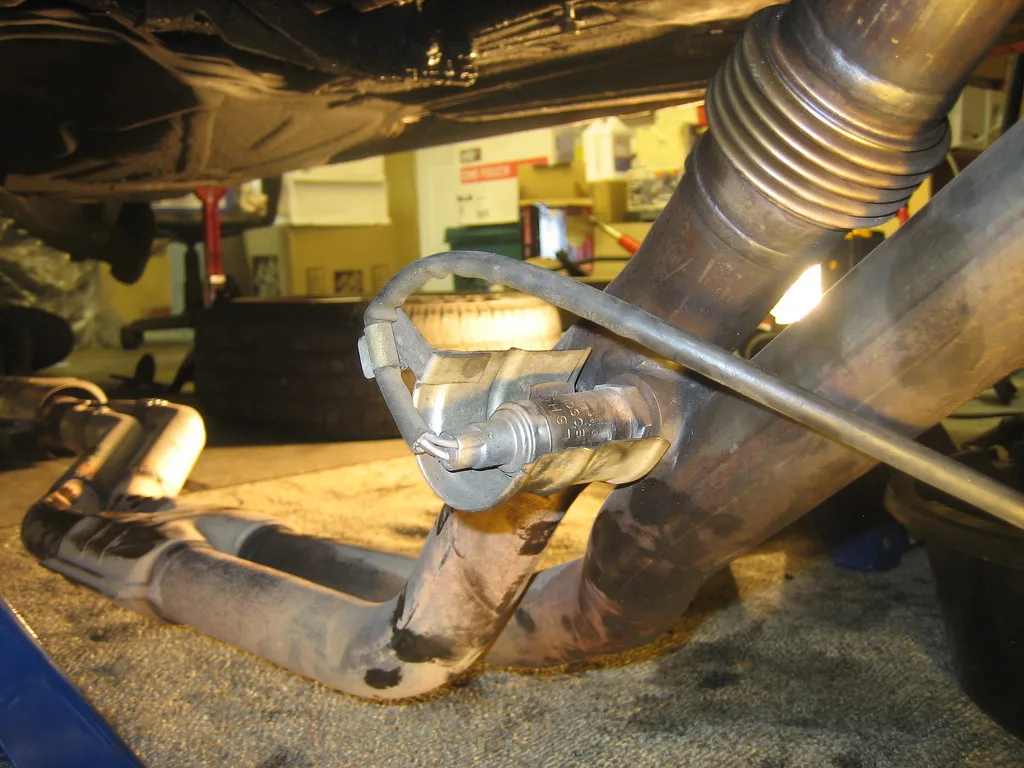
Upstream sensors are mounted before the catalytic converter. Downstream sensors are mounted after it. Upstream location matters for fuel control. Downstream location matters mainly for catalyst monitoring and for checking whether the converter is cleaning up exhaust as expected.
The catalytic converter depends on the correct air-fuel ratio, and the oxygen sensor helps catalytic converters work properly by giving the ECU feedback to keep mixture near target.
📊 The planar-style sensor entered the market in 1990. Source: Oxygen sensor.
How oxygen sensors work in a car engine
Many gasoline vehicles use a heat-dependent exhaust sensor that compares oxygen on one side of the sensing element to oxygen on the other. On a common narrowband zirconia sensor, that difference creates a switching voltage signal the ECU uses in closed loop after warmup to trim fuel.
The zirconia sensing element
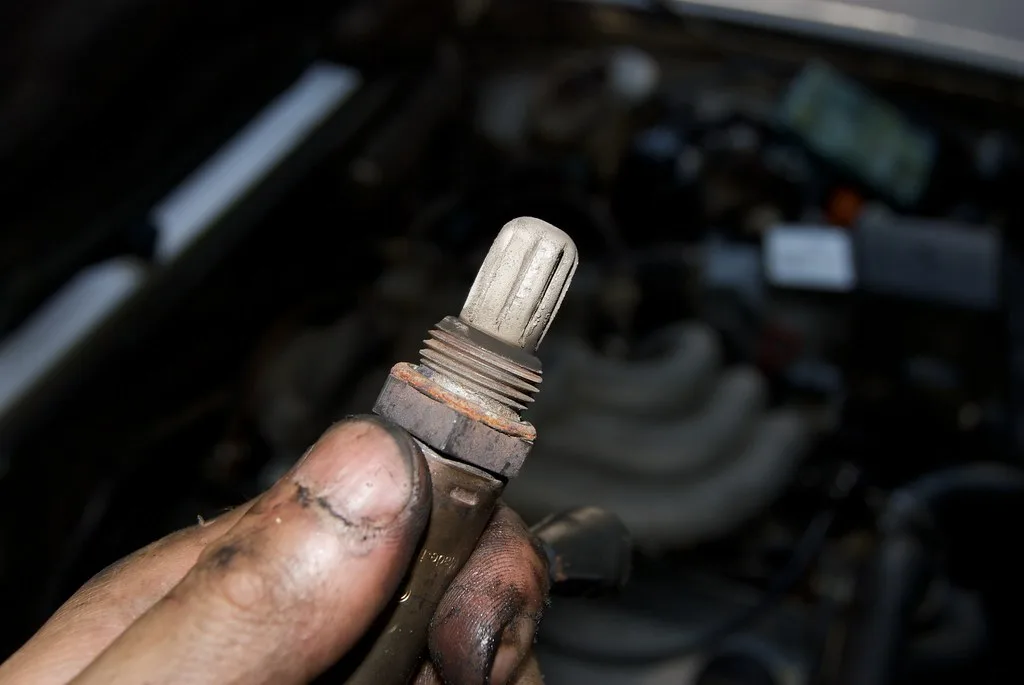
The original sensing element was a thimble-shaped zirconia ceramic. The sensing element is coated with platinum on both sides. That basic zirconia design became the common sensing material in automotive sensors because it can generate a usable signal from the oxygen difference across the element once it gets hot enough.
Later sensor construction changed too. The planar-style sensor entered the market in 1990. That matters mostly as background for parts design and response speed rather than as something a driver needs to memorize.
Why heat matters
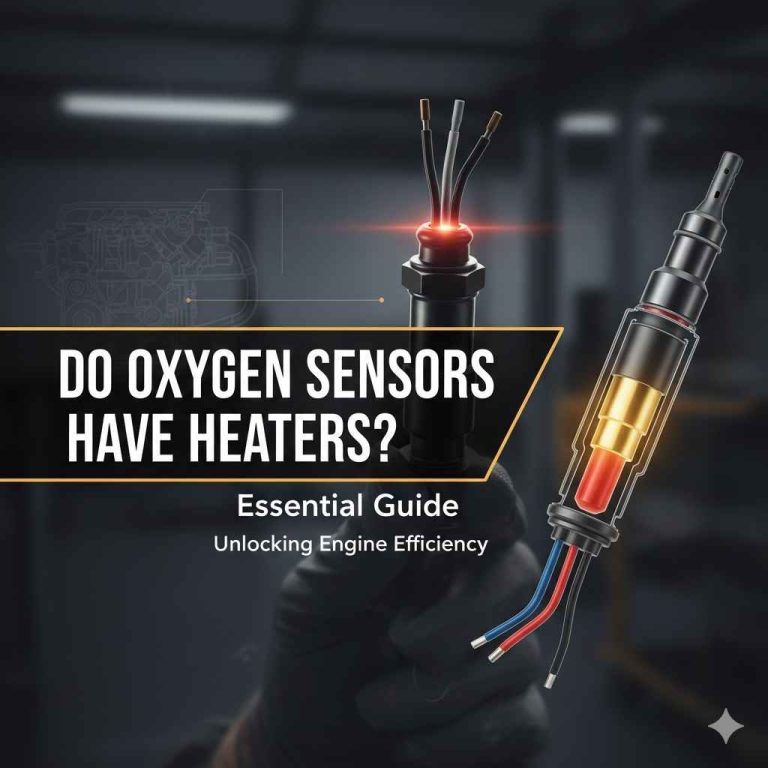
The zirconia element needs heat before it reports properly. Heated oxygen sensors include an internal heater that brings the sensing element up to about 600°F much sooner than exhaust heat alone would. Modern oxygen sensors started sooner and responded faster, which let the ECU enter closed loop earlier after startup.
Before warmup, the computer relies more on other inputs such as coolant temperature and airflow calculations. After warmup, oxygen sensor feedback becomes a main control input for fuel correction.
How a narrowband sensor behaves
A narrowband oxygen sensor is a switch-style sensor. It does not provide a neat fuel ratio number on a simple voltage scale. Instead, it flips between rich and lean around the target mixture, and the ECU reacts to those swings.
On this common voltage-based style, a rich mixture can produce up to about 0.9 volts. Lean exhaust pushes the reading low. The ECU can monitor the oxygen sensor about 100 times per second, so it can make frequent fuel corrections once the engine is warm and the system is in closed loop. (en.wikipedia.org)
Wideband and AFR sensors are different
A wideband oxygen sensor, often called an AFR sensor or lambda sensor in service data, works differently from a narrowband sensor. It is used where more precise mixture control is needed. Beginners should avoid mixing wideband behavior with narrowband voltage switching, because the scan data and failure patterns do not look the same.
With a wideband sensor, scan tools often show current, lambda, or commanded air-fuel values rather than a simple low-to-high switching voltage. Upstream on many newer vehicles, that is normal.
Why heated oxygen sensors matter
Heated vs unheated sensors
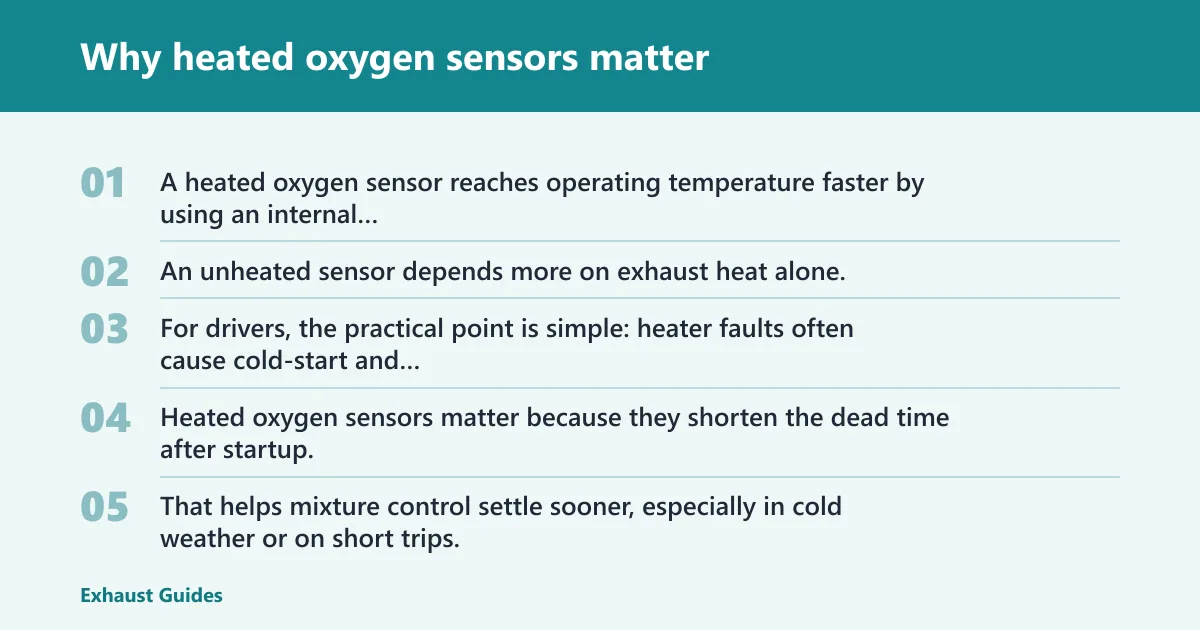
A heated oxygen sensor reaches operating temperature faster by using an internal electrical heater, so the ECU can start accurate mixture correction sooner. An unheated sensor depends more on exhaust heat alone. For drivers, the practical point is simple: heater faults often cause cold-start and code issues even when the sensing element itself is still usable.
Heated oxygen sensors matter because they shorten the dead time after startup. That helps mixture control settle sooner, especially in cold weather or on short trips.
Cold start and closed loop
On cold start, the ECU is usually running open loop. It uses programmed fuel tables and other sensor inputs because the oxygen sensor is not ready yet. Once the heated sensor gets hot enough, the ECU can shift into closed loop and trim fuel based on exhaust oxygen feedback.
If a heater is weak or dead, closed loop can be delayed. Fuel trim may take longer to stabilize. The engine may still run acceptably, but emissions and drivability during warmup can suffer.
What heater-circuit faults look like
Heater-circuit faults are different from mixture-reading faults. A heater-circuit code points first to the heater element, power supply, ground, fuse, relay, or wiring. It does not automatically mean the sensor is falsely reporting rich or lean once hot.
That distinction matters. A sensor can have a failed heater and still show plausible exhaust readings after enough driving time. It can also have a healthy heater and a bad signal circuit. Reading the code family before buying parts saves guesswork.
Which oxygen sensor is more important
For most engine running problems, the upstream sensor matters more because it drives fuel-trim decisions. That is usually Sensor 1 on the affected bank. The downstream sensor matters more for catalyst monitoring. If the code is downstream, the converter or an exhaust issue may be the real problem.
Why Sensor 1 matters first
Sensor 1 means upstream, before the catalytic converter. This sensor gets the first read on whether combustion looks rich or lean. If the engine surges, idles poorly, or sets fuel-trim-related codes, this is the location that usually deserves attention first.
Bank 1 Sensor 1 is the one most beginners should identify before doing anything else. On a single-bank inline engine, it is usually the only upstream sensor. On V engines, there is one upstream sensor per bank.
What Sensor 2 does
Sensor 2 means downstream, after the catalytic converter. Its main job is to monitor converter performance, not to control fueling in the same direct way as the upstream sensor. When the downstream pattern starts looking too much like the upstream pattern, catalyst efficiency becomes suspect.
That is why replacing a downstream sensor does not always fix a catalyst-efficiency code. Sometimes the converter is tired. Sometimes there is an exhaust leak, a wiring problem, or an upstream mixture issue that damaged or fooled the converter monitor.
When a downstream code is really not about the sensor
A downstream code can be the messenger. If the engine has been running rich or misfiring for a long time, the converter can overheat or lose efficiency. In that case the downstream sensor is only reporting the result. Replacing the sensor alone leaves the root cause untouched.
What bank 1, bank 2, sensor 1, and sensor 2 mean
Bank numbers
Bank 1 is the engine side that contains cylinder 1. Bank 2 is the other side on a V engine or flat engine with two banks. On many inline engines, there is only one bank, so codes mention Bank 1 even though there is no Bank 2.
If code text says Bank 2 Sensor 1, that means the upstream sensor on the bank opposite cylinder 1. Once that naming clicks, repairs get much easier.
Sensor numbers
Sensor 1 is upstream. Sensor 2 is downstream. If an exhaust system has more than one converter per bank, later sensors can be numbered farther back, but most beginner scan-tool work involves Sensor 1 and Sensor 2.
Code naming trips people up because they read “sensor” and assume any sensor on that bank affects fuel the same way. It does not. Position matters.
How to map a code to the vehicle
- Find which side of the engine has cylinder 1.
- Decide whether the code says Bank 1 or Bank 2.
- Read the sensor number: Sensor 1 is before the converter, Sensor 2 is after it.
- Check whether the code is for signal performance or heater circuit.
- Inspect the matching exhaust location and wiring before ordering parts.
How many oxygen sensors does a car need
The count depends on engine layout and catalytic-converter count. A basic four-cylinder with one converter often has two sensors, usually one upstream and one downstream. A V6 or V8 with two banks often has at least four. Some newer vehicles use wideband or AFR sensors upstream and conventional downstream sensors.
Common layouts
A single-bank engine usually has one upstream sensor and one downstream sensor for each converter path. A two-bank engine usually has one upstream sensor per bank, plus one downstream sensor per bank if each bank has its own converter monitor point.
Some exhaust systems combine banks or use extra monitor sensors farther downstream. That is why a parts lookup by VIN or build data matters when replacing anything.
Why converter count changes sensor count
Sensor count follows exhaust paths more than cylinder count. More converters, split exhaust routing, or special monitor locations can mean more sensors. Beginners often expect every car to have two. Many do, but plenty do not.
Narrowband vs wideband sensors
Narrowband basics
A narrowband sensor is a common switch-style design found on many gasoline vehicles. It spends its life moving around the target point rather than reporting a broad mixture scale. On a scan tool, it often looks like a fluctuating voltage.
This is the type most people picture when they hear “O2 sensor voltage.” Rich drives the signal high, lean drives it low, and normal closed-loop activity means it should move.
Wideband or AFR basics
Wideband or AFR sensors use a different operating method and provide more precise mixture information. They are popular upstream because the ECU can control fueling more accurately across a wider range.
That difference changes diagnostics. A beginner should not condemn a wideband sensor because it does not swing like a narrowband sensor. The data format is different by design.
When an oxygen sensor is the cause and when it is the messenger
Real sensor failures
True oxygen sensor faults include slow response, a reading stuck high or low, contamination from coolant or oil burning, internal heater failure, and wiring damage. Sensors also fail from connector corrosion or physical abuse during exhaust work.
A slow upstream sensor can make fuel control less responsive. A heater failure can delay useful readings after startup. A damaged signal wire can mimic a dead sensor. These are real sensor problems.
Common non-sensor causes
Many O2 codes are triggered by other faults. Vacuum leaks can create a true lean exhaust condition. Exhaust leaks near the sensor can pull in outside air and fake lean. Misfires leave oxygen in the exhaust. Injector leakage, high fuel pressure, or EVAP purge flow can create a true rich condition.
Intake problems matter too. Unmetered air, restricted airflow measurement, or a PCV fault can push fuel trims around enough to make the oxygen sensor look guilty when it is only reporting what the engine is actually doing.
How to know if a sensor is stuck rich
A truly stuck-rich narrowband sensor tends to stay high even when conditions are forced lean. A real rich-running engine usually shows other clues too, such as fuel smell, blackened plugs, negative fuel trims, or a rich reaction after an injector or purge problem appears.
The key is response testing, not staring at one voltage number. If a suspected upstream sensor never moves when the engine is given a controlled lean condition, the sensor or its circuit becomes suspect. If it reacts correctly, look for the reason the engine is actually rich.
How oxygen sensor problems can hurt the converter
If an upstream sensor lies and the engine runs rich for too long, the catalytic converter can overheat. If the engine runs lean or misfires, converter efficiency can still suffer. The catalytic converter depends on the right air-fuel ratio, so unresolved mixture faults can turn a simple sensor or wiring issue into a much more expensive repair.
Driver decision table: symptoms, clues, and likely sensor location
How to use this one-page table
Use the table to sort cause from symptom before replacing anything. Start with the code or scan pattern, then match it to sensor position and the most likely non-sensor causes. Upstream clues point first to fuel control. Downstream clues point first to catalyst monitoring and exhaust integrity.
| Symptom or scan-tool clue | Likely sensor location | What that location usually means | Likely non-sensor causes to check first |
|---|---|---|---|
| Bank 1 Sensor 1 stuck low lean, fuel trims strongly positive | Upstream, Bank 1 Sensor 1 | Main fuel-control sensor on cylinder 1 bank | Vacuum leak, intake duct leak, low fuel pressure, exhaust leak before sensor, misfire |
| Bank 1 Sensor 1 stuck high rich, fuel trims strongly negative | Upstream, Bank 1 Sensor 1 | Reporting rich exhaust or failed high | Leaking injector, excess fuel pressure, EVAP purge stuck open, restricted air path, contaminated sensor |
| Bank 2 Sensor 1 lean code on a V engine, Bank 1 normal | Upstream, Bank 2 Sensor 1 | Bank-specific mixture issue | Bank 2 intake leak, Bank 2 exhaust leak, injector problem on that bank, wiring fault on that sensor |
| Heater-circuit code for Sensor 1 or Sensor 2, especially after cold start | Named sensor in code, heater side | Heater or heater circuit issue, not automatically a bad mixture reading | Blown fuse, damaged wiring, poor ground, failed heater element, connector corrosion |
| Downstream Sensor 2 switching too much like upstream Sensor 1 | Downstream, Sensor 2 | Converter monitor sees poor oxygen storage | Tired catalytic converter, exhaust leak near rear sensor, long-term rich misfire damage, wrong sensor installed |
| Downstream sensor code with no driveability complaint | Downstream, Sensor 2 | Monitor issue more than fuel-control issue | Catalyst aging, wiring problem, exhaust leak, connector damage |
| Upstream sensor slow to respond after startup | Upstream, Sensor 1 | Slow fuel-feedback start | Weak heater, aged sensor, power or ground issue, contamination |
| Both banks read lean at idle, improve off idle | Both upstream sensors | Probably reporting a real condition | Vacuum leak, intake manifold leak, PCV fault, brake booster leak |
| Both banks read rich, black smoke or fuel smell present | Both upstream sensors | Probably reporting a real rich condition | Fuel pressure fault, large purge flow, injector leakage, failed temperature input causing overfueling |
| Single sensor flatlines while matching bank trims act strange, other bank normal | That specific sensor or its circuit | Local sensor or wiring suspicion rises | Open signal wire, short to voltage or ground, connector issue, sensor contamination |
Beginner decision path
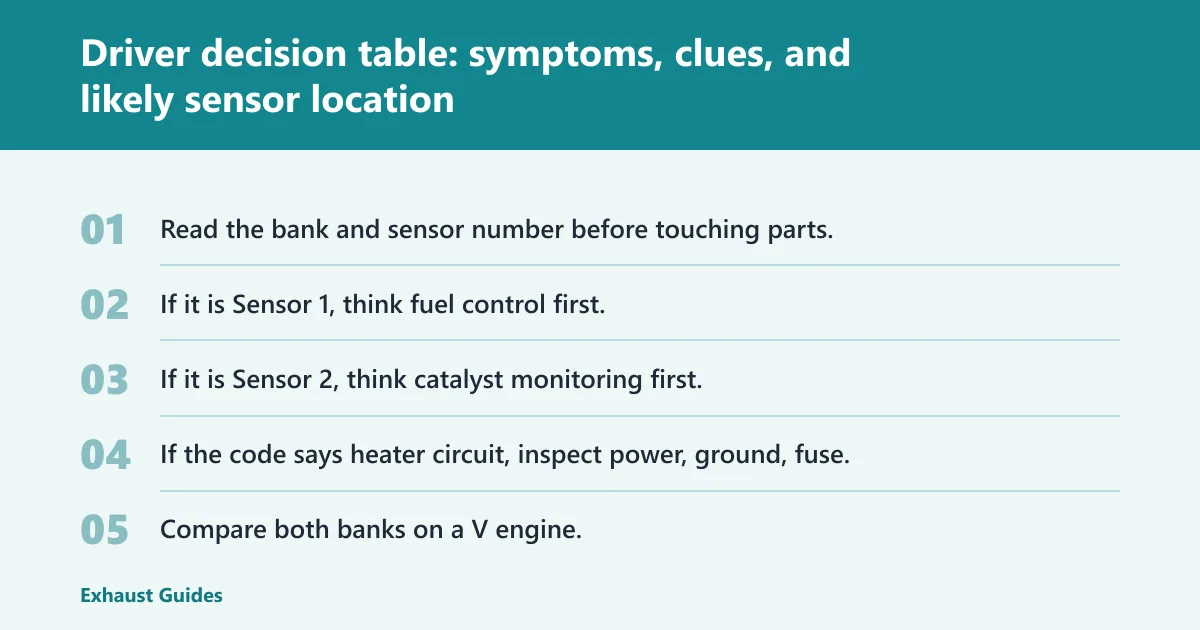
- Read the bank and sensor number before touching parts.
- If it is Sensor 1, think fuel control first.
- If it is Sensor 2, think catalyst monitoring first.
- If the code says heater circuit, inspect power, ground, fuse, and wiring before blaming mixture.
- Compare both banks on a V engine. One-bank problems often point to a local leak or wiring issue.
- Ask whether the sensor is reacting to another fault. Fuel trims, misfire data, and exhaust leaks matter.
Frequently asked questions
is oxygen sensor important
Yes. The oxygen sensor is important because it tells the ECU how much oxygen is left in the exhaust, which lets the computer correct fuel mixture during closed loop. A bad reading can upset fuel trims, and a real mixture fault left unresolved can damage the catalytic converter over time.
can an oxygen sensor cause a check engine light
Yes. A sensor can trigger the light from a failed heater, a wiring fault, slow response, or an out-of-range signal. But an O2-related code does not always mean the sensor failed. Vacuum leaks, exhaust leaks, misfires, and catalyst problems can also set related codes.
how to know if an oxygen sensor is stuck rich
A narrowband sensor suspected of being stuck rich usually stays high instead of responding when the engine is made lean on purpose. A real rich condition usually brings matching clues such as negative fuel trims, fuel smell, or injector and purge issues. Response matters more than one voltage snapshot.
how long do oxygen sensors last on average
There is no universal service life that fits every car. Age, contamination, heat cycles, oil burning, coolant leaks, and general engine condition matter more than mileage alone. I have replaced old originals that still switched fine, and newer sensors ruined early by engines that burned oil or coolant. A sensor can last a long time in a healthy engine, or fail early when the engine has mixture or contamination problems.
is blood oxygen sensor useful
That is a different device entirely. A blood oxygen sensor measures oxygen saturation in a person, while an automotive oxygen sensor measures oxygen concentration in exhaust gas. The two are unrelated for vehicle diagnosis, so blood oxygen sensor information should be ignored in this context.