Oxygen Sensor Replacement Cost Toyota
Toyota oxygen sensor replacement is often quoted at about $150 to $500 per sensor at an independent shop and about $250 to $700 at a dealer, though quotes can rise if the sensor is upstream, rusted, or the diagnosis is uncertain. Let a bad sensor stay in place, and you can lose fuel economy, fail an emissions test, and pay for the wrong repair. This guide breaks down parts, labor, diagnosis fees, and model-specific price differences so you can judge a quote.
Toyota O2 cost by model, engine, and sensor type

Toyota oxygen sensor replacement cost varies by model, engine, and sensor position. A Camry, Corolla, RAV4, Highlander, or Sienna can share the same basic repair idea, yet the quote can differ a lot because Toyota uses different sensor types, different exhaust layouts, and different access paths under the car.
For a fair quote, split the estimate into three parts: the sensor itself, labor, and diagnosis. Upstream sensors are usually more expensive than downstream sensors, and many Toyota engines use an AFR sensor instead of a standard narrowband oxygen sensor. That parts difference matters as much as the shop rate.
Camry cost drivers by engine and sensor position
Toyota Camry oxygen sensor replacement cost often turns on engine family and whether the failed part is upstream or downstream. Four-cylinder Camrys commonly have easier access than V6 layouts, but a Camry with a stubborn upstream sensor can still run into extra labor from heat, rust, or tight access near the exhaust manifold.
If the quote is for an AFR sensor, expect a different part number and often a higher parts price than a simple downstream O2 sensor. If the quote only says “O2 sensor” without naming the bank and position, ask for that detail before you approve the work.
Corolla cost drivers by engine and sensor position
Toyota Corolla oxygen sensor replacement cost is usually driven by the same three variables: sensor type, location, and labor time. Many Corolla repairs are straightforward when the sensor is downstream and the hardware is clean, but upstream replacement can cost more if the sensor is baked into the exhaust and the connector is heat-stiffened.
Corolla quotes should also name the exact sensor. A scan code alone does not tell you whether the issue is the sensor itself, the heater circuit, a wiring fault, or an exhaust leak upstream of the sensor.
RAV4, Highlander, and Sienna cost drivers
RAV4, Highlander, and Sienna replacement prices are often higher than a basic compact-car job because the exhaust layout can be tighter, the engine bay can be more crowded, and V6 or all-wheel-drive packaging can add labor time. On these Toyota models, a quote can change noticeably between front-bank and rear-bank sensors.
Minivans and crossovers also tend to show more spread between dealer and independent pricing because the labor estimate can move with access. A shop that plans for rusted threads or heat shields will quote more than one that assumes an easy swap.
| Toyota model | Likely sensor type | Typical location | Main cost drivers | Quote-check focus |
|---|---|---|---|---|
| Camry | AFR sensor on many engines; standard O2 on some trims | Upstream or downstream, depending on engine | Engine family, access near manifold, rust | Bank, sensor position, exact part number |
| Corolla | AFR sensor or standard O2, depending on year and engine | Often one upstream and one downstream path | Connector access, heater-circuit diagnosis, labor time | Confirm the code and connector match |
| RAV4 | AFR sensor on many newer engines | Usually upstream on engine side or downstream after catalyst | Tight packaging, rust, all-wheel-drive access | Ask whether labor includes underbody access |
| Highlander | AFR sensor or standard O2, engine dependent | Front or rear bank on V6 models; downstream at catalyst | V6 layout, rear-bank access, heat shielding | Check bank location and labor hours |
| Sienna | Often AFR sensor on newer powertrains | Upstream and downstream positions vary by engine | Transverse layout, cramped access, connector heat damage | Confirm the diagnosis and the sensor position |
What a Toyota oxygen sensor quote includes
A Toyota oxygen sensor quote should separate the part price, labor, and diagnosis. If those lines are blended into one number, you cannot tell whether the quote is fair or whether the shop is charging for an avoidable extra step.
Parts price and sensor fitment
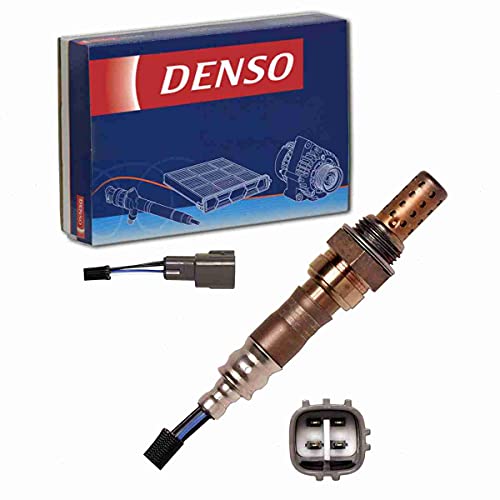
Parts pricing depends on whether the repair needs a standard O2 sensor or an AFR sensor, and whether the part is sold as sensor only or sensor with connector. The fitment also depends on model year, engine size, bank position, and whether the sensor is upstream or downstream.
Parts-store listings can be misleading if they group similar Toyota sensors together. Match the old connector, wiring length, and thread style before you assume a catalog listing is correct.
Labor hours and shop rate
Labor cost varies with shop rate and with access. A clean downstream sensor might take under an hour, while an upstream Toyota sensor on a rusty exhaust can take longer because the shop may need extra time for heat, penetrating oil, or careful removal to avoid breaking the bung.
Independent shops often charge less for this job than a dealer, but dealer quotes may include stricter OEM-fit parts and more model-specific cataloging. Either can be fair if the line items make sense.
Diagnostic fee, rust, and access charges
A diagnostic fee is common when the shop has not yet verified the failed sensor, heater circuit, or wiring. Rust and heat-access charges may appear on older Toyotas or on vehicles driven in salt states. Those charges should be explained, not buried.
Atlas notes that oxygen is a gas used in sensing applications, that the sensor measures gaseous oxygen concentration rather than liquid oxygen, and that it is not for aqueous oxygen. It also lists an embedded stainless steel EZO-O2 at 149.99 USD, a plastic-body EZO-O2 at 99.99 USD, and a separate replacement head, EZO-o2-RE, at 49.99 USD. That kind of separate sensor-body pricing is a useful reminder: Toyota repairs can also vary by what is being replaced, not just by the label on the part.
Why upstream sensors cost more
Upstream oxygen sensors usually cost more because they influence fuel trim and drivability more directly, and they are often harder to reach. On many Toyota engines, the upstream unit is the one most likely to be an AFR sensor, which can cost more than a standard downstream O2 sensor.
Upstream location and fuel-trim impact
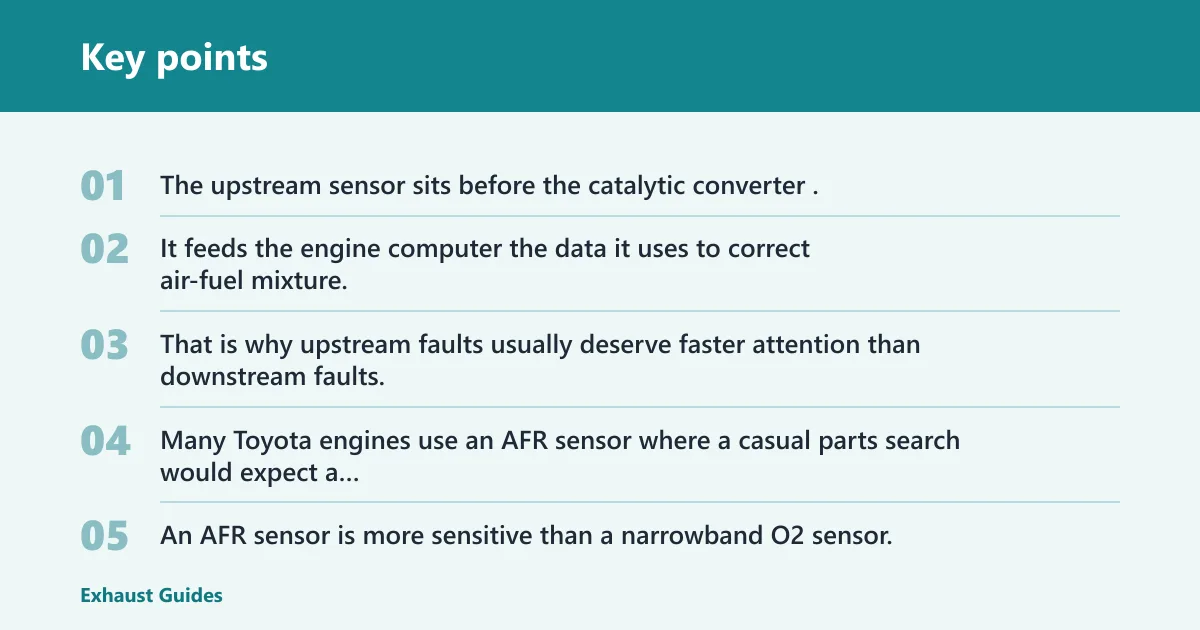
The upstream sensor sits before the catalytic converter. It feeds the engine computer the data it uses to correct air-fuel mixture, so a bad upstream reading can cause rough running, poor fuel economy, and a check engine light. That is why upstream faults usually deserve faster attention than downstream faults.
AFR sensor versus standard O2 sensor
Many Toyota engines use an AFR sensor where a casual parts search would expect a standard oxygen sensor. An AFR sensor is more sensitive than a narrowband O2 sensor, and it is not interchangeable by shape alone. If the catalog says AFR, buy for AFR.
Access issues on transverse Toyota engines
Transverse engines in front-wheel-drive Toyota models can crowd the upstream sensor against the engine bay, firewall, or underhood heat shields. That makes labor more variable than the part price alone would suggest. A rusted sensor on a tight bank can add more to the bill than the sensor itself.
Why downstream sensors are usually cheaper
Downstream sensors are usually cheaper because they monitor catalytic converter efficiency rather than directly controlling fuel trim. They are often easier to reach, and the repair may involve less diagnostic uncertainty than an upstream fault.
Catalyst-monitoring role
The downstream sensor sits after the catalytic converter. Its job is to tell the computer whether the catalyst is working as expected. When it fails, you may see an emissions-related code, but drivability problems are often less immediate than with an upstream failure.
Lower labor in many layouts
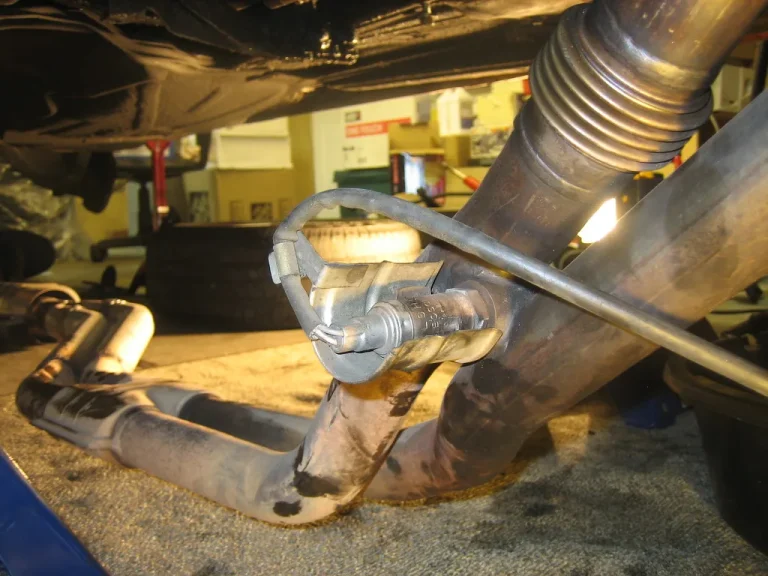
On many Toyota layouts, the downstream sensor threads into a pipe that is more accessible than the upstream mounting point. That often means less labor time, fewer heat-related complications, and a lower total bill.
When downstream replacement is not the real fix
A downstream code can still point to a wiring problem, a catalyst issue, or an exhaust leak. Replacing the downstream sensor without checking those items can waste money. If the catalytic converter is damaged, the sensor may only be reporting the problem.
How many oxygen sensors does your Toyota have?
A Toyota may have one oxygen sensor, two, or several depending on engine layout and emissions equipment. The count depends on cylinder number, bank number, and whether the vehicle uses both upstream and downstream sensors on each bank.
Engine layout and bank position
Inline-four Toyota engines usually have fewer sensor positions than V6 engines because there is only one bank. V6 engines can have front-bank and rear-bank sensors, and that doubles the number of possible failure points and replacement costs.
Front-wheel-drive four-cylinder examples
A front-wheel-drive Corolla or Camry four-cylinder may be simpler because the exhaust layout is shorter and the bank count is lower. Even so, it may still use more than one sensor if the exhaust has both upstream and downstream monitoring points.
V6 and all-wheel-drive layout differences
V6 Highlander and Sienna configurations can create more expensive labor because the rear bank is harder to reach. All-wheel-drive models can also complicate underbody access. In other words, the same code can produce a different quote on two Toyotas that look similar from the outside.
Suppose your Camry lights the check engine light with an upstream heater-circuit code. A shop that quotes a downstream sensor price without naming the bank and position has not yet shown that it has matched the repair to the code.
Is it an O2 sensor or an AFR sensor?
On many Toyota engines, the failed part is an AFR sensor, not a standard narrowband oxygen sensor. That distinction matters because the part number, connector, and price can differ enough to change the final bill.
Common Toyota AFR applications
AFR sensors appear on many newer Toyota engines, especially where the engine management strategy needs more precise mixture feedback upstream. A catalog that lists only “oxygen sensor” can hide that difference and lead to the wrong part being ordered.
How parts catalogs can mislabel the part
Some parts listings lump O2 and AFR parts together under a broad search term. That is a problem if you are comparing quotes. Ask the shop to read the original sensor label or confirm the exact Toyota part number before ordering.
What to match on the old sensor and connector
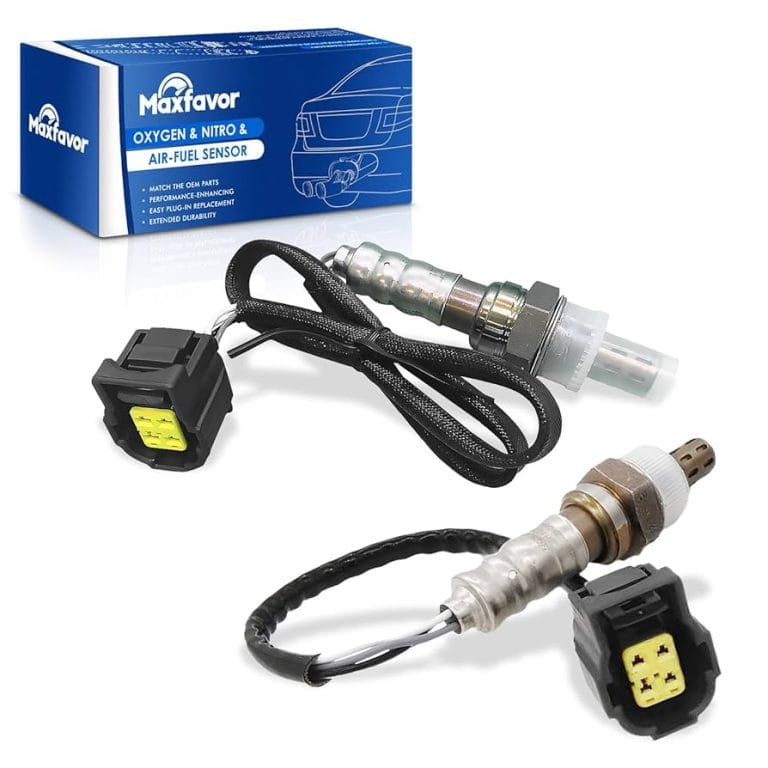
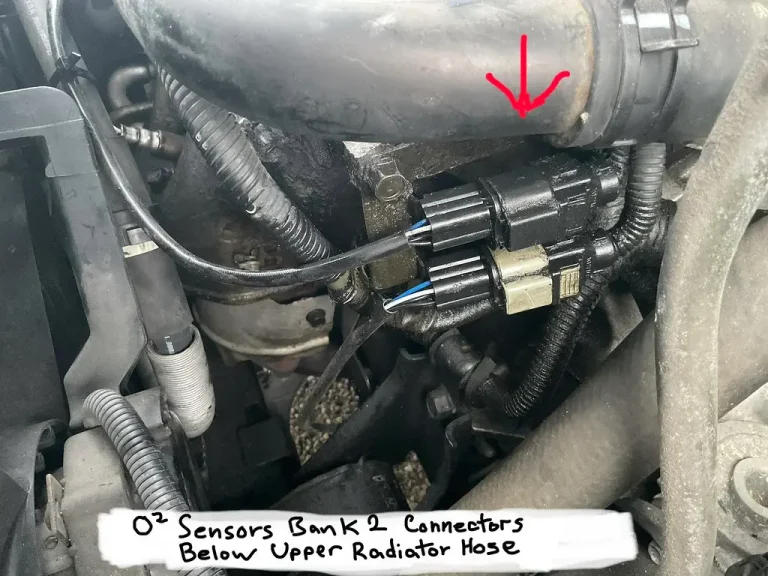
Match the connector shape, wire count, thread size, and wire length against the old unit. If the old sensor has heat damage or connector corrosion, the replacement may need a sensor with an integrated lead rather than a bare head.
Toyota oxygen sensor quote-check worksheet
Use this worksheet to see whether the quote is fair before you approve the repair. A good estimate should tell you what is being diagnosed, what is being replaced, and why the labor time is what it is.
| Line item | What to check | Fair-quote clue |
|---|---|---|
| Scan fee | Is the fee separate from repair labor? | Listed as diagnosis or scan, not hidden in parts |
| Sensor part number | Is the exact Toyota or OEM-fit part listed? | Matches bank, position, and O2 versus AFR type |
| Labor hours | How much time is quoted for the replacement? | Longer time for upstream, rusted, or tight-access repairs |
| Rust or heat-risk surcharge | Is there an extra line for seized hardware or heat damage? | Explained before the work starts |
| Shop type | Dealer, independent shop, or parts-store installation | Matches the labor rate and warranty you want |
- Confirm the diagnostic trouble code and ask which sensor position it points to.
- Ask whether the failed part is upstream, downstream, or an AFR sensor.
- Request the exact sensor part number, not just “oxygen sensor.”
- Separate the scan fee from the repair labor on the estimate.
- Ask whether rust, heat shields, or connector damage could change the labor time.
- Compare the quote with a dealer, an independent shop, and any available parts-store installation option.
A common first-timer mistake is approving a sensor swap before the code is read. A P0135 heater code, a mixture fault, or a catalyst-efficiency code can each point to a different repair path, and they do not all call for the same part.
What to check before you replace the sensor
Before replacing an oxygen sensor, confirm the diagnostic trouble code, inspect the wiring, and look for exhaust leaks. A scan tool with freeze-frame data reduces the risk of replacing the wrong part.
DTC confirmation and freeze-frame data
Common O2-related codes include heater-circuit faults, mixture faults, and catalyst-efficiency codes. Freeze-frame data can show engine load, temperature, and operating conditions when the code set. That helps separate a bad sensor from a problem that only appears under certain conditions.
Wiring, connector, and exhaust leak inspection
Check the wiring for melted insulation, corroded terminals, and broken locking tabs. Inspect the exhaust for leaks upstream of the sensor. A leak can pull in outside air and fool the sensor into reporting a lean condition.
Catalytic converter and mixture fault checks
If the converter is failing or the engine has a mixture problem, the sensor may be doing its job correctly. That is why diagnosis matters. Replacing the sensor without checking fuel trim, exhaust leaks, and converter efficiency can leave the light on and the bill higher than needed.
Can you drive with a bad sensor for a short time? Sometimes, but it depends on the code and the symptoms. If the Toyota still runs normally and the light is steady, short trips to arrange repair may be reasonable. If it runs rough, stalls, or smells strongly of fuel, the repair should move up.
Frequently asked questions
How much to replace oxygen sensor?
Upstream sensors, tight access, and uncertain diagnosis can push the total higher. Always separate parts, labor, and scan fees before comparing quotes.
How much does it cost to replace a faulty oxygen sensor?
A faulty Toyota oxygen sensor usually costs less to replace than a catalytic converter, but the final bill still depends on sensor type and location. If the part is an AFR sensor or the exhaust hardware is rusted, the cost can rise even when the repair seems simple.
Are O2 sensors expensive to replace?
They can be, but not always. Downstream sensors are often moderate repairs, while upstream Toyota sensors can be more expensive because of labor access and sensor type. The expensive part is often the diagnosis and labor, not the sensor alone.
Does AutoZone replace oxygen sensors?
AutoZone installation availability depends on location and local service policy. Some stores may help with testing or parts guidance, but they do not all perform replacement. Ask the specific store whether they offer installation, what vehicles qualify, and whether the service includes diagnosis or only parts sales.
Why does Toyota oxygen sensor replacement cost vary by model?
Cost varies because Toyota uses different engines, exhaust layouts, and sensor types across the lineup. A Camry, Corolla, RAV4, Highlander, or Sienna may use a different bank layout or AFR sensor arrangement, and that changes both parts price and labor time.
What symptoms mean my Toyota oxygen sensor is failing?
Common signs include a check engine light, worse fuel economy, rough idle, hesitation, or failed emissions testing. Those symptoms can also come from wiring faults, exhaust leaks, or mixture problems, so the code and freeze-frame data should be checked before replacement.
Is it cheaper to replace one O2 sensor or all of them?
Replacing only the failed sensor is usually the cheaper choice. Toyota sensors do not age at exactly the same rate, so replacing all of them at once is not automatically better. Replace the confirmed failed unit first unless a technician has shown that multiple sensors are out of spec.