Catalytic Converter Guide
A catalytic converter turns exhaust pollutants into less harmful gases, often lasts many years or a high mileage, and should be replaced only after you confirm the engine and sensors are not causing a false P0420/P0430. I have seen people guess wrong and spend $800–$3,000 on a converter that fails again because the real fault was misfire, oil burning, or an exhaust leak. This guide maps converter types, symptom patterns, code meaning, lifespan, theft risk, and the cheapest valid path from diagnosis to cleaning, repair, or replacement.
What does a catalytic converter do?

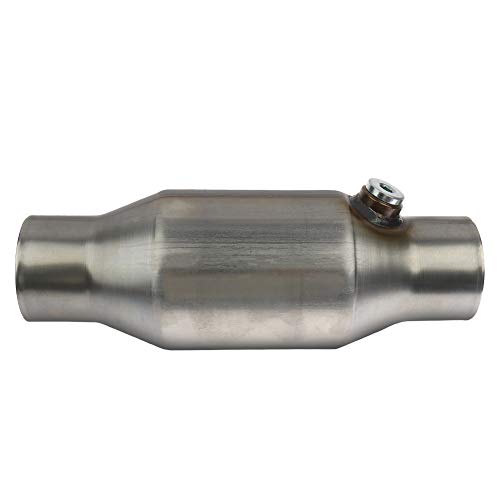

A catalytic converter uses catalyst-coated surfaces in the exhaust to change toxic gases into less harmful ones. Its job is to treat carbon monoxide, unburned hydrocarbons, and oxides of nitrogen before they leave the tailpipe, while the engine, fuel control, and oxygen sensors keep the mixture where the converter can actually do its work.
Its job in the exhaust system
The catalytic converter is bolted into the exhaust pipe after the engine and before the muffler and tailpipe, where every bit of exhaust has to pass through it. Gasoline and diesel engines both use converters, though the chemistry and surrounding emissions hardware differ by engine type.
Most gasoline-powered U.S. vehicles starting with the 1975 model year are equipped with catalytic converters. The first production catalytic converter was created in 1973, and widespread use followed as emissions rules tightened and lead-free fuel became necessary. (en.wikipedia.org)
How it converts CO, HC, and NOx
In a gasoline three-way catalytic converter, the substrate is coated with catalyst metals. Platinum converts carbon monoxide into carbon dioxide. Palladium converts unburned fuel vapors into water vapor and CO₂. Rhodium breaks down NOx into nitrogen and oxygen.
That matters because a three-way converter reduces NOx along with the other pollutants. It needs near-stoichiometric air-fuel control to do all three jobs well, and it can still reduce NOx under slightly fuel-rich conditions better than it can when the engine is running lean for long periods.
Why converters became standard after 1975
Federal emissions limits in the mid-1970s forced automakers to clean up tailpipe output, and unleaded gasoline made converter use practical on mass-market cars. Lead compounds poison catalysts by coating the surface, which is why leaded fuel and catalyst-equipped vehicles do not mix.
📊 The first production catalytic converter was created in 1973. Source: Catalytic converter.
Catalytic Converter vs Downpipe Upgrades
When modifying a forced-induction vehicle, understanding the distinct roles of exhaust components is critical for achieving your performance and compliance goals. A downpipe typically unlocks substantial gains in horsepower and exhaust tone by replacing the restrictive factory piping immediately following the turbocharger. Conversely, focusing solely on a catalytic converter vs downpipe upgrade dictates your emissions legality, check-engine light risk, and inspection results more than peak power output.
Reviewing how these parts compare across power delivery, sound profile, and regulatory requirements prevents costly mistakes that ruin daily drivability or cause inspection failures.
How a catalytic converter works in real driving
Three-way converter basics and air-fuel control
The converter is a chemical reactor, but the engine decides whether it gets a fair chance to work. If fuel trim is way off, if a cylinder is misfiring, or if oxygen sensor feedback is false, the converter can look bad when the real problem is upstream.
Rear oxygen sensor behavior is part of that picture. On a healthy system, the downstream sensor signal is steadier than the upstream signal because the converter is storing and processing oxygen rather than passing raw switching straight through.
Why platinum, palladium, and rhodium matter
Pt, Pd, and Rh are not interchangeable in function. Platinum supports oxidation of CO. Palladium supports oxidation of hydrocarbons and is commonly paired with platinum. Rhodium handles NOx reduction and is especially important in three-way converter operation.
Those metals sit in the washcoat on the substrate. If the surface gets coated with lead, oil ash, or coolant residue, active area drops and efficiency falls even if the shell still looks fine from the outside.
Heat, short trips, and poisoning
Converters need heat before they work well. Short-trip driving can leave the converter spending too much time below full operating effectiveness, so emissions rise even though the part is not broken.
Contamination is worse. Oil burning leaves ash. Coolant entering the chamber leaves deposits that can coat the substrate. Rich running and chronic misfire dump raw fuel into the converter, which can overheat and melt the brick.
Which catalytic converter problem do you actually have?
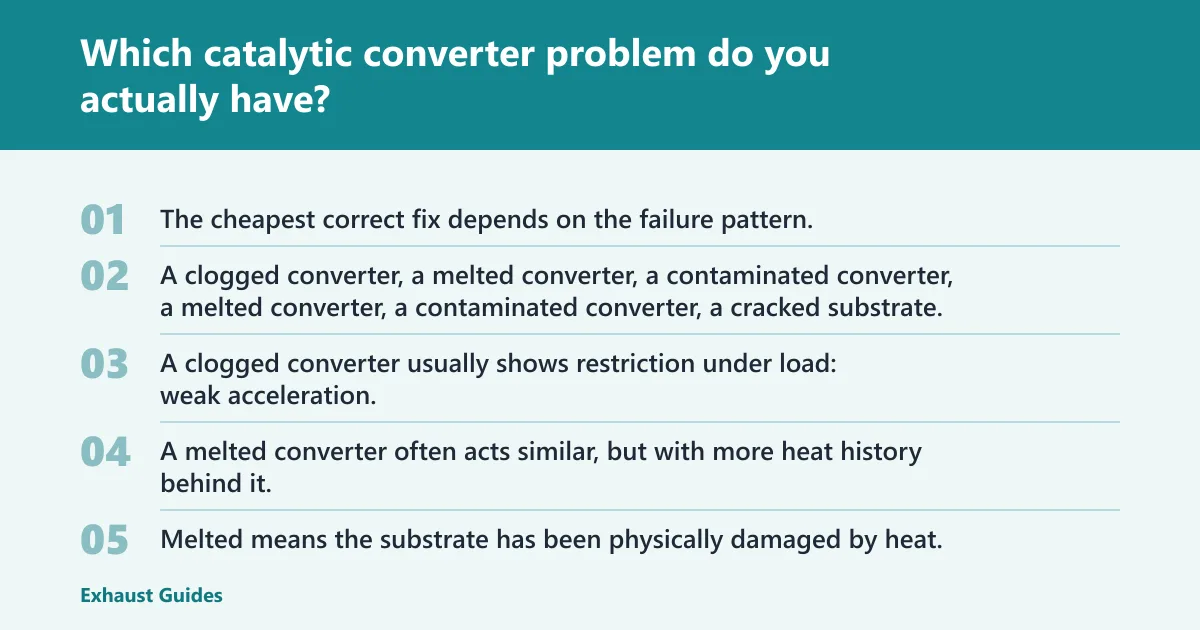
The cheapest correct fix depends on the failure pattern. A clogged converter, a melted converter, a contaminated converter, a cracked substrate, a sensor problem, an exhaust leak, and a stolen converter can all trigger similar complaints, but they do not point to the same repair.
Clogged vs melted
A clogged converter usually shows restriction under load: weak acceleration, rising exhaust heat, and sometimes an engine that revs freely in park but falls flat on the road. A melted converter often acts similar, but with more heat history behind it, commonly after long misfire or rich-running episodes.
Melted means the substrate has been physically damaged by heat. Cleaning does not repair that.
Contaminated vs worn out
A contaminated converter often loses efficiency without causing a major blockage. The car may drive fairly normally, yet set P0420 or P0430 and fail an emissions test. Oil consumption, coolant contamination, or past use of the wrong fuel can leave that pattern.
A simply aged converter can do the same. Many catalytic converters last 100,000 miles or more, so mileage alone is weak proof. Engine condition matters more than the odometer.
Cracked or rattling substrate
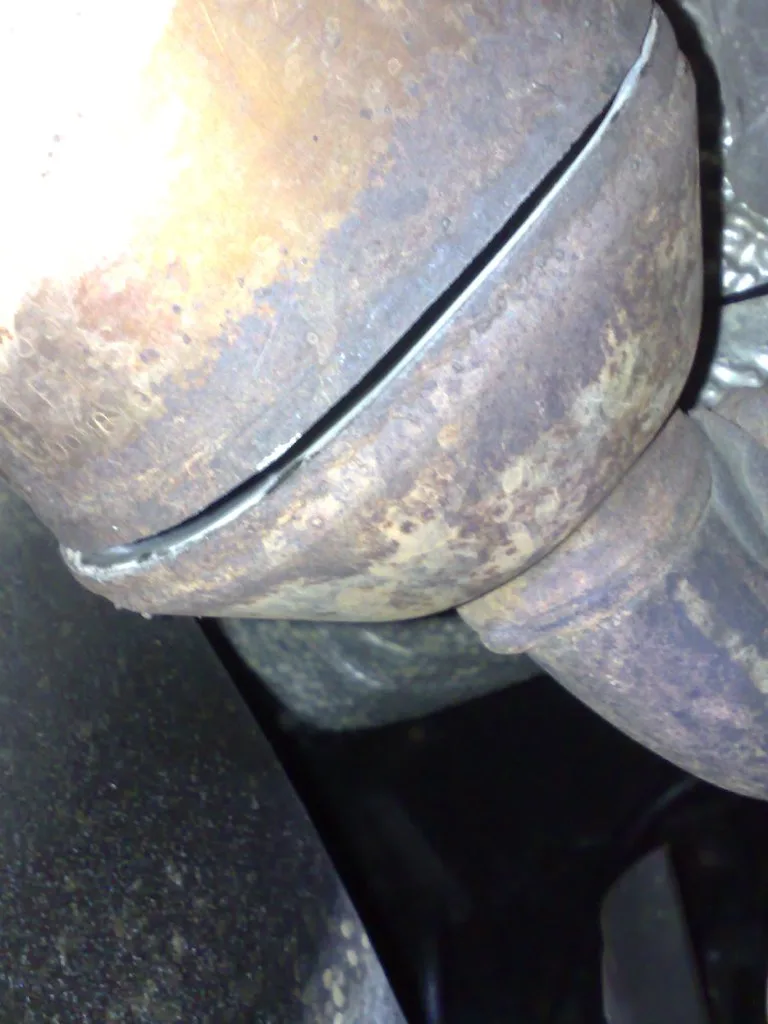
A cracked brick or broken internal mat often causes rattling, intermittent efficiency codes, and vibration-related noise. Sometimes the shell is intact but the ceramic inside has fractured from impact or heat cycling.
That is a physical failure. Cleaning additives will not glue a broken substrate back together.
Stolen converter
Theft is usually obvious. Exhaust noise goes sharp and loud immediately, the smell is stronger, and the cut pipes are visible underneath. The next step is not diagnosis of catalyst efficiency. It is securing the vehicle, documenting the theft, and planning compliant replacement.
Resonators vs. converters: know which part is failing
Exhaust symptoms often overlap, leading owners to buy the wrong part. A catalytic converter handles emissions cleanup, while a resonator tunes acoustic frequency to reduce drone. If your car has a check-engine light, sulfur smell, or failed emissions test, the issue is almost certainly the converter. If the problem is a specific humming noise at certain speeds, it points to the resonator. Replacing a functioning converter with a resonator is not just a waste of money; it renders the vehicle illegal for road use in most regions because it removes critical emissions control equipment. Identifying the correct component before purchasing saves significant repair costs and ensures legal compliance.
You can compare resonator symptoms to distinguish between sound-shaping issues and emissions failures quickly.
What are the signs of a bad catalytic converter?
The common signs are check engine light, emissions-test failure, poor acceleration, reduced fuel economy, sulfur smell, excess heat, and rattling. The useful part is matching the pattern: power loss suggests restriction, rattle suggests physical damage, and a lone efficiency code often still needs leak, sensor, and fuel-trim checks before replacement.
Check engine light and failed emissions test
A bad converter can cause a check engine light, poor acceleration, and reduced fuel economy. It can also fail emissions testing without any dramatic drivability complaint, especially when efficiency has dropped but flow is still acceptable.
Loss of power, poor acceleration, and rising heat
Restriction shows up under load first. Hills become harder. Passing power fades. Exhaust heat builds. In severe cases, the converter can glow from excess fuel burn or backpressure-related heat concentration.
Rattle, sulfur smell, and rough running
A rotten-egg sulfur smell often points to mixture or catalyst stress rather than proving the converter itself is ruined. Rough running, on the other hand, usually starts upstream with ignition, fueling, or compression problems that can kill the converter if ignored.
When the symptoms point elsewhere
An exhaust manifold leak can trip catalyst codes. A lazy rear oxygen sensor can mimic low catalyst storage. Misfires can create heat and smell complaints while the converter is still salvageable if the root cause is fixed early.
Diagnostic decision table: 8 common complaint patterns

How to use the symptom-to-next-step table
Start with the complaint that best matches the vehicle. Run the first checks in order. If a cheaper upstream fix is likely, do that before condemning the converter. Many owners skip this part, and that is where avoidable parts bills start.
| Complaint pattern | Likely causes | First checks | Correct next step |
|---|---|---|---|
| P0420 only, drives normal | Aged catalyst, small exhaust leak, lazy rear O2 sensor, fuel-trim issue | Check freeze-frame data, inspect leaks ahead of rear sensor, review fuel trims, compare front/rear O2 behavior | Fix leaks or mixture faults first; do not replace converter on code alone |
| P0430 only, drives normal | Bank 2 efficiency loss, bank 2 sensor issue, bank 2 leak, bank-specific engine fault | Identify bank 2, inspect that side for leaks, check bank-specific trims and misfire data | Repair bank-specific fault before converter replacement |
| Power loss under load | Clogged converter, melted substrate, severe misfire damage, crushed exhaust | Check for misfire codes, exhaust flow restriction signs, intake vacuum drop under load, temperature imbalance | If restriction is confirmed, replace failed converter and fix root cause |
| Sulfur smell | Rich running, catalyst stress, bad fuel control, aging converter | Scan fuel trims, look for leaking injectors, misfires, thermostat or sensor faults | Correct rich-running cause first; converter may recover if not physically damaged |
| Rattling from under car | Broken substrate, loose heat shield, cracked internal mat | Tap-test shields and shell when cool, inspect mounts and shields | If internal brick is loose, replace converter; if shield is loose, repair shield only |
| Red-hot converter | Chronic misfire, raw fuel entering exhaust, severe restriction | Stop driving, check misfire counters, plugs, coils, injector faults | Repair engine fault before any new converter; replace melted unit if flow is damaged |
| Repeated emissions failure | Low catalyst efficiency, incomplete monitors, sensor issue, leak, fuel control fault | Confirm readiness monitors, scan trims, inspect leaks, verify sensor operation | Finish diagnosis first; emissions failure alone does not prove converter replacement |
| Sudden loud exhaust and smell | Stolen converter, cut pipes, flange separation | Visual inspection underneath, look for missing unit and cut marks | Arrange compliant replacement and theft protection; no further catalyst diagnosis needed first |
At-home diagnostic sequence before replacement
- Scan all stored and pending codes, not just P0420 or P0430.
- Check for active or recent misfires.
- Inspect for exhaust leaks ahead of the rear oxygen sensor.
- Review short-term and long-term fuel trims at idle and light cruise.
- Watch upstream and downstream oxygen sensor behavior.
- Look for oil burning, coolant loss, overheating history, or rich-running symptoms.
- Only then decide whether the converter is contaminated, restricted, broken, or actually fine.
What does P0420 or P0430 mean on OBD2?
P0420 and P0430 are catalyst-efficiency-below-threshold codes, with P0420 often pointing to bank 1 and P0430 to bank 2. They say the system is seeing low catalyst performance on that bank; they do not, by themselves, prove the converter is bad or tell you why efficiency appears low.
Bank 1 vs bank 2
On V engines and flat engines, bank 1 is the side with cylinder 1, and bank 2 is the opposite side. Inline engines usually use only one bank, so P0420 is far more common than P0430 there.
How rear oxygen sensor data drives the code
The engine computer compares oxygen storage behavior. If the downstream sensor begins to mimic the upstream sensor too closely, the computer interprets that as low catalyst efficiency.
That can happen because the catalyst is worn out. It can also happen because unmetered air enters through a leak, the rear sensor is slow or biased, or fuel control is unstable enough to confuse the test.
What scan-tool data is worth checking at home
Useful home checks include freeze-frame conditions, fuel trims, misfire data, coolant temperature plausibility, and front-versus-rear oxygen sensor activity. A code reader that only clears faults is much less useful than one that shows live data.
Can you clean a catalytic converter or do you need to replace it?
Cleaning may help only when the converter is lightly fouled and still structurally sound. It will not repair a melted substrate, cracked brick, loose internal mat, heavy oil ash, coolant poisoning, or theft damage, so diagnosis comes first and root-cause repair comes before any cleaner or replacement part.
When cleaning might help
Light deposit buildup with no rattle, no restriction, and no sign of overheating is the only case where cleaning is worth trying. Even then, success depends on fixing the reason deposits formed.
When cleaning is a waste of time
If the converter is rattling, glowing, physically cracked, missing, or proven restricted, skip the cleaner. If the engine is burning oil or coolant, skip it again. Contamination will return quickly, and some poisoning is permanent.
Fix the root cause first
Installing a new converter behind an active misfire, rich condition, or coolant leak is a short path to another failed converter. The engine has to be stable first.
OEM vs aftermarket choices
Replacement cost varies from about $400 to $7,000+ by vehicle. OEM parts tend to cost more. Aftermarket choices can be cheaper, but emissions requirements, vehicle calibration sensitivity, and local compliance rules can limit what is appropriate.
Safe Methods for Clearing Mild Catalytic Converter Contamination
Cleaning a catalytic converter only works for mild soot buildup, and the underlying cause of contamination must be fixed first. Attempting to clean a melted, cracked, or rattling unit risks overheating the exhaust, damaging oxygen sensors, or starting a fire.
The safest approach uses fuel additives or targeted spray cleaners applied through the sensor port for narrow, on-car attempts. An OBD-II scanner is essential to confirm the fault before any work begins. If one cleaning attempt does not resolve the clog, replacement becomes the necessary repair. Understanding these limits prevents wasted effort and protects your exhaust system. For specific steps and safety precautions, review how to clean a catalytic converter properly before starting the job.
How long is a catalytic converter good for?
Many catalytic converters last a long time, and service life can be toward the lower end of that range when the engine stays healthy. Mileage alone does not decide the issue; misfires, oil burning, coolant contamination, overheating, and repeated short-trip use usually matter more.
Typical lifespan by use pattern
Steady highway use is easier on a converter than endless cold starts and short errands. Long, stable runs keep the catalyst active and reduce the time spent below full operating temperature.
What causes catalytic converters to fail early?
Chronic misfire is the fastest killer because raw fuel burns inside the converter. Rich running does similar harm. Oil burning leaves ash. Coolant contamination coats the substrate. Overheating from engine or exhaust faults can fracture or melt the brick.
Vehicle-specific risk differences
Hybrids are frequent theft targets because their converters can contain valuable catalyst material and often see cleaner engine cycles. Trucks sit higher, so access is easier for thieves. European luxury cars can carry very expensive converter assemblies and sensitive monitoring. High-mileage commuters usually face age and contamination risk more than theft alone.
A buyer-facing checklist to estimate remaining life
- Check mileage, but do not stop there.
- Ask about any history of misfire, overheating, oil consumption, or coolant loss.
- Scan for current, pending, and permanent catalyst or misfire codes.
- Look for sulfur smell, rattle, weak acceleration, or recent exhaust work.
- Review emissions-test history if available.
- Inspect for fresh welds or shields that may suggest prior theft or replacement.
How much does catalytic converter replacement cost?
Replacement cost varies from about $400 to $7,000+ by vehicle because converter size, metal loading, emissions certification, part count, labor access, and vehicle class all change the total. The right estimate separates OEM from aftermarket, EPA-compliant from CARB-compliant, and converter cost from sensors, hardware, and upstream repairs.
Why price changes so much
A small commuter with a simple bolt-in unit sits at one end. A truck, hybrid, or European luxury vehicle with multiple converters, close-coupled units, or integrated manifolds can land at the other.
OEM, EPA-compliant aftermarket, and CARB-compliant parts
OEM generally costs more but tends to match factory fit and calibration best. EPA-compliant aftermarket parts can lower the bill where allowed. CARB-compliant parts can cost more and may be required in some emissions-regulated markets.
Labor, sensors, and extra repair costs
Rusty fasteners, seized oxygen sensors, damaged flanges, and broken hangers can add cost fast. If the engine has a misfire, injector issue, or oil-burning problem, the proper repair total is the converter plus the upstream cause, not the converter alone.
When repair is cheaper than replacement
A loose heat shield, a pinhole leak before the rear sensor, or a failing oxygen sensor can mimic converter trouble. Those are the lowest-cost valid fixes. They should be ruled out first.
How do you protect a catalytic converter from theft?
The best theft protection combines a physical barrier with parking habits that reduce access and a way to identify the part after recovery. Shields, cages, or weld-on deterrents matter more than wishful thinking, especially on hybrids and trucks that are commonly targeted.
Which vehicles are targeted most often
Higher ride height helps thieves work faster, so trucks and SUVs are exposed. Hybrids are frequent targets in many areas. Vehicles parked outside for long periods are easier to hit than those parked in a locked garage or tightly spaced lot.
Shields, cages, and weld-on deterrents
Anti-theft shields make quick saw access harder. Cable cages and weld-on bars can add time and noise to the theft attempt. None make theft impossible, but they can push the thief toward an easier target.
Parking strategy and VIN etching
Park in bright areas, near cameras, or with the vulnerable side blocked where possible. VIN etching helps identification and can make a stolen unit less attractive to resell.
What to do after a theft
Do not keep driving farther than needed to move the vehicle safely. The exhaust will be loud, hot gases may vent under the floor, and the remaining pipes can be damaged. Confirm what was cut, then replace with the correct compliant parts and add protection during the same repair visit.
Choosing a catalytic converter shield for SUVs
If you drive an SUV, the right shield is the one that fits your underbody layout without leaving gaps, rattling, or blocking routine service. The SUV shield guide breaks down the main shield types and compares them by fitment risk, theft resistance, install difficulty, and maintenance access so you can narrow the options fast.
That matters because a poor match can leave the converter exposed even if the shield itself looks substantial. The article also highlights which designs suit stainless durability, lighter weight, easier installation, or off-road use, helping you choose based on how and where your SUV is driven.
Frequently asked questions
Will a bad catalytic converter damage the engine?
A bad converter usually harms drivability before it harms the engine itself. The main risks are backpressure, heat buildup, and poor acceleration if the converter is restricted. The larger concern is often the reverse: an engine misfire, rich condition, or oil burning damages the converter first.
Can you drive with a failing catalytic converter?
It depends on the failure mode. A mild efficiency-loss code with normal power may allow short-term driving while diagnosis is underway. A rattling, glowing, or badly restricted converter should not be ignored because heat and power-loss symptoms can become severe quickly.
What does P0420 mean on OBD2?
P0420 means the computer sees catalyst efficiency below threshold on bank 1. It is a system-performance code, not a guaranteed parts verdict. Exhaust leaks, lazy oxygen sensors, unstable fuel trims, and engine misfires can all trigger it before the converter is truly condemned.