Catalytic Converter Cost Honda Accord
A Honda Accord catalytic converter replacement can cost around $900 to $2,800 installed, and late-model California-spec or OEM parts may push the total above $3,500. Buy the wrong converter and you can fail emissions, trigger another check-engine light, or pay for labor twice. This guide breaks down costs by Accord year and engine, plus the legality of OEM, CARB, and aftermarket parts before you order.
Honda Accord converter cost drivers


The bill is usually a mix of part price and labor, and the part can vary by model year, engine family, and converter position. A front converter, rear converter, or combined assembly can land at different price points, so a quote that looks high may still be correct for your exact Accord.
Parts price versus labor price
Honda’s own guide says cost depends on model, part type, and labor. That matters because the converter itself may be only part of the total. Gaskets, rusty hardware, oxygen sensors, and extra labor time can add up fast on an older Accord.
On many repairs, labor is predictable, but the part is not. OEM pricing is set by the manufacturer, and a dealer or independent shop may quote very different totals depending on availability and whether the vehicle needs a direct-fit part or a legal substitute.
Why year, engine, and position change the bill
Accord converter fitment is not one-size-fits-all. Some years use different layouts, and a front converter may not match a rear converter listing. Engine family differences matter too, especially on emissions-sensitive applications where the approved converter must match the vehicle’s requirements.
That is why two 2007 Accords can have very different parts costs. Trim, state emissions rules, and whether the car uses a SULEV setup can change the buying decision before the wrench turns.
When shop quotes jump fast
Quotes rise quickly when rusted fasteners break, the exhaust flange is damaged, or the shop has to replace sensors at the same time. A failed converter diagnosis that turns out to be an oxygen sensor problem also wastes money, because the second repair repeats the labor.
Say your 2014 Accord has a P0420 code and a shop quote near the top of the range. If the converter is OEM and the flange hardware is seized, the price can move sharply above a basic direct-fit aftermarket job.
Which Accord years need the same converter?
Some Honda Accord years share similar converter fitment, but you still need to verify the engine code and converter position before buying. A 2003 to 2007 rear converter listing may exist, and 2000 to 2007 SULEV cars can have separate approval rules that may override a simple year match.
Year bands that often share fitment
The broadest pattern in the market is by year band, then by engine family and converter location. The 2003 to 2007 rear converter listing is a good example of why year range matters, but it does not mean every trim in that span uses the same part.
| Model year band | Likely converter position | OEM/aftermarket legality notes | Common failure code | Cost risk level |
|---|---|---|---|---|
| 2000-2007 SULEV | Varies by engine and emissions package | Honda OEM catalytic converters are available; certain approved aftermarket options are also available; EFN match can matter | P0420 | High |
| 2003-2007 | Rear converter applications are listed | Some listings are EPA compliant, but legality still depends on the exact application | P0420 | Medium |
| 2004-2007 | Often tied to engine-specific front or rear layouts | Check whether the part is OEM, EPA-compliant, or approved for your state before buying | P0420 | Medium to high |
| 2008-2012 | Layout changes are common by engine and trim | Aftermarket may be legal on some older out-of-warranty Hondas, but state rules still control the sale and use | P0420 | Medium |
| 2013-2017 | Usually engine-specific direct-fit assemblies | Late-model applications can push owners toward OEM because fit and emissions compliance matter more | P0420 | High |
Why trim and engine code still matter
An LX, EX, or higher trim badge does not tell you enough. The engine code and emissions package decide which converter you need, especially when the car is close to an emissions cutoff or has a special approval rule. Buy by VIN, engine family, and position, not by badge alone.
Front versus rear converter differences
Front and rear converters are not interchangeable just because they fit the same generation. The front unit may be built into a different section of the exhaust, while the rear converter may appear as a separate kit. That is why a rear listing for 2003 to 2007 does not solve every Accord’s fitment problem.
OEM vs aftermarket on an Accord
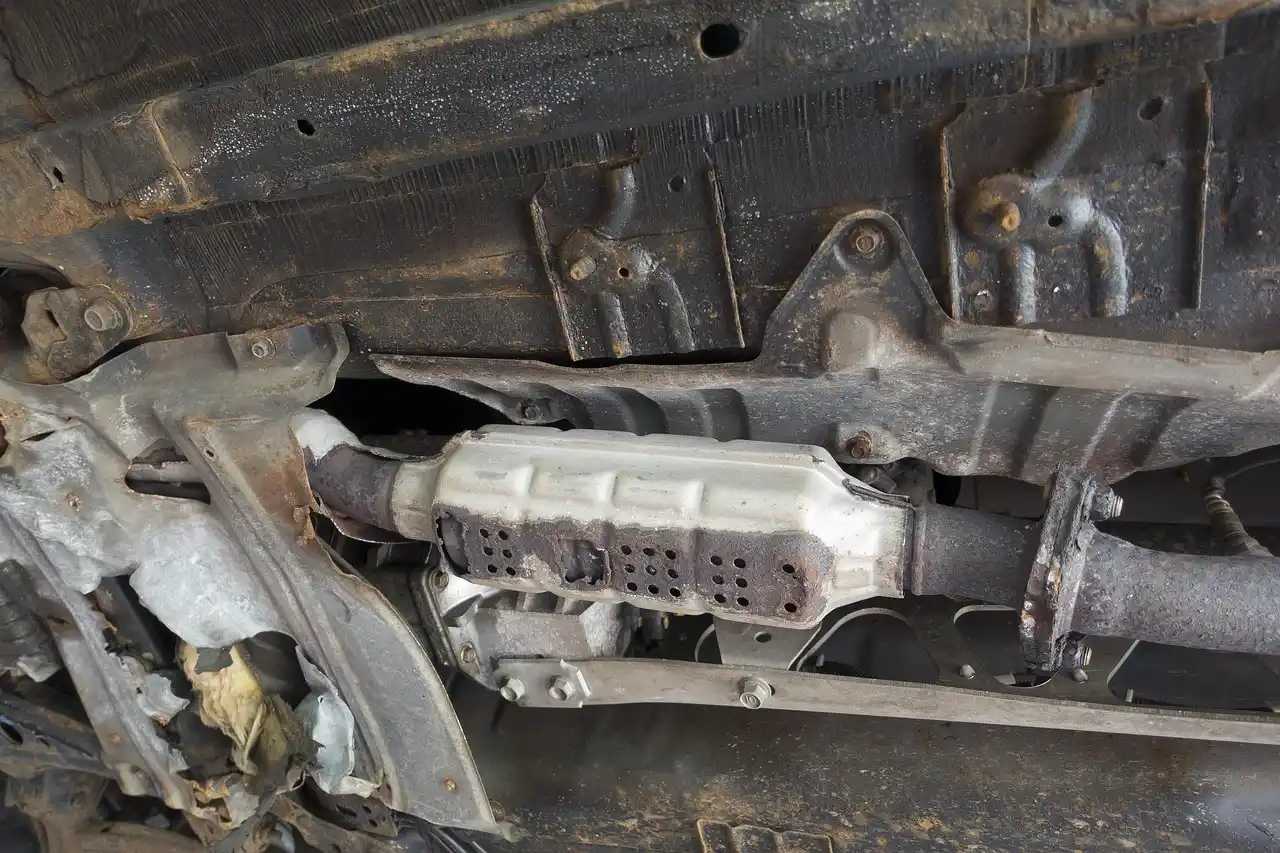
OEM is usually the safer buy for fit and emissions compliance, but it is often the expensive one. Aftermarket can save money, yet the part must match the car’s engine family and local emissions rules, and some applications require approved or state-legal parts only.
When OEM is the safer buy
Honda OEM catalytic converters are available for 2000 to 2007 Accord SULEV models, and that matters because SULEV cars can have stricter converter rules. If you need the least guesswork on fit, or the car is close to inspection-sensitive territory, OEM is usually the cleaner path.
OEM also helps when the application has limited approved aftermarket choices. That is especially important if the converter position is unusual or the vehicle has already failed smog once because the previous part was not correct.
Aftermarket fit and warranty tradeoffs
Aftermarket converters usually cost less, and Honda’s guide notes that an aftermarket converter may be an option on older out-of-warranty Hondas. The catch is legality and fit. An aftermarket converter that does not match the EFN can fail smog inspection, even if it bolts in.
Suppose a 2004 Accord needs a replacement and the owner chooses a cheap direct-fit unit. If the converter is not approved for that exact EFN, the car may clear the driveway but fail the inspection lane.
Why price alone can mislead
Low price does not mean low total cost. A cheaper converter that fails inspection, lights the MIL again, or needs to be replaced a second time can cost more than a pricier OEM part. The real comparison is part price plus compliance risk plus labor.
That is why “cheapest” is a weak buying rule for this repair. The right question is whether the part matches the Accord’s year, engine, converter position, and state legality.
Honda Accord converter legality
Legality depends on where you live, what your Accord is built to use, and whether the part is approved for that exact application. Some aftermarket converters are legal only in certain states, and some vehicles need an EFN match to pass inspection.
EPA and smog inspection basics
Emissions rules do not care whether the part was a bargain. The converter must be emissions-legal in your state, and the car must pass the required inspection. A converter that looks correct on paper can still fail if the application is wrong.
Honda’s guide also cautions that a converter must be emissions-legal in your state. That is the cleanest rule to keep in mind before ordering a part online or letting a shop install one.
CARB states and approved parts
In states with stricter emissions rules, a nonapproved converter can be a dead end. The same part may be fine in one state and illegal in another. That is why a “universal” label is not enough for an Accord that needs a legal, inspection-ready replacement.
EFN matching on SULEV applications
For 2000 to 2007 Accord SULEV models, Honda OEM catalytic converters are available, and certain approved aftermarket options are also available. The effective date for the OEM and approved option change is August 1, 2023.
On these cars, the Engine Family Number matters. An aftermarket converter that does not match the EFN can fail smog inspection. That is the key detail many buyers miss when they shop by year alone.
Honda Accord cost table
This table groups common Accord buying decisions by year band. Treat it as a decision aid, not a substitute for VIN and engine-code verification. The main goal is to avoid ordering the wrong converter, especially on SULEV cars and on models with separate rear converter listings.
| Model year band | Likely converter position | OEM/aftermarket legality notes | Common failure code | Cost risk level |
|---|---|---|---|---|
| 2000-2007 SULEV | Front or rear, depending on engine and emission package | Honda OEM catalytic converters are available; certain approved aftermarket options are also available; EFN match is important | P0420 | High |
| 2003-2007 | Rear converter applications are commonly listed | One listing shows EPA compliance; verify that the exact part is legal for your vehicle and state | P0420 | Medium |
| 2004 | Engine-specific front or rear fitment | Check OEM first if emissions legality is uncertain; some aftermarket parts may be legal only in certain states | P0420 | Medium to high |
| 2008 | Often engine-specific and not interchangeable across trims | Aftermarket may be an option on older out-of-warranty Hondas, but state rules still apply | P0420 | Medium |
| 2010 | Usually direct-fit by engine family | OEM reduces fit risk; aftermarket legality depends on approval status | P0420 | Medium |
| 2012-2017 | Direct-fit assembly is common | Late-model pricing can rise fast with OEM parts and labor; verify emissions legality before purchase | P0420 | High |
Honda catalytic converter pricing is set by the manufacturer, so the same job can price very differently from one shop to another depending on sourcing and labor. One Accord might need only a rear converter kit, while another needs a full OEM assembly and new hardware.
Could the O2 sensor be the problem?
Yes. A bad oxygen sensor can mimic a failing converter, and P0420 alone is not enough to condemn the converter. Before you spend on a catalytic converter, check the sensors, exhaust leaks, and the exact code pattern on the scanner.
Why P0420 is not a final diagnosis
P0420 is a common catalyst-efficiency code, but it does not prove the converter is dead. It only means the engine computer sees a problem in the catalyst monitor. That can happen because the converter is worn out, or because the sensor data is wrong.
Common Honda catalytic converter symptoms include sluggish acceleration, a rotten-egg smell, and P0420. Those signs are useful, but they still need confirmation before you buy a part that can cost more than the repair it was supposed to solve.
Signs of a bad oxygen sensor
An aging O2 sensor can skew readings, trigger the same code, or make a healthy converter look weak. If the car has no loud exhaust noise, no missing section, and no obvious heat damage around the converter, the sensor should stay on the suspect list.
When to stop and inspect before replacing
- Read the code and freeze-frame data.
- Check for exhaust leaks ahead of the converter.
- Inspect the upstream and downstream O2 sensor wiring.
- Look for a loose heat shield, broken flange, or cracked pipe.
- Confirm the exact engine code, model year, and converter position.
- Verify whether the replacement part must be OEM, EPA-compliant, or EFN-matched.
A common first-timer mistake is replacing the converter after one P0420 code and ignoring a lazy upstream sensor. That can turn a single repair into two bills and still leave the warning light on.
Theft or failure on your Accord?
A sudden loud exhaust, a dangling pipe, or a missing converter can point to theft rather than gradual failure. Wear usually builds over time, while theft often creates an immediate noise change and a visible gap in the exhaust system.
Signs of theft versus catalyst wear
Theft often leaves fresh cut marks, broken hangers, and an obvious hole in the exhaust path. Wear is more gradual. The car may set P0420, run sluggish, or smell bad before the converter fails inspection, but the exhaust system will still be physically present.
What a missing converter sounds like
Without a converter in place, the Accord can sound much louder at idle and under load. The exhaust note is often sharp and raw, and you may hear rattling from a dangling shield or open pipe section. That is not the same as a tired catalyst.
When the car should not be driven
If the exhaust is open, hot gases can escape under the car, and the vehicle may be unsafe to drive for any distance. A missing converter or damaged pipe can also make the car illegal for road use where emissions inspections apply. If the exhaust is obviously broken, stop and inspect before continuing.
Frequently asked questions
How much does a catalytic converter cost for a Honda Accord?
The final number depends on the year, engine, converter position, parts source, and labor time, especially if the hardware is rusted or the sensors need replacement too.
Is OEM or aftermarket better for a Honda Accord catalytic converter?
OEM is usually the safer choice for fit and emissions compliance, especially on SULEV models or where inspection rules are strict. Aftermarket can be cheaper and may be legal on older out-of-warranty Hondas, but only if the part matches the engine family and state rules.
What years of Honda Accord have the same catalytic converter?
Some 2003 to 2007 Accord applications may share rear converter listings, but that does not mean every trim or engine is interchangeable. You still need the exact year, engine code, and converter position. SULEV cars from 2000 to 2007 have separate approval concerns and should be matched carefully.
Can a bad O2 sensor make it seem like the catalytic converter is bad?
Yes. A bad oxygen sensor can mimic a failing converter and trigger P0420, even when the converter is still serviceable. Before replacing the converter, check the sensor data, wiring, and exhaust for leaks. That quick diagnosis can save the cost of a part and a second labor charge.
Will a Honda Accord pass smog with an aftermarket catalytic converter?
It can, but only if the converter is legal for your state and the specific Accord application. An aftermarket converter that does not match the EFN can fail smog inspection, even if it fits physically. In stricter states, approved parts matter as much as price.
Are there legal catalytic converter options for a 2000-2007 Honda Accord SULEV?
Yes. Honda OEM catalytic converters are available for 2000 to 2007 Accord SULEV models, and certain approved aftermarket options are also available. The effective date for the OEM and approved option change is August 1, 2023, and EFN matching can be necessary to stay inspection-legal.