
Muffler vs Catalytic Converter
If the car is loud, check the muffler first. If the check-engine light, rotten-egg smell, or failed emissions test appears, check the catalytic converter first. Guessing wrong can waste money, leave an emissions fault unfixed, and let an exhaust leak damage nearby parts. This guide covers symptoms, quick checks, and the tests that separate muffler failure from catalytic converter failure.
Quick decision table:
| Symptom | Likely part | Quick at-home check | Next step |
|---|---|---|---|
| Sudden loud exhaust, rumble, or hissing from the rear | Muffler or rear exhaust leak | Look under the back of the car for rust holes, soot, broken hangers, or a split seam | Inspect the muffler and rear pipe joints first |
| Check engine light with P0420 or emissions failure | Catalytic converter, O2 sensor, or exhaust leak ahead of the converter | Read codes with an OBD2 scanner and inspect for leaks near the converter | Check live data and rule out sensor or leak issues before replacing parts |
| Rotten-egg smell or weak acceleration | Catalytic converter | Check for heat discoloration, rattles, or restricted exhaust flow | Have the converter and upstream sensors diagnosed |
| Noise change but no warning light | Muffler, resonator, or rear pipe | Trace the exhaust path and listen for the loudest point | Start with the rear exhaust section |
| Factor | muffler | catalytic converter | Winner |
|---|---|---|---|
| Primary job | Reduces exhaust noise with chambers, baffles, or perforated tubes | Reduces harmful exhaust gases before they exit the tailpipe | tie |
| Typical symptom pattern | Sudden louder exhaust, rattles, rust, holes, leaks | Check engine light, P0420, sulfur smell, power loss, emissions failure | catalytic converter |
| Location in the exhaust system | Usually farther back, just before the tailpipe | Near the engine or under the vehicle floor | tie |
| Replacement cost tendency | Usually lower part cost and simpler labor | Usually higher part cost and more labor sensitivity | muffler |
| Emissions impact | Usually none unless an exhaust leak is present | Directly affects emissions and inspection results | catalytic converter |
Primary job
The muffler cuts exhaust noise. The catalytic converter cleans exhaust gases. Those failures are different, so a car can be quiet and still fail inspection, or be loud and still pass emissions if the converter works.
Typical symptom pattern
A bad muffler usually shows up as a sudden increase in exhaust noise, especially when rust opens a hole or a seam splits. A failing catalytic converter usually shows up through the check engine light, P0420, sulfur smell, power loss, or a failed emissions test.
Location in the exhaust system
The exhaust system typically includes the manifold or header, catalytic converter, resonator, muffler, and tailpipe. The converter sits closer to the engine, while the muffler is usually near the rear of the car. That spacing matters because a leak near the front can sound different from a leak near the tailpipe.
Replacement cost tendency
The muffler is usually the cheaper fix because the part is simpler and often easier to reach. Catalytic converter jobs usually cost more because of part price, sensors, and labor access. A precise quote depends on vehicle layout, rust, and whether the unit is welded in.
Emissions impact
A muffler can fail without changing tailpipe chemistry. A catalytic converter cannot. The converter helps reduce pollutants such as hydrocarbons, carbon monoxide, and nitrogen oxides, and exhaust defects can create abnormal noise and unsafe leaks.
What does the muffler do?
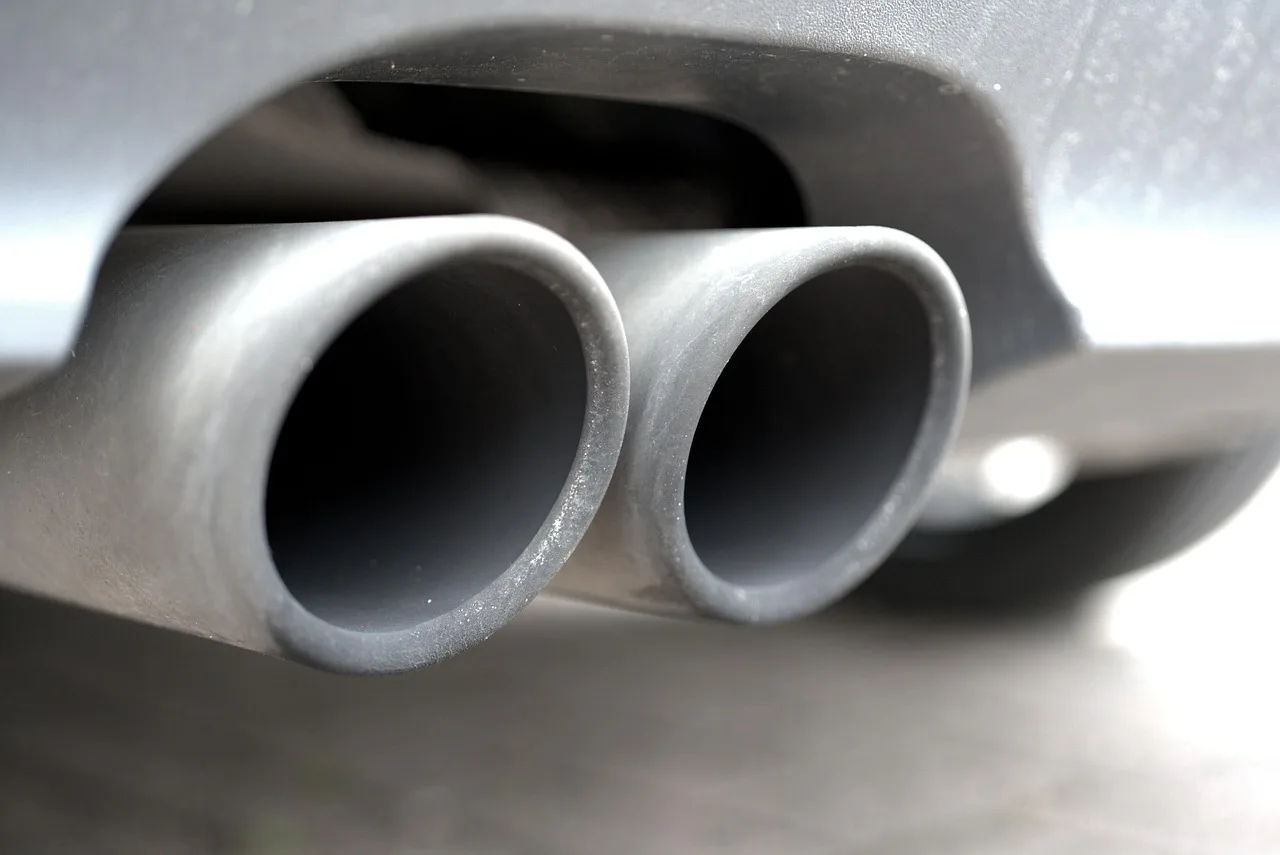
The muffler lowers engine noise for comfort and compliance. It uses chambers, baffles, or perforated tubes to break up sound waves, usually near the rear of the exhaust system just before the tailpipe.
How mufflers reduce noise
Exhaust pulses leave the engine in sharp bursts. The muffler slows, redirects, and breaks up those pulses so less noise reaches the rear of the car. It does not clean exhaust gas, and it does not replace the catalytic converter.
Common muffler materials
Mufflers are commonly made from steel, aluminum, stainless steel, or titanium. Material choice affects corrosion resistance and price, but the diagnostic point stays the same: if the muffler case rusts through, cracks, or leaks at a seam, the car often gets much louder.
Typical failure signs
A bad muffler usually causes a sudden increase in exhaust noise. Rust, holes, broken hangers, and seam leaks are common clues. If the sound is strongest at the rear and changes when the engine revs, the muffler or a rear exhaust joint needs a close look.
What does the catalytic converter do?
The catalytic converter reduces harmful exhaust gases before they exit the tailpipe. Inside the shell is a ceramic or metallic honeycomb coated with platinum, palladium, and rhodium, which helps convert pollutants into less harmful output as exhaust flows through it.
How the honeycomb substrate works
The honeycomb gives the exhaust a large surface area to pass over. That structure helps the chemical reactions happen quickly enough for normal driving. A clogged or melted substrate restricts flow, which can create power loss even when the car does not sound especially loud.
Failure signs tied to emissions
A failing catalytic converter often shows code P0420. It can also bring a sulfur smell, weak acceleration, or an emissions failure. The check engine light matters here because it often points to catalyst efficiency problems, not just a noise issue. Before condemning the converter, check exhaust leaks, O2 sensor operation, and misfire or fuel-trim issues.
O2 sensor checks matter
The engine computer uses the O2 sensor to monitor catalytic converter efficiency. A faulty sensor can feed bad data and make a good converter look bad. That is why a scan tool and sensor diagnosis should come before any expensive converter replacement.
Where are they located?
The catalytic converter is usually closer to the engine or under the vehicle floor, while the muffler is usually farther back, just before the tailpipe. Their placement helps explain why a front exhaust leak, a mid-pipe problem, and a rear muffler hole can each create a different symptom pattern.
How the rest of the exhaust system fits
The exhaust system moves hot exhaust gases away from the engine. In a typical layout, exhaust leaves the manifold or header, passes through the catalytic converter, may pass through a resonator, then reaches the muffler and tailpipe. Some vehicles omit the resonator; some combine parts in one section.
Resonator vs muffler vs catalytic converter
The resonator tunes exhaust frequencies and cuts drone or rasp. It does not clean emissions. A resonator problem usually changes tone, not emissions. A muffler problem usually changes volume. A catalytic converter problem often changes emissions data, warning lights, or engine performance.
Quick location check
- Trace the exhaust from the engine rearward.
- Look for the converter closest to the engine.
- Look for the muffler near the tailpipe.
- Inspect joints, clamps, and hangers for soot or rust.
Muffler vs catalytic converter sound
Sound alone does not identify the failed part. A bad muffler usually makes the car noticeably louder, while a bad catalytic converter may be quiet, noisy, or nearly unchanged except for drivability and emissions symptoms. That is why diagnosis should separate noise from emissions data.
What a bad muffler sounds like
A failed muffler often sounds like a deeper exhaust note or a sudden roar under throttle. If the case is rusted through, the leak may hiss or pop near the rear. Loose internal baffles can also create a rattling sound at idle or during revs.
What a bad catalytic converter sounds like
A bad catalytic converter can rattle if the substrate breaks apart, and a clogged converter can muffle power more than noise. Some failures are nearly silent. That is why a car can be loud and still have a fine converter, or be quiet and still have a dead one.
Why sound alone misleads diagnosis
A rear exhaust leak can mimic a muffler failure. A gutted catalyst can sound loud and also set emissions faults. A resonator failure can change tone without affecting emissions. You need location, scan data, and a visual check, not just the sound of the car.
Why a check engine light matters
A check engine light changes the diagnosis path. When the code is P0420, the engine computer is flagging catalyst efficiency, but the converter is not the only possible cause. Oxygen sensor faults, wiring issues, and exhaust leaks can all distort the reading.
P0420 and catalyst efficiency
P0420 commonly appears when the converter is not storing and cleaning exhaust gases as expected. That code does not prove the converter is bad by itself. It is a clue that the converter, O2 sensors, and any leaks in the exhaust stream need inspection.
How O2 sensors affect diagnosis
The O2 sensor compares exhaust changes before and after the converter. If a sensor is slow, contaminated, or wiring is damaged, the computer may log a false catalyst diagnosis. A scan that includes live data is far more useful than replacing parts at random.
What to check before buying parts
- Read codes with an OBD2 scanner.
- Check whether P0420 is present.
- Inspect the exhaust for leaks ahead of the converter.
- Look at O2 sensor data for unusual switching patterns.
- Only then decide whether the converter, sensor, or a leak is the real fix.
Muffler vs catalytic converter cost
The catalytic converter usually costs more than the muffler. Part price is only part of the bill, though. Labor, corrosion, and the vehicle’s exhaust layout can push a converter job much higher than a muffler swap, especially on cars with tight access or integrated components.
Part cost versus labor cost
Muffler replacement often stays in the lower range because the part is simpler and the rear exhaust is easier to access. Converter labor can rise fast if fasteners are rusted, the unit is welded in, or sensors must be removed and reinstalled carefully.
Why vehicle layout changes the bill
A converter located close to the engine can be buried under heat shields, brackets, and sensor wiring. A rear muffler is usually easier to reach. If the vehicle uses one assembly for the converter and front pipe, the repair can cost much more than the part price suggests.
Cost clues that help diagnosis
If the quote is modest and the complaint is mostly noise, the muffler is often the more likely repair. If the quote includes sensor work, emissions concern, and a P0420 diagnosis, the catalytic converter side of the system is more likely to be involved.
Choose muffler if…
Choose the muffler if the main complaint is loud exhaust, the damage is near the rear of the system, and there is no emissions code or rotten-egg smell. Choose the catalytic converter if the check engine light is on, P0420 is stored, power is down, or the car fails an emissions test.
Choose muffler if the problem is noise first. Choose catalytic converter if the problem is emissions first. If the car is loud but also has a check engine light, inspect both the rear exhaust and the converter path before replacing anything.


Frequently asked questions
What’s the difference between a muffler and a catalytic converter
The muffler cuts exhaust noise with chambers, baffles, or perforated tubes. The catalytic converter reduces harmful exhaust gases with a ceramic or metallic honeycomb coated with platinum, palladium, and rhodium. One affects sound first; the other affects emissions first.
Is the muffler and catalytic converter the same thing?
No. They are separate parts in the exhaust system with different jobs and different failure signs.
Muffler vs catalytic converter cost: the muffler usually costs less
The muffler usually costs less to replace. Catalytic converter jobs rise because of part cost, sensors, and labor access. Rust and welded joints can push either repair higher.
Muffler vs catalytic converter sound: a bad muffler often makes
A bad muffler often makes the car much louder, sometimes with a deep roar, hiss, or rattly note. A bad catalytic converter can rattle if the substrate breaks, but it can also fail quietly while still causing power loss or a code.
Resonator vs muffler vs catalytic converter: the resonator tunes exhaust frequencies
The resonator tunes exhaust frequencies and cuts drone or rasp, but it does not clean emissions. The muffler mainly reduces overall noise. The catalytic converter cleans exhaust gases.
Muffler vs exhaust vs catalytic converter
The exhaust system is the whole path that moves exhaust gases away from the engine. The catalytic converter and muffler are parts of that system, along with the manifold or header, resonator, and tailpipe.
What muffler and catalytic converter
The muffler is the rear noise-control part of the exhaust system. The catalytic converter is the emissions-control part closer to the engine.
Muffler vs cat converter
People often shorten catalytic converter to “cat converter,” but it is not the same as the muffler. The muffler controls noise. The catalytic converter cleans exhaust.
Which muffler sounds the best?
There is no single best-sounding muffler for every car. Sound depends on engine size, pipe diameter, chamber design, baffles, and whether the vehicle uses a resonator.