Why Exhaust Smoke Smells Like Fuel
A fuel smell from the exhaust usually means unburned fuel, a rich mixture, or a fuel leak; if the odor is strong, the engine misfires, or smoke is heavy, stop driving. Ignoring it can damage the catalytic converter, wash down cylinders, or create a fire risk. Match the odor, smoke color, and driving condition to the likeliest fault.
Quick verdict on fuel-smelling exhaust
If the smell is light, brief, and limited to a cold start, it may be normal condensation or a short rich start-up event. White smoke that clears within a few minutes on a cold morning can be harmless,. A strong gasoline odor, visible wetness, heavy smoke, or a smell that remains after warm-up can indicate a problem and is not normal.
Stop driving right away if you see liquid fuel, smell raw hydrocarbons strongly enough to reach the cabin, or notice misfiring with heavy smoke. A fuel leak can be a fire-risk sign, and unburned fuel may overheat the catalytic converter. A check engine light may be off even when the fault is real.
Fuel-smell diagnostic matrix
| Symptom pattern | Most likely subsystem | Quick at-home check | Stop-driving threshold |
|---|---|---|---|
| Cold-start only, clears in a few minutes | Cold-start condensation | Watch whether the white plume fades as the engine warms; note whether the odor is absent or only faint. | Do not stop for this alone unless the smoke turns dense, sweet, or fuel-heavy. |
| Warm-engine persistent white smoke | Coolant intrusion, blown head gasket, cracked cylinder head, or cracked block | Check coolant level, look for sweet odor, and see whether smoke continues after full warm-up. | Stop driving if the smoke is thick, the engine overheats, or coolant drops quickly. |
| Acceleration-only fuel smell | Leaking injector, rich mixture, or fuel pressure regulator fault | Note whether the smell appears under load and whether black smoke follows hard throttle. | Stop if the engine runs rough, misfires, or smoke becomes heavy. |
| Idle-only fuel smell | Rich idle, injector leakage, EVAP vapor leak | Stand near the tailpipe and under hood separately to locate the strongest odor. | Do not keep idling if the smell is strong enough to enter the cabin. |
| Post-fill-up fuel odor | EVAP system, loose gas cap seal | Check the cap seal and fuel door area, then look for smell that fades after driving. | Stop if there is wet fuel, dripping, or the odor gets stronger instead of fading. |
| No check engine light, but fuel smell persists | Intermittent fuel leak, EVAP vapor leak, rich running, or monitor not run yet | Inspect odor source, cap seal, hoses, and whether the smell is tailpipe, under-hood, or cabin based. | Do not treat the missing light as proof of safety. |
What the smoke color and timing mean
Smoke timing matters as much as color. A brief cold-start plume can be normal condensation, but smoke that persists after warm-up points toward a fault, especially if the odor is fuel-like or sweet. White smoke can be steam; fuel-smelling exhaust is a separate clue.
Cold-start condensation versus real smoke
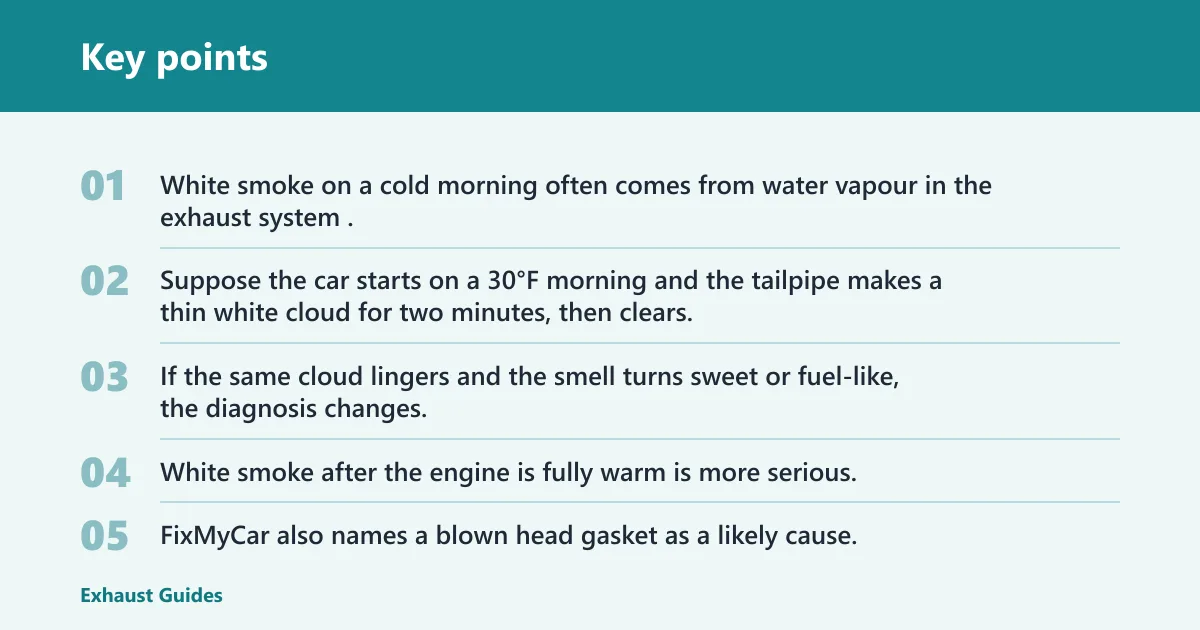
White smoke on a cold morning often comes from water vapour in the exhaust system. It should clear as the engine warms,. That kind of plume should not smell like gasoline or petrol.
Suppose the car starts on a 30°F morning and the tailpipe makes a thin white cloud for two minutes, then clears. That pattern fits condensation. If the same cloud lingers and the smell turns sweet or fuel-like, the diagnosis changes.
Warm-engine smoke that keeps coming back
White smoke after the engine is fully warm is more serious. Persistent white smoke with a sweet smell points to coolant burning inside the engine, and thick white clouds at all temperatures can indicate a significant coolant leak. FixMyCar also names a blown head gasket as a likely cause.
When the engine is warm, coolant intrusion becomes a top concern. A cracked cylinder head or cracked engine block can create the same pattern. If the smoke is white but also smells faintly of fuel, a misfire or overfueling condition may be mixing with the coolant issue.
Acceleration-only and idle-only patterns
Fuel smell that appears mainly during acceleration usually points to a mixture problem under load. That can happen when the engine runs rich, a fuel injector leaks, or fuel pressure is too high. Fuel smell that appears mostly at idle may point more toward injector leakage, EVAP vapor, or a fuel pressure fault that shows up when demand is low.
A common first-timer mistake is to blame any smoke seen under throttle on the head gasket. If the smoke appears only when you floor it, and the odor is raw fuel rather than sweet coolant, the fuel system moves higher on the list.
Why does exhaust smell like gas?
Raw fuel or gasoline vapor in the exhaust means fuel is leaving the cylinders without being fully burned. That can happen from a leak, an injector fault, overfueling, or aftertreatment that is not converting exhaust properly. If the odor is strongest at the tailpipe, think exhaust-side or combustion-side causes first,.
Raw fuel or gasoline vapor clues
A strong gasoline odor, visible wetness around the tailpipe, dripping near the fuel system, or a smell that stays after warm-up raises urgency. OBD2 Beginner notes that a wet hose, leaking injector, or damaged fuel line may cause a gasoline smell.
If the smell is strong enough to notice without opening the hood, treat it as a safety problem, not a nuisance. Raw fuel vapor is flammable, and visible wet fuel is a stop-driving sign.
Leaking injector and rich-running clues
Damaged fuel injectors are among the causes of white smoke, and they can also create a fuel-heavy exhaust smell. A leaking injector can drip fuel into the cylinder when it should not, which may cause rough idle and black smoke during acceleration. The same source says an engine running rich can make the exhaust smell fuel-heavy.
Rich running often leaves extra clues: poor fuel economy, black soot at the tailpipe, and a smell strongest after throttle input. That points toward overfueling rather than coolant intrusion.
Fuel pressure regulator clues
A faulty fuel pressure regulator can overfuel the engine and leave the tailpipe smelling strongest. It can also hurt fuel economy. If the odor is strongest behind the vehicle, and the engine seems to run too rich across a range of speeds, this subsystem belongs high on the list.
That kind of fault may not always trigger an immediate fault light. Intermittent pressure problems can come and go before the monitor catches them.
Catalytic converter clues
The catalytic converter is part of aftertreatment, and it should convert leftover hydrocarbons into cleaner exhaust. If conversion is incomplete, fuel odor can pass through even when the engine is not obviously misfiring. A weak converter often follows another fault, such as rich running or misfires, rather than acting alone. (Wikipedia)
If the smell is fuel-heavy and the tailpipe is sooty, do not assume the converter is the root cause first. It may be the part suffering from another issue upstream.
Can a fuel smell come from exhaust without a check engine light?
Yes. A car can smell like gas even when the check engine light is off. The light may stay off if the monitor has not run yet, if the fault is intermittent, or if the problem sits below the threshold needed to turn on the MIL. No light does not clear the diagnosis.
Why the light may stay off
The check engine light is not a complete fault detector. It may miss a loose gas cap seal, a small EVAP vapor leak, a brief rich condition, or a problem that happens only under certain loads. The same source says a loose gas cap may cause the smell.
That matters after a fill-up, after a short trip, or when the smell appears only sometimes. A fault can be real even if the dashboard stays dark.
What to inspect next when the MIL is off
- Check the odor source. Stand near the tailpipe, fuel door, cabin, and hood one at a time. OBD2 Beginner says the key question is where the smell is strongest.
- Inspect for wet fuel. Look for damp hoses, fuel stains, or dripping near the engine bay and under the car. Wet fuel changes this from a diagnosis problem into a safety problem.
- Verify the gas cap. Tighten it fully and inspect the seal for cracks or dirt. A loose cap can create a vapor smell without an immediate light.
- Note the driving condition. Write down whether the smell happens at idle, during acceleration, or only after refueling. That pattern often points to the subsystem.
What does white exhaust smoke mean when the engine is warm?
White exhaust smoke after warm-up usually means more than condensation. Persistent white smoke with a sweet smell points to coolant burning inside the engine, and thick white clouds at all temperatures can indicate a significant coolant leak. If the smell is fuel-like instead, look for a second fault such as rich running or misfire.
Coolant intrusion signs
Coolant intrusion often comes from a blown head gasket, cracked cylinder head, or cracked engine block. The smell is usually sweet, not gasoline-like. You may also see the coolant level drop, overheating, or unexplained loss of coolant without external dripping.
If white smoke stays visible after the engine reaches full temperature, do not write it off as morning condensation. That is the point where the diagnosis shifts toward internal coolant loss.
How to separate coolant steam from fuel odor
Steam from coolant tends to smell sweet. Fuel odor smells sharper and more like raw gasoline or petrol. If the exhaust plume is white but the tailpipe also smells like gas, you may be seeing a mix: coolant intrusion plus a rich or misfiring condition.
Picture a warm sedan that idles rough, sends out white smoke, and leaves a fuel odor at the bumper. That combination is not a simple condensation event. It calls for both coolant and fuel-system checks.
What to check by odor location
Where the smell is strongest matters. A tailpipe odor points toward combustion, injector, or aftertreatment issues. A fuel-door odor after a fill-up points toward EVAP or cap sealing. Under-hood odor points toward leaks. Cabin odor raises urgency because vapors can enter the passenger area.
Tailpipe odor
A fuel smell strongest at the tailpipe usually points toward a rich mixture, leaking injector, fuel pressure regulator fault, or catalytic converter that is not cleaning up the exhaust. If black smoke appears with the odor, rich running moves higher on the list.
Fuel door odor after fill-up
If the smell starts after refueling and is strongest near the fuel door, check the gas cap seal first. EVAP vapor leaks can release fuel smell without an immediate light. If the odor fades after a drive, that supports a vapor leak more than an active liquid fuel leak.
Under-hood odor
A smell strongest under the hood points to a fuel leak near the rail, lines, injectors, or regulator. That is the location most likely to produce raw fuel vapor before it reaches the exhaust. Wet spots, staining, or a hot-fuel odor are warning signs.
Cabin odor
A cabin odor means vapors are entering the vehicle, which increases the need to stop and inspect. Do not keep driving if the smell is strong inside the cabin, especially with visible smoke or any sign of dripping fuel.
Frequently asked questions
Why does my exhaust smoke smell like gas?
That usually means unburned fuel is reaching the exhaust. Common causes are a rich mixture, a leaking injector, a fuel pressure regulator fault, or a fuel leak. If the smoke is white on a cold start and clears quickly, condensation may be part of it, but a true gasoline odor should not be ignored.
Why does my exhaust fumes smell like gas?
Exhaust fumes that smell like gas often point to fuel leaving the cylinder unburned or a vapor leak reaching the tailpipe area. Check whether the smell is strongest at idle, under acceleration, or after refueling. If it is persistent, even without a warning light, you need a diagnosis.
Why does my exhaust smell like petrol?
Petrol smell means the same thing as gasoline odor: fuel is escaping combustion or evaporating where it should not. The most likely causes are rich running, injector leakage, or an EVAP problem. If the smell is strongest at the tailpipe and the car uses more fuel than usual, rich mixture becomes more likely.
What causes white smoke from exhaust smells like gas
That combination can come from two overlapping issues: coolant steam and a fuel fault. White smoke that persists after warm-up points toward coolant intrusion, while the gas smell points toward unburned fuel, a rich mixture, or a leak. The odor type helps separate the systems instead of blaming one part too quickly.
Why does my exhaust smell like gas?
A gas smell from the exhaust usually means the engine is sending too much fuel or not burning all of it. A leaking injector, faulty fuel pressure regulator, weak catalytic converter performance, or misfire can all do this. A missing check engine light does not rule it out.
Is white smoke from exhaust dangerous?
White smoke is not always dangerous. Brief cold-start condensation can be normal and should clear as the engine warms. But persistent white smoke, thick clouds, coolant loss, a sweet smell, or any fuel odor changes the picture. Stop driving if smoke is heavy, the engine misfires, or you see wet fuel.
What does white exhaust smoke mean when the engine is warm: when the engine is warm?
When the engine is warm, white smoke is more concerning than on a cold start. Persistent white smoke with a sweet smell points toward coolant burning inside the engine, often from a blown head gasket, cracked head, or cracked block. If the smoke also smells like gas, a fuel fault may be present too.