Why Exhaust Smoke Smells Sweet and What It Means
Persistent sugary-smelling smoke can be a reason to inspect the coolant level, radiator hoses, and reservoir before driving again; brief white steam on a cold start can be normal condensation. Ignoring it can overheat the engine, warp the head, and turn a small leak into a major repair. This guide shows how to tell steam from coolant smoke, fuel or oil odors, and what to inspect next.
Sweet exhaust versus gasoline exhaust odor
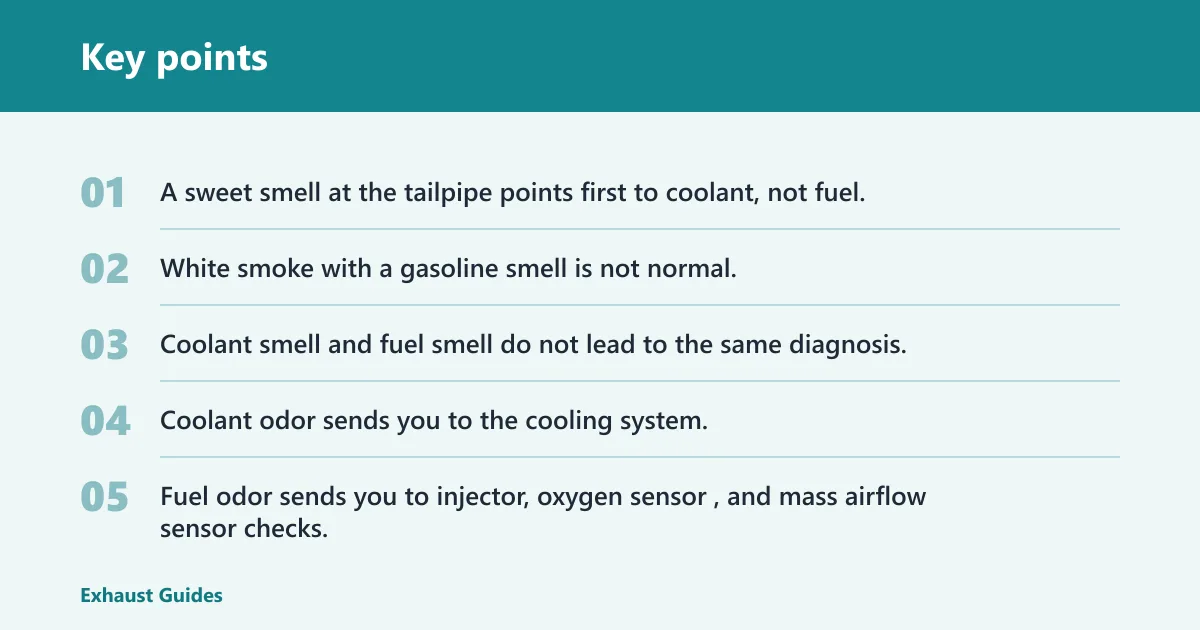


A sweet smell at the tailpipe points first to coolant, not fuel. Coolant leaks can create a sugary odor, and when that coolant burns in the engine or exhaust, it can leave white smoke that lingers instead of fading quickly.
That is different from raw-fuel odor. Fuel-related smoke often smells sharp or gasoline-like and can point toward rich running, a leaking injector, or a sensor problem. White smoke with a gasoline smell is not normal.
Sweet smell versus fuel smell
Coolant smell and fuel smell do not lead to the same diagnosis. A sweet odor with white smoke points toward coolant intrusion, while a gasoline smell with smoke points toward excess fuel, incomplete combustion, or an injector fault.
That split matters because the next check changes. Coolant odor sends you to the cooling system. Fuel odor sends you to injector, oxygen sensor, and mass airflow sensor checks.
Smoke color, texture, and duration
Look at how the smoke behaves. Steam is thin, wispy, and brief. Coolant smoke is often thicker, hangs longer, and may return after the engine is warm. Oil smoke is usually bluish-gray and smells burnt, not sweet.
Duration is one of the best clues. If the smoke clears after a short drive and does not come back, condensation is more likely. If it keeps coming out after warm-up, treat it as a fault until proven otherwise.
Exhaust smoke diagnosis matrix
| Smell | Smoke behavior | Likely source | Next check |
|---|---|---|---|
| None or faint damp odor | Thin white vapor for a short time after cold start, then gone | Condensation | Check whether it disappears after a short drive and whether coolant level stays steady |
| Sweet | Persistent white smoke at idle or while driving | Coolant entering the combustion chamber or exhaust | Check coolant level, look for residue, and inspect for a head gasket, cracked head, or block crack |
| Sweet | White smoke plus rising temperature gauge or overheating | Blown head gasket or serious internal coolant leak | Park the vehicle, let it cool, then inspect coolant loss and arrange prompt repair |
| Fuel-like or sweet-and-fuel mixed | Smoke appears after hard driving, heavy throttle, or a rough idle | Rich running, leaking injector, oxygen sensor fault, or mass airflow sensor issue | Scan for fuel-system faults, inspect plugs, and check sensor data |
Is it just condensation?
Brief cold-start vapor is often normal condensation, especially after overnight parking or in cold weather. It usually looks like light white mist, has little or no odor, and clears after the exhaust warms up.
Why cold-start vapor is often normal
When a parked car cools, water condenses in the exhaust system. On startup that moisture turns to vapor and leaves the tailpipe. That is why Vehicle Seeks says white smoke on startup can disappear after a short drive, and why condensation is commonly the harmless cause.
Condensation is more visible in cold weather. It can look dramatic in a driveway, then vanish once the pipe and muffler heat up.
When steam stops being normal
Steam stops looking normal when it lasts beyond a short warm-up, comes back after the engine is hot, or leaves a coolant-loss trail. If the coolant level drops, the smoke has a sweet smell, or the temperature gauge rises, the problem is no longer just water vapor.
Picture a car that puffs white vapor for 30 seconds on a frosty morning, then clears completely. That is consistent with condensation. If vapor keeps coming after about 10 minutes of driving and the coolant bottle is down, That pattern points away from condensation.
Sweet exhaust smoke and coolant leaks
Coolant is often the reason exhaust smoke smells sweet. Coolant leaks can produce a sweet odor, and if coolant reaches the combustion chamber or hot exhaust, it can make white smoke that lingers and thickens with engine heat.
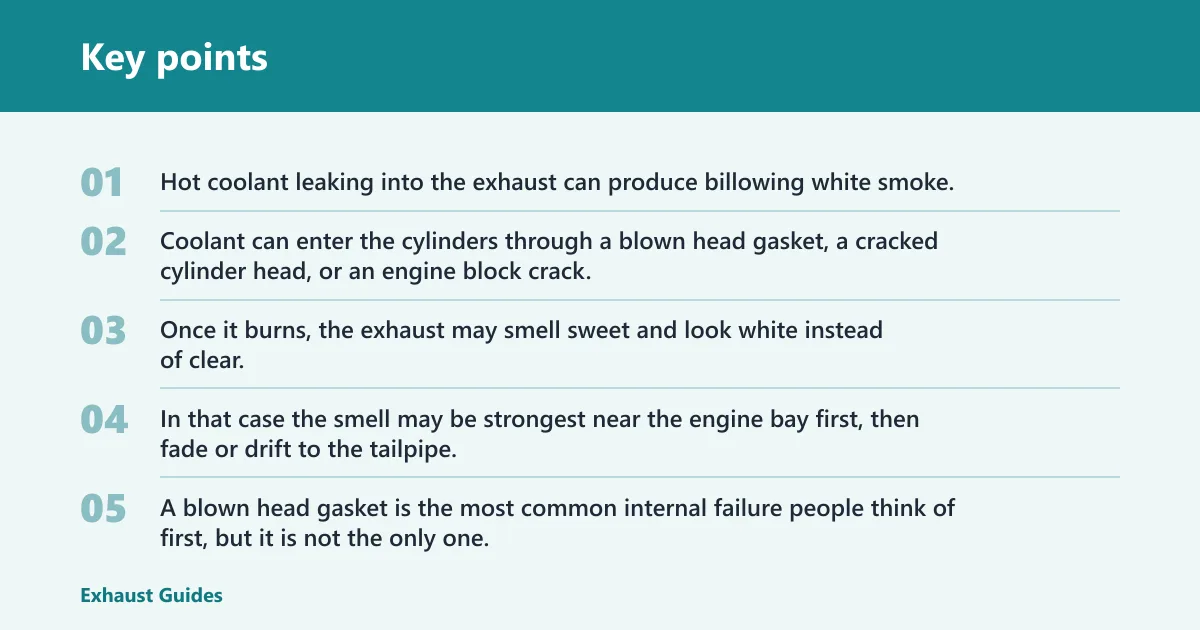
Hot coolant leaking into the exhaust can produce billowing white smoke. A heater core leak, an external leak dripping onto hot exhaust parts, or residual coolant left in the exhaust after a repair can also leave a sweet smell without a warning light.
How coolant reaches the exhaust
Coolant can enter the cylinders through a blown head gasket, a cracked cylinder head, or an engine block crack. Once it burns, the exhaust may smell sweet and look white instead of clear.
It can also leak from hoses, the radiator, the water pump, or the heater core area and land on hot metal. In that case the smell may be strongest near the engine bay first, then fade or drift to the tailpipe.
Where the leak may be coming
A blown head gasket is the most common internal failure people think of first, but it is not the only one. A cracked cylinder head can mimic a head gasket failure and may worsen as heat cycles repeat. An engine block crack is more serious and usually not a minor repair.
Where the smoke starts matters. Smoke that begins only after warm-up, or only under load, often suggests coolant entering a hot chamber rather than simple condensation. A coolant smell outside the car, especially near the firewall or exhaust pipe, can point to an external leak instead.
Can a blown head gasket cause sweet-smelling smoke?
A blown head gasket can sometimes allow coolant into one or more cylinders, which can create persistent white smoke with a sweet smell. It often shows up with overheating, coolant loss, rough running, or misfires, and it needs prompt inspection.
Blown head gasket signs
Look for a coolant level that drops without an obvious puddle, white smoke that does not fade, and a temperature gauge that climbs higher than usual. Bubbles in the coolant reservoir, rough idle, and a sweet odor from the exhaust support the same suspicion.
If coolant is entering a cylinder, spark plugs can foul and misfires can follow. That is why a gasket fault can turn into poor running quickly.
Cracked cylinder head and engine block crack
A cracked cylinder head can mimic head gasket failure and may leak only when the metal expands under heat. That makes the smoke pattern recurring rather than constant, especially after heat cycles.
An engine block crack is a more severe internal leak source. It can burn coolant and produce persistent white smoke, but it is usually not a small repair. If the smoke is steady and the coolant keeps dropping, do not assume the gasket is the only problem.
Fuel-system causes of sweet-smelling smoke
Sweet-smelling smoke is usually coolant-related, but fuel-system faults belong in the diagnosis when the smell leans gasoline or the smoke appears after hard driving. A leaking or stuck-open injector can overfuel the engine, leave fuel odor, and produce smoke.
Leaking fuel injector
A leaking fuel injector can dump too much fuel into a cylinder. That can make the exhaust smell like gasoline, create smoke, and foul spark plugs. It is one of the named causes of gas-smelling white smoke.
If the car runs rough after startup, smells strongly of fuel, or misfires under load, a fuel-system inspection is the right next move. The injector fault may be on one cylinder or several.
Oxygen sensor and mass airflow sensor faults
An oxygen sensor that sends bad data can skew air-fuel readings and push the engine rich. A mass airflow sensor that misreads incoming air can do the same. Both can contribute to incomplete combustion and a fuel smell at the tailpipe.
These faults can also trigger a check engine light, but not always right away. The diagnosis should include sensor data, fuel trims, and ignition and plug condition, especially if the smell appears after heavy throttle or highway driving.
Catalytic converter damage from rich running
Ongoing rich running sends unburned fuel into the exhaust, which can damage the catalytic converter. The converter may overheat or clog, and that can add more exhaust smell and reduce performance.
If the engine has been misfiring or running rich for a while, do not keep driving as if the smoke were harmless. The converter can become part of the damage path, not just a victim of it.
What to check before driving again
Check the cooling system before you decide to drive. If the smell is sweet, the smoke is persistent, or the temperature has climbed, do not treat it as a harmless vapor issue. Coolant level, visible residue, overheating signs, and smoke behavior over time are the main checks.
-
Check the coolant level.
Inspect the reservoir when the engine is cold and note whether the level is below the marked range. A steady drop points toward a leak, even if the check engine light is off.
-
Look for residue.
Search around hose connections, the radiator, the water pump, the heater core area, and the exhaust path for wetness or dried crust. Coolant often leaves colored or crusty residue after it dries.
-
Watch the temperature gauge.
If the engine has overheated, shut it down and let it cool. Overheating alongside sweet white smoke raises the chance of a head gasket, cracked head, or block issue.
-
Inspect the smoke pattern.
Note whether the smoke appears only at cold start, only after hard driving, or continuously at idle. That pattern helps separate condensation from coolant intrusion and from rich running.
-
Scan for fault codes.
A warning light can help, but its absence does not rule out coolant intrusion or a rich condition. If the odor is sweet and the smoke persists, further inspection is still needed.
Say your car leaves a light white haze for the first minute after an overnight freeze, then clears and holds coolant level over several days. That is much closer to condensation than engine trouble.
Suppose the same car begins making sweet-smelling white smoke after a long uphill pull, the coolant bottle drops, and the temperature gauge runs hotter than normal. That pattern needs a cooling-system inspection before more driving.
Frequently asked questions
Why does my exhaust smell sweet?
A sweet exhaust smell usually points to coolant. When coolant leaks into the cylinders or onto hot exhaust parts, it can burn and leave a sugary odor. If the smell is persistent or tied to white smoke, check coolant level and look for internal or external leaks.
Is sweet-smelling exhaust smoke coolant or condensation?
It can be either, but the pattern matters. Condensation is usually brief, light, and odorless after a cold start. Sweet-smelling smoke that keeps coming back, especially after warm-up, is more consistent with coolant burning or leaking onto hot exhaust parts.
How do I tell if the smoke is steam or actual exhaust smoke?
Steam is usually thin, short-lived, and most visible during a cold start. Actual exhaust smoke tends to hang longer, look denser, and may leave residue or match a coolant or fuel smell. If it stays after warm-up, treat it as a fault.
Is white smoke with a sweet smell safe to keep driving?
Not if it is persistent. Brief cold-start vapor can be normal, but sweet-smelling white smoke that continues can mean coolant intrusion, overheating risk, or rich-running damage. If the coolant level is dropping or the temperature rises, park it and inspect it first.
What checks can confirm a coolant leak without a check engine light?
Check the coolant level when cold, look for residue or wetness around the engine and exhaust path, watch for overheating, and note whether the smoke persists after warm-up. A check engine light is helpful, but it is not required for coolant loss or internal coolant intrusion.