Exhaust Odor Problems: Causes and Fixes for Vehicles
Exhaust odor usually means a leak before the tailpipe. If I smell it in the cabin, especially at idle with the windows up, or I see soot at a joint, I stop driving until I confirm the source. Ignore it and you risk carbon monoxide exposure, failed emissions parts, and heat damage that can turn a small leak into a bigger repair.
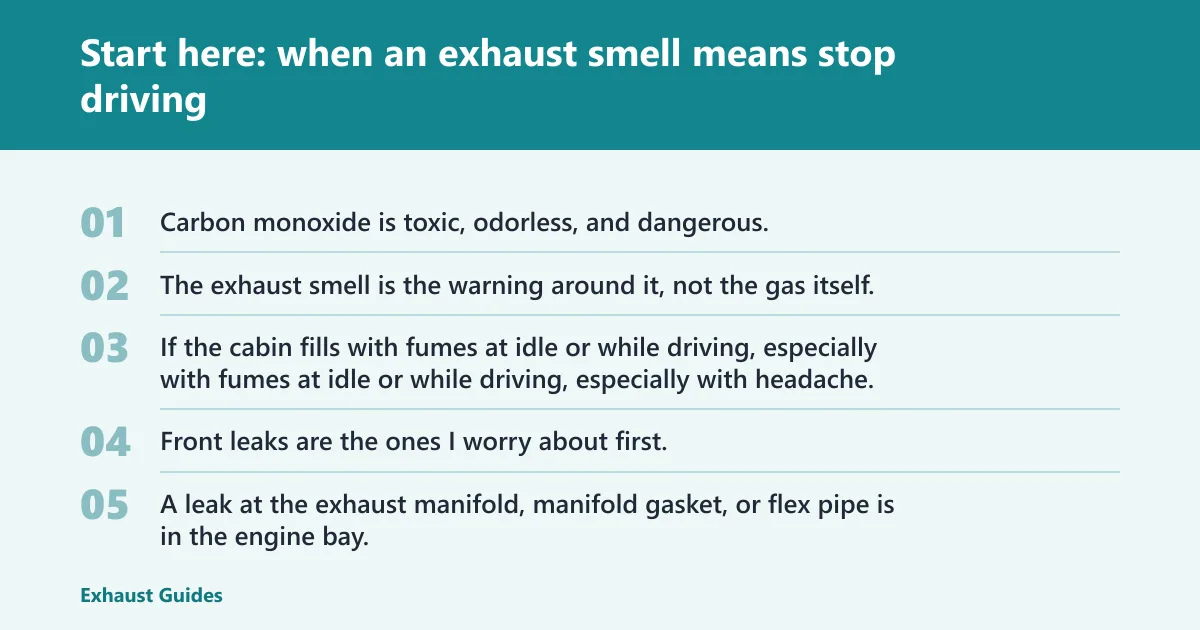
Start here: when an exhaust smell means stop driving

Immediate stop-driving triggers
Carbon monoxide is toxic, odorless, and dangerous. The exhaust smell is the warning around it, not the gas itself. If the cabin fills with fumes at idle or while driving, especially with headache, dizziness, nausea, eye irritation, or unusual fatigue, treat that as a tow-home or tow-shop problem.
Front leaks are the ones I worry about first. A leak at the exhaust manifold, manifold gasket, or flex pipe is in the engine bay, close to the HVAC fresh-air intake, so fumes may get inside quickly. VehicleRuns says cabin exhaust smell plus loud exhaust noise most likely points to an exhaust leak, and it flags a cracked manifold or manifold gasket as the highest-risk fault when the noise is loudest at the front.
Engine-bay leaks versus rear leaks
An exhaust system guides reaction exhaust gases away from controlled combustion inside an engine or stove. In a car, the exhaust system may include an exhaust manifold, turbocharger, catalytic converter, and muffler. A leak near the manifold, front pipe, or flex section can send hot gas up the firewall and across the cowl, where the blower intake may pull it into the cabin. (en.wikipedia.org)
Rear leaks at the muffler or tailpipe are usually less likely to get into the cabin while the vehicle is moving with the windows closed. They still matter when parked, idling, reversing, or driving a hatchback or SUV with rear body leaks, a missing floor plug, or an open liftgate.
Safety triage box
| Situation | Risk level | What to do now |
|---|---|---|
| Cabin fumes with headache, dizziness, or nausea | Stop now | Shut the vehicle off in a safe place, get out, and arrange towing |
| Strong smell at idle with windows up or HVAC on fresh air | Stop now | Suspect manifold, manifold gasket, or flex pipe near the front; do not keep driving to “test” it |
| Smell only outside near the rear tailpipe, no cabin fumes, no noise change | Inspect soon | Check whether it is normal tailpipe odor or a rear leak around the muffler or tailpipe joint |
| Sweet smell, oily smoke, or raw fuel smell rather than exhaust | Varies | Follow the smell-type checks below before blaming the exhaust system |
| Garage smells after parking in an enclosed space | Stop and inspect | Do not idle indoors; indoor generators and furnaces can quickly fill enclosed spaces with poisonous exhaust gases, and vehicle exhaust can also build up in enclosed areas |
What kind of smell is it really?
True exhaust odor versus raw fuel smell
Exhaust odor usually smells spent, hot, and gassy. Raw fuel smells sharper and more like solvent. If the smell is strongest near the fuel rail, injectors, tank area, or during refueling, do not start with the muffler. Start with the fuel system.
A catalytic converter reduces air pollution, so a healthy tailpipe smell is usually less raw than an upstream leak. If the converter is leaking upstream, damaged, or overheated, the odor can turn harsher or sulfur-like.
Exhaust odor versus burning oil
Burning oil usually smells acrid and smoky, and it often comes with a haze from the engine bay after a drive. Valve cover leaks, timing cover leaks, or spilled oil can drip onto a hot manifold or front pipe and mimic an exhaust problem.
The clue is location. If the smell rises from above the manifold and there is wet residue rather than dry black soot, suspect oil first. Exhaust leaks leave soot trails or a puffing sound more often than oily leaks do.
Exhaust odor versus coolant smell
Coolant has a sweet smell. Exhaust does not. If the odor is sweet near the front of the vehicle, or the heater produces a sweet smell with fogging on the inside of the windshield, check for a coolant leak or heater-core issue before chasing the exhaust.
Why does my car smell like exhaust inside?
A car usually smells like exhaust inside because fumes are escaping before the tailpipe and getting pulled into the cabin through the HVAC intake, floor openings, rear body leaks, or pressure changes with windows open. Front leaks at the manifold, manifold gasket, or flex pipe are the first suspects.
Front leaks at the exhaust manifold and manifold gasket
The exhaust manifold is mounted on the engine. It is often a leak source, and it can crack or leak at the gasket where it seals to the cylinder head. Those leaks are often loudest on cold start and can push fumes straight into the engine bay.
The exhaust manifold gasket seals the manifold to the cylinder head. When it fails, ticking or puffing is common, especially just after startup.
Cabin entry paths besides the leak itself
The leak is only half the problem. The other half is the path into the cabin. Missing body plugs, torn shifter boots, rust holes in the floor, damaged hatch seals, and loose rear trim vents can all let fumes in.
Hatchbacks and SUVs can be more sensitive to rear pressure effects. A partly open side window or open liftgate can create a low-pressure zone behind the vehicle and pull rear exhaust forward. Trucks often show the problem through floor penetrations, cab mounts, and worn firewall grommets. Motorcycles route exhaust close to the rider, so the “cabin” symptom becomes fumes on clothing and around the helmet at stops.
Why windows, fan speed, and vent mode change the symptom
If the smell gets worse with the blower on fresh air, that points toward engine-bay fumes reaching the cowl intake. If it eases on recirculate, that is another strong clue. If it gets worse with windows cracked open, suspect cabin pressure pulling fumes from the rear or from under the floor.
Why does my car smell like exhaust when the AC is on?
Exhaust smell that gets worse with the AC or heater on usually means the HVAC fresh-air intake is pulling fumes from the engine bay or cowl area. A manifold, manifold gasket, or flex pipe leak near the front of the vehicle is the most likely source.
HVAC fresh-air intake and cowl airflow
The fresh-air intake is often near the base of the windshield. When the blower runs, it can draw in whatever is pooling in that area. Engine-bay leaks that barely smell outside the vehicle can become obvious inside with the fan on.
This is why people misread the symptom as an AC problem. The AC is not making exhaust. It is moving air past a leak path.
Fresh air versus recirculate
Switching from fresh air to recirculate is a quick triage step. If the smell drops sharply, look near the manifold, manifold gasket, front pipe, and flex pipe. If the smell stays strong on recirculate, inspect for cabin floor leaks, body openings, or a rear leak being pulled in through the back of the vehicle.
Why is the exhaust smell worse after cold start?
Exhaust smell is often worse after cold start because metal joints and gaskets seal less tightly before heat expands them, and the leak is loudest then. The usual pattern is a ticking or puffing sound at the front that fades as the manifold and gasket warm up.
Cold metal gaps and manifold behavior
Small cracks in the exhaust manifold and minor gasket failures often show up most clearly in the first minute or two. The leak may quiet down later, but that does not make it safe. It only means heat changed the gap.
Condensation can mislead the diagnosis
White vapor from the tailpipe on a cold morning can be normal condensation. That is different from exhaust odor inside the cabin or from soot around the manifold area. Use smell location and sound, not visible vapor alone.
Why does my car smell like exhaust in winter?
Winter makes exhaust smells more obvious because cold starts stress manifold gaskets, short trips keep the system cooler, and dense air can hold fumes around the vehicle longer. Heater use also raises the odds that the HVAC intake will pull engine-bay fumes into the cabin.
Short trips and seasonal patterns
In winter, many vehicles never stay hot for long. That keeps a marginal manifold gasket leak in its noisiest phase more often. Rain and slush also speed corrosion at flanges, flex pipes, and rear muffler seams.
Cabin pressure changes in cold weather
Closed windows, heater blower use, and snow-clogged drains or body vents can alter cabin airflow. If the smell appears only with the heater on and fades on recirculate, inspect the cowl intake area and the front exhaust path first.
Why does my garage smell like exhaust after parking?
A garage can smell like exhaust after parking because residual fumes drift off the tailpipe and underbody, and enclosed air holds them longer. If the odor is unusually strong or lingers well after shutdown, suspect a leak under the floor, at the rear section, or near the front.
Residual exhaust versus an active leak
Some tailpipe odor right after a hot shutdown is normal. The tailpipe is the final exhaust outlet, so it is the reference point for normal outside odor. A smell concentrated under the middle of the vehicle or near a wheelbase joint points more toward a leak.
The exhaust pipe must be heat-resistant and kept away from anything that can burn. If a leak is blowing hot gas at underbody insulation, plastic shields, or cargo-floor material, garage odor and heat damage can rise together.
Enclosed-space urgency
Never use a garage smell as a reason to idle longer for diagnosis. Enclosed spaces trap fumes. That changes a mild outside smell into a safety issue quickly.
Use this diagnostic matrix to match smell, timing, and leak point
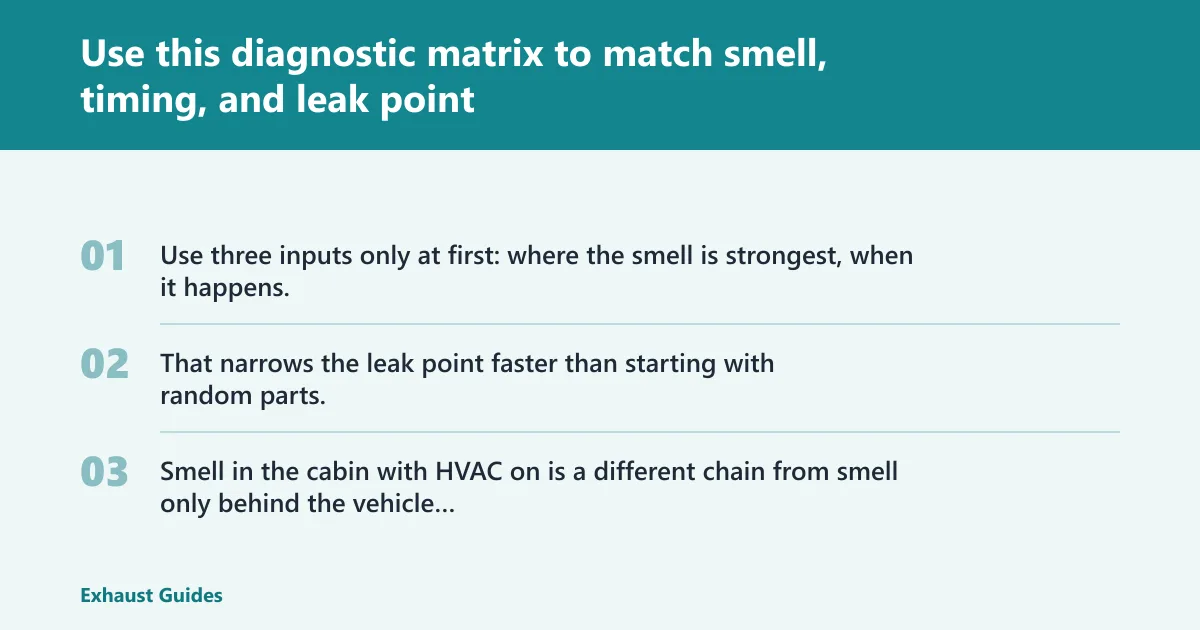
One-page diagnostic matrix
| Smell location | When it appears | Likely failure point | Urgency | First inspection step |
|---|---|---|---|---|
| Cabin, strongest with fan on fresh air | Idle, cold start, stoplights | Exhaust manifold crack or exhaust manifold gasket leak | Stop driving | Look for soot and listen for ticking or puffing at the cylinder head/manifold area |
| Cabin floor area or front footwells | Idle and acceleration | Flex pipe split or front-pipe flange leak | Stop driving | Inspect the braided flex section and nearby joints for cracks, soot, or loose flanges |
| Outside near engine bay | Worse on cold start, then fades | Manifold gasket leak | High | Check for black soot near the head-to-manifold joint |
| Under middle of vehicle | Cruise or acceleration | Catalytic converter inlet leak, mid-pipe leak, or flange failure | High | Inspect joints near the converter for soot and heat-stained leakage marks |
| Rotten-egg or sulfur-like odor | After hard driving or with a misfire/check-engine light | Catalytic converter overheating, damage, or fuel-control problem | High | Scan for engine faults and inspect for an upstream leak feeding the converter |
| Rear of vehicle only | After parking or while reversing | Muffler / silencer rust-through or tailpipe joint leak | Medium | Check muffler seams, hangers, and tailpipe connection for holes or separation |
| Cabin in hatchback or SUV | Windows cracked or liftgate open | Rear exhaust re-entry through hatch seal or body vent leak | High | Close rear openings, inspect hatch seals and body vents, then check rear exhaust routing |
| Rider clothing or helmet area on motorcycle | Stops and low speed | Header leak or routing close to rider | High | Inspect header joints and collector area for soot and loose fasteners |
How to read the matrix
Use three inputs only at first: where the smell is strongest, when it happens, and what the airflow is doing. That narrows the leak point faster than starting with random parts. Smell in the cabin with HVAC on is a different chain from smell only behind the vehicle after parking.
Most likely failure points, from front to rear
Exhaust manifold and exhaust manifold gasket
This is the highest-priority area. The manifold sits at the engine and handles the hottest flow. Cracks happen. Gaskets fail. Broken studs make both problems worse and can turn a simple gasket job into extraction work.
Typical clues are front-of-engine ticking, a puffing sound, soot near the head, and fumes that worsen on cold start or with the blower on fresh air.
Flex pipe and front-pipe joints near the catalytic converter
The flex pipe is the vibration-coping section of the front exhaust. It is a common front exhaust leak point, and it cracks or splits with age. These leaks often smell at idle and get noisier under load.
Nearby flanges and slip joints also fail. A catalytic converter itself may not be the leak, but the joint ahead of it often is. If the converter is restricted or damaged, heat and odor patterns can change, and a check-engine light may appear.
Catalytic converter, mid-pipe, muffler, and tailpipe
A failing catalytic converter can produce unusual odor, heat, rattling, or power loss. A leak upstream of it often smells stronger than a leak behind it because the gases are hotter and less treated.
The muffler, called a silencer in the UK and India, is the rear noise-control unit. Rust-through, seam separation, and failed hangers are common here. Rear leaks are often easier to hear than to smell in the cabin, unless the vehicle is parked, reversing, or prone to rear fume re-entry.
Some trucks use a vertical exhaust pipe. That changes odor location outside the cab, but floor leaks, cab mounts, and firewall penetrations can still let fumes inside.
How to inspect in the right order without chasing the wrong smell
Start with location, timing, and sound
- Decide whether the smell is in the cabin, engine bay, under the floor, or only at the tailpipe.
- Note when it appears: cold start, idle, acceleration, highway speed, windows open, HVAC on, or after parking.
- Listen for ticking, puffing, rattling, or a new loud exhaust note.
- Switch HVAC from fresh air to recirculate and see whether the smell changes.
- Inspect for soot, rust-through, cracked flex sections, loose flanges, and failed hangers once the system is cool.
What to look for
Dry black soot at a joint is a better leak clue than surface rust alone. Focus on the manifold area, the flex pipe braid, catalytic converter inlet and outlet flanges, and muffler seams. A loose hanger can also stress a joint and create a leak one section ahead of where the movement is obvious.
Do not crawl under a poorly supported vehicle. Do not touch hot exhaust parts. If the leak is hard to find from above and from the side, a smoke test or lift inspection usually saves time.
When scan data matters
If the smell comes with a check-engine light, misfire, fuel-trim codes, or converter-efficiency codes, the exhaust odor may be part leak and part running problem. Rich running can overwork the converter and change the smell even when the pipe itself is still mostly intact.
What the repair usually involves and what drives cost
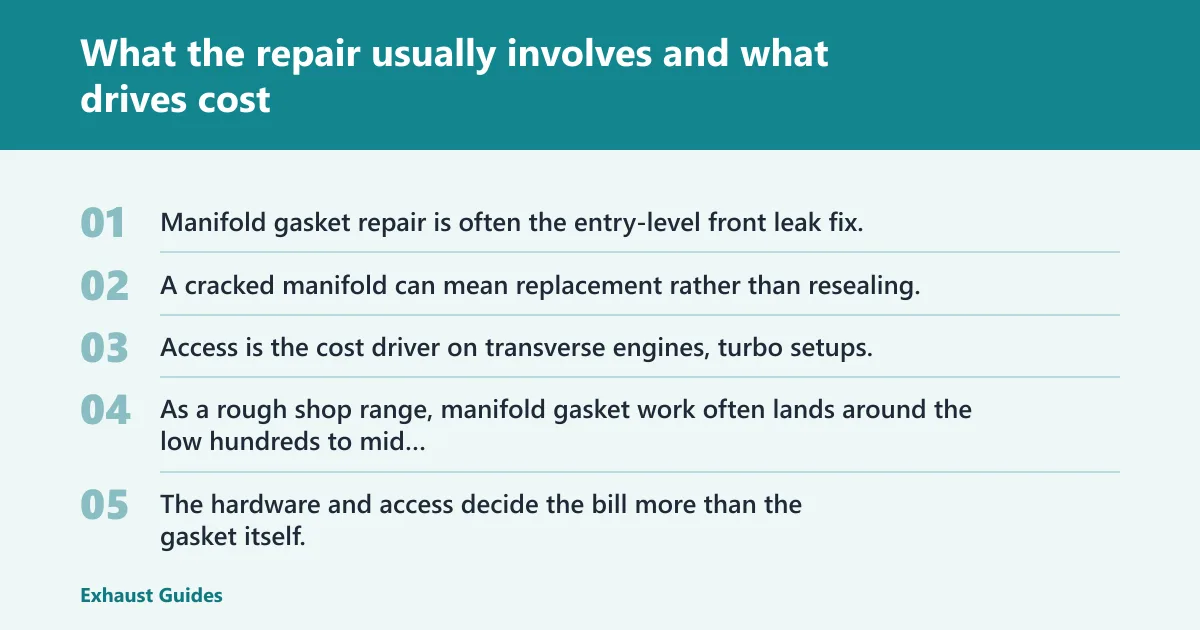
Front leaks: manifold gasket, cracked manifold, broken studs
Manifold gasket repair is often the entry-level front leak fix, but labor rises fast when studs seize or snap. A cracked manifold can mean replacement rather than resealing. Access is the cost driver on transverse engines, turbo setups, and vehicles with tight firewall clearance.
As a rough shop range, manifold gasket work often lands around the low hundreds to mid hundreds in easier layouts, while a cracked manifold with broken hardware can move into the high hundreds or more. The hardware and access decide the bill more than the gasket itself.
Flex pipe, flange, and converter-adjacent repairs
Flex pipe repairs vary by design. Some shops weld in a section; others replace a larger front pipe assembly. Flange leaks may need only hardware and a gasket, or they may need cutting if the flange is too far gone.
In practice, a simple flange reseal is usually one of the cheaper fixes. Flex pipe replacement tends to sit above that. Catalytic-converter-adjacent repairs jump in cost when the converter shell, heat shields, or sensor threads are damaged. Federal catalytic converters are described as EPA compliant, while California converters are designed to meet California emissions standards, so the exact replacement path can change parts cost.
Muffler, rear section, hanger, and clamp repairs
Rear section repairs are usually simpler to access. A clamp, hanger, or short rear pipe section is often a smaller bill than a front leak. A rusted muffler replacement can still add up if adjoining pipes break during disassembly.
Direct-fit kits can lower labor when the system is badly rusted from the middle back. BRExhaust offers direct-fit replacement exhaust systems and kits that meet or exceed OEM fitment standards. BRExhaust kits include every essential pipe, clamp, gasket, and mounting component, and the brand says its systems eliminate cutting, welding, or custom fabrication. Those kit-style replacements make the most sense when several rear sections are already weak.
Frequently asked questions
What causes exhaust smell in the cabin?
Cabin exhaust smell usually comes from a leak before the tailpipe plus a path into the vehicle. The usual pair is a front leak at the manifold, manifold gasket, or flex pipe and airflow through the HVAC intake, floor opening, hatch seal, or rear body vent.
How do I tell exhaust smell from a coolant leak?
Coolant smells sweet and often shows up with damp residue, heater fogging, or a low coolant level. Exhaust smells hot and gassy, often with soot or ticking at a joint. If the smell is strongest with the heater on, check both the heater core and front exhaust path.
How do I tell exhaust smell from an oil leak?
Burning oil smells sharper and smokier than exhaust and often leaves wet residue above the hot exhaust part it lands on. Exhaust leaks leave dry black soot, ticking, or puffing. If the smell rises from the top of the engine, inspect oil leaks before blaming the muffler.
How do I tell exhaust smell from a gas leak?
Gasoline smell is more raw and solvent-like, and it often appears near the tank, filler neck, fuel lines, or engine fuel rail. Exhaust smell is spent combustion odor and usually gets stronger near exhaust joints or with blower airflow changes. Raw fuel smell is a stop-and-inspect issue too.
Is it safe to drive if I smell exhaust inside the car?
No, not until the source is known. Cabin fumes mean exhaust is reaching the passenger area, and carbon monoxide exposure is the main risk even though carbon monoxide itself has no smell. If the odor appears at idle with windows up, or symptoms start, stop driving.
Why is the exhaust smell worse after cold start?
Cold start makes small leaks show themselves because the manifold, gasket, and front joints have not expanded yet. That is why ticking and odor are often strongest in the first moments after startup. A leak that fades warm still needs repair because the path remains there.