
How to Find a Leaking Catalytic Converter Flange
A leaking catalytic converter flange usually shows up as a sharp tick or puffing near the joint, soot around the gasket or bolt ears, and an exhaust smell that changes with engine speed. A blocked converter more often causes weak power and high backpressure, not a visible flange leak. Miss it, and you can chase the wrong fault, replace good parts, or cook nearby seals and sensors. This guide shows how to separate flange leaks from clogged-converter symptoms and nearby exhaust faults.
Catalytic converter flange leak signs
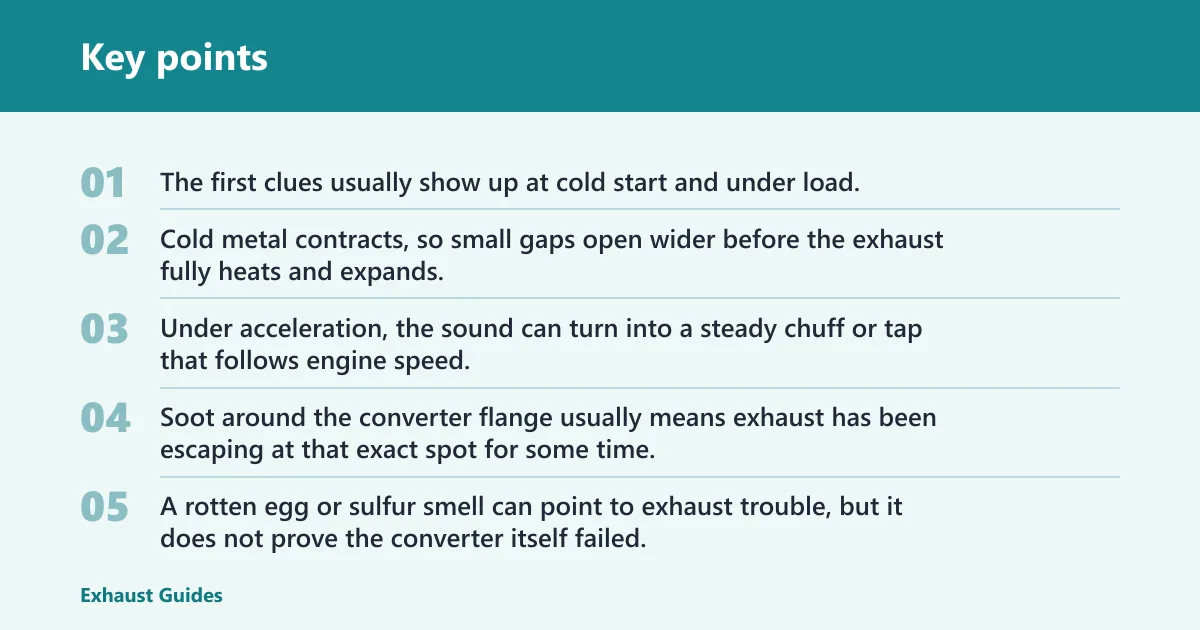


The first clues usually show up at cold start and under load. A flange leak often ticks when exhaust pulses escape through a small gap, then gets louder when the engine loads up and exhaust flow rises. A clogged converter usually does the opposite: it dulls power, raises backpressure, and resists flow rather than letting gas escape at a joint.
Check the flange gasket, studs, nuts, springs, welds, and pipe ends for soot, rust tracks, or a black line across the seam. If the smell appears in the cabin at idle or after deceleration, the leak may be close enough for fumes to enter through floor seams or HVAC intake paths.
Cold-start ticking and under-load noise
Cold metal contracts, so small gaps open wider before the exhaust fully heats and expands. That is why a flange leak often makes a sharper tick or puffing sound right after startup, then changes as the joint warms. Under acceleration, the sound can turn into a steady chuff or tap that follows engine speed.
Soot, odor, and check engine light clues
Soot around the converter flange usually means exhaust has been escaping at that exact spot for some time. A rotten egg or sulfur smell can point to exhaust trouble, but it does not prove the converter itself failed. The check engine light may appear if the leak distorts oxygen sensor readings or catalyst monitoring.
How leak symptoms differ from restriction symptoms
A flange leak tends to announce itself with noise, soot, and fumes. A clogged converter tends to announce itself with loss of power, slower acceleration, and higher exhaust restriction. If the car feels weak at highway speed and the noise does not change much at the flange, focus on restriction checks before replacing the converter.
What a catalytic converter flange leak means
The catalytic converter sits in the exhaust system between the engine and the muffler. The flange is the connection point between exhaust sections, and it may be upstream of the converter or at the outlet depending on vehicle design. That joint may use a flange gasket, studs, nuts, or springs to clamp two mating surfaces together.
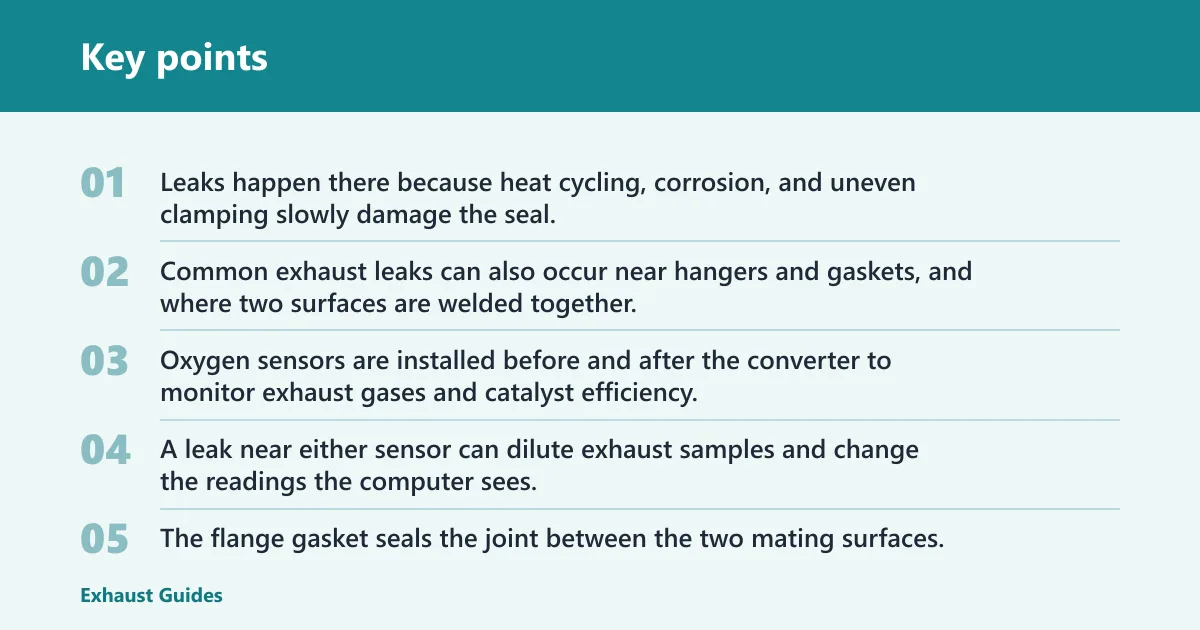
Leaks happen there because heat cycling, corrosion, and uneven clamping slowly damage the seal. Common exhaust leaks can also occur near hangers and gaskets, and where two surfaces are welded together. A leak near the converter can mislead diagnosis because the converter itself may still be intact while the joint around it is not.
Oxygen sensors are installed before and after the converter to monitor exhaust gases and catalyst efficiency. A leak near either sensor can dilute exhaust samples and change the readings the computer sees. That is one reason a leak at the flange can trigger efficiency-related codes without proving the converter is bad.
Why gaskets and hardware fail
The flange gasket seals the joint between the two mating surfaces. Once corrosion starts on the flange faces, or the bolts lose clamp force, the gasket may stop sealing evenly. Springs, nuts, and studs can also stretch, seize, or corrode until the joint no longer holds pressure.
How nearby sensors can be affected
A leak upstream of the converter can pull in outside air and make the upstream sensor look leaner than it should. A leak downstream can change what the downstream sensor sees and confuse catalyst monitoring. A leak near the sensors can make the data look inconsistent even when the converter core itself is still intact.
How do you find the leak?
Start with the joint itself. A leaking catalytic converter flange is often found by inspection, sound, and flow clues rather than by swapping parts. Use a cold-start listen, a close visual check, and a smoke test if the leak is too small to hear at idle. Do not rely on a cold engine with no exhaust flow for a bubble test.
-
Inspect the joint closely.
Look at the flange gasket, studs, nuts, springs, welds, and pipe ends for soot, rust trails, or a black line across the seam. If the leak is near the converter outlet, check the downstream joint as well, because the leak path can sit on either side depending on the vehicle. -
Listen at cold start.
Start the engine from cold and stay clear of moving parts. A sharp tick or puffing sound that fades as the metal warms points to a small flange leak more than a clogged converter. -
Use smoke for small leaks.
If the leak is hard to hear, use a smoke test with the exhaust sealed in the normal diagnostic setup. Smoke can reveal a gap that only opens under pressure, especially around a warped flange face or a failed gasket. -
Check soot and escaping gas.
With the engine running, look for soot movement, a pulsing paper strip, or a faint gas stream at the joint. A glove can help you feel the pulse near the seam, but keep hands away from hot parts and belts.
A sedan may tick for about the first 20 seconds after startup, then quiet down. If soot is visible on the lower edge of the converter flange, the gasket or clamp load is a better suspect than the converter core. The pattern fits a seal issue, not a plugged honeycomb substrate.
Suppose a truck smells of exhaust in the cabin only while climbing a hill. That load-sensitive odor, plus a dark ring around the flange, points to a joint leak that opens wider when exhaust pressure rises. A clogged converter would be more likely to flatten power than send soot to the joint.
Visual inspection at the joint
Use a light and inspect both sides of the flange, not just the visible face. Check for missing hardware, bent ears, corrosion under the washer, and cracks where the pipe meets the flange. If the vehicle uses springs, confirm they are present and seated evenly.
Cold-start listening check
Cold start matters because small leaks are easier to hear before heat expansion seals part of the gap. Listen near the converter flange, then move upstream and downstream to separate the flange noise from a manifold gasket, flex joint, or Y-pipe connection. The sound should localize to one point.
Smoke test for small leaks
A smoke test is useful when the leak is too minor to hear at idle. It can show smoke at the flange gasket, a cracked pipe end, or a split weld. Do not treat smoke at a nearby sensor bung as proof of a flange leak until you trace the exact escape point.
Safe on-car checks for soot and escaping gas
With the engine running and the exhaust still cold enough to approach safely, check for pulsing soot or a faint gas stream at the seam. A small strip of paper can move with escaping exhaust and help localize the joint. Use caution around hot pipes, spinning fans, and sharp heat shield edges.
What sounds and smells point to the flange?
A flange leak usually sounds like a sharp tick, tapping, or puffing from one fixed spot. A heat shield rattle sounds lighter and more metallic, and it often changes when the shield is tapped by hand or when engine speed changes. Smell matters too: an exhaust odor that grows with throttle points closer to a leak path than to a loose panel.
Ticking versus puffing at the joint
A small gap often makes a tick at idle because each exhaust pulse escapes in short bursts. A larger gap or cracked pipe end can turn that into a puffing sound. If the noise stops when pressure drops but returns under load, the joint is a stronger suspect than the converter core.
Cabin odor and exterior exhaust smell
If exhaust odor enters the cabin, the leak may be close enough to draw fumes into the body shell or HVAC intake. If the smell stays outside, the leak can still be real, but the joint may be farther from the cabin opening. Either way, odor tracks exhaust flow, not converter efficiency by itself.
Heat shield rattle and nearby false leads
Loose shields can rattle beside the converter and sound like a leak. Flex joints can hiss or buzz, and Y-pipe connections can mimic a flange fault. Check each nearby part before replacing the converter flange, because the noise source may be within inches of the joint but not at the gasket.
Catalytic converter leak decision table
This table separates common symptoms from likely flange locations, then points to a confirming test and the next repair step. Use it as a branch guide before replacing the converter.
| Symptom | Likely flange leak location | Confirming test | Next repair step |
|---|---|---|---|
| Cold-start ticking near the converter | Flange gasket or warped flange face | Cold-start listen plus soot check at the seam | Replace the gasket if the faces are flat; replace the flange section if the faces are warped |
| Soot trail on one side of the joint | Loose studs, nuts, or springs | Inspect clamp load and hardware alignment | Tighten to spec if the hardware is reusable; replace corroded hardware if it will not hold tension |
| Exhaust smell in the cabin | Cracked pipe end near the flange | Smoke test at the connection and adjacent weld | Repair or replace the cracked pipe section before rechecking the joint |
| P0420 risk with no visible converter damage | Leak near upstream or downstream sensor | Compare sensor readings and inspect for escaping gas near the bung | Fix the leak first, then retest before replacing the converter |
| Under-load noise with weak power | Joint leak or restricted converter | Check for soot and perform a restriction check | If soot is present, repair the joint; if power loss and backpressure point to restriction, move to converter diagnosis |
| Visible soot and a flat sealing face | Flange gasket | Inspect the gasket imprint and the seam after cold start | Replace the gasket if the flange faces are flat and undamaged |
| Uneven clamp marks or hardware that will not hold tension | Hardware | Check studs, nuts, and springs for seizure, stretch, or corrosion | Replace the damaged hardware before retesting the joint |
| Leak persists after a new gasket and sound hardware | Flange warpage | Trace the seam for uneven contact or repeat leak at the same edge | Repair or replace the warped flange section |
| Leak tracks from the pipe end or adjacent weld | Cracked pipe | Smoke test the pipe end and weld line | Repair or replace the cracked pipe section |
Flange gasket, hardware, or warped flange?
The right repair depends on what failed. A bad gasket usually leaves soot and a clear leak path at the seam. Corroded hardware usually shows uneven clamp force or missing spring tension. A warped flange face may keep leaking even after new hardware and a fresh gasket are installed.
-
Judge the gasket first.
If soot centers on the seam and the flange faces look flat, replace the gasket. Heat cycling and corrosion can harden the seal until it no longer conforms to the joint. -
Inspect the hardware next.
Check studs, nuts, and springs for rust, stretch, or seizure. If the hardware cannot hold even clamp force, replace it instead of reusing it. -
Check the flange face and pipe end.
If the gasket and hardware look sound but the leak persists, the flange face may be warped or the pipe end may be cracked. In that case, section repair or replacement is more effective than another gasket.
Gasket failure signs
A failed flange gasket often leaves a clean soot halo around one edge of the joint. The leak can appear only when the engine is cold or under load, because the seal opens and closes with temperature and pressure changes. If the faces are still even, a new gasket may solve it.
Loose, corroded, or stretched hardware
Hardware problems show up as uneven clamp marks, rusted threads, or a joint that will not stay tight. Springs can lose tension, and nuts can seize before they reach proper clamp force. In that case, replacing hardware is smarter than tightening damaged parts again.
Warped flange faces and cracked pipe ends
Warped faces prevent the gasket from sealing evenly, even with fresh hardware. Cracks near welds or pipe ends can open only when the pipe vibrates or expands. If the leak remains after a proper hardware check, the flange section itself is likely the repair target.
Can a leak set a check engine light?
Yes. A how to diagnose a bad catalytic converter at home can trigger a check engine light if it changes oxygen sensor readings or confuses catalyst monitoring. That light does not prove the converter itself failed. It may mean the leak is upstream of the sensor, downstream of the converter, or close enough to distort the signal.
Leaks near the converter can also contribute to efficiency-related codes such as P0420. The computer expects a certain relationship between upstream and downstream sensor signals, and escaping exhaust can skew that relationship. Fix the leak first, then retest before replacing the converter.
Why P0420 can appear with a flange leak
P0420 means the system sees poor catalyst efficiency, but a leak can create false evidence of that problem. If outside air enters near the flange, the downstream sensor may read in a way that looks like low catalyst performance. That is why a leak check comes before converter replacement.
How oxygen sensor readings get distorted
OEM service information and major service manuals describe the upstream sensor as a rapidly switching feedback signal and the downstream sensor as a steadier catalyst monitor. A leak can dilute exhaust or pull in outside air, which changes those signals and can make the computer misread catalyst behavior even when the converter core is still intact.
When the converter is more likely at fault
If the joint is sealed, the hardware is sound, and restriction symptoms still show up, then the converter itself moves higher on the suspect list. A clogged converter more often creates weak power, poor acceleration, and higher exhaust restriction. A vacuum gauge or pressure-based restriction check should point away from a healthy converter and toward a blocked one before replacement.
Frequently asked questions
How do I find a leaking catalytic converter flange?
Start with a cold-start listen, then inspect the gasket, studs, nuts, springs, and welds for soot or rust streaks. If the leak is small, use a smoke test to find the escape point. A sharp tick at one joint is more consistent with a flange leak than with a clogged converter.
What does a catalytic converter flange leak sound like?
It usually sounds like a sharp tick, tap, or puffing from one fixed spot near the joint. The sound often grows with engine speed and load, then fades as the exhaust heats and expands. A shield rattle is lighter and more metallic, so do not confuse the two.
Can a catalytic converter flange leak cause a check engine light?
Yes. A leak near the converter can change oxygen sensor readings and trigger efficiency-related codes, including P0420. The warning light does not prove the converter is bad by itself. Check the flange, gasket, and nearby sensor bungs before condemning the converter.
How do I check for an exhaust leak without a smoke machine?
Use a cold-start listening check, then inspect for soot around the joint while the engine is running. A small strip of paper can help detect pulsing gas at the seam. That is safer and more useful than spraying liquid on an exhaust that is not under diagnostic flow.
Is it safe to drive with a leaking catalytic converter flange?
Short trips may be possible, but it is not a good idea to ignore it. Exhaust fumes can enter the cabin, nearby sensors can read wrong, and hot gas can damage adjacent parts. Fix the leak soon, especially if the smell is strong or the check engine light is on.
What causes catalytic converter flange bolts to leak?
Rust, heat cycling, and stretched or seized hardware are common causes. When studs, nuts, or springs lose clamp force, the gasket cannot seal evenly. The result is a leak at the joint, often with soot on one side and a tick that changes with engine speed.
How do I tell if the flange gasket is bad or the converter is clogged?
A bad gasket usually makes noise, soot, and smell at the joint. A clogged converter usually causes weak power, poor acceleration, and higher backpressure. If the joint is sealed and the power loss remains, move to restriction testing before replacing the converter. If the leak is visible, repair the flange first.
What should I check first for safety?
Let the exhaust cool enough to inspect without touching hot surfaces, and keep clear of fans, belts, and sharp heat shields. Work in a ventilated area, because exhaust leaks can put fumes where you do not expect them. If the car is on stands, confirm it is stable before you reach under it.