How to Diagnose a Bad Catalytic Converter at Home
Diagnose a bad catalytic converter at home by checking engine misfires, fuel trim, and oxygen-sensor behavior first; if upstream and downstream O2 sensors switch in a similar pattern after the engine is hot, the converter is likely failing. If you chase the wrong fault, you can spend money on a converter that does not fix the check engine light or the drivability problem. This guide lays out a safe step-by-step test plan, common lookalike faults, and when replacement is actually justified.
What a bad catalytic converter looks like


A catalytic converter is an exhaust emissions control device. EPA and CARB describe its job as converting harmful exhaust gases into less harmful substances, which is why a failed converter can affect both drivability and emissions compliance. When it fails, it can clog, crack, melt, or lose efficiency. The check engine light often comes on first, but by itself it proves nothing.
Common clues include slow acceleration, a rotten egg or sulfur odor, rough idle, rattling under the vehicle, and emissions inspection failure in states that test exhaust output. A clogged converter can also raise exhaust backpressure and lead to power loss or stalling. Keep in mind that OEM service information and major scan-tool guidance treat P0420 and P0430 as catalyst-efficiency codes that require confirmation with live-data patterns, fuel trims, misfire checks, and leak inspection before replacement.
What you’ll need
- OBD2 scan tool that can read stored codes and live data
- Basic hand tools for heat shields or underbody inspection
- Flashlight
- Gloves
- Level work surface
- Wheel chocks
- Safety glasses
Symptoms
The most useful symptom clusters are loss of power under load, a sulfur smell, rough idle, rattling from the converter area, and a check engine light with catalyst-efficiency codes. A single symptom is not enough. The strongest home-diagnosis clue is when drivability symptoms line up with OBD2 data and appear after the engine is fully warm.
What the symptoms usually mean
- Loss of power that gets worse with speed or load can point to restriction.
- Sulfur or rotten egg odor can mean the converter is overheating or not treating exhaust properly.
- Rattling can indicate a broken substrate inside the converter.
- Rough idle with misfire codes often means the converter is being damaged by an upstream engine problem.
Tools
You do not need specialized lab equipment to sort the most common lookalikes. You do need a scan tool with live data, enough access to inspect the exhaust safely, and a way to compare sensor behavior after the engine reaches closed loop.
What the scan tool should show
- Stored and pending codes
- Freeze frame data
- Fuel trims
- Upstream and downstream oxygen sensor data
- Engine coolant temperature
Step-by-step workflow
Start with codes and live data, then check the causes that commonly imitate converter failure. P0420 and P0430 are catalyst-efficiency flags, not automatic proof of a bad converter. The safest workflow is to verify misfires, leaks, and fuel-control problems before condemning the part.
Step 1: Confirm the symptom pattern with the engine fully warm
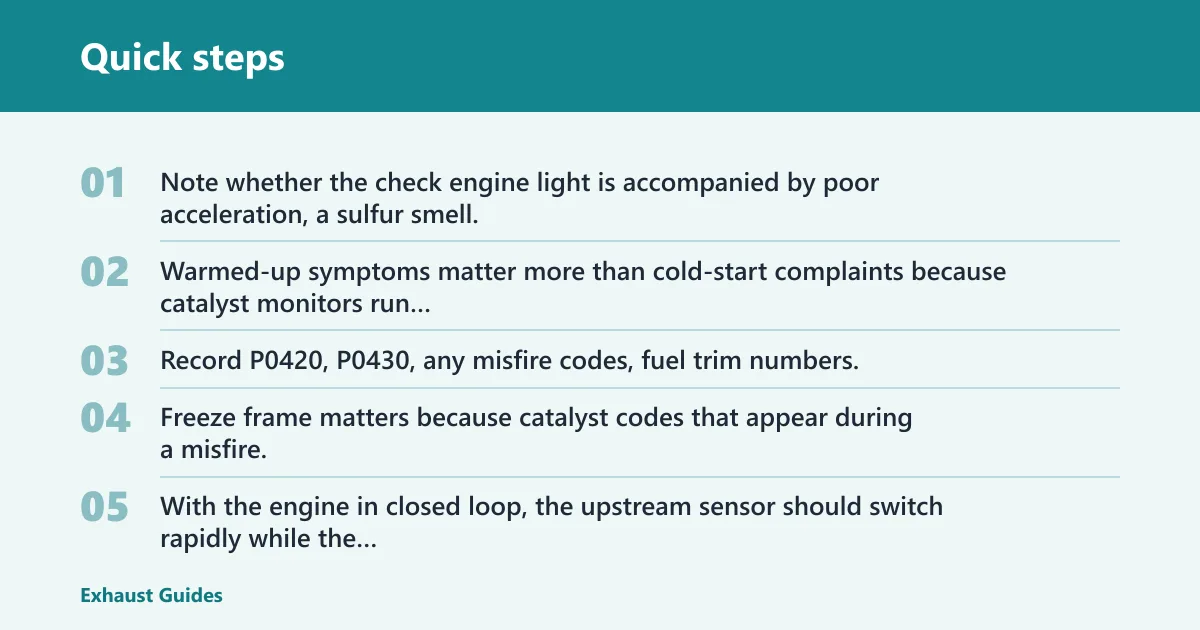
Note whether the check engine light is accompanied by poor acceleration, a sulfur smell, rough idle, or stalling. Warmed-up symptoms matter more than cold-start complaints because catalyst monitors run only after the engine reaches the proper operating conditions.
Step 2: Read codes and freeze frame data
Record P0420, P0430, any misfire codes, fuel trim numbers, and engine temperature at the moment the code set. Freeze frame matters because catalyst codes that appear during a misfire, a rich condition, or heavy load are less trustworthy as direct proof of converter failure.
Step 3: Compare upstream and downstream oxygen sensor behavior
With the engine in closed loop, the upstream sensor should switch rapidly while the downstream sensor should generally be steadier if the converter is working. If both sensors switch in a similar pattern once hot, suspicion rises for a failed converter, a downstream sensor problem, or an exhaust leak. Reputable diagnostics sources and OEM-style service logic both use this pattern as a key divider between catalyst failure and sensor noise.
Step 4: Look for misfire, fuel-trim, and leak clues before replacing parts
A misfire can send raw fuel into the converter and overheat it. A rich-running engine can do the same. An exhaust leak ahead of the converter can pull in outside air and distort oxygen-sensor readings. Any of these can create a false catalyst code and should be corrected first.
Step 5: Judge whether restriction is becoming dangerous
Strong power loss, repeated stalling, or severe heat near the converter points toward restriction. If the car starts normally but loses power as load rises, do not keep driving long enough to “see what happens.”
Clogged-converter checks
A clogged converter creates backpressure, which can cause power loss, sluggish acceleration, and possible stalling. That is the home test that matters most here. If the engine starts normally but loses power as load rises, or stalls after warming up, do not keep driving long enough to “see what happens.”
Restriction-focused branch
- Warm the engine and note whether the power loss grows worse under load.
- Check the exhaust area for extreme heat, discoloration, or a rotten egg smell.
- Use the scan tool to compare fuel trims at idle and at 2,000 to 2,500 rpm.
- Look for misfire codes before blaming the converter.
- If the car stalls, bucks under light throttle, or the underbody area smells very hot, stop driving and arrange professional confirmation.
A clogged converter can fail from melting or from broken internal material that shifts and blocks flow. Home checks can point to the restriction, but they cannot measure backpressure directly without the right tool. If the substrate has softened or collapsed, heat damage may also be visible through discoloration or a rattling shell when the system cools.
Bad converter or O2 sensor?
Use concrete live-data differences to separate these faults. The key question is not simply whether a catalyst code is present; it is whether the upstream sensor is active, the downstream sensor is artificially mimicking it, and whether the code survives after fixing other engine problems first.
What the sensor patterns should look like
After closed loop begins, the upstream O2 sensor should switch rapidly as the engine management system corrects air-fuel ratio. The downstream sensor should usually be smoother and less active if the converter is storing oxygen and doing its job. If the downstream sensor switches almost like the upstream sensor after the engine is hot, that suggests low catalyst efficiency or a bad sensor signal on the downstream side.
What to do after fixing misfires first
If a misfire or rich condition is present, repair that issue before judging the converter. Clear the codes, complete a drive cycle, and rescan. If P0420 or P0430 returns only after the engine runs cleanly, the converter becomes a much stronger suspect. If the code disappears, the converter may have been reacting to an upstream fault rather than causing the problem.
Exhaust leak clues that weaken the catalyst code
An exhaust leak ahead of the converter can introduce extra oxygen and make the upstream/downstream comparison misleading. Listen for ticking on cold start, inspect gasket joints and flange areas, and look for soot around connections. If you find a leak upstream of the converter, repair that first before trusting the catalyst code.
Freeze frame conditions that make P0420 or P0430 less trustworthy
These codes are less convincing when the freeze frame shows a misfire, rich fuel trims, low coolant temperature, or heavy load right before the code set. In those cases, the catalyst may be the victim rather than the root cause. A steady cruise freeze frame with no misfire and normal fuel trims makes a true catalyst fault more believable.
Decision table
This decision table maps common symptom clusters to the most likely cause, a home test, what the result means, and whether to stop driving. Use it to sort the fault before buying parts.
| Symptom | Confidence level | Likely root cause | Exact scan-tool pattern | Home test | Next step | Stop driving threshold |
|---|---|---|---|---|---|---|
| Check engine light with P0420 or P0430 | Medium | Catalyst efficiency loss, O2 sensor fault, or exhaust leak | Upstream O2 switches rapidly; downstream stays mostly flat if converter is working; similar switching from both sensors after warm-up raises suspicion | Read freeze frame and compare upstream/downstream O2 live data after warm-up | Check for leaks, misfire codes, and downstream sensor faults before replacing the converter | Stop only if power loss, stall, or extreme heat is present |
| Exhaust leak ahead of cat | High | False catalyst code caused by oxygen intrusion | Fuel trims may look odd; downstream pattern can become unreliable; code may set intermittently | Inspect flanges, gaskets, flex joints, and soot marks around the front of the converter | Repair the leak, clear codes, and retest before condemning the converter | Usually no, unless leak is severe or exhaust is entering cabin |
| Lazy downstream O2 sensor | Medium | Sensor aging or wiring issue | Downstream sensor responds slowly, sticks, or mirrors upstream erratically without other restriction signs | Compare the sensor response after closed loop and inspect connector/wiring condition | Verify sensor circuit health before replacing the converter | No, unless drivability is also poor |
| Misfire with catalyst code | High | Misfire causing converter damage | Misfire counters rise; fuel trims may swing; catalyst code appears after misfire activity | Repair the misfire first, then clear codes and retest | Treat the converter as a possible victim, not the first part to replace | Yes, if the misfire is severe or the engine runs rough enough to damage the converter |
| Heat-damaged or melted substrate | High | Overheated converter from misfire, rich running, or prolonged restriction | Power drops under load, converter area gets excessively hot, and the vehicle may stall or feel choked | Inspect for discoloration, rattling, and symptom worsening as load increases | Confirm the upstream cause before replacement so the new converter is not damaged again | Yes, if power loss is severe or the vehicle stalls |
| Rattling from under the vehicle | Medium | Broken internal substrate | Codes may or may not be present; performance may worsen over bumps or at certain rpm | Tap the shell lightly when cool and listen for loose debris | Replace if the substrate is broken and other causes are ruled out | No, but avoid rough roads and long trips |
Emissions inspection
If inspection failure matters in your state, do not assume the light can be ignored. A bad converter can fail emissions inspection even when the car still runs. EPA and state-level emissions programs focus on whether the vehicle’s control systems are working and whether fault codes are present, so a P0420 or P0430 can matter even if the car feels only mildly off.
The practical workflow is straightforward: fix misfires, fuel-control issues, and exhaust leaks first; clear codes; complete the required drive cycle; then rescan before the inspection. If the code returns after the engine has run cleanly, the converter is a stronger candidate for replacement.
When to stop driving
Drive only short distances when the symptom set is light and the engine still pulls normally. If the car has major power loss, stalls, or strong heat near the converter, do not plan a long trip. Backpressure can get worse, and a hot converter can damage nearby parts.
When the only clue is a check engine light with a catalyst code, cautious local driving to a repair bay is usually safer than a long highway run. When the clue set includes stalling, heavy sulfur odor, repeated misfires, or a glowing-hot exhaust area, stop driving and confirm the fault before more damage happens.
FAQ
What codes point to a bad catalytic converter
P0420 and P0430 are the main catalyst-efficiency codes. They point to a problem on the catalyst side of the exhaust system, but they do not prove the converter is the only fault. Use the codes with freeze frame, live O2 data, and fuel trims before buying the part.
Can a bad catalytic converter cause a car to stall?
A clogged converter can raise backpressure enough to cause sluggish acceleration and stalling, especially under load or after the engine heats up. If stalling appears with severe power loss or strong heat from the converter area, avoid driving and get a direct diagnosis.