High Flow Catalytic Converter vs No Cat
For street-driven cars, a high flow catalytic converter is the safer choice. A no cat exhaust is usually for track or off-road use only, and it can create legality and check-engine issues. Under federal EPA tampering rules, removing or defeating emissions equipment on a public-road vehicle is prohibited, and California-style CARB rules require the correct Executive Order identification where applicable (EPA tampering guidance; CARB aftermarket catalytic converter requirements). Run no cat in the wrong place and you can fail inspection, face fines, and deal with tune issues or drone. This guide compares legality, emissions, CEL risk, sound, and power so you can pick the right setup.
| Decision factor | high flow catalytic converter | no cat | Winner |
|---|---|---|---|
| Legality | Can be legal on street cars only when it meets the relevant EPA or CARB requirements and, in CARB states, carries the required EO number. | Usually illegal for street use because it removes emissions control hardware. | high flow catalytic converter |
| Emissions test risk | Lower risk when the catalyst monitor runs ready and the part is compliant; visual inspection can still matter. | High risk of failure from readiness, visual, or tailpipe checks. | high flow catalytic converter |
| Check-engine-light risk | Lower than no cat, but P0420-type faults can still appear if the converter is marginal, the tune is off, or sensors are unhappy. | High risk because the downstream oxygen sensor sees no catalyst function. | high flow catalytic converter |
| Sound and odor | Slightly louder than stock in many setups, with less odor than no cat. | Louder and smellier, with more exhaust drone risk. | high flow catalytic converter |
| Expected power gain | Typical stock naturally aspirated gain is usually about 0-5 hp at the wheels unless the factory converter is a real restriction; mildly tuned NA cars may see a small torque/response improvement. On turbo cars, gains are often roughly 5-20+ hp at the wheels when the factory cat is restrictive, with bigger gains possible only in high-flow, high-boost combinations. | Can reduce restriction the most, but gains are not guaranteed and depend on the rest of the system. | no cat for peak flow, high flow catalytic converter for street-relevant balance |
| Best use case | Street cars, daily drivers, and builds that still need inspections or lower odor. | Track-only or off-road use where local law allows it. | Depends on use case |
| NA vs turbo note | Often the smarter compromise on naturally aspirated cars; useful on turbo cars where the factory cat is a bigger restriction. | More often chosen for maximum flow on turbo builds, but the legal and inspection costs are the same. | high flow catalytic converter on street NA builds; no cat only where legal and purpose-built |
| CEL likelihood by setup | Low to moderate on a well-sized, direct-fit, compliant unit with healthy sensors; moderate to high on marginal fitment, aggressive cams, spacer use, or a tune that keeps catalyst monitors from completing. | High, because the rear O2 sensor usually sees little to no catalyst storage behavior and the ECU interprets that as low catalyst efficiency. | high flow catalytic converter |
| Pass-risk by inspection type | OBD-only: low to moderate if readiness is complete and monitors pass. Visual: low to moderate if the part has proper approval and is visibly present. Tailpipe: low to moderate, depending on engine state and converter quality. | OBD-only: high if catalyst monitor is not ready or fails. Visual: very high because the missing converter is obvious. Tailpipe: very high in most cases because emissions control is removed. | high flow catalytic converter |
Legality
A high flow catalytic converter can be street legal only if it meets the rule set that applies to your car and market. A no cat setup removes emissions control entirely, so it is generally the riskier choice for any road-driven vehicle. Federal EPA guidance treats removal or defeat of emissions controls as tampering on public-road vehicles, and CARB requires the correct approval path and EO identification where its rules apply (EPA tampering rules; CARB EO requirements).
Federal EPA rules
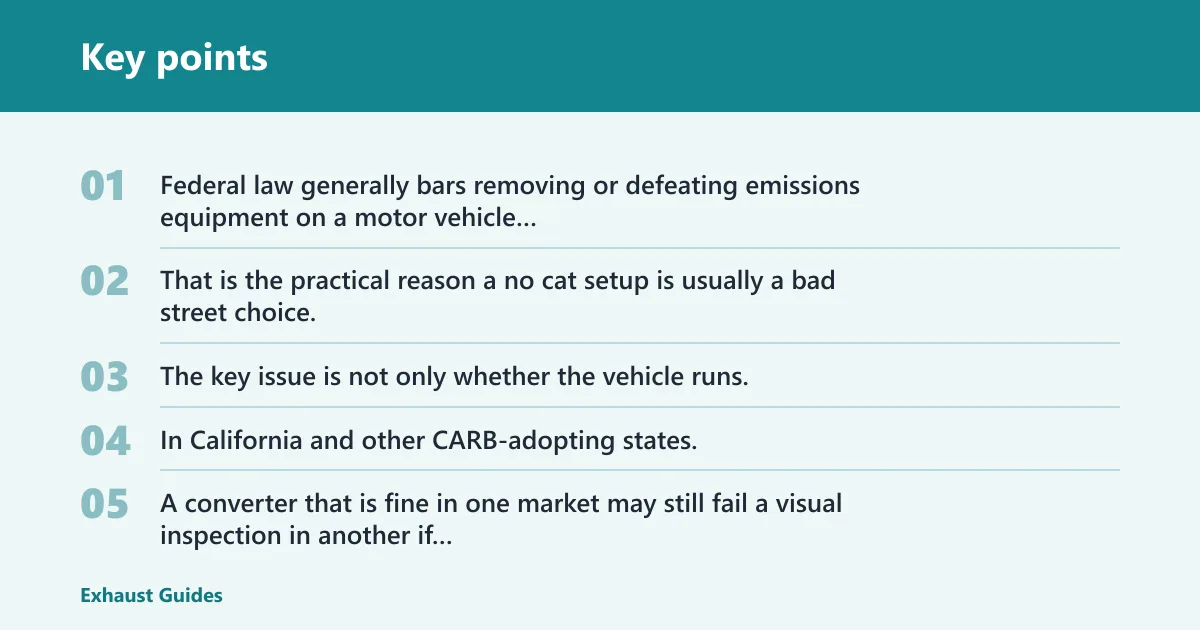
Federal law generally bars removing or defeating emissions equipment on a motor vehicle used on public roads. That is the practical reason a no cat setup is usually a bad street choice, even if the car feels quicker or sounds stronger. The key issue is not only whether the vehicle runs, but whether the emissions system has been altered in a way that defeats its intended function.
CARB approval and EO numbers
In California and other CARB-adopting states, the part must carry an Executive Order number when the law requires it. A converter that is fine in one market may still fail a visual inspection in another if it lacks the right approval. For buyers, that means the label and EO status matter as much as the fitment and advertised flow rate.
Why direct-fit and universal parts differ
Direct-fit high flow catalytic converter kits usually keep the factory sensor placement and pipe geometry, which helps with fitment and inspection consistency. Universal units can work well, but the installer must match diameter, location, and sensor spacing carefully or the risk of drivability and legality problems rises.
Emissions test risk
Will a high flow catalytic converter pass emissions testing? Often yes, but only when the part is compliant and the OBD2 catalyst monitor has run ready. A no cat setup is far more likely to fail, especially where a visual check, readiness check, or tailpipe test is part of the process. OBD-based inspections usually rely on readiness monitors and catalyst-efficiency logic rather than just whether the car “feels” clean, so a setup that looks fine on the road can still fail if the catalyst monitor is incomplete (EPA OBD guidance).
OBD2 readiness and catalyst monitors
Modern inspections often look at readiness status before they even get to tailpipe numbers. If the catalyst monitor is not ready, or if the monitor never completes because of a tune issue, the car can fail inspection even when it runs clean enough in daily driving. This is why “no code” is not the same thing as “ready,” and why a tune that suppresses one fault can create another readiness problem instead.
Visual inspection risk
Some inspections are not only about gas readings. If the technician can see the missing converter, a no cat setup can fail on sight regardless of how the car sounds or feels on the road.
Why tune state and local rules matter
Some cars need calibration changes after exhaust work to keep monitors happy. Others may pass in one county or state and fail in another because the inspection procedure, visual standard, or emissions threshold is different.
Check-engine-light risk
Does a high flow cat trigger a check engine light? Sometimes, yes. The risk is lower than with no cat, but a marginal converter, a poorly placed sensor, or a tune that does not match the hardware can still set catalyst-efficiency faults such as P0420.
Upstream and downstream oxygen sensors
The upstream oxygen sensor helps the engine management system trim fuel. The downstream sensor checks how well the catalyst cleans up exhaust, so a missing or weak converter changes the signal the ECU expects to see. In a healthy setup, the front sensor should switch actively while the rear sensor stays comparatively steadier; when the rear waveform starts mimicking the front, the ECU often interprets that as poor catalyst storage efficiency.
P0420-related faults after exhaust changes
P0420 is not guaranteed, and it is not impossible to avoid. But a no cat setup gives the ECU little or no catalyst activity to read, so the fault risk is much higher than with a properly sized, properly installed high flow catalytic converter.
When tuning helps and when it does not
Tuning can sometimes calm false catalyst codes, especially on modified turbo cars with otherwise healthy sensors. It does not create legal compliance, and it does not turn a missing catalyst into a compliant one. Spacer tricks can also move the rear sensor out of the main exhaust stream, and some software workarounds can delay or mask a fault, but neither approach recreates actual catalyst function or satisfies the legal requirement to retain emissions controls.
Sound and odor versus flow
High flow cat vs stock cat usually means a small shift in sound and a moderate shift in exhaust restriction. High flow cat vs cat delete brings a bigger jump in smell and noise than many buyers expect, while the power gain difference is often smaller than the sound difference suggests.
High flow cat vs stock cat
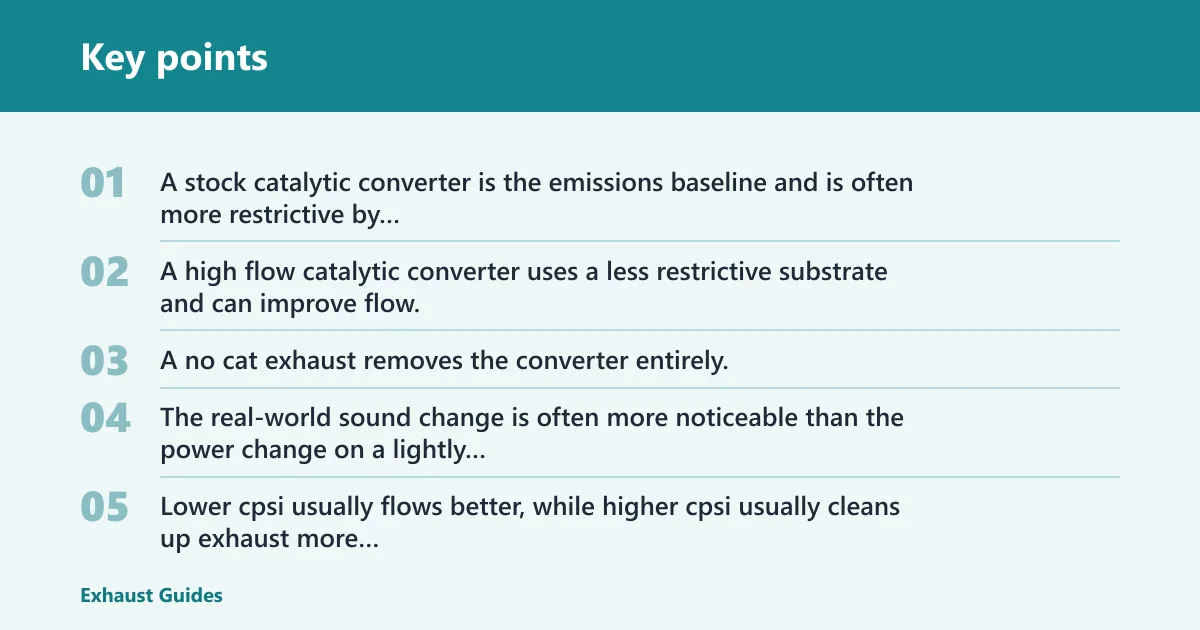
A stock catalytic converter is the emissions baseline and is often more restrictive by design. A high flow catalytic converter uses a less restrictive substrate and can improve flow, but the change is often subtle from the driver’s seat unless the factory unit was especially tight.
High flow cat vs cat delete
A no cat exhaust removes the converter entirely, so exhaust note gets sharper and odor becomes more obvious, especially at idle and during cold start. The real-world sound change is often more noticeable than the power change on a lightly modified naturally aspirated car.
How substrate and cpsi affect flow
Cell density, measured in cpsi, matters. Lower cpsi usually flows better, while higher cpsi usually cleans up exhaust more effectively. Common performance converter buckets are often roughly 100-200 cpsi for race-oriented flow, around 200-300 cpsi for many street-friendly performance units, and 400+ cpsi for stock-like emissions bias. Substrate material matters too: metallic cores often tolerate heat well, spool quickly in boosted applications, and can flow well, while ceramic cores are common and can be less costly, but the final result depends on design, diameter, washcoat loading, and placement. Technical references from catalyst manufacturers and suppliers generally describe these same tradeoffs, including the relationship among cpsi, substrate construction, and conversion efficiency (catalytic-converter technical overview).
Say your 2.0-liter naturally aspirated coupe still uses the original converter and you want a little more response without making the car smell like raw fuel. A direct-fit high flow catalytic converter is the safer move, because the gain is usually modest but the car stays far easier to live with and inspect.
Suppose your turbo sedan is built for track days, already tuned, and never sees public roads. In that narrow case, a no cat setup may be chosen for the least restriction, but the same setup becomes a poor choice the moment the car has to pass a road inspection or sit in traffic with the windows down.
Choose high flow catalytic converter if… / Choose no cat if…
Choose high flow catalytic converter if you need street use, inspections, or lower odor. Choose no cat only for track or off-road use where it is legal and the tradeoffs are acceptable.
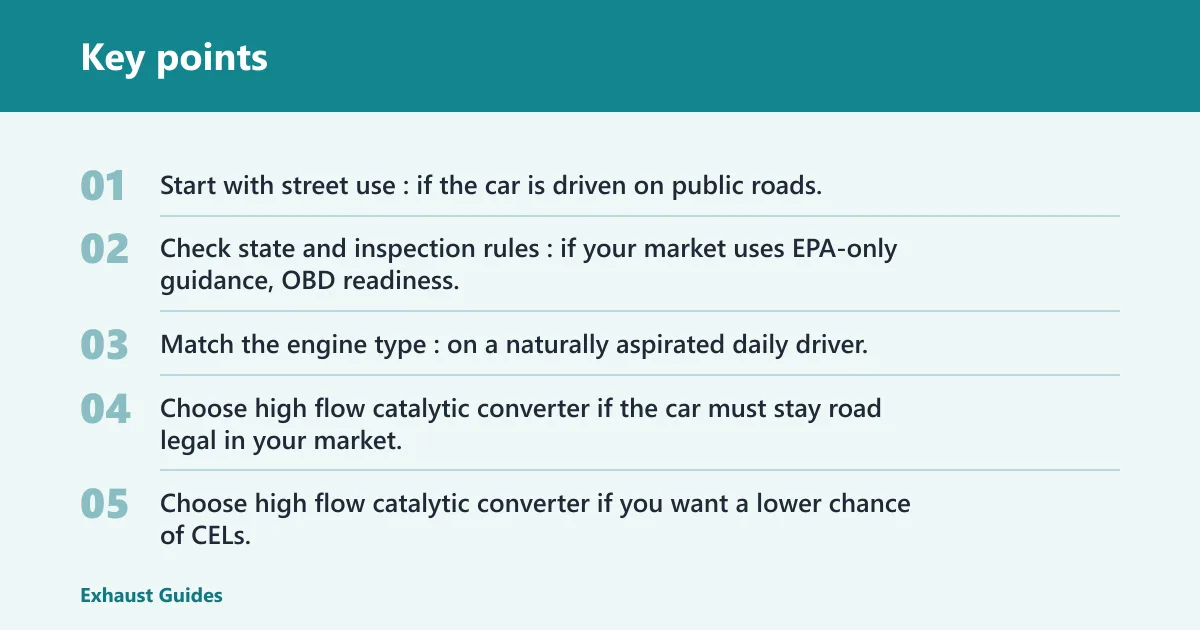
3-step decision flow
Use this short flow before you buy:
- Start with street use: if the car is driven on public roads, default to high flow catalytic converter; if it is track-only or off-road only, continue to the next step.
- Check state and inspection rules: if your market uses EPA-only guidance, OBD readiness, or CARB EO checks, choose the compliant converter; if a no-cat setup would fail visual or readiness inspection, do not buy it for that vehicle.
- Match the engine type: on a naturally aspirated daily driver, the high flow converter is usually the better balance; on a turbo build with no street-use requirement, no cat may be a flow-first choice if local rules allow it.
Checklist
- Choose high flow catalytic converter if the car must stay road legal in your market.
- Choose high flow catalytic converter if you want a lower chance of CELs, readiness problems, and odor.
- Choose high flow catalytic converter if the car is naturally aspirated and only lightly modified.
- Choose no cat only if the car is not used on public roads and local rules allow it.
- Choose no cat when the build is track-focused, the tune is sorted, and you accept more noise and smell.
- Choose no cat if maximum flow matters more than compliance, inspection readiness, and cabin comfort.

- Includes O2 port and heat shield
- Aluminized tubing with stainless steel body
- Universal fit for 2.5-inch exhaust pipes
Frequently asked questions
High flow catalytic converter vs stock
A high flow catalytic converter usually moves more exhaust than the stock converter because it uses a less restrictive core and, often, lower cpsi. The stock unit still wins on emissions margin and factory calibration fit, so the tradeoff is more flow for a smaller safety buffer.
High flow cat vs regular cat
Most buyers mean a high flow cat versus an OE-style regular cat. The regular cat is built for maximum conversion efficiency and strict factory assumptions, while the high flow version usually gives up some emissions headroom to reduce restriction and noise a little.
High flow cat vs cat delete: a high flow cat keeps
A high flow cat keeps emissions control in place, while a cat delete removes it completely. The delete can flow more and usually sounds louder, but it also brings the highest odor, the highest inspection risk, and the greatest chance of catalyst-related trouble codes.
High flow cats vs catless
High flow cats versus catless is mostly a compliance versus flow decision. If the car has to pass a road inspection, the high flow cat is the practical option. If the car is track-only and legal where it runs, catless may be chosen for the least restriction.
Are high flow cats worth it?
They are worth it when you want a compromise that keeps the car easier to register, inspect, and live with. On a stock naturally aspirated engine, the gain is usually modest. On a turbo or otherwise restrictive setup, the result can be more useful.
How much power does a high flow catalytic converter add?
Power gain is usually small on a stock engine and can be hard to feel without other supporting changes. The gain becomes more relevant when the factory converter is a real choke point, such as on some tuned or boosted setups with higher exhaust mass flow.
Will a high flow cat make my exhaust louder?
Usually a little, yes, but the change is often modest compared with a no cat setup. Expect a cleaner, slightly freer sound rather than a dramatic volume jump, and expect much less smell than with a deleted converter.