Fuel Cost Per Mile Calculator
Fuel cost per mile is calculated by dividing fuel price by fuel economy in US units: divide dollars per gallon by miles per gallon; in metric, multiply liters per 100 km by fuel price per liter, then divide by 100. If you miss the unit match, trip budgets, commuter costs, and charge-rate comparisons drift quickly. This guide gives the formulas, unit checks, a calculator widget, and worked examples for gas, diesel, hybrid, and UK petrol users.
How is this calculated?
Press Calculate to see the math with your numbers.
Fuel-only costs and the factors that shift them
Fuel cost per mile is the fuel-only cost of driving one mile or one kilometer. It uses fuel price and vehicle efficiency to show the money spent on fuel alone. It does not include tires, repairs, depreciation, parking, or insurance. For comparison benchmarks, public fuel-economy datasets from EPA fuel economy resources, IRS mileage guidance, and national transportation statistics are the right kinds of references because they separate vehicle efficiency, reimbursement, and travel behavior.
Fuel-only cost versus all-in driving cost
Keep those separate. Fuel cost per mile answers one narrow question: what does the trip consume in fuel money alone? All-in driving cost adds fixed and variable items such as maintenance, tires, registration, depreciation, and sometimes tolls or parking. Rigbooks separates cost per mile into fixed costs and variable costs, while Calculator Online’s driving cost formula includes gas cost, car value, and a fixed 0.05 component. For route planning, compare the fuel-only figure with full operating cost pages such as Diesel vs Gas Mileage Comparison and Tax Deductible Mileage Rates.
Why the answer changes by vehicle and fuel price
The same route can cost differently because both inputs move. A vehicle with better mileage uses less fuel per mile. A higher pump price raises the cost per mile even when the vehicle stays the same. That is why two drivers on the same road can get different answers. For vehicle-level comparisons, sibling guides like Fuel-Efficient Driving Tips, MPG to L/100km Converter, and Gas vs Diesel Fuel Cost Calculator help keep the unit logic consistent.
When to use miles, kilometers, or odometer readings
Use trip distance when the trip is known in advance. Use odometer readings when you want a real-world fill-up calculation: subtract the start reading from the end reading, then pair that distance with fuel used. Calculator.now supports both input methods, and it accepts distance in miles or kilometers. If you are comparing commuting claims, travel logs, or reimbursement records, related pages such as Mileage Reimbursement Calculator, Trip Distance Calculator, and Fuel Economy Converter are useful companions.
For a hybrid example, suppose a car averages 52 MPG on a 120-mile trip and fuel costs $3.80 per gallon. The trip uses about 2.31 gallons, so fuel-only cost is about $8.78, or roughly $0.073 per mile. In metric terms, that same style of vehicle might be described as 4.5 L/100km; the math still works, but you must keep the unit system aligned before you convert.
How do you calculate fuel cost per mile?
Start with total fuel cost, then divide by distance traveled. In the US, that usually means dollars per gallon divided by miles per gallon. In metric, you can use liters per 100 km or liters per kilometer, but the units must match before you divide. Calculator.now includes fuel efficiency as distance traveled divided by fuel used and cost per mile as total fuel cost divided by distance traveled.
Core formula: total fuel cost divided by distance
The general form is simple: fuel cost per mile = total fuel cost ÷ distance traveled. If you already know how much fuel was used, multiply that by the fuel price first. If you already know efficiency, convert it into cost per mile or cost per kilometer using the same unit system.
Trip-based method with fuel price and fuel used
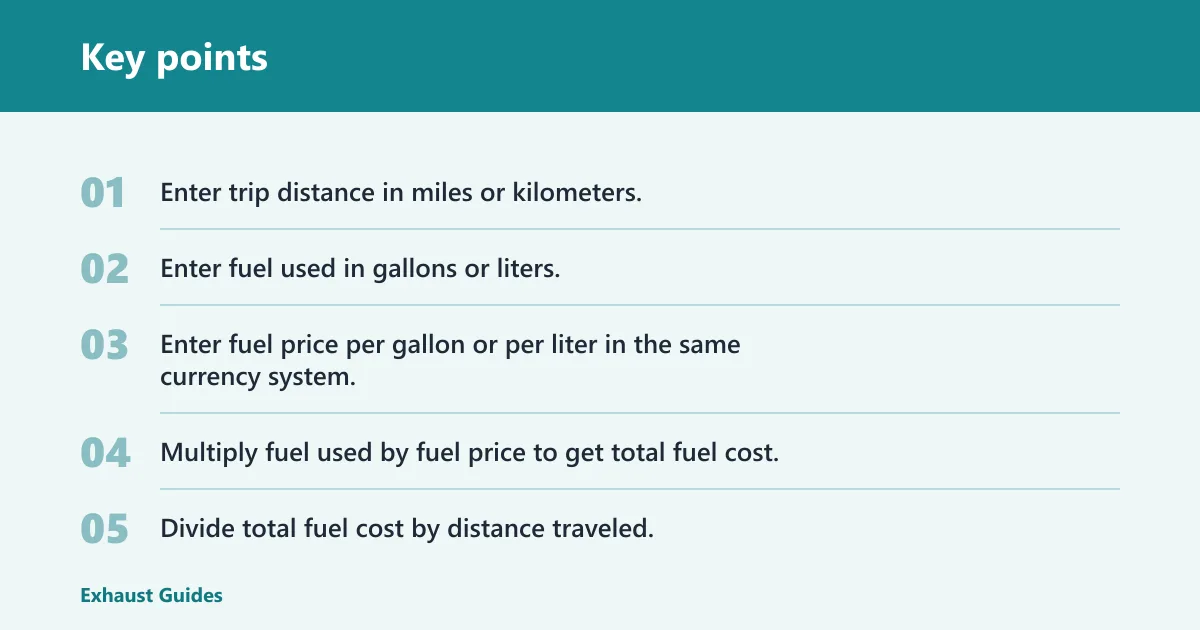
- Enter trip distance in miles or kilometers.
- Enter fuel used in gallons or liters.
- Enter fuel price per gallon or per liter in the same currency system.
- Multiply fuel used by fuel price to get total fuel cost.
- Divide total fuel cost by distance traveled.
This method fits road trips, commuting, and delivery routes. It also works with fuel logs because it uses actual fuel consumed, not a guess.
Odometer-based method with start and end readings
Use the odometer when you want fill-up tracking. Subtract the starting reading from the ending reading to get distance traveled, then use the fuel added or fuel used for that interval. This is useful for monthly records because it ties one fuel purchase to one measured span.
A common first-timer mistake is mixing liters with gallon pricing. Suppose the receipt shows £1.55 per liter, but the calculation uses gallons by accident. The number will look plausible and still be wrong. Match liters with liters, gallons with gallons, and kilometers with kilometers before you compute anything.
Fuel cost table
The table below shows six unit-safe examples. Each one gives the input values, the formula used, the final cost per mile, and the most common setup mistake to avoid. The math uses only the stated units, so you can copy the structure into a fuel cost per mile calculator without guessing.
| Example | Input values | Formula used | Final cost per mile | Common mistake to avoid |
|---|---|---|---|---|
| 1. US gasoline, MPG | $3.60 per gallon; 30 MPG | $3.60 ÷ 30 | $0.12 per mile | Using liters per 100 km math on MPG data |
| 2. US diesel, MPG | $4.20 per gallon; 42 MPG | $4.20 ÷ 42 | $0.10 per mile | Assuming diesel is always cheaper without checking MPG |
| 3. Miles and gallons from a trip | 240 miles; 8 gallons; $3.75 per gallon | (8 × $3.75) ÷ 240 | $0.13 per mile | Dividing gallons by miles before pricing the fuel |
| 4. Kilometers and liters in Canada | 500 km; 35 liters; CAD 1.80 per liter | (35 × CAD 1.80) ÷ 500 km | CAD 0.13 per km | Quoting per mile while the inputs are in kilometers |
| 5. UK petrol price per liter | £1.55 per liter; 6.5 L/100km | (6.5 × £1.55) ÷ 100 km | £0.10075 per km | Using £/gallon with a liters-per-100km figure |
| 6. Metric to mile conversion | £1.55 per liter; 6.5 L/100km; 1 km = 0.621371 mile | £0.10075 per km ÷ 0.621371 | £0.162 per mile | Reporting per mile without converting from per km |
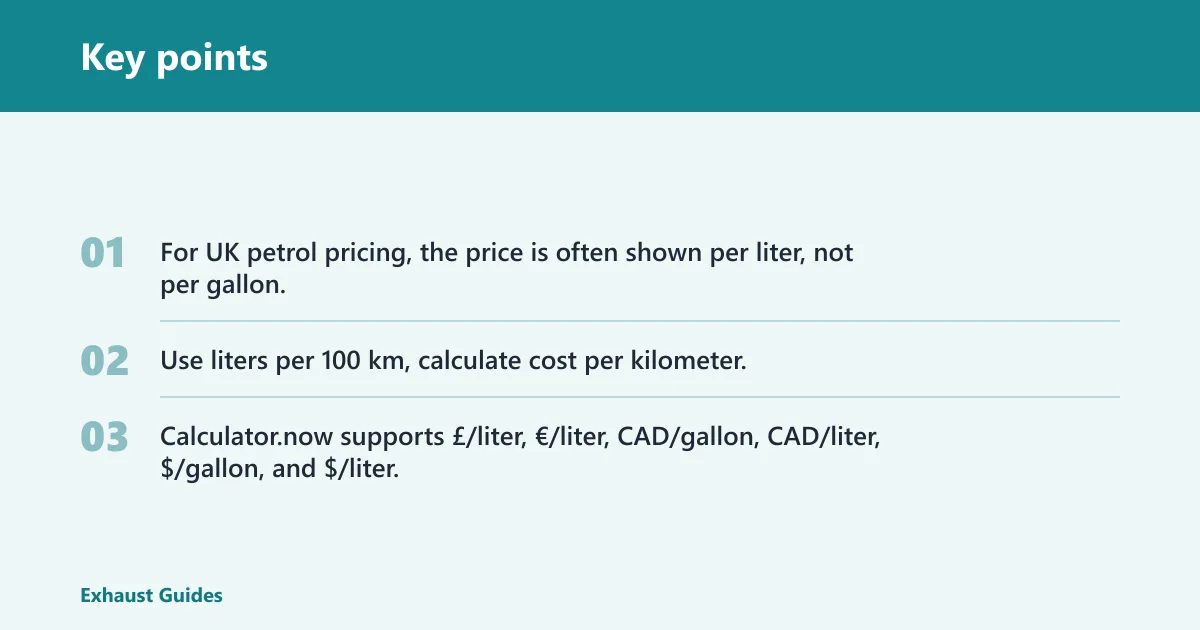
For UK petrol pricing, the price is often shown per liter, not per gallon. That changes the calculation shape. Use liters per 100 km, calculate cost per kilometer, then convert to cost per mile only if you need a mile-based result. Calculator.now supports £/liter, €/liter, CAD/gallon, CAD/liter, $/gallon, and $/liter.
How does MPG relate to fuel cost?
MPG tells you how far the vehicle goes on one gallon. Higher MPG means less fuel used for the same distance, so the cost per mile falls when fuel price stays the same. To convert directly, divide the price per gallon by MPG. Calculator.now offers MPG, km/L, and L/100km display options.
What MPG means in plain terms
MPG is a distance-per-gallon measure used in the United States. If a car gets 30 MPG, it travels 30 miles on one gallon under the stated test or real-world condition. That is a mileage measure, so a bigger number means less fuel burned per mile.
Convert MPG to per-mile fuel cost
Use the price per gallon and divide by MPG. At $3.60 per gallon and 30 MPG, the fuel cost is $0.12 per mile. At $4.20 per gallon and 42 MPG, it is $0.10 per mile. Same route, different efficiency, different answer.
Why lower fuel use lowers cost per mile
Less fuel used per mile means less money spent on fuel per mile. That sounds obvious, but it is easy to miss when comparing vehicles by sticker MPG alone. A slightly higher fuel price can erase part of the gain from better mileage, so both inputs matter.
How does L/100km fit the same math?
L/100km is a fuel consumption measure, so lower numbers are better. It tells you how many liters the vehicle uses to travel 100 kilometers. To get cost per kilometer, multiply L/100km by price per liter and divide by 100. To get cost per mile, convert the result from kilometers to miles.
What L/100km means
A vehicle rated at 6.5 L/100km uses 6.5 liters to travel 100 kilometers. That is the opposite direction of MPG, but the logic is the same. Lower fuel use means lower fuel cost per distance.
Convert L/100km to per-kilometer cost
At £1.55 per liter and 6.5 L/100km, the fuel cost is £10.075 per 100 km, or £0.10075 per km. If you need per mile, divide by 0.621371 to convert kilometers to miles. That gives about £0.162 per mile.
Convert L/100km to MPG when needed
Use a conversion step before comparing with US-style MPG figures. Do not treat the two scales as interchangeable. One is a distance-per-fuel measure; the other is a fuel-per-distance measure. The units point in opposite directions, so a direct comparison without conversion can mislead you.
Diesel versus gasoline costs
Diesel is not always cheaper per mile. A lower pump price can help, but a vehicle’s efficiency matters just as much. If a diesel truck costs more per gallon but gets better MPG, it may still win on cost per mile. If the gasoline car is much more efficient, the result can flip.
How fuel price and efficiency interact
Compare both inputs on the same route. A diesel at $4.20 per gallon and 42 MPG costs $0.10 per mile. A gasoline vehicle at $3.60 per gallon and 30 MPG costs $0.12 per mile. In that case, diesel wins. Change either number and the answer changes.
Why a cheaper pump price does not always mean lower cost per mile
Fuel price is only one half of the equation. A vehicle that burns more fuel per mile can erase a lower pump price fast. That is why business comparisons should use the actual route, the actual efficiency, and the actual fuel price, not a rough label on the fuel cap.
How to compare two vehicles with the same route
Use the same distance, then apply each vehicle’s efficiency and fuel price. If both vehicles use the same currency, the lower cost per mile is the cheaper one to run on fuel. This works for commuting, towing, and road-trip planning because the route stays fixed while the vehicle changes.
Suppose a van is used for a 200-mile delivery run. One version returns 25 MPG on gasoline at $3.60 per gallon; another returns 30 MPG on diesel at $4.20 per gallon. The diesel version costs less per mile on fuel, but only because the higher MPG outweighs the higher pump price.
What should you charge per mile for fuel?
For personal budgeting, charge yourself the fuel-only rate from the route and vehicle you actually use. For business or reimbursement, fuel-only pricing can be a starting point, but it is not the full driving rate. If you need to recover tires, maintenance, depreciation, or empty-return time, add those separately. IRS standard mileage rate guidance is the appropriate benchmark for reimbursement, and fuel-only charging is only a subset of that broader calculation.
Personal budgeting versus business charging
A personal budget can stop at fuel cost per mile. Business charging usually should not. A courier, contractor, or delivery driver often needs a rate that covers the vehicle, not only the tank. That means fuel-only cost is useful, but incomplete.
Using a fuel-only rate for delivery or reimbursable trips
For short reimbursable trips, a fuel-only rate can be a simple baseline. Take your actual fuel cost per mile and multiply it by the trip distance. If a 120-mile run costs $0.13 per mile in fuel, the fuel-only charge is $15.60.
Adding non-fuel costs when a full driving rate is needed
Add fixed and variable costs when the job calls for the full vehicle cost. Rigbooks splits fixed costs and variable costs for that reason. Fuel is only the variable part tied directly to the trip. Tires, oil, depreciation, and registration do not disappear just because the trip is short.
Frequently asked questions
How much does gas cost per mile calculator?
Use fuel price per gallon divided by MPG. If gas costs $3.60 per gallon and the car gets 30 MPG, the answer is $0.12 per mile. If you track fuel in liters, convert first or use a metric formula. The calculator should show the unit with the result.
How much does fuel cost per mile?
It depends on fuel price and vehicle efficiency. A car at 30 MPG and $3.60 per gallon costs $0.12 per mile. A diesel vehicle at 42 MPG and $4.20 per gallon costs $0.10 per mile. The same route can produce different answers if either input changes.
How do I calculate my cost per mile?
Divide total fuel cost by distance traveled. If you know fuel used, multiply fuel used by fuel price first, then divide by miles or kilometers. If you have odometer readings, subtract the start reading from the end reading to get the distance before dividing.
How much is fuel per mile?
That phrase usually means fuel-only cost per distance. In US units, divide dollars per gallon by miles per gallon. In metric, use liters per 100 km and price per liter, then convert to per-kilometer or per-mile as needed. Keep the units matched.
How much to charge for fuel per mile
For reimbursement, charge the fuel-only rate tied to the actual trip and vehicle. For business billing, fuel alone is usually not enough because it ignores maintenance, tires, depreciation, and other vehicle costs. Add those if the job requires a full operating rate.
How much does 1 mile cost?
There is no single answer. One mile could cost $0.10 in fuel on an efficient diesel run or more on a less efficient vehicle with higher fuel prices. The correct number comes from fuel price and efficiency, then the unit must stay as dollars per mile, pounds per mile, euros per kilometer, or the local format you chose.