Is an Exhaust Leak Expensive to Fix?
Usually no: a small exhaust leak often costs about $150 to $500 to fix, while cracked manifolds, rusted pipes, or broken flange bolts can push repairs to about $800 to $1,500 or more. Ignoring it can raise noise, trigger check-engine lights, hurt fuel economy, and let exhaust fumes enter the cabin. This guide breaks leaks into cheap, moderate, and expensive repairs so you can judge the right fix.
Exhaust leak cost table
The biggest cost driver is not the leak itself. It is the leak location, how much rust surrounds it, and whether the shop can repair one joint or must remove half the exhaust to reach the damaged part. Front-of-engine leaks usually cost more than rear leaks because labor time climbs fast.
| Leak location | Likely repair | Parts range | Labor range | Total typical range | Replace instead trigger |
|---|---|---|---|---|---|
| Tailpipe pinhole near the rear bumper | Weld patch or rear pipe section | $20-$80 | $80-$180 | $100-$260 | Metal is thin across a long section |
| Muffler seam leak | Muffler replacement | $70-$250 | $80-$200 | $150-$450 | Rust has spread into the shell or hanger mounts |
| Clamp joint leak | New exhaust clamp and reseal | $15-$60 | $60-$140 | $75-$200 | Pipe ends are crushed or too rusty to seal |
| Flange leak at a bolt joint | Flange gasket and hardware | $20-$90 | $120-$300 | $140-$390 | Flange is warped or bolt holes are torn out |
| Mid-pipe rust hole | Weld patch or mid-pipe section | $30-$150 | $100-$250 | $130-$400 | Pipe is thin along a wider area |
| Flex pipe crack | Flex pipe section replacement | $40-$180 | $150-$400 | $190-$580 | Flex braid is broken across most of its length |
| Small joint leak near the front pipes | Clamp, gasket, or weld repair | $20-$100 | $120-$300 | $140-$400 | Hardware is seized or pipe is heat-bent |
| Exhaust manifold gasket leak | Gasket replacement | $30-$120 | $250-$700 | $280-$820 | Broken studs, warped flange, or cracked manifold |
| Cracked exhaust manifold | Manifold replacement | $150-$700 | $300-$900 | $450-$1,600 | Crack is near a mounting ear or sensor port |
| Catalytic-converter-adjacent leak at the inlet or outlet | Flange, gasket, or assembly replacement | $50-$1,200 | $200-$800 | $250-$2,000 | Heat damage or broken mounting means the assembly is failing |
| Front-end leak with seized studs | Manifold gasket plus hardware | $60-$180 | $350-$900 | $410-$1,080 | Studs snap, surfaces warp, or the manifold cracks during removal |
| Rust-damaged pipe section in an accessible underbody run | Section replacement | $40-$200 | $120-$350 | $160-$550 | Rust extends past the cut line or repair is near another bad joint |
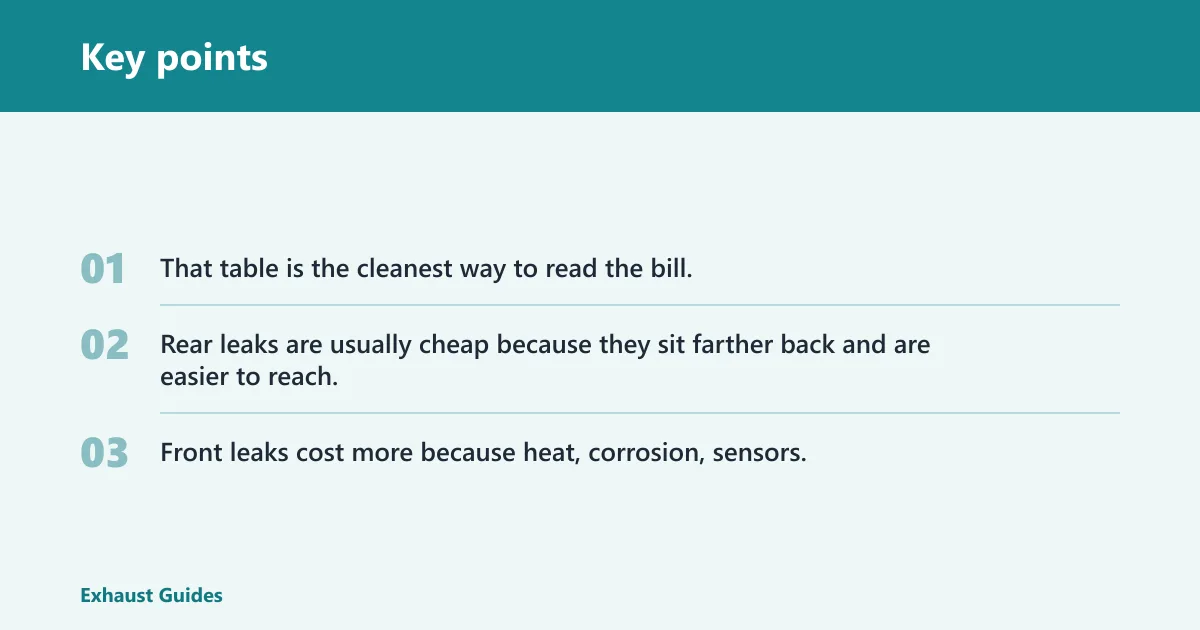
That table is the cleanest way to read the bill. Rear leaks are usually cheap because they sit farther back and are easier to reach. Front leaks cost more because heat, corrosion, sensors, and tighter access turn a short repair into a longer one.
Is an exhaust leak expensive to fix?
Usually not if the leak is small, rearward, and easy to reach. A simple clamp, a short welded patch, or a muffler swap often stays in the low hundreds. It gets expensive when the leak sits near the engine, when rust has weakened the pipe, or when hardware breaks during removal.
What usually makes the bill small
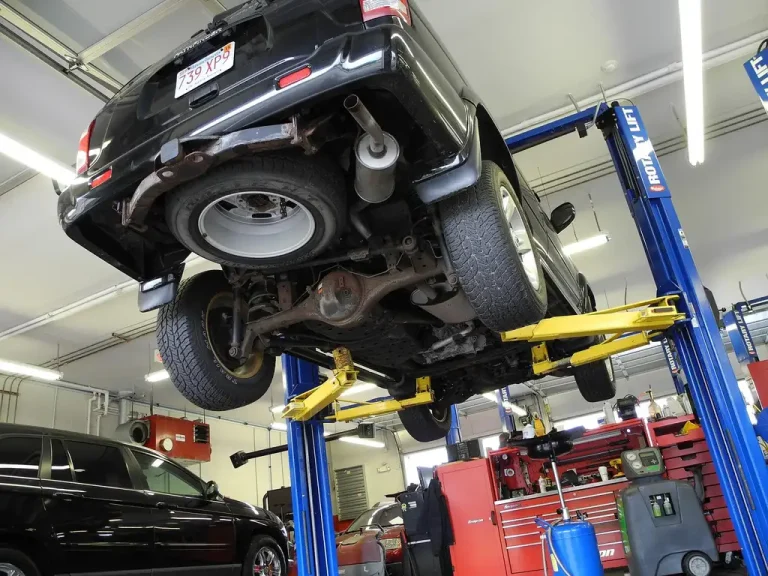
Small holes, one loose clamp, and an accessible rear pipe are the budget-friendly cases. If the technician can reach the joint without removing shields, hangers, or nearby heat-sensitive parts, labor stays contained. A pinhole in a muffler or tailpipe is usually far cheaper than a manifold or catalytic-converter-area leak.
What pushes the bill higher
Rust, broken fasteners, and awkward access are the usual price multipliers. A part may be inexpensive, but if the shop has to cut hardware, drill snapped studs, or remove a heat shield to get to it, labor becomes the real cost. Vehicle design matters too, since some layouts hide the leak.
What a leak location changes
Location drives both repair type and labor time. Rear leaks are usually under the car and visible. Front leaks often sit near the exhaust manifold, oxygen sensors, and tight engine-bay packaging, which means more disassembly before the actual repair starts.
Front-of-engine leaks
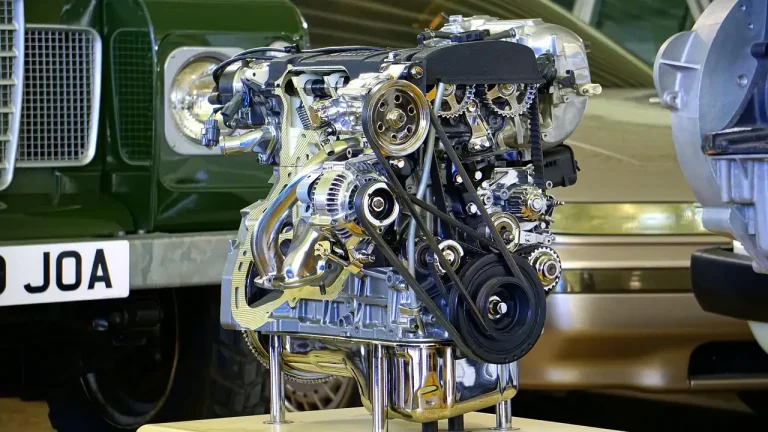
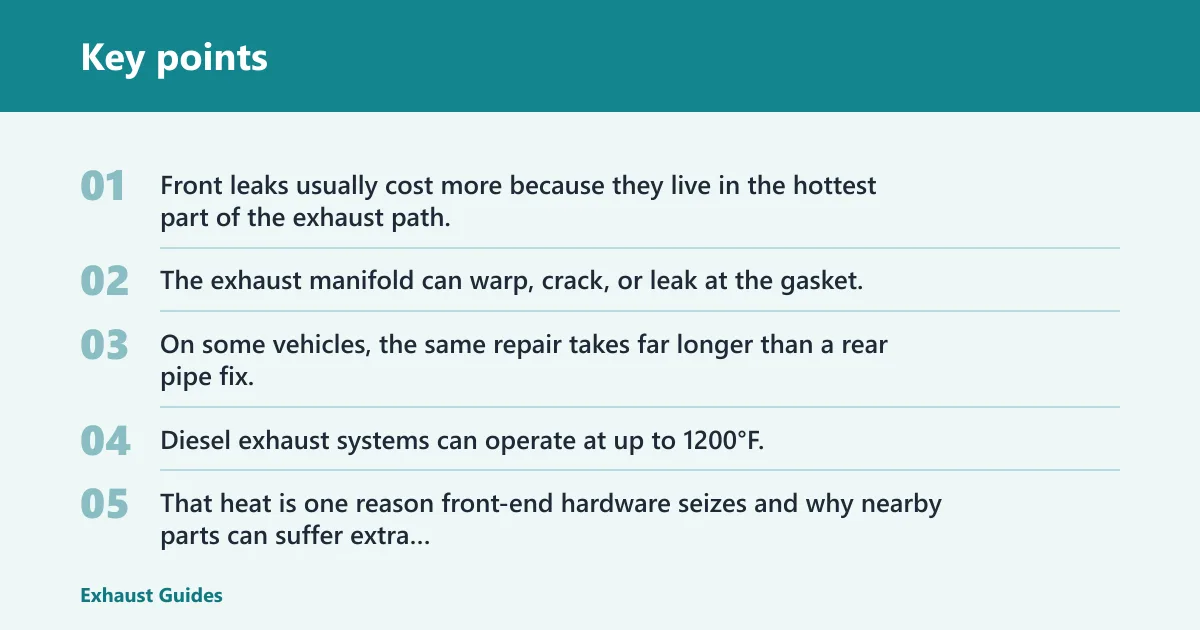
Front leaks usually cost more because they live in the hottest part of the exhaust path. The exhaust manifold can warp, crack, or leak at the gasket, and the work often involves studs, gaskets, shields, and sensors. On some vehicles, the same repair takes far longer than a rear pipe fix.
Diesel exhaust systems can operate at up to 1200°F. That heat is one reason front-end hardware seizes and why nearby parts can suffer extra damage when a leak goes unfixed.
Mid-pipe, clamp, and flange leaks
Mid-pipe leaks often land in the middle of the price range. If the pipe is still solid, a weld or section replacement may be enough. Clamp and flange leaks are especially sensitive to fit; the clamp must match pipe diameter and joint type, and over-tightening can deform the tubing.
Say your sedan starts whistling only under light throttle and the sound comes from the center of the car. If the pipe wall is still thick and the flange faces are flat, a clamp or gasket repair may be enough. If the pipe is crusted through for several inches, section replacement is the better fix.
Rear muffler and tailpipe leaks
Rear leaks are usually the cheapest because the muffler and tailpipe sit at the back of the car, where access is better and parts usually cost less than front exhaust components. A rear leak may still need replacement if the shell is thin or the rust is widespread.
Is a manifold leak expensive to fix?
Yes, often more expensive than a tailpipe or muffler leak. A manifold leak sits at the front of the engine, where heat and access both work against low labor time. If the leak is only the gasket, the bill may stay moderate. If the manifold is cracked, warped, or held by broken studs, the cost rises fast.
Manifold gasket leaks
A manifold gasket leak is common and often repairable, but it usually requires removing the manifold. That means the final cost depends on whether the hardware comes apart cleanly. Broken studs, seized bolts, or damaged sealing surfaces can turn a gasket job into a much longer repair.
Cracked or warped exhaust manifolds
A cracked manifold usually means replacement instead of patching. The part sits in a high-heat zone, so temporary sealants are not a real fix. If the manifold is warped, the new gasket may fail again unless the surface problem is corrected or the manifold is replaced.
Broken studs and seized bolts
Hardware failure is one of the hidden costs people miss. A quote for a gasket may look manageable until a stud snaps flush with the head or a bolt rounds off. At that point, the labor time can rise enough to push the repair into the expensive range even if the parts are modest.
Can a small exhaust leak be patched cheaply?
Yes, but only for the right kind of leak. High-heat sealant, tape, and patch kits can help with small cracks, pinholes, and some joints. They are temporary or minor-leak fixes, not good answers for a cracked manifold, a crushed pipe, or a rusted section that has lost strength.
Sealant, tape, and patch kit limits
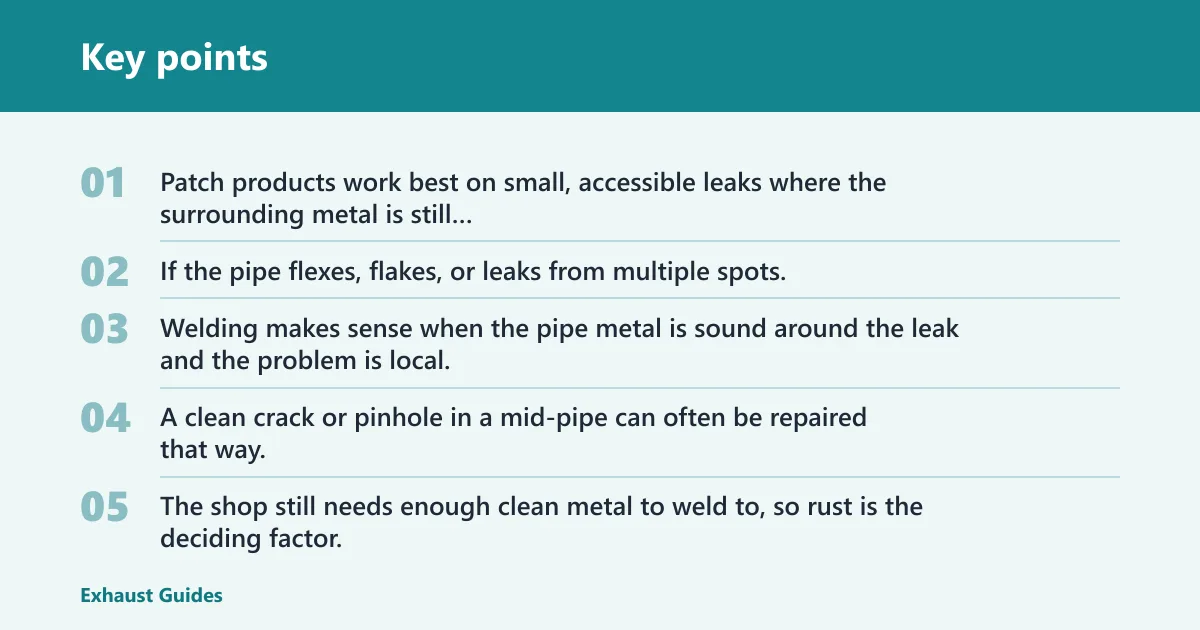
Patch products work best on small, accessible leaks where the surrounding metal is still solid. They are not meant for structural failure. If the pipe flexes, flakes, or leaks from multiple spots, the patch may hold briefly and then fail again.
When welding is enough
Welding makes sense when the pipe metal is sound around the leak and the problem is local. A clean crack or pinhole in a mid-pipe can often be repaired that way. The shop still needs enough clean metal to weld to, so rust is the deciding factor.
A common first-timer mistake is patching a rusty muffler seam because the leak looks tiny. If the seam is thin everywhere around the spot, the patch can buy a little time, but it will not stop the shell from opening again. In that case, replacement is usually the better spend.
When a section must be replaced
If the pipe is thin over a longer stretch, if the flex braid is torn, or if the same joint keeps leaking, section replacement is usually cheaper in the long run than repeated patching. Replacement also makes more sense when heat has damaged nearby seals, wiring, or sensors.
How much does diagnosis usually cost?
Diagnosis is often a smaller line item than the repair, but it matters. A smoke test, pressure test, and careful visual inspection help locate the exact leak before anyone buys parts. That can prevent paying for the wrong gasket, clamp, or section.
Smoke test and pressure test
A smoke test is one of the cleanest ways to find a leak path. Technicians may also use soapy water or pressure testing to reveal escaping gas at joints and cracks. That matters because exhaust noise can travel, and the loud spot is not always the actual leak source.
Visual inspection and rust checks
Under a cool vehicle, a visual check can reveal soot, rust, loose hardware, and cracked hangers. You should never rely on a jack alone; use jack stands, and wear gloves and eye protection. Hot exhaust parts can burn skin even after the engine has been off for a while.
Why diagnosis can save money
Good diagnosis prevents guesswork. Suppose a hissing sound seems to come from the muffler, but a smoke test finds a loose flange near the front pipe. Fixing the flange is cheaper than replacing the muffler, and it avoids buying parts that were never the problem.
What repairs are worth doing now?
Cheap fixes are worth doing now if the metal is still healthy and the leak is small. Moderate repairs are worth it when the pipe or gasket is still repairable but labor is meaningful. Replace instead when rust, cracks, or repeated failure make another patch a short-lived solution.
Cheap fixes
Clamps, gaskets at accessible joints, small weld patches, and some rear muffler leaks belong here. These are the cases where the repair cost is low because the labor is simple and the part itself is not expensive. The repair is usually straightforward if the fasteners are not seized.
Moderate repairs
Flex pipe replacement, mid-pipe section replacement, and some manifold gasket jobs sit in the middle. The parts are still manageable, but access and labor matter. This is where a technician’s time often costs more than the hardware.
Replace instead
Replace instead when the manifold is cracked, the pipe is thin from rust, a joint keeps leaking after repair, or broken studs turn a gasket job into a hardware rescue. Catalytic-converter-adjacent leaks also belong in this group more often, because heat and mounting damage can make a patch pointless.
Frequently asked questions
Is an exhaust manifold leak expensive to fix?
Often yes. A manifold gasket leak can be moderate, but the repair usually needs careful removal and reinstallation. If studs snap, bolts seize, or the manifold itself is cracked or warped, the cost climbs quickly. Front-of-engine heat makes this one of the pricier exhaust repairs.
How much is an exhaust leak to fix?
For a small leak, a common ballpark is $150 to $500. Rear pipe or muffler issues may land below that, while manifold, flex pipe, and catalytic-converter-adjacent repairs can move well above it. The final number depends on rust, access, and whether repair is possible at all.
When does an exhaust leak need replacement instead of repair?
Replacement makes more sense when the pipe is thin, the manifold is cracked, the leak returns at the same joint, or rust has spread too far for a weld or patch to hold. Broken studs, warped surfaces, and heat-damaged nearby parts also point toward replacement rather than another temporary fix.
What does an exhaust leak repair usually cost?
Most repair bills fall into one of three bands: cheap rear or joint fixes, moderate mid-pipe and flex pipe work, and expensive front-end or catalytic-converter-area repairs. Parts may be modest, but labor can dominate the total when access is poor or hardware breaks during removal.