
Exhaust leak diagnosis cost: what shops charge
Many shops seem to charge roughly $75 to $150 for an exhaust leak diagnosis, with simple visual checks sometimes costing less and more involved fault-finding costing more when the leak is hard to locate. Skip the diagnosis and you can pay for the wrong repair, miss a dangerous leak, or turn a small gasket fix into a larger bill. This guide breaks down what that fee usually includes, what raises it before repairs start, and how to compare quotes.
How much do shops charge to diagnose an exhaust leak?
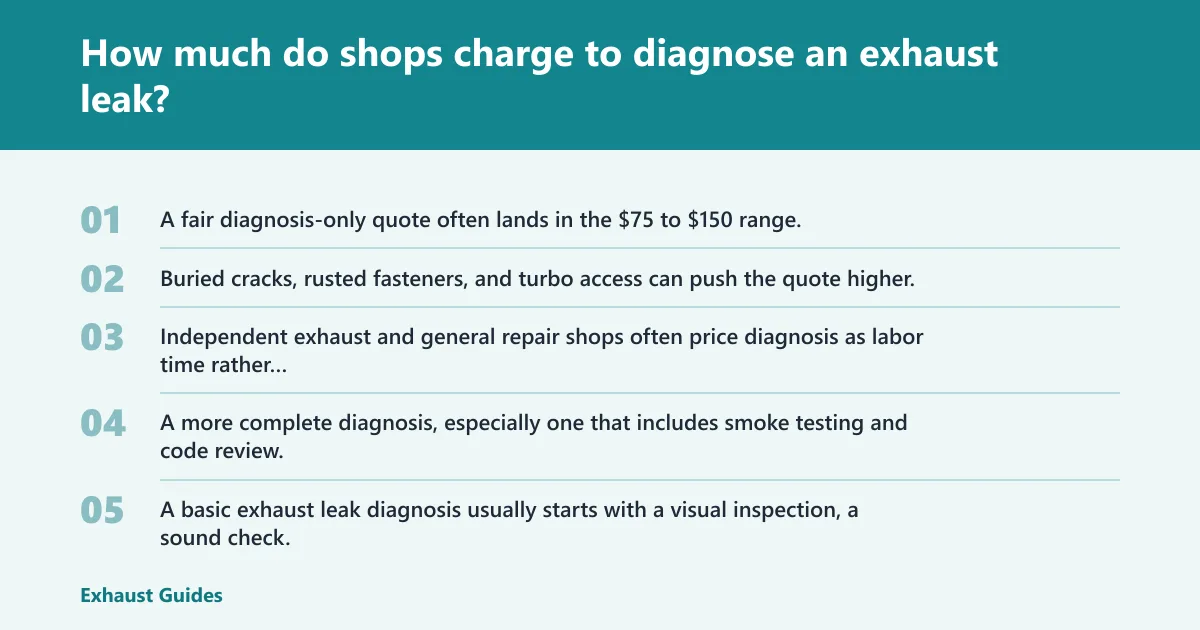

A fair diagnosis-only quote often lands in the $75 to $150 range, but the final number depends on how long the shop expects leak isolation to take and whether it includes scan-tool checks or a smoke test. Simple front-half leaks may cost less. Buried cracks, rusted fasteners, and turbo access can push the quote higher.
Typical diagnostic fee ranges by shop type
Independent exhaust and general repair shops often price diagnosis as labor time rather than a flat menu item. A quick inspection can be near the low end. A more complete diagnosis, especially one that includes smoke testing and code review, can move toward $150 to $200 or more before repair starts.
What a basic diagnosis usually includes
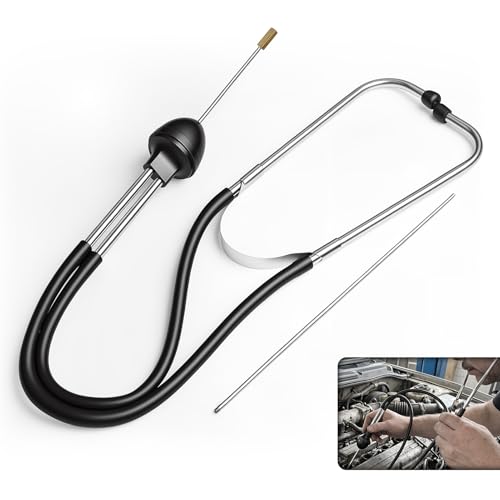
A basic exhaust leak diagnosis usually starts with a visual inspection, a sound check, and a check for soot marks, broken joints, or failed gaskets. The cited example uses 0.8 hours to isolate the leak, and shops in that example average $120 per hour, which puts diagnostic labor near $96 before add-ons.
When the fee is applied to the repair
Some shops credit all or part of the diagnostic fee toward the repair if you approve the work. Others do not. Ask whether the fee is separate, whether it is refundable, and whether it still applies if the vehicle needs a second visit for parts ordering or a post-repair retest.
Diagnosis and repair are separate charges. The diagnostic fee pays for isolating the leak. Repair labor pays for removing parts, replacing seals or sections, and checking the system again after the fix.
📊 Shops in the cited example average $120 per hour. Source: Exhaust Leak Repair Cost: Real Shop Prices (2026).
What does an exhaust leak diagnosis fee cover?

The fee pays for finding the leak, not guessing at the failed part. That usually means a visual check, listening under load or on cold start, and sometimes a smoke test. It may also include scan-tool review for fuel-trim clues, misfire codes, and other signs that point to the wrong component.
Visual inspection and sound check
Technicians often begin by looking for soot, rust trails, loose clamps, broken flanges, cracked manifolds, or a split flex pipe. Listening helps, but it is not enough by itself. The cited page says proper leak diagnosis requires smoke testing, not just listening.
Smoke test and leak isolation
A smoke test can be faster than listening alone because it reveals where vapor escapes from a manifold, flange, gasket, or joint. It is especially helpful when the leak is small, intermittent, or hidden behind heat shields. Some shops include it in the base diagnosis; others list it as an add-on.
Scan-tool checks for codes and fuel-trim clues
Many shops also check OBD-II data. That does not prove the failed part, but it can show whether the engine is reacting to unmetered air or exhaust leaks. A leak before the upstream oxygen sensor can make the ECU think the engine is running lean.
Picture a 2.4-liter sedan with a cold-start tick and a P0171 lean code. A scan tool may show the symptom, but the real cause could be a small pre-cat leak at the manifold gasket. Without leak isolation, the wrong part can get replaced first.
Why does the diagnosis cost rise for some leaks?
Diagnosis rises when the leak is hard to reach, heat-soaked, or hidden behind other parts. Front exhaust work is usually easier than undercar or turbo-side access. Rusted hardware, broken studs, and shield removal add time. If the shop must separate several joints before it can confirm the source, the fee climbs.
Front exhaust versus undercar access
Front-half exhaust leaks near the engine bay can be quick to confirm, but they can also be cramped and hot. Underbody leaks may be easier to see on a lift, yet rusted fasteners and long pipe runs often slow the job. Diagnosis pricing usually follows the access problem, not just the symptom.
Heat shields, rust, and broken fasteners
A cheap-looking gasket leak can turn expensive when shields must come off or bolts snap during inspection. In older vehicles, diagnosis may include carefully opening access just to verify whether the seal failed or the surrounding pipe has cracked. That extra labor often appears before any repair quote.
Turbo and manifold access issues
Turbo-specific exhaust leaks are often harder to isolate because heat and packaging crowd the hot side. Manifold cracks can also be slow to find. The cited estimate puts a cracked exhaust manifold at 3.2–4.8 hours, much higher than a simple joint check.
Which leak locations are cheapest or hardest to find?
Leak location changes both diagnosis time and repair difficulty. Joint leaks are often cheaper than cracked cast parts. A manifold-to-downpipe flange leak is usually less involved than a manifold crack. A flex pipe rupture often needs replacement, not just a clamp or gasket swap. Catalytic converter inlet and outlet leaks sit in the middle.
Manifold cracks and gasket leaks
An exhaust manifold can fail at the gasket or crack in the casting itself. Gasket failure is often faster to confirm and repair than a cracked manifold. The cited estimate places a cracked exhaust manifold at 3.2–4.8 hours, which reflects how much labor the hot-side layout can demand.
Flange and joint leaks
Flanges and gaskets are common at the manifold-to-downpipe connection and at catalytic converter inlet and outlet joints. These leaks are often seal-related rather than pipe replacement jobs. The cited hours estimate 0.7–1.2 hours for a manifold-to-downpipe flange leak, and 1.4–2.1 hours for a catalytic converter inlet/outlet leak.
Flex pipe failure
A flex pipe rupture usually means the pipe section itself is damaged. That often raises repair labor more than a gasket or clamp job because the part must be cut out or replaced. The cited estimate places a flex pipe rupture at 2.0–2.6 hours.
Catalytic converter inlet and outlet joints
A leak near the converter can mimic converter problems, especially if the noise or odor changes with load. Diagnosis should separate a sealing problem from an actual converter failure. That distinction matters because a leak at the inlet or outlet does not automatically mean the converter is bad.
| Case type | Diagnostic-only fee | Smoke test add-on | Scan-tool check | Example total before repair |
|---|---|---|---|---|
| Mild: accessible flange leak | $75 | $25 | $0 | $100 |
| Moderate: catalytic converter inlet/outlet leak | $110 | $35 | $25 | $170 |
| Severe: cracked manifold with rusted hardware | $150 | $40 | $25 | $215 |
| Repair-credit scenario | $120 | $0 | $0 | $0 to $120, depending on shop policy |
Those examples fit the kind of fee splitting a customer should expect to see on an estimate. The diagnosis line should be clear. Add-ons should be listed separately. A shop that bundles everything into one vague number makes it harder to compare quotes.
How do smoke tests, O2 sensors, and OBD-II codes fit in?
Smoke testing, sensor checks, and code review work together, but none of them proves the failed part on its own. A smoke test can locate the leak. O2 sensor data can show how the engine is reacting. OBD-II codes provide context, not a verdict. That order matters.
Why a smoke test can find leaks faster than listening alone
Smoke can escape from a small gap that barely makes noise. That helps locate manifold, flange, and joint leaks without tearing down extra parts. It is often the fastest way to isolate a leak when sound alone points to the wrong spot.
How pre-cat leaks can skew sensor readings
A leak before the upstream oxygen sensor can make the ECU think the engine is running lean. That can trigger mixture or fuel-trim complaints that look like sensor trouble. The diagnosis should check whether the leak is creating bad data before any sensor is replaced.
Why misfire or mixture codes may point to the wrong part
OBD-II codes are clues, not proof. A misfire or lean code can appear when exhaust gas pulls in fresh air near the sensor or when exhaust flow changes after a leak. The shop should read the code in context, then confirm the leak location before recommending parts.
Suppose a compact SUV sets a lean code and smells hot after highway driving. If the leak is ahead of the upstream sensor, the code may describe the symptom, not the fault. Replacing the sensor first would miss the more direct fix.
| Shop quote item | What it means | What to confirm |
|---|---|---|
| Diagnostic-only fee | Finds the leak source | Whether smoke test and scan review are included |
| Smoke-test add-on | Uses smoke to isolate small or hidden leaks | Whether it is needed for your vehicle |
| Scan-tool check | Reads codes, fuel trims, and sensor data | Whether it is separate from diagnosis |
| Repair credit | Fee applied toward approved work | Whether it applies only to the same visit |
Shop quote examples: diagnostic only, add-ons, and repair credits
Good quotes separate finding the leak from fixing it. They should show labor time, add-on tests, and whether any diagnostic fee can be credited. A fair quote for a small flange leak looks very different from one for a cracked manifold or flex pipe rupture, even before parts enter the estimate.
Quote comparison table setup
- Ask for the diagnostic labor time, not only the total.
- Ask whether smoke testing is included or billed separately.
- Ask whether scan-tool checks are part of diagnosis or an extra line.
- Ask whether the fee is credited if you approve the repair.
- Ask whether the quote assumes a gasket, a section of pipe, or a full component replacement.
Mild, moderate, and severe leak examples
Budget parts in the cited material run from $14 to $42, mid-range parts from $58 to $149, and premium parts from $179 to $412. Those ranges matter after diagnosis, because a seal-only fix and a full manifold or flex pipe replacement do not live in the same labor bracket.
| Leak severity | Likely shop path | Diagnosis labor | Common repair direction | Typical bill pressure before repair |
|---|---|---|---|---|
| Mild | Visual check plus quick isolation | About 0.8 hours | Clamp, gasket, or flange seal | Lower, if access is open |
| Moderate | Smoke test and scan review | 0.8 to 2.1 hours | Converter joint or flex pipe section | Middle, due to testing and access |
| Severe | Extended hot-side inspection | 3.2 to 4.8 hours on a cracked manifold path | Manifold or major section replacement | Highest, before parts are even priced |
When a diagnostic fee is waived or credited
A fee may be waived or credited when the shop clearly states that diagnosis becomes part of an approved repair order. That is common on straightforward jobs. It is less common when the shop must spend extra time on a hidden fault, a second test, or a retest after partial teardown.
How to compare an exhaust leak diagnosis quote
Compare quotes by scope, not by the cheapest number. A low quote that skips smoke testing or scan review may leave the leak unfound. A higher quote may be fair if it includes access time, lift time, and a retest. The right question is what the shop is actually doing for the fee.
Questions to ask before approval
- What exact tests are included in the diagnosis fee?
- Does the quote include smoke testing, or only visual inspection?
- Will the shop check OBD-II codes and live data?
- Is the fee credited if you approve the repair?
- Will rusted fasteners, shields, or extra teardown add labor before repair starts?
- Does the quote separate diagnosis from parts and repair labor?
What counts as a fair diagnostic scope
A fair scope names the suspected area, lists the tests, and gives a labor estimate with any add-ons called out. For pre-cat leaks, it should mention oxygen sensor influence and mixture-code context. For converter-adjacent leaks, it should say whether the shop is ruling out sealing failure before discussing converter replacement.
When a second opinion makes sense
A second opinion can help when one shop wants to replace an expensive component before isolating the leak, or when the estimate does not explain why diagnosis costs more than the repair should. It also helps when the fault is near the manifold, turbo, or converter inlet and the first quote is vague.
Frequently asked questions
How much does a shop charge to diagnose an exhaust leak?
Most shops charge about $75 to $150 for diagnosis, with simpler visual checks sometimes near $50 and difficult leak-finding above $200. The exact price depends on access, whether smoke testing is needed, and whether scan-tool checks or retesting are included in the quoted labor.
Is exhaust leak diagnosis usually a separate fee from repair?
Yes, often it is separate. Diagnosis pays for finding the leak, while repair labor pays for replacement or resealing work. Some shops credit the fee if you approve the repair, but that policy is not universal, so it should be confirmed before authorizing the job.
What makes exhaust leak diagnosis cost more?
Cost rises when the leak is hard to reach, hidden by shields, or tied to rusted hardware. Turbo-side access, cracked manifolds, flex pipe damage, and converter-adjacent leaks usually take more time than a simple clamp or gasket issue, so the diagnostic labor can climb before any repair starts.
Do shops use smoke tests to find exhaust leaks?
Many do, because smoke can reveal small or hidden leaks faster than listening alone. It is especially useful for manifold, flange, and joint leaks. Some shops include smoke testing in the base diagnosis, while others list it as an add-on, so the estimate should spell that out.
Can a small exhaust leak turn into a bigger repair bill?
Yes. A small leak can damage nearby seals, cook hardware, or make diagnosis harder after rust and heat exposure increase. If the leak is ahead of the upstream oxygen sensor, it can also create misleading codes that send the repair in the wrong direction and add more labor later.
Does the leak location change the diagnosis price?
Yes. A front-half flange leak is usually easier to isolate than a cracked manifold, flex pipe rupture, or converter inlet leak. Access, heat, and hardware condition change the labor time, so the quote should reflect the actual location rather than a generic exhaust leak price.
Will an exhaust leak diagnosis include O2 sensor or catalytic converter checks?
It should often include them when the leak is near either component. A pre-cat leak can skew oxygen sensor readings and lean the ECU out on paper. A converter-adjacent leak can mimic converter trouble, so the shop should rule out sealing issues before blaming the converter itself.