How Much Does Exhaust Repair Usually Cost? Price Guide
Exhaust repair often ranges from relatively inexpensive clamp or hanger fixes to much more costly work when pipes, mufflers, catalytic converters, or manifolds are involved. Ignoring a leak can burn more fuel, raise cabin noise, and turn a small repair into a larger bill. This guide breaks down costs by failure location, then explains labor, rust, diagnostics, and other add-ons that change quotes.
How much does exhaust repair usually cost?
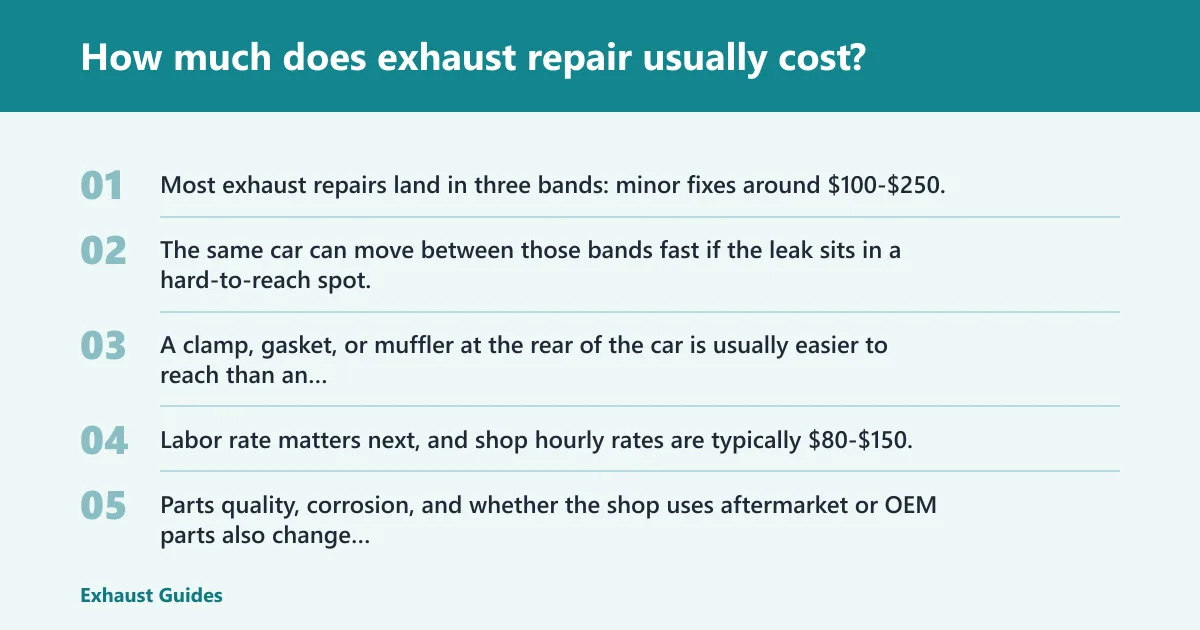


Most exhaust repairs land in three bands: minor fixes around $100-$250, mid-level repairs around $300-$650, and major repairs around $800-$1,200 or more. The same car can move between those bands fast if the leak sits in a hard-to-reach spot, fasteners are rusted, or the shop finds more than one damaged section.
What changes the price fastest
Failure location matters first. A clamp, gasket, or muffler at the rear of the car is usually easier to reach than an exhaust manifold at the engine. Labor rate matters next, and shop hourly rates are typically $80-$150. Parts quality, corrosion, and whether the shop uses aftermarket or OEM parts also change the bill.
What an exhaust leak can do
A leak often sounds like ticking, hissing, or a deeper-than-normal exhaust note. Depending on the location, it can affect fuel economy and, in a worst-case scenario, let carbon monoxide enter the cabin. That is why a small noise near the manifold or flex section should not be treated like a cosmetic issue.
📊 Clamps and gaskets cost $10-$40 each. Source: How Much Does Exhaust Leak Repair Cost and What to Expect.
Which exhaust repair location drives the bill?
The repair location usually decides whether the quote feels cheap or expensive. Rear exhaust pieces often stay in the lower or middle price bands, while engine-mounted parts and emissions-related parts push the total higher because they need more labor, more diagnostics, or both. Rust can move any of these jobs upward.
Exhaust leak locations and typical repair pressure
Common leak points include clamps, flange gaskets, flex pipes, mufflers, pipe sections, manifolds, and catalytic converter connections. A leak near the rear of the car usually points to a lower-cost repair. A leak near the engine or converter usually means more labor, tighter access, and a larger final estimate.
| Failure location | Parts range | Labor range | Total estimate range | Typical note |
|---|---|---|---|---|
| Clamp or gasket | $10-$40 each | $50-$150 | $100-$250 | Often a minor fix if the pipe is sound |
| Muffler | $50-$250 standard; $200-$600 performance | $75-$250 | $150-$650 | Usually cheaper than manifold work |
| Exhaust pipe section | $30-$150 steel; $100-$300 stainless | $100-$300 | $150-$600 | Corrosion often decides whether patching is worth it |
| Exhaust manifold | $150-$800+ | $300-$800+ | $500-$1,500+ | Hard access usually drives labor higher |
| Catalytic converter | $200-$1,200 before labor | $200-$600+ | $500-$1,800+ | Often the most expensive exhaust component |
Muffler and tailpipe repairs
Muffler work is usually one of the lower-cost exhaust repairs because the part sits farther back and is often easier to access. A standard muffler usually costs $50-$250, while performance mufflers cost $200-$600. Tailpipe damage can sometimes be repaired separately if the rest of the exhaust is still solid.
Exhaust pipe sections and clamps
Pipe sections sit in the middle of the cost range. Steel sections usually cost $30-$150, while stainless sections cost $100-$300. Clamps and gaskets are cheaper parts at $10-$40 each, but rusty hardware can add time. If the surrounding metal is thin, a patch may fail quickly and replacement makes more sense.
Exhaust manifold repairs
Exhaust manifold work is usually more expensive than muffler or tailpipe repairs because the manifold is engine-mounted and harder to reach. Heat cycling, broken studs, and cramped access can drive labor up fast. A quote that looks high at first may be reasonable if the shop must remove seized fasteners or clear nearby components.
Catalytic converter replacement
Catalytic converter replacement is often the priciest exhaust job. The part alone usually costs $200-$1,200 before labor, and emissions-related diagnostics can add more. If the converter is damaged, plugged, or stolen, compare the quote carefully because the total often includes sensor work, gaskets, and emissions checks.
How much does muffler repair usually cost?
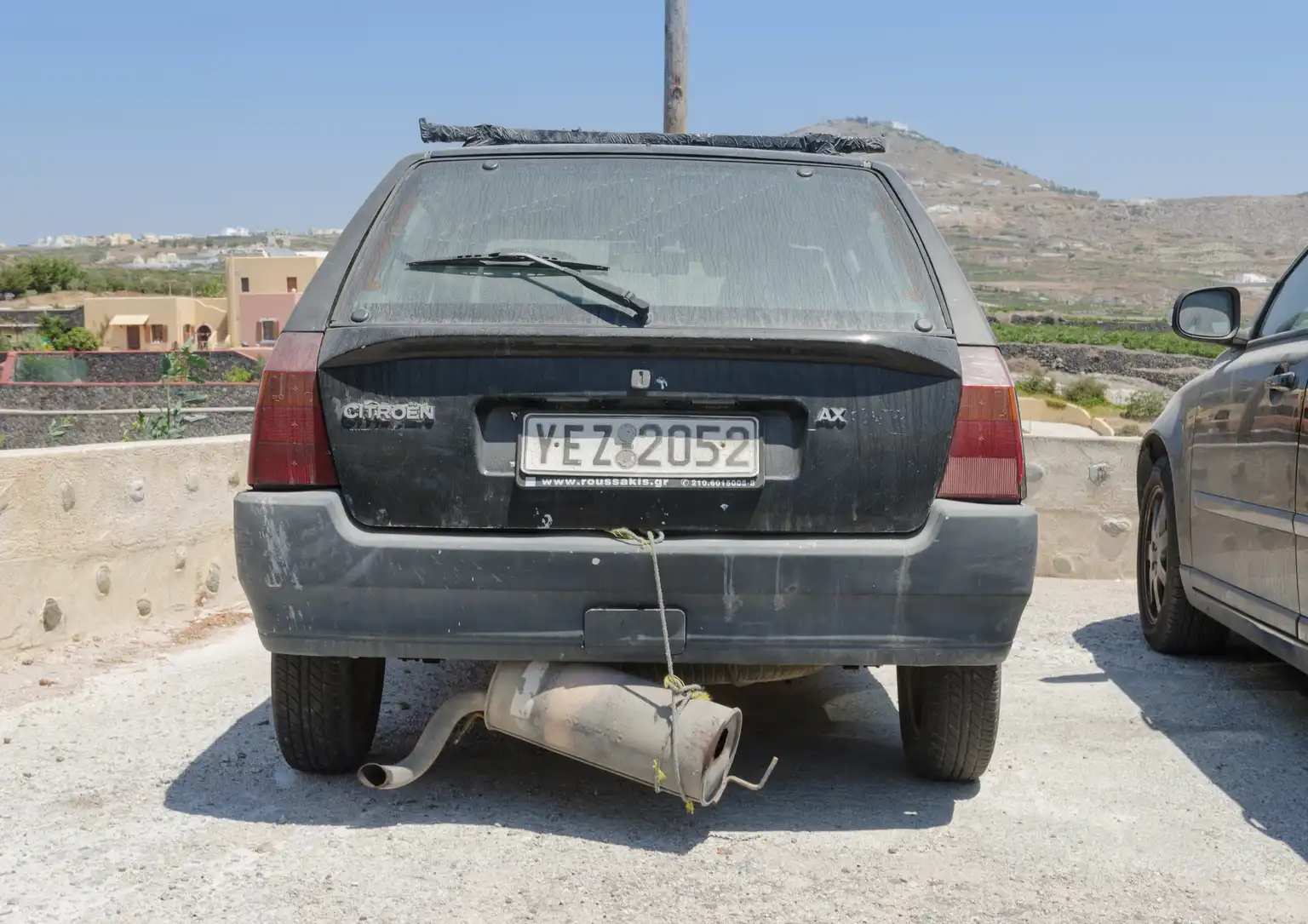
Muffler repair often costs somewhere in the low hundreds, depending on whether the shop replaces the muffler alone or also needs to deal with rusted pipe, hangers, or nearby clamps. Standard mufflers sit at the low end. Performance mufflers cost more, and a badly corroded rear section can move the job into the mid-range.
When a muffler can be replaced separately
If the muffler is the only damaged piece and the connecting pipes are still solid, the repair is often straightforward. That is one reason muffler work is usually cheaper than manifold work. If the flanges, hangers, or nearby pipe are rusted through, the quote may grow because the job is no longer a simple swap.
Standard muffler vs performance muffler pricing
Standard mufflers usually cost $50-$250. Performance mufflers cost $200-$600. The difference matters because the part price alone can change the whole estimate, especially on vehicles where labor is similar. For a daily driver, aftermarket standard mufflers are often the lower-cost option when fit and emissions rules still match the vehicle.
What else can change an exhaust quote?
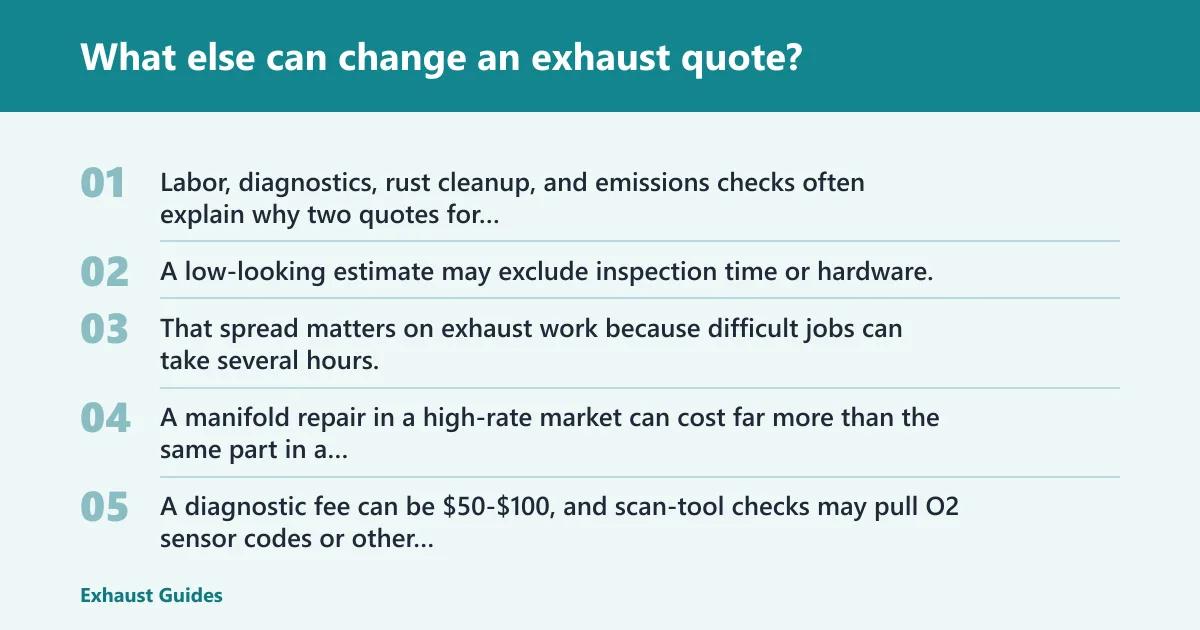
Labor, diagnostics, rust cleanup, and emissions checks often explain why two quotes for the same symptom differ by hundreds of dollars. A low-looking estimate may exclude inspection time or hardware, while a higher one may include everything needed to finish the repair cleanly and pass inspection.
Shop labor rate and local market differences
Shop hourly rates are typically $80-$150. That spread matters on exhaust work because difficult jobs can take several hours. A manifold repair in a high-rate market can cost far more than the same part in a lower-rate area, even if the parts line looks similar.
Smoke tests and scan-tool diagnostics
Smoke tests usually add $30-$70 to the bill. A diagnostic fee can be $50-$100, and scan-tool checks may pull O2 sensor codes or other related faults. If the shop charges for both diagnosis and smoke testing, ask whether one fee is being applied toward the repair or billed twice.
Rust cleanup, broken fasteners, and seized hardware
Rust is a common cost driver on older and salt-belt vehicles. Corroded clamps, welded joints, and broken studs add labor and material cost. Some shops charge separately for rust treatment or extra hardware, while others fold it into labor. A quote that mentions rust cleanup is often more realistic than one that does not.
Emissions testing and inspection fees
After certain repairs, emissions testing may be required and can add to the final bill. That matters most when the repair affects a converter, oxygen sensor code, or another emissions-related part. The repair itself may be fine, but the car still needs a test or inspection to confirm compliance.
How to read the cost matrix by part and labor
Think in three columns: parts, labor, and add-ons. A low parts price does not mean a low total if labor is high. The matrix below helps you compare a quote against the failure location instead of against a vague “exhaust repair” label.
Common add-ons to check line by line
Ask whether the estimate includes gaskets, clamps, sensors, shop supplies, and hardware. Aftermarket parts are often cheaper than OEM parts, but fit and quality still matter. On simple rear-exhaust repairs, aftermarket pieces are usually the lower-cost option. On emissions-related parts, confirm that the part type matches the vehicle and local rules.
- Identify the failed section first: muffler, pipe, manifold, converter, clamp, or gasket.
- Compare parts, labor, and diagnostics separately.
- Check whether rust cleanup or broken hardware is listed.
- Ask whether emissions testing is included or extra.
- Compare at least two quotes for the same failure location.
Should you repair, patch, or replace the section?
Use the condition of the metal, not just the noise, to decide. A small clamp or gasket problem can often be fixed cheaply. A thin, rusted pipe section usually should be replaced instead of patched. If corrosion has spread beyond one joint, the larger repair often costs less over time than repeated small fixes.
Simple clamp or gasket fixes
These are the least expensive jobs and can be reasonable when the surrounding pipe is still healthy. Because clamps and gaskets cost $10-$40 each, the bill is often driven by labor rather than parts. A shop may recommend this route when the leak is isolated and the rest of the exhaust is still solid.
When a pipe section is better than a patch
If the pipe has pinholes, flaking rust, or a split near a weld, replacement is usually the cleaner option. A steel section often stays cheaper than stainless, but stainless can make sense when corrosion is already a pattern. A patch can be a short-term fix; replacement is usually the better call when the metal is thin.
When corrosion makes replacement the better call
On older cars and salt-belt vehicles, one damaged section often hints at more rust nearby. In that situation, replacing the section can stop the bill from growing through repeat visits. Suppose a rear pipe has one rust hole and the hanger mount is soft; a shop may price a bigger section now rather than chase another failure later.
How can you keep exhaust repair costs down?
Compare quotes for the same failure location, not just the same symptom. Ask for line-item pricing and make sure each estimate names the part, labor time, and any diagnostic or emissions fees. That is the best way to spot duplicated charges or an unnecessary full-section replacement.
Ways to compare quotes
Ask whether the shop is quoting aftermarket or OEM parts, whether the price includes clamps and gaskets, and whether rust cleanup is extra. A common first-timer mistake is comparing a bare-bones muffler price with another shop’s complete installed quote. Those are not the same number.
When DIY makes sense
DIY is only reasonable for simple clamp, hanger, or tailpipe issues. Once the job involves a manifold, converter, sensor codes, seized fasteners, or emissions equipment, the risk of making the repair larger is too high for most owners. Exhaust work also sits near hot components and underbody rust, so safety matters.
Frequently asked questions
How much does exhaust repair cost?
Exhaust repair usually costs $150 to $1,200, but the exact number depends on the failed part and how hard it is to reach. Minor clamp or gasket fixes are often near the low end. Manifold and catalytic converter work can move the total well above $1,000.
How much does muffler repair usually cost?
Muffler repair usually costs $100-$650, with standard mufflers on the lower end and performance mufflers higher. If the surrounding pipe is rusted, the labor portion may grow. That is why one muffler quote can look much cheaper than another even for the same noise complaint.
How much does exhaust leak repair cost?
Exhaust leak repair can cost $100-$250 for a small clamp or gasket fix, then climb into the mid-range if the leak comes from a pipe section or muffler. Leaks near the manifold or converter cost more because access is harder and diagnostics often take longer.
How much does exhaust manifold repair cost?
Exhaust manifold repair often costs $500-$1,500 or more because the part is engine-mounted and labor is usually the main cost driver. Broken studs, tight access, and heat damage can raise the bill further. If a quote is high, ask for the labor hours and hardware list.
How much does exhaust pipe repair cost?
Exhaust pipe repair usually falls in the mid-level range, often around $150-$600 depending on whether the shop replaces a steel section or a stainless section. Rusted pipes on older vehicles can cost more because cutting, fitting, and cleaning seized joints take extra time.
How much does exhaust work cost?
Exhaust work can mean anything from a $100 clamp fix to a $1,200-plus major repair. The best way to judge a quote is by the failure location, not the word “exhaust” by itself. Ask for separate lines for parts, labor, diagnostics, and emissions testing.