
What Causes Exhaust Rust on Short Trip Cars
Short trips keep the exhaust cold long enough for water vapor to condense inside the pipes and stay there; if rust has reached holes, flaking seams, or an exhaust leak, repair time starts. Left alone, that can mean louder noise, failed hangers, broken pipes, and in some cars dangerous carbon-monoxide leakage. This guide explains why short-trip driving speeds corrosion, which exhaust parts fail first, and when rust is only cosmetic versus a safety problem.
Why short trips leave exhausts wet inside
Short trips can leave the exhaust wet inside. Cold starts make a lot of water vapor, but about a five- or ten-minute drive often does not get the pipes hot enough to drive that moisture back out. The result is a moisture-and-heat-cycle problem: each start adds water, each brief warm-up expands the metal, and each shutdown leaves condensate behind.
Cold starts and trapped condensate
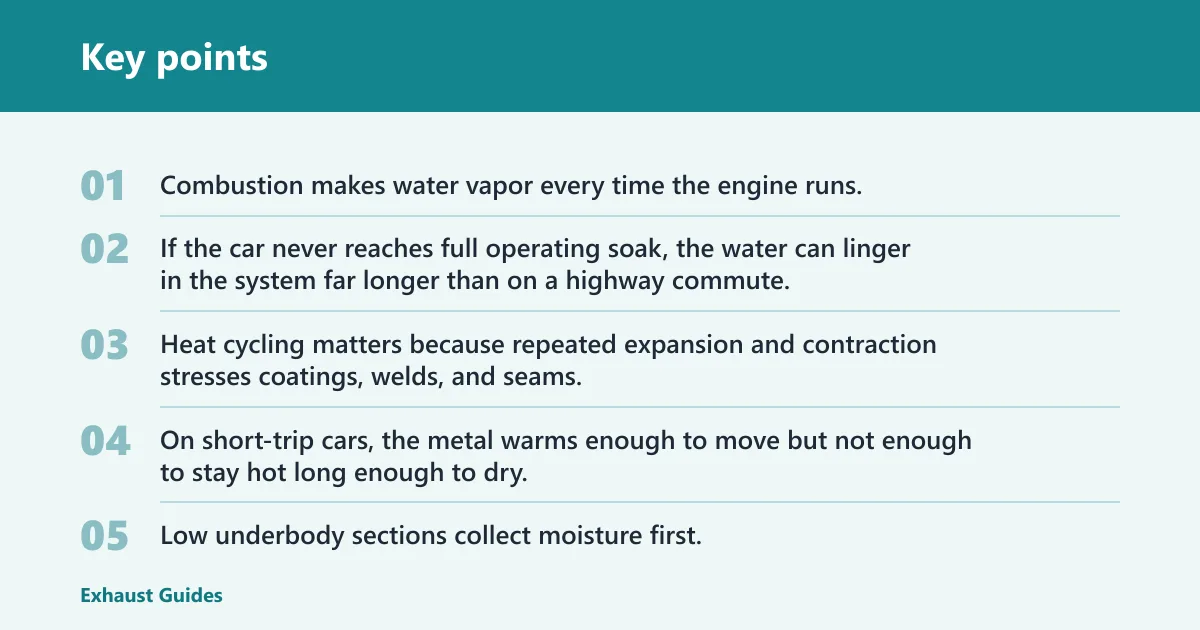
Combustion makes water vapor every time the engine runs. On a cold exhaust, that vapor condenses on the pipe walls, low spots, seams, and muffler shells, then pools until the next long hot run. If the car never reaches full operating soak, the water can linger in the system far longer than on a highway commute.
Heat cycling without full dry-out
Heat cycling matters because repeated expansion and contraction stresses coatings, welds, and seams. On short-trip cars, the metal warms enough to move but not enough to stay hot long enough to dry. That combination speeds coating breakdown, opens tiny seam defects, and gives rust a place to spread.
Short commutes and low spots
Low underbody sections collect moisture first. A rear muffler, a resonator mounted below the floor, or a tailpipe section with a slight droop can hold condensate after shutdown. Once water sits there, oxygen and road contamination keep working on the metal between drives.
What condensation does inside the exhaust
Exhaust condensation is water vapor from combustion that turns back into liquid when the pipe is still too cool. That water is not always plain water for long. It mixes with exhaust byproducts and can become mildly acidic, which makes trapped moisture more corrosive than a dry pipe surface would be.
Acidic condensate and seam attack
When condensate sits in seams, at weld toes, or around clamp joints, it attacks the thinnest material first. Seams and welds have stress, texture changes, and coating gaps, so they often rust faster than smooth pipe wall. A drain hole can help only if it stays open and the muffler design lets liquid escape.
Why mufflers hold moisture longer
Mufflers are often among the first rust-through points because they are large internal cavities that can cool slowly in some areas and trap moisture in others. Many have baffles and chambers that hold condensate after shutdown. If the rear section stays cooler longer, the water does not flash off quickly, so internal corrosion can start before the shell looks bad outside.
What parts of the exhaust rust first?
The muffler often fails first, then the resonator, then the tailpipe, though layout can change the order. The parts that sit lowest, run coolest, or have the weakest drainage are the ones that trap moisture and salt the longest. Surface rust often appears on the outside first, but internal rust-through is the more serious failure.
Muffler as a moisture trap
The muffler is often the first rust-through point because it acts like a tank for condensed water. Drain-hole design, seam shape, and internal baffles decide how well it empties. A muffler with poor drainage can look only mildly rusty outside while thinning from the inside.
Resonator corrosion and underbody airflow
Resonators often sit in cooler underbody airflow, so they may not retain heat long enough to dry out after short trips. Their seams and welds are frequent corrosion points. If the resonator is tucked under the floorpan or near splash zones, it can collect a mix of condensate, grit, and salt spray.
Tailpipe rust from spray and debris
The tailpipe is exposed to road spray, slush, and grit from behind the wheels. It may show surface rust before any leak appears. That is common, but if rust starts at the seam, the hanger area, or the tip connection, the issue is more than cosmetic.
Short-trip exhaust rust risk map
This map shows where moisture tends to pool and which driving patterns make those zones fail first. Risk rises when cold starts are frequent, winter salt is present, and the exhaust never gets a long dry-out run. The most common pattern is not one cause, but two at once: repeated condensate plus salt on the underside.
| Driving pattern | Manifold area | Mid-pipe | Resonator | Muffler | Tailpipe |
|---|---|---|---|---|---|
| 5-10 minute winter errands | Low risk; surface rust near flange; brief heat, little pooling | Medium; seam rust; pipe warms, then cools before dry-out | High; seam corrosion; cooler underbody air keeps condensate in place | Very high; internal rust-through; chamber traps water after shutdown | Medium; surface rust; spray and slush stick to rear section |
| Stop-and-go city commute | Low; flange oxidation; repeated starts add moisture but heat helps briefly | Medium; clamp and weld rust; short runs never fully dry low spots | High; weld corrosion; frequent cooling leaves residue in seams | Very high; drain-hole blockage or seam failure; condensate stays trapped | Medium; exterior rust; road grime and curb splash hit the rear |
| Two to three short trips daily | Medium; gasket-edge corrosion; multiple cold starts add water each day | High; scale loss at seams; repeated heat cycling opens coating damage | High; pocket rust; water collects after each shutoff | Very high; first leak likely; internal moisture plus frequent cool-down | Medium; cosmetic rust; exposed metal stays wet between trips |
| Year-round suburban driving | Low; flange discoloration; enough heat for partial dry-out on longer drives | Medium; coating wear at clamps; minor pooling still occurs in low spots | Medium; seam rust; some dry-out, but not on every drive | High; shell thinning; rear section often stays damp longer than pipe | Low to medium; surface rust; spray exposure, but regular drying helps |
| Highway use with weekly salt exposure | Medium; bolt and flange corrosion; hot runs dry moisture, salt still attacks | Medium; coating breakdown at welds; salt stays on underside after winter drives | Medium; seam rust; spray lands on a warm but still wet housing | High; hanger and seam rust; salt plus condensate speed loss | Medium; exterior pitting; rear spray zone keeps metal contaminated |
| Short trips on salted roads and slush | Medium; joint rust; salt residue clings after each wet drive | High; seam and clamp rust; trapped slush adds chlorides to condensation | Very high; weld failure; underbody airflow keeps the area wet and salty | Very high; rust-through near seams; moisture, salt, and cold all combine | High; surface and edge rust; constant spray exposure from behind the wheels |
Why salt makes the problem worse
Road salt adds a second corrosion path. It sticks to the underside after winter driving, mixes with slush, and stays wet longer than plain water. That makes the exhaust corrode faster even if the car gets occasional longer drives, because salt keeps the metal damp and electrically active.
Road salt on the underside
Salt speeds electrolytic corrosion on coated and bare steel alike. It is worst on salted roads, in wheel spray, and in slush that packs around brackets, seams, and the rear of the system. A short trip after a salted drive can be enough to leave the underside wet until the next day.
Corrosion at welds and seams
Welds, clamps, and folded seams are where coatings thin out first. Salt and heat cycling work together there. The metal expands and contracts, the coating cracks, and the saltwater film keeps feeding rust in the same line until the seam starts to flake or separate.
What materials and layouts resist rust better?
Aluminized and galvanized steel resist rust better than plain steel, but the coating only delays corrosion. Stainless steel helps more, yet it is not rust-proof. Seams, clamps, and welds can still corrode, especially where salt, condensate, and heat cycling keep working on the same area.
Aluminized and galvanized steel
These are common OE and aftermarket materials because they slow corrosion at a reasonable cost. The coating blocks oxygen and moisture at first, but once it breaks at a seam, chip, or weld, rust can spread under the edge. That is why a coated exhaust can still fail early on short-trip cars.
Stainless steel weak points
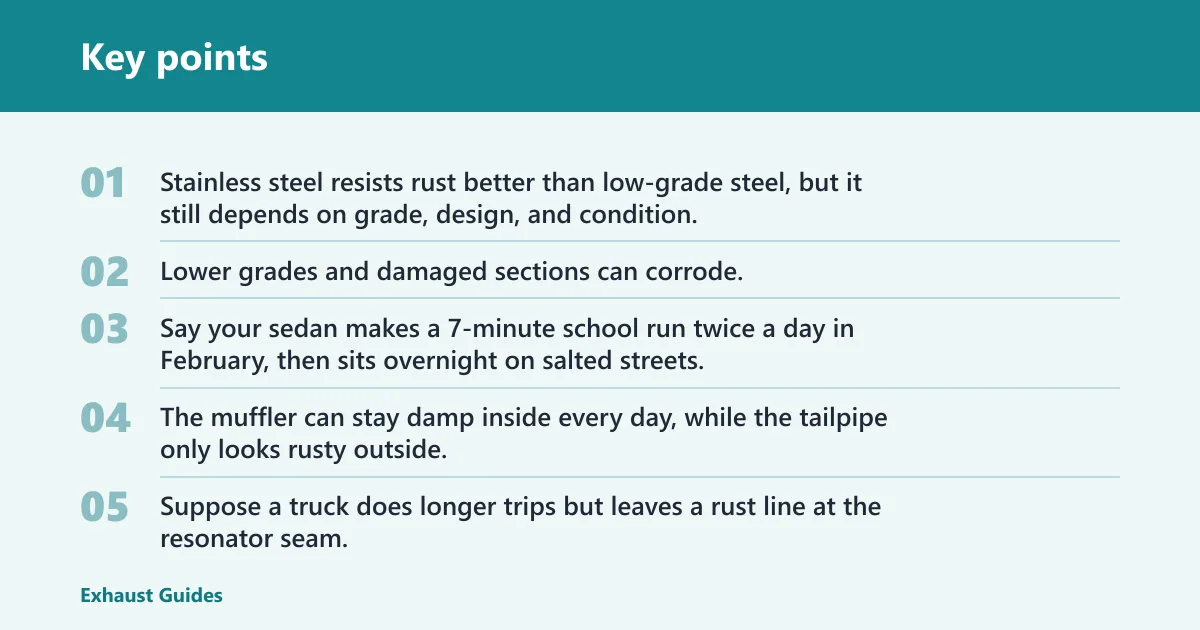
Stainless steel resists rust better than low-grade steel, but it still depends on grade, design, and condition. Lower grades and damaged sections can corrode. Clamps, hanger straps, welds, and heat-affected zones are common weak points, so a stainless system can still need repair if moisture is trapped.
How layout changes moisture pooling
A long low mid-pipe, a rearward muffler, or a resonator tucked under a cooler section of the floor can all hold condensate longer. Vehicles with low ground clearance, long rear overhangs, or exhaust routing that dips before the muffler tend to trap more water. Layout matters as much as material.
Say your sedan makes a 7-minute school run twice a day in February, then sits overnight on salted streets. The muffler can stay damp inside every day, while the tailpipe only looks rusty outside. That pattern points to internal moisture retention, not just age.
Suppose a truck does longer trips but leaves a rust line at the resonator seam. The issue may be the underbody location and salt spray, not short trips alone. A layout that sits in direct wheel spray can corrode faster than a system with better drainage.
When exhaust rust is more than surface corrosion
Rust becomes a safety issue when it creates holes, flaking scale, exhaust leaks, or hanging sections. Cosmetic surface rust is common on a used car. Rust-through, cracked seams, and failed hangers are different because they can change exhaust flow, make noise worse, and let fumes escape.
Holes and exhaust leaks
A hole in the muffler, resonator, or pipe can produce a sharper exhaust note, soot around the leak, and a smell near the cabin or rear of the car. If the leak is upstream or under the floor, repair becomes more urgent because exhaust can enter the vehicle body more easily.
Flaking scale and seam failure
Heavy flaking means the steel has lost section thickness. If the rust starts at a seam, the part may fail from the inside out. Look for swelling, peeling layers, and soft spots around welds, because those signs often appear before an actual break.
Hanging sections and repair timing
When a pipe sags or a hanger tears, the exhaust can strike the body or pavement. That is no longer a cosmetic problem. A hanging section can crack the next weld, enlarge an existing leak, or separate enough to create a sudden noise change and a safety hazard.
How can I prevent exhaust rust if I only make short trips?
You can slow rust by removing salt, giving the exhaust a longer hot run, and checking the parts that trap water. Those steps work because they target the mechanism: trapped condensate, salt film, and damaged coatings. None of them stops corrosion forever, but they can delay rust-through.
Wash the underside. Rinse salt and slush off the floorpan, muffler, resonator, and tailpipe after winter driving. Focus on seams, hangers, and rear spray zones, because salt left there keeps moisture active.
Drive long enough to dry out. Give the car a steady run that reaches full operating temperature and holds it there long enough to dry the system. Short errands do not do that, but a longer hot drive can boil off some retained condensate.
Inspect drains and seams. Check for blocked drain holes, soft spots, rust blisters, and seam cracks on the muffler and resonator. Those are the spots where trapped water becomes rust-through first.
Look at clamps and hangers. Rust at hangers and clamps can spread into the pipe next to them. Replace parts that are thinning, not just stained, because the coating has already failed there.
Frequently asked questions
What causes exhaust rust on short trip cars?
Short trip cars rust faster because the exhaust stays cold long enough for water vapor to condense and sit inside the system. Each cold start adds moisture, and the next short shutdown leaves it behind. If road salt is present, that moisture becomes more corrosive and stays active longer.
Why does my car rust faster when I only drive short distances?
Short distances create repeated cold starts without full dry-out. The exhaust heats, expands, and cools again before the water has time to leave. That cycle stresses seams and coatings, while any salt on the underside keeps the metal wet and speeds corrosion in the same spots.
How do short trips make exhaust rust worse?
They keep the exhaust in the temperature range where condensation forms but does not fully evaporate. The muffler, resonator, and low pipe sections hold liquid longer than the rest of the system. That trapped moisture attacks seams, welds, and drain areas from the inside.
Is exhaust rust normal on a car that is driven mostly around town?
Some surface rust is common, especially on coated steel parts and around seams. What is not normal is rust-through, flaking scale, or an exhaust leak from a muffler or resonator that should still have structural life left. Those signs mean the corrosion has moved beyond cosmetics.
What parts of the exhaust rust first on short-trip cars?
The muffler usually goes first because it traps condensate inside. Resonators often follow, especially when they sit in cooler underbody airflow. Tailpipes can show external rust earlier because they face spray and debris, but the first serious failure is often a seam or chamber inside the muffler.
When is exhaust rust on a short-trip car dangerous?
It becomes dangerous when you see holes, flaking seams, hanging sections, or a leak near the cabin floor. Those issues can increase noise, damage hangers, and allow exhaust gas to escape. If rust has reached that stage, the part should be repaired or replaced, not monitored.