Signs Your Exhaust Is Rusting From the Inside
If rust is flaking from seams, holes appear along the muffler or pipes, or the exhaust gets louder, the rust is likely active and replacement is due; light surface rust on the outside alone is often cosmetic. Left alone, inside-out corrosion can turn into leaks, fumes in the cabin, broken hangers, and a repair that costs far more once the pipe fails. Check rust location, sound changes, seams, and moisture trails to sort cosmetic rust from structural failure.
Exhaust rust severity table
This table separates surface rust on an exhaust pipe from rust that is already weakening the system. Match what you see on the pipe, muffler, hanger, and clamp with the sound or smell changes, then use the next step as your cutoff.
| Severity | What it looks like | Sound or smell changes | Next step |
|---|---|---|---|
| Cosmetic rust | Orange-brown film on the outside of the pipe or muffler; no holes; hanger and clamp still solid; seams intact. | No new noise; no exhaust smell; no rattles or vibration beyond normal. | Monitor it. Clean off loose scale, wash the underside after salt exposure, and recheck at the next oil change. |
| Active corrosion | Flaking scale, bubbling at welds, thinning metal near seams or bends, rust on hanger mounts, rusted clamp threads, or black soot around joints. | Louder exhaust note, hissing, rumbling, popping, drone, rattles, or a faint exhaust smell near the rear or underbody. | Repair locally if the metal around the damage is still firm; otherwise plan replacement soon. |
| Unsafe-through-rust | Holes, soft metal, separated seams, cracked welds, sagging hanger points, or a clamp that no longer holds the joint aligned. | Strong exhaust smell, fumes in the cabin, sharp noise jump, floor vibration, or movement that changes with engine speed. | Replace now. If fumes reach the cabin, stop driving and inspect as soon as possible. |
What inside-out exhaust rust looks like
Inside-out rust starts where moisture stays trapped, especially in mufflers and low points in the pipes. Exhaust systems are attacked from both the inside and outside by moisture, and short drives can prevent the muffler from getting hot enough to dry internal moisture. That is why the worst damage often starts at seams, drains, and bends, not the most visible outer face. The EPA notes that carbon monoxide is odorless and dangerous, which is why leak symptoms should be treated as a safety issue, not just a noise problem.
Why condensation starts corrosion inside mufflers and pipes
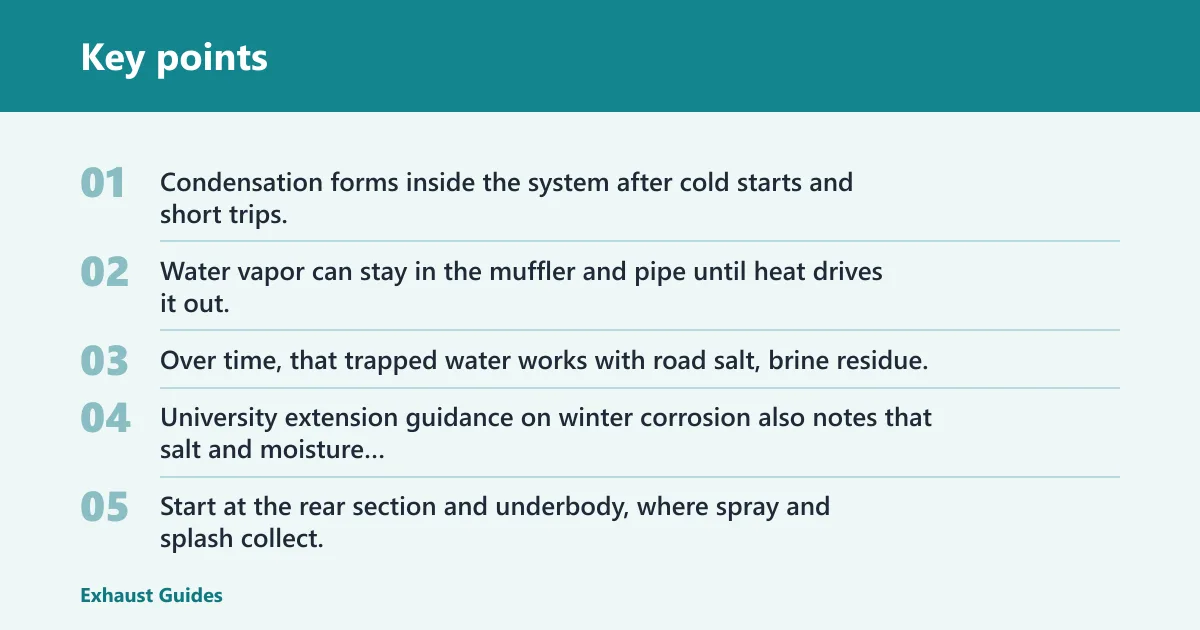
Condensation forms inside the system after cold starts and short trips. Water vapor can stay in the muffler and pipe until heat drives it out, so repeated short trips may leave moisture behind. Over time, that trapped water works with road salt, brine residue, and dirt to attack the metal from the inside. University extension guidance on winter corrosion also notes that salt and moisture accelerate rust on exposed metal parts, which makes repeated wet-and-salty use harder on exhaust components.
Where to look first: rear pipe, muffler seams, clamps, and hangers
Start at the rear section and underbody, where spray and splash collect. Look closely at muffler seams, pipe joints, clamps, and hanger brackets. Rust that is worse around a seam than on the nearby flat surface usually points to inside-out corrosion, joint failure, or trapped moisture rather than simple outside staining.
How short trips, salt, and wet storage speed the process
Short-trip driving can leave moisture inside the exhaust. Road salt is a major rust trigger for exhaust systems because it holds moisture against metal and speeds corrosion; wet storage keeps the underside damp longer than normal. Beach-area vehicles face a similar problem because salt air and spray leave residue on the underbody, then keep pulling moisture back to the metal. NIOSH’s carbon monoxide guidance also underscores why a leaking exhaust system is more than a comfort issue.
Exhaust rusting from inside matrix
Use this component-by-component check when the exhaust is rusty but the symptom is not obvious. The goal is to match the rust pattern to the failing part, then decide whether a clamp, hanger, or short section can be repaired or whether the system is at replacement level.
| Part | Visual pattern | Likely sound or smell | Risk level | Repair cutoff |
|---|---|---|---|---|
| Pipe | Scaling, thinning, or pinholes on a straight section; rust concentrated where spray hits the underside or near bends. | Sharp hiss, louder exhaust note, or a faint exhaust odor near the underbody. | Moderate to high, depending on wall thickness and leak size. | Repair if the surrounding metal is still firm and the affected section is short; replace when holes, soft spots, or seam loss spread. |
| Muffler | Rust around the shell, seam line, or end caps; bubbling at the seam; flakes at the canister edge. | Drone, dull rumble, louder overall exhaust note, or rattling from loose internal material. | Moderate to high because noise and leakage often progress together. | Replace when seams open, the shell thins, or the muffler no longer controls sound. |
| Hanger | Rust at the bracket, cracked rubber, sagging pipe angle, or shiny rub marks where the exhaust touches the body. | Clunking, vibration, tapping, or intermittent contact over bumps. | Moderate, but it can become high if the pipe shifts into other parts. | Repair early if the pipe itself is sound; replace when the hanger is bent, broken, or nearly eaten through. |
| Clamp | Rusty threads, swollen clamp bands, soot at the joint, or movement where the pipes should be locked together. | Hiss at the joint, exhaust leak sound, or a change in noise when the engine loads and unloads. | Moderate, but seized hardware can make the job expensive. | Replace the clamp if it still releases cleanly; move to section replacement when threads seize or the joint will not stay aligned. |
Cosmetic rust: what it looks and sounds like
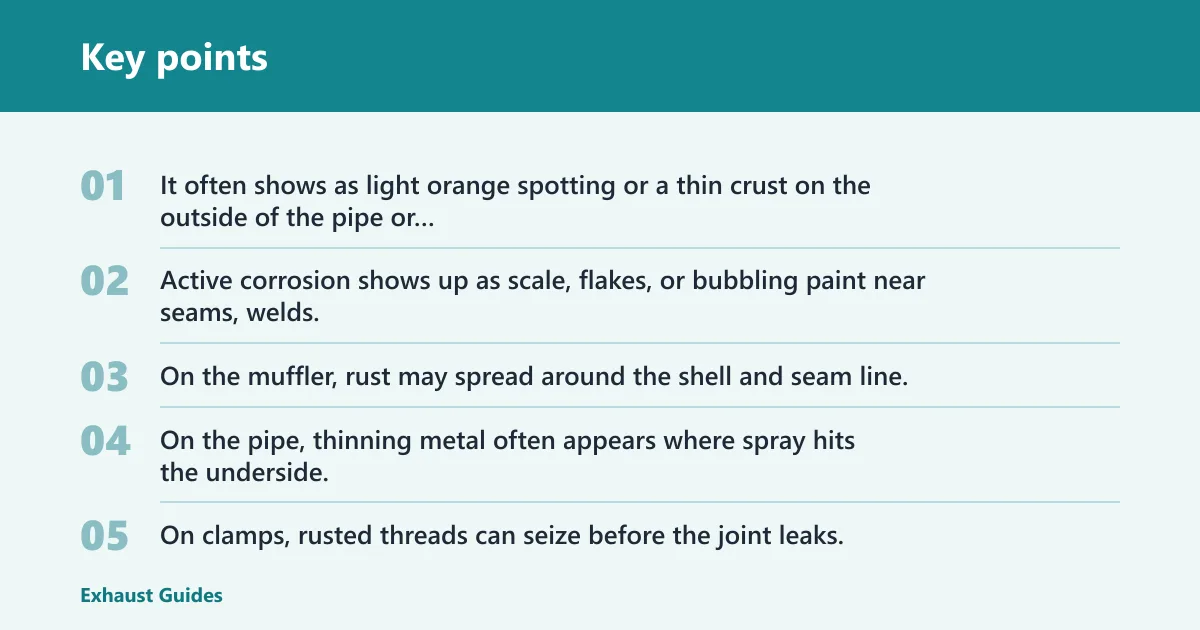
Cosmetic rust stays on the surface. It often shows as light orange spotting or a thin crust on the outside of the pipe or muffler shell, with no movement at the hanger and no soot marks around joints. Sound usually stays the same.
Active corrosion: warning-stage signs by part
Active corrosion shows up as scale, flakes, or bubbling paint near seams, welds, and bends. On the muffler, rust may spread around the shell and seam line. On the pipe, thinning metal often appears where spray hits the underside. On clamps, rusted threads can seize before the joint leaks.
Unsafe-through-rust: replace-now signs and symptoms
Unsafe-through-rust means the metal is no longer reliable. Holes, split seams, or a hanger bracket that is nearly eaten through can let the exhaust move, leak, or separate. If the cabin smells like exhaust, the problem moves into immediate-inspection territory because carbon monoxide exposure is possible.
What are the first signs of exhaust rust?
The first signs are usually flaking scale, bubbling at seams, soft metal, or black soot near a joint. Sound changes often follow: the exhaust gets louder, starts to drone, or makes hissing, rumbling, or popping noises. A smell change, especially exhaust odor near the rear or underbody, means the rust may already be opening a leak.
Flaking scale, soft metal, and seam bubbling
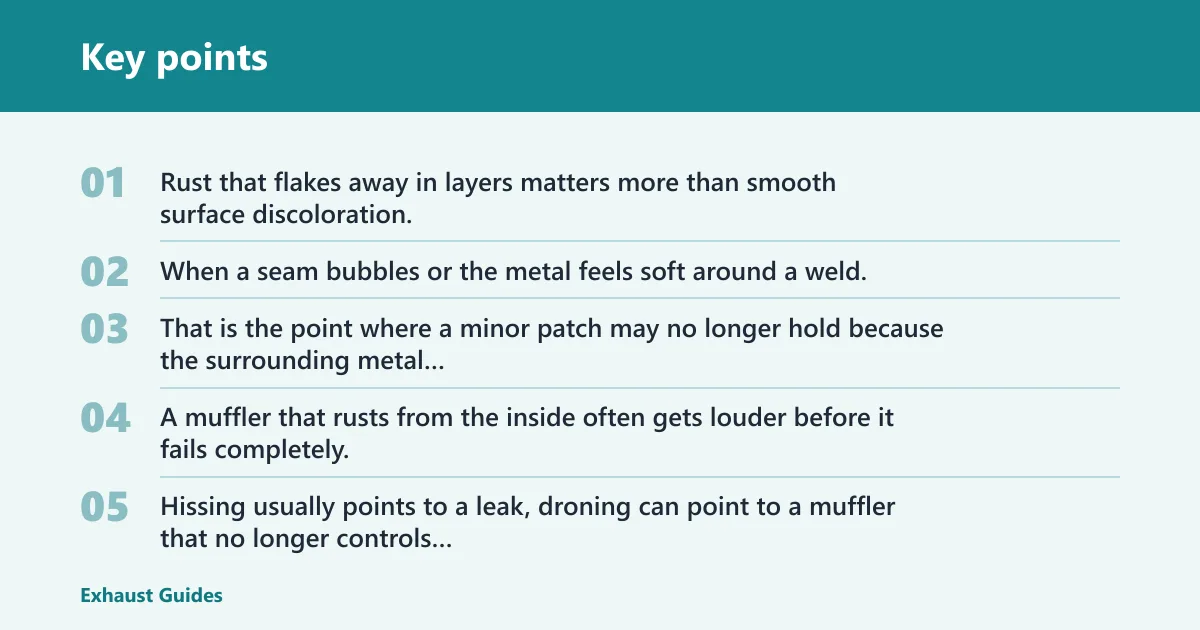
Rust that flakes away in layers matters more than smooth surface discoloration. When a seam bubbles or the metal feels soft around a weld, the corrosion is working inward. That is the point where a minor patch may no longer hold because the surrounding metal has thinned.
Rattles, droning, or a louder exhaust note
A muffler that rusts from the inside often gets louder before it fails completely. Hissing usually points to a leak, droning can point to a muffler that no longer controls flow well, and rattling can come from loose rust scale inside the muffler or a hanger that can no longer steady the system.
Soot marks, fumes, or a change in tailpipe smell
Black soot near a seam or clamp often suggests exhaust gas may be escaping there. If you smell exhaust near the cabin or floor, treat it as a leak until proven otherwise. That is especially important if the smell changes when the car idles, accelerates, or sits at a stoplight.
Say your sedan has a rusty muffler shell and a damp-looking seam line after a week of short errands. If the rust is only on the outside, it may still be cosmetic. If the same seam also hisses at idle and leaves black soot on the joint, the problem has moved into active leakage.
How do you tell which part is failing?
You can separate pipe, muffler, hanger, and clamp problems by matching the rust pattern to the symptom. Pipe damage usually brings leaks or soot along a straight section. Muffler failure often brings drone or a louder note. Hanger failure causes sagging and vibration. Clamp failure causes separation, movement, or a leak at a joint.
Pipe damage versus muffler damage
Exhaust pipe rust tends to show up as scaling, thinning, or holes along exposed sections, especially under the body and near the rear. Muffler rust often starts around seams and the shell, then changes the sound. A pipe leak is more likely to make a sharp hiss or a direct noise increase, while muffler failure more often changes the overall tone.
Hanger failure: sagging, vibration, and contact marks
An exhaust hanger supports alignment. When it rusts, the system can sag, swing, or tap against the body or suspension. Look for shiny rub marks, fresh contact points, or a pipe that sits lower than the rest of the system. A failing hanger can create rattles even when the pipe itself is still intact.
Clamp failure: leaks, separation, and seized threads
An exhaust clamp holds pipe connections together. Rusted threads can seize, which makes later repair harder, and a weakened clamp can let the joint open under vibration. If you see soot around the clamp, hear a hiss at the joint, or notice the pipe can be moved by hand, the clamp is no longer doing its job.
How can you inspect the exhaust at home?
Use a flashlight, a careful touch, and a few simple checks. Look for seam bubbling, rust at welds, soot around joints, and movement at hangers or clamps. If the metal feels soft, the joint shifts, or the smell changes, stop treating it as surface rust and move to repair or replacement planning.
- Park on level ground and let the exhaust cool fully.
- Use a flashlight to trace the rear pipe, muffler seams, clamps, and hanger mounts.
- Look for flakes, bubbles, holes, black soot, or damp brine residue.
- Tap the pipe lightly with a fingertip or a small non-marring tool; thin metal often sounds duller.
- Check touchpoints for sagging, looseness, or metal that flexes more than expected.
- Confirm whether any smell, rattle, or louder note matches the rusty area you found.
A common first-timer mistake is checking only the visible side of the muffler. The underside, seam line, and hanger mount usually tell the better story, especially on winter cars where salt and moisture sit under the shell after road spray.
How do you stop exhaust rust from getting worse?
Wash road salt and brine off the underside, reduce trapped moisture with longer drives when appropriate, and inspect problem areas before small rust becomes thin metal. Stainless steel resists rust better than other exhaust metals, but it is not rust proof, and it still needs washing and inspection. A manufacturer technical resource from Walker Exhaust also notes that stainless systems generally outlast aluminized steel in corrosive conditions, though no exhaust material is immune forever.
Wash underside after winter driving or beach exposure
Routine underside washing helps remove rust-causing particles. That matters most for salt-belt drivers and beach-area vehicles, where brine and salt residue stay on the underbody after the road dries. Some drivers use undercoating, but results vary by product and application, so washing remains the cleaner first step.
Reduce condensation with longer drives when appropriate
Short drives keep moisture in the system. A longer trip that fully warms the muffler and pipes can help dry internal condensation, which is one reason repeated short-trip use is harder on exhaust parts. If the car is mostly used for errands, regular inspection matters more.
What stainless steel changes and why it still needs care
Stainless steel exhaust systems cost more than standard steel systems, and they resist rust better, but they still collect salt, moisture, and grime. That means you still need underside washing and regular checks at seams, clamps, and hangers. In coastal or salt-belt use, even stainless systems may need replacement sooner than expected.
Repair or replace rusted exhaust parts?
A local repair can hold when the metal around the damage is still firm and the problem is limited to a clamp, hanger, or short section of pipe. Replace the part when rust has thinned the shell, opened seams, or spread across multiple joints. If the cabin smells like exhaust, the repair moves to the front of the line.
When a local repair can hold
Small leaks at a joint, a worn hanger, or a clamp with intact pipe metal around it may be repairable. A shop can often replace the clamp, section of pipe, or hanger if the surrounding metal still has strength. That option makes sense when rust is localized and the system is still aligned.
When rusted bolts, clamps, or seams push you to replace
Rusted exhaust bolts can seize and snap during removal, which turns a small job into a larger one. If the clamp will not loosen, the seam is opening, or the pipe is thinning near the joint, replacement is often the better call. Coastal or salt-belt drivers may face faster turnover; some exhausts there are replaced every 3 to 4 years.
Why cabin fumes mean the job moves to the front of the line
Exhaust fumes inside the cabin are a serious health risk because of carbon monoxide. If you smell fumes while idling, driving, or after starting the car, do not wait for the next service visit. The EPA and NIOSH both warn that carbon monoxide can accumulate without obvious warning, so inspect the system right away and treat the leak as a safety issue, not a cosmetic one.
Frequently asked questions
What are some indicators of rusting?
Look for orange-brown scale, bubbling at seams, thinning metal, black soot around joints, and rust on hanger brackets or clamp threads. Sound changes matter too: a louder exhaust note, hissing, rumbling, or droning often means rust has reached a point where the system is leaking or moving.
Will stainless steel exhaust rust out?
Yes, stainless steel can still rust, even though it resists rust better than cheaper exhaust metals. Salt, moisture, and trapped condensation still attack seams, clamps, and welds over time. Stainless usually lasts longer, but it is not whether rust-proofing exhaust parts helps and still needs underside washing and inspection.