How to Choose the Right Exhaust Clamp Size
Measure the pipe’s actual outside diameter at the joint, then buy the clamp whose working range covers that largest OD. If the pipe ends differ, size to the larger end and match the clamp style to the joint. A clamp that is too small will not fit, and one that is too large can slip, crush pipe, or leak money through repeat repairs. This guide shows how to measure the joint, read clamp ranges, and pick the right size the first time.
How do you measure exhaust clamp size?
Measure the pipe outside diameter at the exact clamp location, not the inside diameter and not the advertised vehicle size. If the pipe is slightly out of round, take more than one reading around the circumference and use the largest one. That is the number that matters when you order the clamp.
Measure at the joint, not the part number
Exhaust pipe sizes are nominal, so the printed size can be approximate. Real systems often vary by brand, age, heat, and repair history. If the joint is meant to overlap, measure where the clamp will sit, including the larger end if the two ends differ.
Use a tape, then a fallback if space is tight
A flexible tape measure is the easiest tool. If you cannot fit a tape under the vehicle, wrap string, wire, a zip tie, or a paper strip around the pipe, mark the overlap, then measure that length with a ruler. Divide circumference by pi, 3.14159, to get OD.
- Clean loose rust and debris from the clamp zone.
- Measure the pipe around the intended clamp location.
- Repeat at least two points around the circumference.
- Use the largest reading if the pipe is imperfect.
- Match that OD to the clamp size band.
Convert circumference to diameter
If you only have circumference, divide by 3.14159. For example, a 9.42-inch circumference gives a 3.0-inch OD. That conversion is especially handy on cramped undercarriages where a tape cannot reach the full pipe face.
| Nominal exhaust size | Outside diameter | Circumference equivalent |
|---|---|---|
| 2.5 inch | 2.50 inch | 7.85 inch |
| 3.0 inch | 3.00 inch | 9.42 inch |
| 3.5 inch | 3.50 inch | 10.996 inch |
| 4.0 inch | 4.00 inch | 12.57 inch |
What size exhaust clamp do you need?
You need the clamp size band that covers the measured OD at the joint. Common exhaust clamp sizes run from 2 inch through 5 inch, with frequent bands at 2.5, 3.0, 3.5, and 4.0 inch. Choose the band that matches the actual pipe, then confirm the joint type before ordering.
Clearer sizing rule
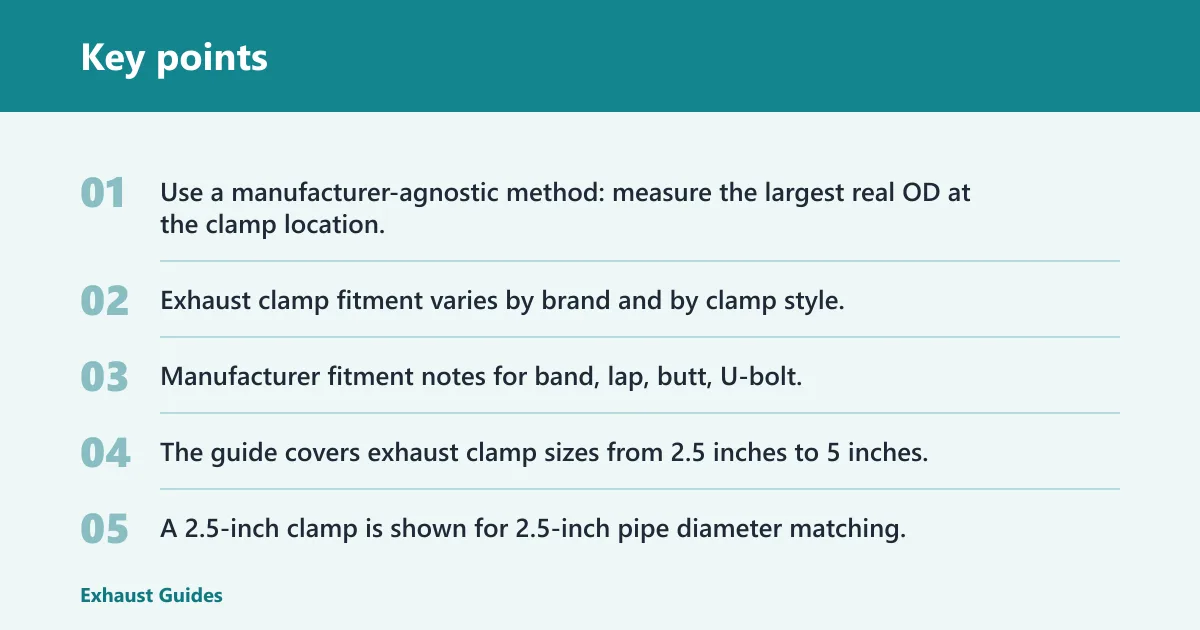
Use a manufacturer-agnostic method: measure the largest real OD at the clamp location, then compare that measurement to the clamp maker’s published working range. Exhaust clamp fitment varies by brand and by clamp style, so the package label is not enough on its own. Manufacturer fitment notes for band, lap, butt, U-bolt, and V-band clamps consistently tie fit to OD and joint type, not to vehicle model alone.
The guide covers exhaust clamp sizes from 2.5 inches to 5 inches. A 2.5-inch clamp is shown for 2.5-inch pipe diameter matching. A 3-inch clamp is listed for pipe OD around 2.95 to 3.10 inches. A 3.5-inch clamp is listed for pipe OD around 3.45 to 3.60 inches. A 4-inch clamp is listed for pipe OD around 3.90 to 4.10 inches.
That is why nominal pipe size is only a starting point. The printed size may point you toward the right family, but the real OD at the clamp location decides the final choice. Manufacturer fitment sheets also caution that the working range, overlap length, and joint type can change the correct clamp even when the nominal size looks close.
When to round up or down
Round to the clamp band that fully covers the measured OD without forcing the clamp to reach beyond its working range. If the pipe is oval or rusty, use the largest measurement. Do not round down to make an order look closer on paper; that usually creates a fit problem.
Say your pipe measures 3.08 inches on one side and 3.12 inches on another because the end is slightly oval. Buy for the larger reading and choose the 3-inch clamp band only if its listed range still covers the larger OD. If the clamp range does not cover that value, move up to the next band.
Which clamp type fits your joint?
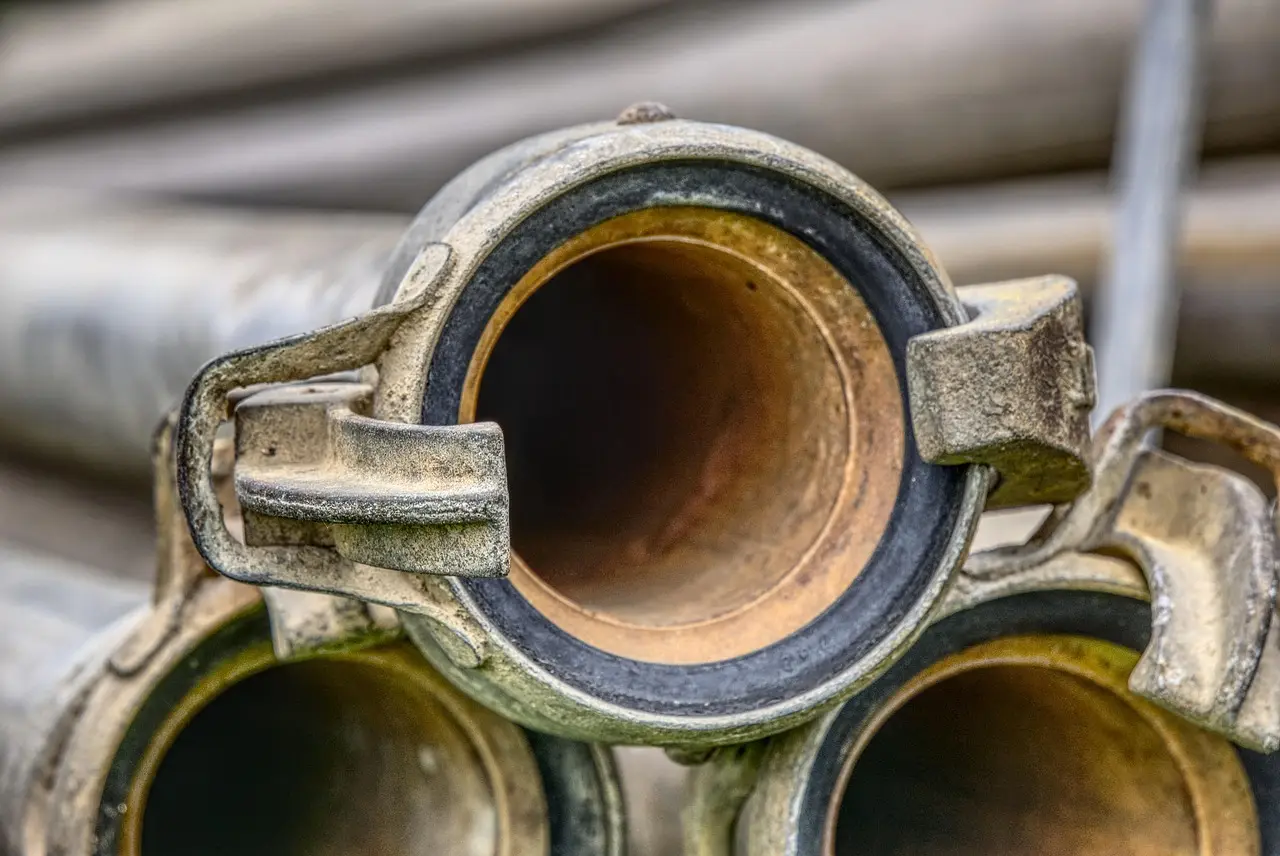
Clamp style matters as much as size. Lap joint clamps fit overlapped pipe joints and slip-fit connections. Butt joint clamps fit same-size pipe connections and are common for non-welded straight repairs. V-band clamps are for flanged connections. Do not swap these styles as if they were the same part.
Lap joint clamp
Use a lap joint clamp when the pipes overlap. The clamp has to fit the combined joint shape, so sizing depends on the overlap, the outer pipe OD, and the clamp design. This style is common on slip-fit connections where one pipe slides over another.
If the overlap is short, the clamp may not compress evenly. If the overlap is long, the clamp must still sit over the correct OD band. Measure at the exact clamp site, not at the loose end of the pipe.
Butt joint clamp
Use a butt joint clamp when the pipe ends meet at the same size. This is the right choice for many straight, non-welded repairs where both ends have the same OD. It is not interchangeable with lap-joint sizing, because the joint geometry is different.
For same-size 2.5-inch, 3-inch, 3.5-inch, or 4-inch pipe, the clamp band should match the measured OD at the joint, not the nominal label on the system. Manufacturer product sheets for butt-joint clamps generally specify matching OD-to-OD ends and a defined working range at the sealed joint.
U-bolt, band, and V-band differences
A U-bolt exhaust clamp is a basic repair clamp and often the lowest-cost choice. It is fine for simple connections, but it can dent pipe if the nuts are driven down to force a bad fit. Manufacturer installation cautions for U-bolt clamps typically stress even tightening and avoiding over-torque because the clamp loads the pipe at two points instead of around the whole circumference.
A band clamp wraps around the joint and spreads force more evenly, which helps reduce pipe deformation. Manufacturer fitment guidance for band clamps usually ties the published range to a specific OD window, so the actual measured pipe size should be the final check.
A V-band clamp belongs on flanged connections that need easy removal, such as turbo or downpipe applications. It is a different joint system. If you need a slip-joint repair, a V-band is the wrong part. Manufacturer docs for V-band clamps treat the clamp as a flange-to-flange fastener, not a substitute for sleeve or lap clamps.
Exhaust clamp size decision matrix
This matrix gives the decision rule in one place: measure the pipe OD at the clamp location, identify the joint type, note pipe condition, then choose the matching clamp style and size band. If the pipe is oval, rusted, or has different end sizes, base the choice on the largest measured OD at the joint rather than the nominal pipe size on the box.
| Measured pipe OD | Joint type | Pipe condition | Clamp style and size band | Wrong choice consequence |
|---|---|---|---|---|
| 2.5-inch OD | Butt joint, same-size ends | Clean, round pipe | 2.5-inch butt joint band clamp | Too small will not fit; wrong style can leak |
| 2.95 to 3.10 inches OD | Butt joint, same-size ends | Clean, round pipe | 3-inch butt joint band clamp | Too large may clamp unevenly and leak |
| 3.45 to 3.60 inches OD | Butt joint, same-size ends | Clean, round pipe | 3.5-inch butt joint band clamp | Wrong size can leave gaps at the seal |
| 3.90 to 4.10 inches OD | Butt joint, same-size ends | Clean, round pipe | 4-inch butt joint band clamp | Too small will not seat; too large can leak |
| 5-inch OD | Butt joint, same-size ends | Clean, round pipe | 5-inch butt joint band clamp | Size mismatch causes fit or sealing problems |
| Overlap present at the joint | Lap joint, slip-fit connection | Minor surface rust | Lap joint clamp sized to the larger OD at the overlap | Butt-joint clamp can miss the shape and leak |
| Out-of-round or rusted end | Any slip-fit repair joint | Oval, pitted, or heat-warped pipe | Band clamp if the shape can still be matched; clean and remeasure first | Wrong style or undersize clamp can dent pipe or leak |
| Flanged connection | V-band joint | Removable, flanged connection | V-band clamp | Slip-joint clamp will not substitute correctly |
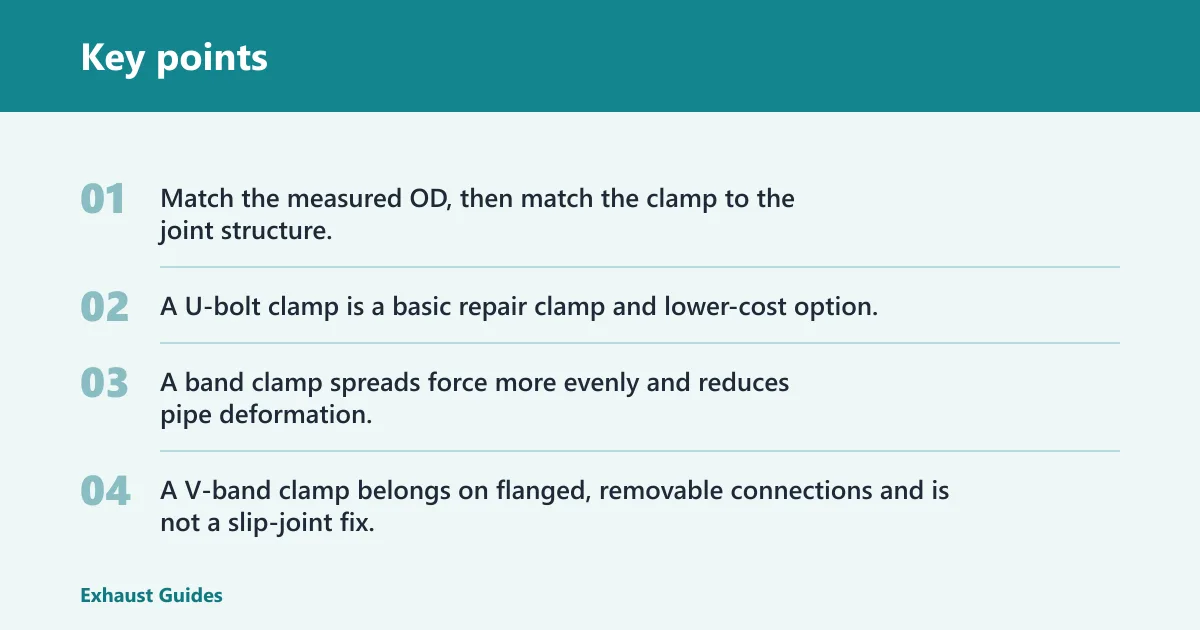
The main rule is simple. Match the measured OD, then match the clamp to the joint structure. A U-bolt clamp is a basic repair clamp and lower-cost option, but it can dent pipe if over-tightened. A band clamp spreads force more evenly and reduces pipe deformation. A V-band clamp belongs on flanged, removable connections and is not a slip-joint fix.
Can you use the old clamp size?
Use the old clamp as a clue, not as the only sizing reference. If the old clamp was the right style and the pipe ends are still round, it can point you toward the next order. If the pipe is rusted, dented, or changed by heat, the old clamp can be misleading.
When the old clamp helps
If the old clamp came off a clean, unchanged joint, its size band may still be close to the new need. That is most useful when the pipe has not been cut, widened, or crushed and the replacement joint matches the old one.
When the old clamp misleads you
If the pipe end has rust scale, ovaling, or heat warp, the old clamp may no longer fit the real OD. The same is true if the new joint has a different overlap length or a different end structure. In that case, the measurement on the pipe wins.
Pipe condition changes the answer
Rust can make a clamp sit crooked or fail to compress evenly. Deformation can make the clamp feel loose even when the strap reaches around the pipe. Out-of-round pipe should be measured in at least two places, then sized to the largest reading. That prevents a return that was caused by the pipe, not the clamp.
A common first-timer mistake is to reuse the old clamp on a pipe that has already been sanded, expanded, or flattened by heat. The clamp may close, but the seal still fails because the pipe shape changed. Measure the joint again before ordering another part.
Installation checklist
Fit problems are easier to prevent than to fix later. Before tightening any exhaust clamp, confirm the joint style, the true OD, and the clamp’s published range. Manufacturer installation instructions commonly call for clean mating surfaces, even clamp loading, and avoiding overtightening that can distort pipe or pinch the seal unevenly.
- Clean rust, scale, and soot from the clamp zone.
- Verify the clamp style matches the joint type.
- Check the clamp’s working range against the largest measured OD.
- Align the pipes so the joint seats squarely before tightening.
- Tighten evenly, then recheck after the joint is fully seated.
- Do not keep tightening past the point of proper seal.
| Problem | Likely cause | Fix |
|---|---|---|
| Fits but leaks | Wrong clamp style, oval pipe, or clamp range too wide for the joint | Recheck joint type, measure the largest OD, and use the correct clamp band |
| Won’t slide over pipe | Clamp size is too small or the pipe is larger than the nominal label | Measure the real OD and move to the next published working range if needed |
| Dents pipe | U-bolt or over-tightened clamp concentrating force in two spots | Use a band-style clamp and tighten only to the point of proper seal |
| Hard to service later | Clamp style chosen for convenience instead of access and removability | Choose a clamp type that matches the joint and the expected service plan |
Mistakes to avoid
The most common error is sizing from vehicle model or nominal pipe size alone. That often misses the real OD at the joint. Another error is measuring inside diameter, which does not tell you what clamp will fit over the pipe.
Do not treat the old clamp as proof of the new size. Do not buy a butt joint clamp for an overlapped lap joint, or a lap joint clamp for a same-size butt joint. And do not try to solve a bad size by over-tightening a U-bolt clamp; that can dent the pipe and still leave a leak.
If the pipe is rusty or out of round, clean it first, then remeasure. If the pipe has an overlap, size the clamp to the larger real OD at the joint. If the joint is flanged, use a V-band clamp instead of a slip-joint part.
Frequently asked questions
Do I measure exhaust clamp size by pipe OD or ID?
Use outside diameter, not inside diameter. The clamp sits around the pipe, so the outside measurement is what determines fit. Nominal pipe size can be approximate, which is why the printed number alone is not enough for ordering.
How do I size a clamp for a lap joint versus a butt joint?
For a lap joint, size to the overlap geometry and the larger real OD at the clamp location. For a butt joint, size to the same-size pipe OD on both ends. The two joints are not interchangeable, so the clamp style has to match the connection type.
Why does a clamp fit loosely but still leak?
A clamp can reach around the pipe and still leak if the pipe is rusty, deformed, or out of round. A loose-looking fit can also mean the clamp style does not match the joint. If the pipe shape is wrong or the style is wrong, tightening harder does not fix the seal.
What if my pipe is slightly out of round or rusted?
Measure in at least two places around the circumference and use the largest reading. Clean off loose rust first so the measurement is closer to the true pipe OD. If the pipe is badly deformed, the safest choice is usually the next clamp band that fully covers the real size.
How do I measure the pipe if I only have a string or zip tie?
Wrap the string, wire, zip tie, or paper strip around the pipe where the clamp will sit, mark the overlap, then measure that length with a ruler. Divide the circumference by 3.14159 to get OD. That method works well in cramped spaces where a tape measure will not fit.
Sources
- Manufacturer fitment and installation guidance for exhaust band, lap, butt, U-bolt, and V-band clamps, including OD-based sizing and joint-type matching.
- Manufacturer and product-spec documentation for clamp working ranges and torque or tightening cautions.
- Exhaust pipe sizing guidance based on measured outside diameter and circumference-to-diameter conversion.

- Joins 2.5-inch OD pipe to 2.5-inch OD pipe
- No-weld design for easier installation and removal
- 360-degree force distribution helps seal joints

- Joins 3.0-inch OD pipe to 3.0-inch OD pipe
- No-weld design for easier install and removal
- 360-degree force distribution helps seal joints

- Includes 2 muffler U-clamp pieces
- No-weld design with nuts and saddle flange
- Made for general exhaust pipe connections