Choose Exhaust Clamps for Mild Steel vs Stainless Steel
Choose clamp material to match the pipe first: use stainless clamps on Stainless Steel systems, and coated or mild-steel clamps on Mild Steel systems; then match joint type and wall thickness. Skip that order, and you can seize hardware, crush thin-wall tube, or let corrosion lock the clamp in place before the joint seals. This guide shows which clamp style fits each pipe material, how joint design changes the choice, and what wall thickness means for tightening load.
| Decision factor | Mild Steel | Stainless Steel | Winner |
|---|---|---|---|
| Corrosion and rust | More prone to rust, especially after winter road spray and heat-cool cycles. | Higher corrosion resistance, so the clamp and pipe are less likely to seize together. | Stainless Steel |
| Heat-cycle movement | Can relax over time, but the material usually tolerates basic clamp load well. | Moves more across repeated heating and cooling, so clamp retention matters more. | Stainless Steel |
| Thin-wall distortion risk | Lower than stainless in many repair pipes, but U-bolts can still crush the tube. | Higher concern on thin-wall tube, especially with aggressive tightening or poor fit. | Stainless Steel |
| Best clamp match for slip-fit joints | Band clamp is usually the better seal; U-bolt is a budget fallback on thicker wall. | Band clamp is usually the better seal because it spreads load around the tube. | Stainless Steel |
| Low-cost repair fit | Often the easier low-cost match for common U-bolt or band clamps. | Usually costs more because clamp material should better match the pipe and heat environment. | Mild Steel |
How to choose the right exhaust clamp
Start with pipe material, then move to joint style and wall thickness. Stainless Steel usually needs a clamp that resists corrosion and keeps pressure after heat cycling, while Mild Steel is more forgiving on cost but more likely to rust and deform if you over-tighten a thin tube.

Pipe material comes first
Stainless Steel needs compatible clamp material because dissimilar metals, heat, and road salt can lock hardware in place or shorten service life. Mild Steel can work with standard band or U-bolt clamps more often, but the joint may corrode sooner and need earlier replacement.
That difference matters more than brand name or vehicle fitment. NORMA says exhaust pipe clamps are engineered to keep exhaust gases from escaping, provide even contact pressure around the pipe circumference, and hold up under high temperature. Those traits matter most on stainless systems that move through repeated heat soak.
Then match joint type
Slip-fit joints usually point you toward a band clamp because the clamp can wrap the full circumference and squeeze evenly. Lap joints need the clamp to sit on the doubled-wall section with enough overlap for a stable seal. Butt joints often need a connector or coupler first, because the clamp alone does not solve end preparation.
Suppose a 2.5-inch stainless repair pipe slides over the mating tube but leaves a visible gap after hand placement. A band clamp sized to the actual outside diameter can seal that slip-fit joint better than a U-bolt, which loads two points and can leave the rest of the circumference looser.
Check wall thickness and OD
Outside diameter is the sizing number that matters. Measure at the clamp location, not the nominal pipe name, because the labeled size can differ from the actual pipe OD. Wall thickness changes the inside diameter and how the tube reacts when you tighten the clamp, especially on common aftermarket tubing that is often around 0.065 inch.
Ledaut says the clamp size must match the pipe’s outside diameter, and that a 3-inch exhaust means a 3-inch clamp only if the OD is 3 inches. It also warns that the wrong size can prevent installation or sealing, so the pipe itself is the measurement that counts.
Exhaust clamp decision matrix
This table matches material, wall thickness, and joint style to clamp choice and failure risk. Use it as a quick filter before you buy, then confirm the clamp size against the measured outside diameter at the joint.
| Mild Steel / Stainless Steel | Thin-wall / Thick-wall | Slip-fit / Lap / Butt joint | Recommended clamp type | Sealing priority | Distortion risk | Corrosion note | When to replace or reuse |
|---|---|---|---|---|---|---|---|
| Mild Steel | Thin-wall | Slip-fit | Band clamp | High | Moderate | Rust can lock the clamp after one or two seasons of exposure. | Replace if the band is scored, bent, or the bolt threads feel rough; reuse only if the band stays flat. |
| Mild Steel | Thick-wall | Lap | U-bolt clamp | Medium | Low to moderate | Coating loss can speed corrosion at the saddle contact point. | Reuse is reasonable if the saddle is not grooved and the threads run clean; replace on visible rust scale. |
| Mild Steel | Thin-wall | Butt | Coupler plus band clamp | High | Moderate | Joint edges can rust quickly if fit is loose or moisture stays trapped. | Replace the coupler if the seam opens or the tube ends no longer meet squarely. |
| Stainless Steel | Thin-wall | Slip-fit | Stainless band clamp | High | Low to moderate | Best choice when you want to avoid mixed-metal seizure and preserve corrosion resistance. | Reuse only if the band is not warped and the clamp still tightens evenly; replace after galling or thread damage. |
| Stainless Steel | Thick-wall | Lap | Stainless band clamp | Medium to high | Low | Better at surviving heat cycling, but hardware must stay free enough to retighten if needed. | Reuse is acceptable if the band remains round and the bolt threads do not seize. |
| Stainless Steel | Thin-wall | Butt | Coupler plus stainless band clamp | High | Low to moderate | Most forgiving choice when end prep is clean and the hardware matches the pipe material. | Replace if the coupler slips, the joint leaks after heat cycling, or the clamp no longer holds torque. |
Why the table favors stainless hardware on stainless systems
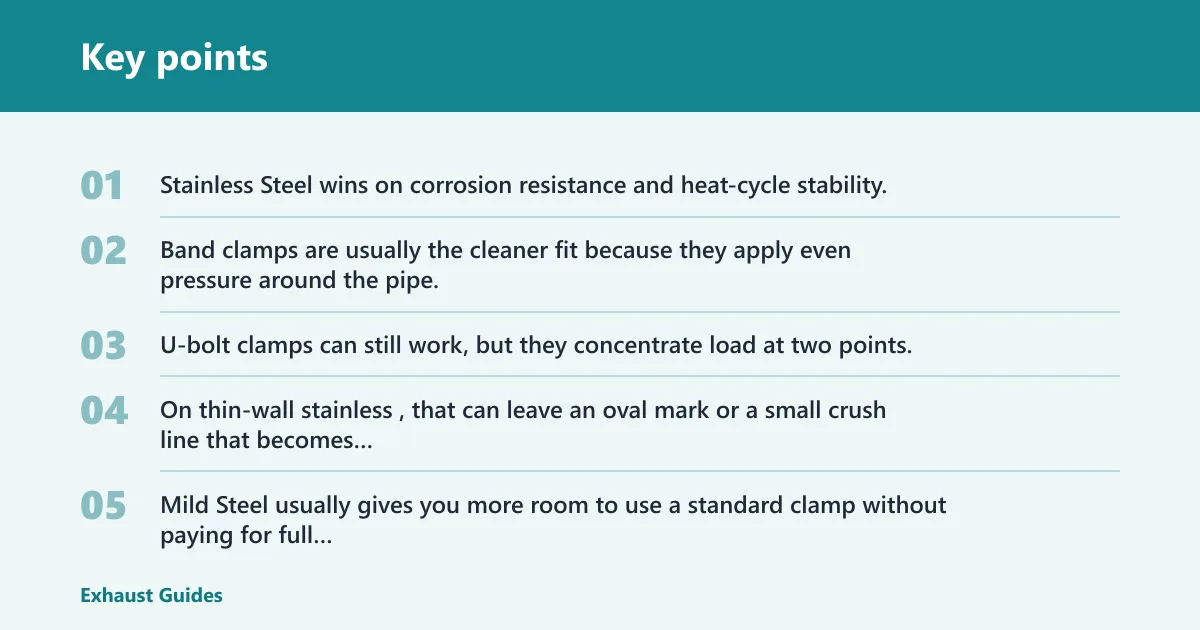
Stainless Steel wins on corrosion resistance and heat-cycle stability, so the clamp choice should support that advantage instead of fighting it. Band clamps are usually the cleaner fit because they apply even pressure around the pipe, which helps the seal stay consistent as the exhaust expands and contracts.
U-bolt clamps can still work, but they concentrate load at two points. On thin-wall stainless, that can leave an oval mark or a small crush line that becomes a leak path after the joint cools and reheats.
Why mild steel can still use cheaper hardware
Mild Steel usually gives you more room to use a standard clamp without paying for full stainless hardware, especially on thicker wall repair pipe. The tradeoff is rust and surface deformation. If the tube wall is thin, a cheap U-bolt can leave permanent flattening where the saddle pulls hardest.
A common first-timer mistake is assuming the lowest-cost clamp is always right for Mild Steel. That works only when the pipe is thick enough and the joint is simple. Once the wall gets thin, clamp shape matters more than price.
What type of exhaust clamp seals best on Stainless Steel systems?
Band clamps are often a good seal choice on stainless steel systems because they wrap the tube and apply around 360-degree contact pressure. That even load helps the joint seal without crushing the tube, and it suits slip-fit repairs where you want a clean, serviceable joint after repeated heat cycles.
Band clamps: best starting point
The same source says its clamps provide even contact pressure around the whole pipe circumference and are engineered to keep exhaust gases from escaping. That is the behavior you want on stainless slip-fit joints, especially where temperature cycling can relax a lesser clamp over time.
Ledaut’s sizing rule still applies: match the clamp to the actual outside diameter, not the pipe label. A 3-inch clamp only fits a 3-inch OD pipe. If the OD is off by even a small amount, the band may tighten without sealing or may bottom out too early.
When U-bolts still make sense
U-bolt clamps can still fit stainless repairs on thicker-wall tubing, especially where cost matters and the joint will not see frequent teardown. They are common and cheap, but the two-point squeeze is less even than a band clamp and can distort thin-wall stainless more easily.
Torque matters here. Over-tightening a U-bolt on stainless can gall the threads, crush the tube, or make the saddle bite so hard that later removal becomes difficult. Under-tightening leaves a leak and a joint that works loose with vibration.
Do you need a different clamp for Mild Steel exhaust pipes?
Usually yes, because Mild Steel rusts sooner and deforms more easily than stainless under a bad clamp load. That does not mean every mild-steel joint needs a specialty part. It means you should choose based on wall thickness, overlap, and if you expect the joint to come apart later.
Rust exposure and reuse planning
On Mild Steel, a clamp that is easy to remove later has value because corrosion can bind the fastener to the pipe. Band clamps and coated clamps are a smart choice when you expect service work. U-bolt clamps remain common on budget repairs, but their hardware can rust into place faster at the saddle and nut.
Say your repair uses a 2.5-inch mild-steel slip-fit section on a daily driver. A band clamp can seal that joint and still give you a better chance of removal later than a bare, low-grade U-bolt that has been cooked through several winters.
Where mild steel can deform
Mild Steel often tolerates basic clamping, but thin-wall tube can still flatten where the clamp bites. Lap joints spread the load better than a loose butt joint, because the clamp sits on a doubled section of metal. If the pipe wall is thin, that extra metal under the clamp matters.
For thick-wall mild-steel repair sections, a U-bolt can be acceptable when the joint is simple and access is tight. For thin-wall tubing, a band clamp is usually the safer first choice because it reduces point loading.
How to measure exhaust pipe diameter for the right clamp
Measure the pipe’s outside diameter at the clamp location and buy to that number. Do not size by vehicle make or model alone, and do not trust the old clamp as your only reference. The pipe itself sets the fit, not the name stamped on the part.
Use a tape or string method
Wrap a flexible tape around the pipe and note the circumference, or use string and then measure the string with a ruler. Convert that measurement to OD, then compare it to the clamp size. This is the cleanest way to confirm the actual pipe size when a caliper will not fit around the joint.
The same source notes that measuring the pipe itself is better than measuring the old clamp. That matters because a stretched or crushed clamp can mislead you into buying the wrong replacement size.
Why nominal size can mislead
A nominal 3-inch exhaust part may not have a 3-inch OD at the clamp point. Wall thickness changes the inside diameter, and many aftermarket tube sections do not match the label exactly. That is why the actual pipe measurement should control the purchase.
Ledaut also says clamp sizes run from 2.5 inches to 5 inches in its guide, which covers many common repair jobs. The exact size still depends on the pipe OD, not the nominal label on the box.
Mistakes to avoid
The most common failures come from wrong size, wrong joint section, or wrong tightening load. Skip any one of those, and the clamp can leak, distort the tube, or seize before the repair has time to settle.
- Do not size by vehicle alone. Measure the actual OD at the clamp location.
- Do not buy too small. Ledaut warns it can block installation or sealing.
- Do not buy too large. The clamp may tighten without enough grip on the tube.
- Do not clamp a lap joint at the wrong spot. Put it on the doubled-wall section.
- Do not treat butt joints like universal clamp jobs. Many need a coupler first.
- Do not crush thin-wall stainless with a U-bolt just because it is cheaper.
- Do not ignore torque guidance. Check the manufacturer’s spec for the clamp type and size.
- Do not skip a recheck after heat cycling. Stainless especially can relax and lose seal.
Too-small and too-large clamps
A too-small clamp may not go over the pipe or may close before the joint is seated. A too-large clamp may tighten down but never produce enough compression to seal. Both problems waste time, and both are avoidable if you measure the OD first.
Torque and recheck steps
Torque specification matters because under-tightening leaks and over-tightening can crush, distort, or gall the joint. That caution is especially important on Stainless Steel, where repeated heat cycles can change clamp load and where hard tightening can damage the hardware before the pipe seals.
Our picks by need
Best for slip-fit stainless joints: Shineyoo 2.5-inch 304 stainless band clamp

- 304 stainless helps resist rust and corrosion
- Joins 2.5" OD pipe to 2.5" ID pipe
- Easy to install on exhaust components
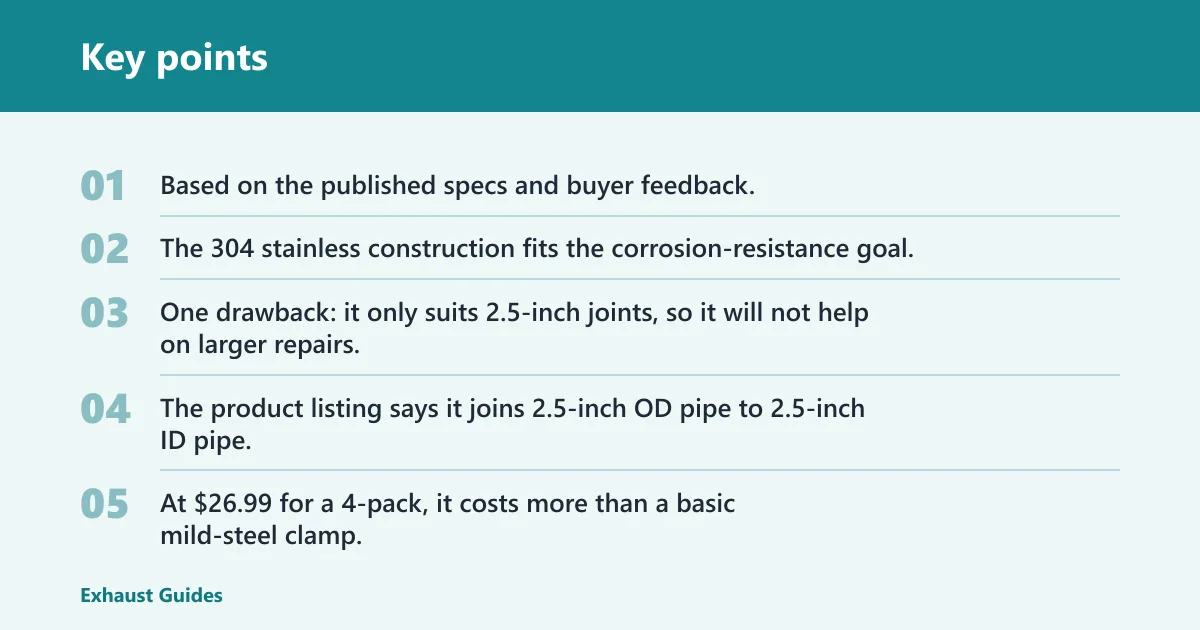
Based on the published specs and buyer feedback, this is the cleaner pick for a 2.5-inch Stainless Steel slip-fit joint. The 304 stainless construction fits the corrosion-resistance goal, and the band style supports even pressure around the circumference. One drawback: it only suits 2.5-inch joints, so it will not help on larger repairs.
The product listing says it joins 2.5-inch OD pipe to 2.5-inch ID pipe, which fits the slip-fit use case well. The tradeoff is price. At $26.99 for a 4-pack, it costs more than a basic mild-steel clamp, but that cost matches the stronger corrosion profile.
Best for thicker mild steel repairs: GESEXI 2.5-inch U-bolt exhaust pipe clamp

- Made for 2.5-inch exhaust pipe size
- Mild steel construction matches basic exhaust setups
- No-welding design is simple and reusable
This is the better low-cost choice for a Mild Steel repair where a simple no-welding clamp is enough and the tube wall is not fragile. The mild-steel construction matches basic exhaust setups, and the saddle style is familiar for quick installs. One drawback: the two-point squeeze is less gentle on thin-wall tubing.
At $9.99 for a 4-pack, it is the budget option here. That makes sense for thicker mild-steel sections, but it is not the first pick for thin-wall stainless or any joint where you need the most even sealing pressure.
Best when you need a reusable joint: Shineyoo 2.5-inch 304 stainless band clamp
A reusable joint is easier to maintain when the clamp tightens evenly and resists rust. That points back to the stainless band clamp, especially on Stainless Steel piping where heat cycling can loosen weaker hardware. The drawback remains the same: size coverage is narrow, so you need a confirmed 2.5-inch OD.
If the joint may come apart later for service, the stainless band clamp is the more practical choice. It is less likely than a rust-prone U-bolt to freeze in place, and it is kinder to the tube surface on repeated installs.
Choose Mild Steel if…
Choose Mild Steel if the pipe is thick enough for a simpler clamp, the joint is a basic repair, and price matters more than long-term corrosion resistance. It is the better fit for budget fixes, thicker sections, and jobs where the clamp will not see repeated teardown.
Choose Stainless Steel if the joint is exposed to heat cycling, road spray, or frequent service, or if the tube wall is thin and you need more even pressure. That is the better call for slip-fit stainless repairs, especially when you want the clamp to stay round, resist rust, and keep sealing after repeated heat soak.
Frequently asked questions
How do I choose an exhaust clamp for stainless steel versus mild steel?
Match the clamp material to the pipe first, then match the joint type and wall thickness. Stainless Steel usually calls for a stainless band clamp because corrosion resistance, heat cycling, and galling risk matter more. Mild Steel can use standard band or U-bolt clamps more often, especially on thicker wall pipe.
How do I measure exhaust pipe diameter for the right clamp?
Measure the actual outside diameter at the clamp location using a flexible tape or a string wrapped around the pipe, then compare that number to the clamp size. Do not size by vehicle model alone or by nominal pipe label. The same source says the pipe itself is the measurement that matters.
What happens if an exhaust clamp is too small or too large?
A too-small clamp may not install at all, or it may close before the joint seats fully. A too-large clamp can tighten without sealing, which leaves leaks and vibration. Either mistake can also distort the pipe or make the joint hard to remove later, especially on stainless hardware.
Can exhaust clamps seal pipes fitted into one another?
Yes. The same source says exhaust clamps secure pipes fitted into one another, and band clamps are the usual choice when you want even contact pressure around the joint. The clamp still has to match the actual OD, and the joint must be seated properly before tightening.
What exhaust clamp size do I need for a 3-inch pipe?
You need a 3-inch clamp only if the pipe’s actual outside diameter is 3 inches. That is the key check. If the OD is different, buy to the measured size instead of the nominal label. Ledaut’s sizing guidance is clear on that point, and the wrong size can block sealing.
Are exhaust couplings better than clamps for same-diameter exhaust parts?
Not always. The same source says exhaust couplings join same-diameter components without overlapping or slitting pipes, which is useful when you want a cleaner service joint. But a coupling is not automatically better than a clamp; the right choice still depends on fit, wall thickness, and if the joint is slip-fit, lap, or butt.