Exhaust clamp vs weld connection: which is better for you
Use a clamp if you need future removal, minor alignment correction, or a rusty system you may reopen; weld when the pipes fit well, the metal is sound, and you want the most permanent joint. Pick the wrong joint and you can end up with leaks, warped pipes, seized hardware, or a connection that has to be cut apart later. This guide compares clamp and weld joints by seal quality, durability, cost, serviceability, and where each makes the most sense.
Exhaust clamp vs weld connection: the core trade-off
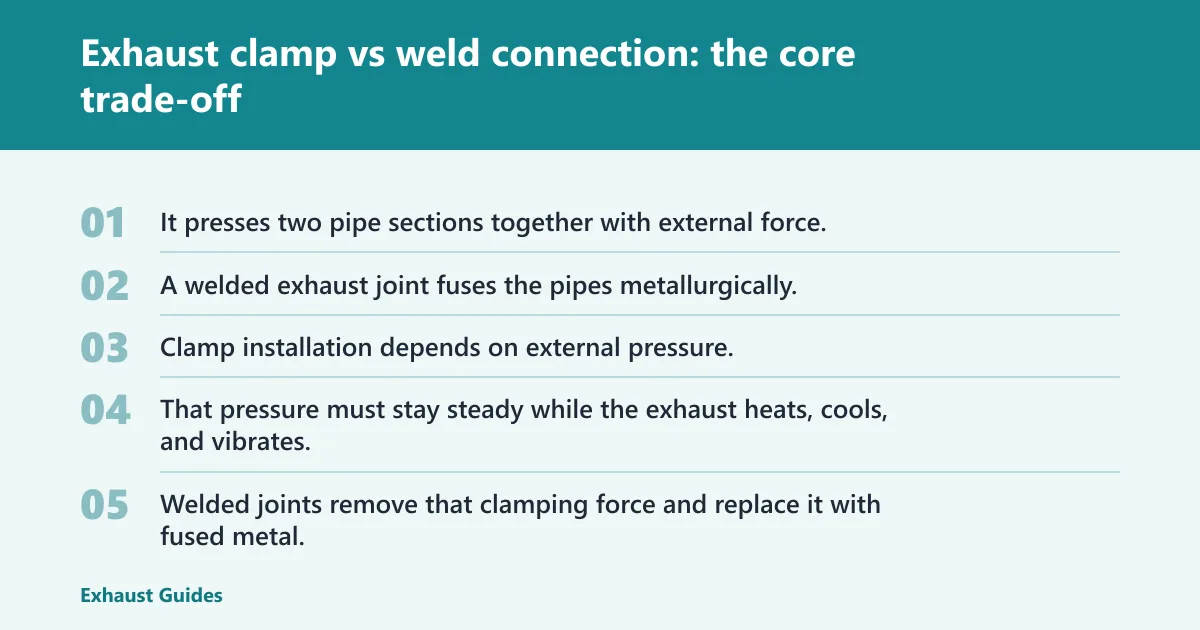


An exhaust clamp is a mechanical fastener. It presses two pipe sections together with external force, usually with little tooling and no fusion of the metal itself. A welded exhaust joint fuses the pipes metallurgically, so the connection becomes one continuous metal joint with no intended movement.
| Decision factor | Exhaust clamp | Weld connection: which is better | Winner |
|---|---|---|---|
| Upfront cost | Lower parts cost, tool-light installation | Higher labor and equipment cost | Exhaust clamp |
| Leak resistance | Fitment dependent | Generally strongest seal when done correctly | Weld connection: which is better |
| Serviceability | Easy removal, repositioning, and disassembly | Requires cutting for later removal | Exhaust clamp |
| Durability under heat and vibration | Can loosen over time | Higher resistance to vibration and heat cycling | Weld connection: which is better |
| Best fit for rusty or reused pipe | Sometimes workable if enough sound metal remains | Poor choice if metal is thin or contaminated | Exhaust clamp |
How each joint works mechanically
Clamp installation depends on external pressure. That pressure must stay steady while the exhaust heats, cools, and vibrates. Welded joints remove that clamping force and replace it with fused metal, which is why they usually score better for strength and long life when the pipe fit is correct.
Fit matters for both methods, but in different ways. A clamp can cover small position changes, while a weld needs clean, tight, well-prepared pipe ends. Poor overlap, out-of-round tubing, or misalignment can turn either joint into a problem.
What changes the result: pipe fit, overlap, heat cycles, and vibration
Thermal cycling means expansion and contraction as the exhaust heats and cools. That movement often loosens clamp joints, which can lead to seepage and rattles. Vibration adds to the problem by working the fastener loose and stressing nearby hangers.
Welds handle those forces better, but they can still fail. Repeated heat cycling can crack poor welds, and vibration can fatigue thin or poorly supported sections. The difference is simple: a sound weld has fewer moving parts to retighten.
📊 The piece lists repair cost for clamped joints at about $20–$100. Source: Clamp vs Weld Exhaust: Which Exhaust Option Is Best?.
Which lasts longer, exhaust clamps or welds?
Welds usually last longer because the joint is fused and does not depend on clamp pressure staying constant. Clamps can last a long time on well-fit pipe, but heat cycling and vibration make them more likely to need checking, retightening, or replacement over time.
Thermal cycling and why it loosens clamp joints
Exhaust systems expand and contract on every drive cycle. A clamp that feels tight on a cold system can relax after a few heat cycles, especially if the pipes were not fully aligned or overlapped. That movement raises leak risk and can create a ticking or rasping sound at the joint.
Vibration and how it affects both joint types
Vibration is often a major factor in joint failure. On a clamp joint, it can reduce retention and let the pipes shift against each other. On a weld, vibration mainly threatens the surrounding pipe, hangers, and any thin or rusted area next to the bead rather than the fused seam itself.
Suppose a 2.5-inch slip joint on a daily driver sits close to a hanger that is already tired. A clamp may seal today and start buzzing after a few weeks if the hanger lets the pipe move. A sound weld, with the same support fixed first, is less likely to back off.
Where welds last longer, and where they still fail
Welds last longer on permanent, well-supported sections with clean metal. They still fail when the pipe is contaminated, the bead is thin, or the joint is stressed by poor hanger placement. In those cases, the problem is often the surrounding system rather than the weld alone.
Are clamped exhaust joints more likely to leak?
Clamped joints can be more prone to leaks when the fit is poor, the overlap is short, or the pipe surface is rusty, thin, or out of round. A clamp can seal well when the joint geometry is right and the hardware is kept tight after heat cycles.
Fitment issues that create leaks in clamped joints
A clamp seal depends on proper alignment and fitment. If one pipe sits cocked, the pressure lands unevenly and leaves a path for exhaust gas. Insufficient overlap is another common problem because the clamp cannot compress enough stable contact area to hold a lasting seal.
Pipe condition problems: rusty, thin, or out-of-round tubing
Rusty pipe can crush, split, or simply fail to give the clamp a solid surface to bite. Thin tubing may deform before the joint seals. Out-of-round sections can feel tight at one point and loose at another, which is why reused exhaust sections often leak at the first joint that is asked to do too much.
How to judge a clamp seal before you commit
- Check that both pipes are round enough to mate evenly.
- Confirm the overlap is sufficient for the clamp style being used.
- Make sure the joint sits straight, not pulled sideways by a hanger.
- Inspect for rust flakes, dents, or thinning near the clamping area.
- Plan a retorque check after the first few heat cycles.
A common first-timer mistake is clamping over damaged pipe because the joint feels snug on the bench. That often becomes a leak after the first drive, when heat and vibration expose the weak spot.
What are the downsides of welding an exhaust?
The main downsides are higher welding labor, more equipment, and more skill required. A welded joint also makes future service harder because the connection must be cut apart rather than unbolted. That matters any time you expect muffler swaps, sensor access, or section replacement later.
Why welded joints are harder to service later
Welded exhaust joints are permanent by design. If a downstream section needs replacement, the technician may have to cut the pipe, clean the ends, and fit a new section. That adds time and can turn a simple repair into a larger job.
When a permanent joint creates extra work on the next repair
If the exhaust passes near a transmission crossmember, suspension link, or tucked-under body panel, cutting a welded joint later may create clearance problems. A clamp in that location can save time during a converter swap, resonator change, or rust repair because the pipe can come apart without cutting.
What is the cheapest way to connect exhaust pipes?
A clamp is often the lower-cost upfront option, because parts tend to cost less and installation is relatively tool-light. That is not the full cost picture, though. If a clamp is installed on bad pipe and has to be redone, the rework can erase the initial savings quickly.
Welding can cost more because of labor, equipment, and safety precautions. The article’s repair-cost ranges place clamped joints at about $20–$100 and welded joints at about $100–$300+ per joint, which reflects both labor and the extra work involved in cutting or redoing a weld.
How labor changes the total cost of welding versus clamping
A clamp often needs basic hand tools, while welded exhausts are presented as requiring skilled labor and safety precautions. That is why weld cost rises with shop rate and fit-up time. A simple clamp swap can be inexpensive; a welded repair can climb once fabrication and cleanup are included.
Rework risk when a joint must be cut apart or redone
Clamp rework is usually simpler because the joint can be loosened and repositioned. Weld rework is slower because the old bead must be removed or cut out. If the surrounding pipe is already thin, that extra handling can force a larger section replacement than planned.
Decision matrix: which joint fits each real-world scenario?
This matrix matches the joint to the job. The best choice changes with pipe condition, service access, and how much permanence you actually need. Use the leak-risk column as a shorthand for fit sensitivity, not as a universal ranking of quality.
| Scenario | Leak risk | Serviceability | Cost | Recommended joint type |
|---|---|---|---|---|
| Daily driver repair | Low to medium if pipe fit is good; higher if the joint moves | Medium | Clamp is lower upfront | Clamp if the section may need reopening; weld if the pipe is already sound and access is not a concern |
| Stainless performance system | Low with proper fit; poor fit still leaks | Medium | Weld costs more in labor | Weld for permanent sections; clamp only on removable sections |
| Rusty pipe repair | High if rust is active or the tube is thin | High if any repair is expected later | Clamp may avoid immediate pipe replacement | Clamp, or replace the pipe first if there is not enough sound metal |
| Future-service-friendly build | Low to medium | Highest with clamps | Clamp is usually less expensive to service later | Clamp |
| Permanent track setup | Lowest when weld quality is good | Lowest | Higher upfront labor is acceptable | Weld |
Daily driver repair
A daily driver needs a joint that survives heat cycles and still allows future service. If the exhaust section may come apart again for a muffler, resonator, or catalytic repair, a clamp often makes more sense. If the pipe fit is excellent and access later will not matter, a weld can be the cleaner long-term answer.
Stainless performance system
Stainless systems often justify a hybrid approach because the tubing is usually part of a more carefully built exhaust. Clamps can work on removable sections, but welds are a better call for permanent, high-stress areas where you want fewer movement points and a cleaner package.
Rusty pipe repair
Rust changes the answer fast. If the pipe is thin, flaking, or badly pitted, a weld may burn through or fail to hold sound metal. A clamp can buy time only if enough solid tubing remains; otherwise, replacing the pipe is better than forcing a joint onto bad material.
Future-service-friendly build
If the exhaust may need frequent access, clamps win because they allow easier installation, disassembly, and repositioning without specialized tools. That is useful around sensors, slip-fit mid-pipes, and sections that might be adjusted after the first test fit.
Permanent track setup
Track setups favor permanence and heat resistance over convenience. A welded joint resists vibration and repeated heat cycles better, and the system is less likely to shift under repeated hard use. The tradeoff is simple: later service gets harder, so plan the layout before final welding.
Choose Exhaust clamp if… / choose weld connection: which is better if…
Choose a clamp if the joint may need to come apart later, if you need minor alignment correction, or if you are repairing a section that may be reopened after inspection. Choose a weld if the fit is right, the metal is sound, and the joint sits in a high-stress area that should stay fixed for the life of the system.
Clamp-first jobs
- Removable sections near a muffler, resonator, or mid-pipe
- Quick repairs on a sound pipe with proper overlap
- Builds that may need repositioning after initial fitment
- Systems where future access matters more than permanence
Weld-first jobs
- Permanent high-stress sections with good pipe condition
- Systems that see repeated vibration and heat cycling
- Track or competition builds where service access is secondary
- Joints where the cleanest seal matters more than removal
When a hybrid exhaust joint strategy makes the most sense
A hybrid setup is often the best answer. Use clamps for sections needing frequent access and welds for permanent, high-stress areas. That gives you a system that can be serviced without cutting every joint apart, while still locking down the parts that should not move.
Say your truck has a stainless cat-back with a mid-pipe section that may need future sensor access. Welding the rear over-axle pipes but clamping the mid section gives you durability where it matters and removal where you will actually need it.
Frequently asked questions
Is a clamped exhaust as good as a welded exhaust?
Not in every situation. A clamped exhaust can be durable enough for daily use if the pipes fit well and the hardware stays tight, but a welded exhaust usually gives better seal quality, higher vibration resistance, and less chance of loosening as the system heats and cools.
Which lasts longer, exhaust clamps or welds?
Welds usually last longer because they create a fused joint that does not rely on clamp pressure staying constant. Clamps can last a long time on well-prepared pipe, but heat cycling and vibration make them more likely to need inspection or retightening over time.
Are clamped exhaust joints more likely to leak?
Yes, especially when the pipe is rusty, misaligned, or short on overlap. Clamp seals are fitment dependent, so a joint that looks tight on the bench can still seep once the exhaust heats up and moves under load.
When should you weld an exhaust instead of clamping it?
Weld when you want a permanent joint, the metal is sound, and future disassembly is unlikely. It is the better pick for high-stress sections, track setups, and places where you want the joint to stay fixed through repeated heat cycles and vibration.
Can you make a clamped exhaust permanent enough for daily driving?
Yes, if the pipe condition is good and the clamp is sized and positioned correctly. Daily-driving durability depends on fit, overlap, and retorque checks after heat cycles. If the joint is in a high-motion area, welding is usually the safer long-term choice.
What are the downsides of welding an exhaust?
The main downsides are cost, equipment, and future service difficulty. Welding labor is higher, the work needs skill and safety precautions, and any later repair may require cutting the joint apart instead of loosening hardware.