Exhaust Gaskets and Seals Guide
Match the gasket to the joint first: ball-and-socket joints usually seal on shaped metal seats and often use no flat gasket, two-bolt flat flanges usually need an OE-style crush or composite gasket, and slip joints seal with clamps, sealant, or an interference fit depending on the design. Get that wrong and you end up chasing ticking leaks, melted nearby parts, false O2 readings, broken studs, and doing the same job twice. This guide maps joint types to failure modes, measurement steps, gasket materials, and the right hardware and torque approach for cars, trucks, bikes, and powersports machines.
How exhaust gaskets and seals actually work


What an exhaust gasket does at each joint in the system
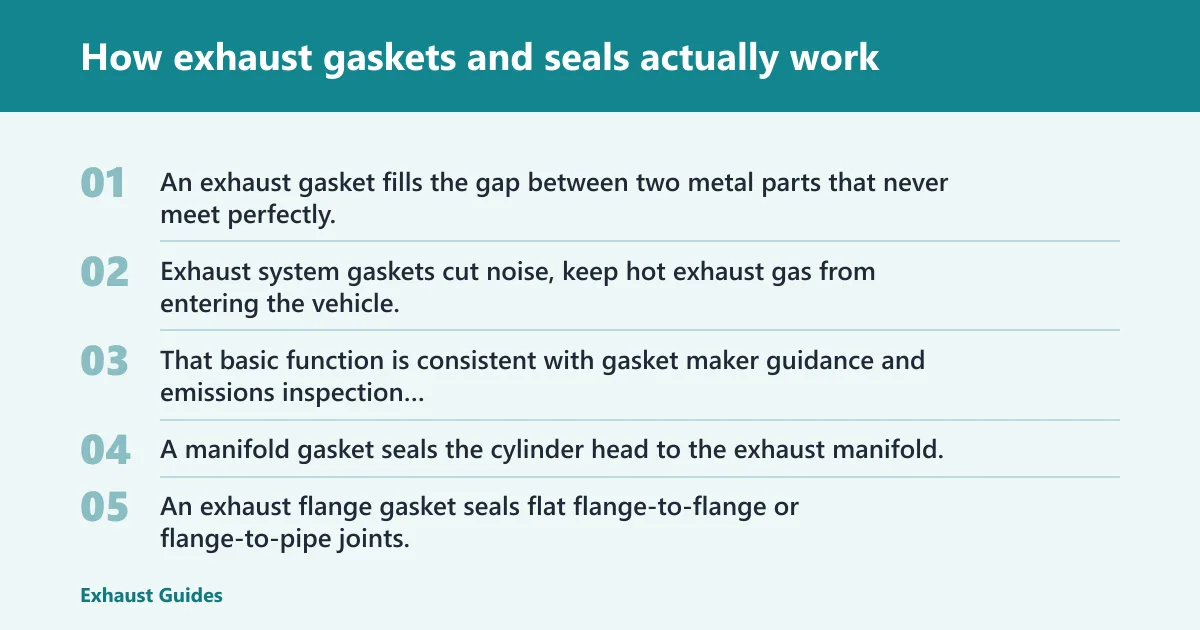
An exhaust gasket fills the gap between two metal parts that never meet perfectly, then holds that seal through heat, vibration, corrosion, and movement while clamp load tries to relax. Exhaust system gaskets cut noise, keep hot exhaust gas from entering the vehicle, and help maintain proper pressure in the system. That basic function is consistent with gasket maker guidance and emissions inspection practice, even though the exact joint design varies by platform (EPA OBD guidance; California BAR repair and inspection resources).
That job changes by location. A manifold gasket seals the cylinder head to the exhaust manifold. An exhaust flange gasket seals flat flange-to-flange or flange-to-pipe joints. A donut gasket seals ring-style moving joints, often where springs maintain load as the system shifts. A ball-and-socket joint is different again: it seals on matching spherical or tapered seats and may use no flat gasket at all, or it may use a dedicated ring designed specifically for that seat. Catalytic converter gaskets seal inlet and outlet connections where a small leak can affect oxygen sensors and emissions behavior. EGR gaskets seal exhaust gas recirculation passages, and some use a drilled hole to meter flow (Fel-Pro EGR gasket catalog category).
Those are different sealing problems. They are not interchangeable “exhaust leaks.”
Heat, movement, and clamp load: why exhaust joints seal differently from intake joints
Exhaust joints move more than many DIY owners expect. The engine rocks on mounts, the exhaust hangs on isolators, and long pipes expand and contract. A gasket that seals a flat, rigid manifold flange can fail fast at a spring-loaded outlet joint. Walker and other exhaust manufacturers treat support, alignment, and hardware condition as part of the seal, not separate issues (Walker Exhaust technical support).
Clamp load matters as much as gasket material. Springs, bolts, studs, and nuts are sealing parts, not accessories. Fel-Pro lists flange bolt and spring kits for a reason: the gasket only works if the joint keeps pressure on it through heat cycles and movement.
Some joints are meant to crush. Others are meant to seat metal-to-metal with a ring between shaped surfaces. Ball-and-socket joints may use no flat gasket at all. Slip joints can seal through fit, clamping, and in limited cases a small amount of paste made for that style of connection. In my experience, repeat failures on front-pipe joints are more often about lost spring load or a misidentified seat style than about the gasket material itself.
Why aftermarket repairs are harder than factory assembly
Factory parts meet on fresh surfaces with known hardware and alignment. Aftermarket replacement gaskets must make up for corrosion, pitting, and warping. That is where exhaust sealing gets hard, especially on older vehicles with mixed-brand pipes, reused studs, and flanges that have already been pulled crooked once or twice.
Catalog fitment gets the search started. It does not finish the job. Joint style, sealing face shape, hardware condition, stand-off height, and surface damage decide whether a part that “fits” will actually seal. If you are already dealing with a rusty system, it also helps to inspect related exhaust manifold, catalytic converter, and oxygen sensor issues at the same time rather than treating the gasket in isolation.
📊 Powersport Superstore shows 321 exhaust gasket products in one collection. Source: Powersportsuperstore.
Which exhaust gasket type should I use for my vehicle?
Use the gasket that matches the way the joint is shaped, how much it moves, and how the hardware squeezes it, then check the sealing faces before ordering. Flat rigid flanges usually want a flat gasket, spring-loaded donut seats usually want a donut, ball-and-socket joints need the correct seat geometry and often no flat gasket, converter and EGR joints need exact application shape, and damaged hardware often needs replacement with the seal.
Manifold gasket: head-to-manifold sealing and flatness limits
Manifold gaskets seal the cylinder head to the manifold or header flange. Fel-Pro lists manifold gaskets as a sealing product category because this joint has its own failure pattern: warped manifolds, corroded head faces, broken studs, and poor reuse decisions.
A manifold gasket can look acceptable after removal and still leak on reassembly. Heat sets the material. Embossed layers lose spring. Graphite faces can imprint around ports and stop recovering. If the manifold face is pulled out of flat, the new gasket may only hide the problem for a short time. That matches common service-manual practice as well: inspect the manifold and head sealing faces before blaming the gasket alone.
Use the gasket style intended for the manifold and head surface. Do not substitute a softer universal sheet because the bolt pattern lines up.
Exhaust flange gasket: flat flanges, two-bolt joints, and pipe-to-flange repairs
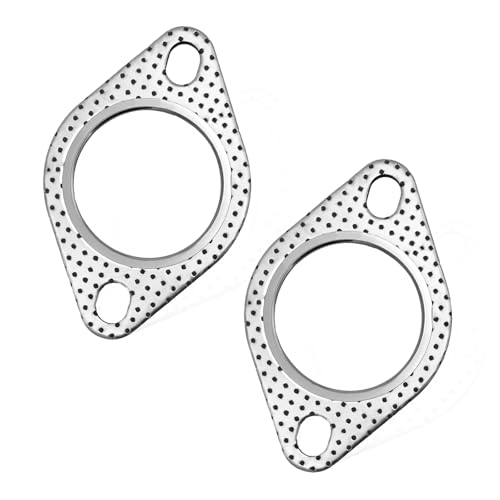
Exhaust flange gaskets seal flat flange-to-flange or flange-to-pipe joints. Common styles include graphite-faced steel core and embossed stainless steel. Embossed stainless works better where the flanges are flat, rigid, and evenly loaded.
Both styles fail when the flanges are bent, the hardware has lost tension, or the pipe is hanging from the joint. A flat gasket cannot make up for a flange that is acting like a hinge.
Fel-Ramic material is also common in some high-heat exhaust gaskets, including ring-style and flat designs. It works well where the joint needs heat resistance and some compressibility, but it still depends on proper support and clamp load.
Donut gasket: spring-loaded and moving joints
A donut gasket is a ring-style exhaust seal used where the joint may move, pivot, or slide slightly under load. This is common at manifold outlets, crossover pipes, and some front pipe connections. The seal often works with springs that keep pressure on the donut as the exhaust shifts.
Here, clamp load usually matters more than sealant. If the springs are weak, missing, or bottomed out, the donut burns, shifts, or crushes unevenly. Many ring gaskets in this category use high-heat materials such as Fel-Ramic because the joint sees motion and direct flow.
Do not swap a flat flange gasket into a donut seat. It may tighten down, but it is the wrong geometry and will usually fail quickly. Likewise, do not assume every rounded outlet is a donut joint; some are true ball-and-socket connections that seal on machined or formed seats rather than on a compressible flat flange gasket.
Catalytic converter and EGR gaskets: emissions-sensitive joints with exact fit needs
Catalytic converter gaskets seal inlet and outlet joints, and Fel-Pro lists converter, connector, and crossover gaskets as a separate category. Shape matters here. A near-cat leak can skew upstream oxygen sensor readings and affect fuel trim, and a failed exhaust gasket may contribute to an emissions test failure (EPA basic OBD information; NTK oxygen sensor technical information).
EGR gaskets need even more care. Fel-Pro lists EGR gaskets, and some use a drilled hole to meter flow. That hole size must match the application exactly. If the gasket meters too much or too little, drivability and emissions control can suffer even when the joint itself does not leak.
On late-model vehicles, a small upstream leak can create confusing symptoms. The engine may sound only slightly louder, yet the control system reacts strongly. If you are diagnosing that chain of symptoms, it is worth checking related oxygen sensor and catalytic converter guidance before replacing parts at random.
How do I know if my exhaust gasket is leaking?
Look for symptoms by joint location, then confirm the exact leak point before buying parts. Cold-start ticking often points to a manifold or front-pipe leak, soot marks help find escaping exhaust gas, smells and cabin noise suggest a body-side leak, and near-cat leaks can disturb oxygen sensor readings and fuel trim.
Symptoms by location: ticking at cold start, soot marks, smell, and cabin noise
Manifold leaks often tick most at cold start. As parts expand, the sound may fade. Black soot near a manifold port or flange edge is a strong visual clue.
Flange and donut leaks tend to produce chuffing sounds lower in the system. A donut leak can also leave a dark ring around the seat. Converter-joint leaks often show soot at the gasket perimeter or around bolt holes.
Inside the vehicle, extra noise and exhaust smell matter. Failing exhaust gaskets can compromise drivability and safety, and hot exhaust gas entering the vehicle is never acceptable.
What upstream leaks do to oxygen sensor readings and fuel trim
Leaks ahead of or near the catalytic converter can pull fresh air into the stream during pulse events. That can make oxygen sensors report leaner conditions than the engine is actually running, a point echoed in oxygen-sensor technical training from major sensor suppliers (Bosch oxygen sensor technical overview).
The result may be unstable fuel trim, odd part-throttle behavior, catalyst efficiency complaints, or repeated sensor replacement that never fixes the root cause. I have seen plenty of “bad sensor” diagnoses turn out to be a lying joint upstream.
How to confirm the leak point without guessing
- Inspect cold, with good light. Look for soot tracks, rust trails, and missing hardware.
- Check support points. A torn hanger can overload a gasket farther forward.
- Feel for pulses carefully around suspect joints during a cold start, keeping hands clear of rotating and hot parts.
- Use a straightedge on removed flanges and manifold faces.
- Verify joint style before ordering. Many wrong-part installs happen because a socket joint was mistaken for a flat flange.
Do not start with sealant. Start with identification.
Why exhaust gaskets fail and keep blowing out
Repeated exhaust gasket failure can mean the gasket is being asked to solve the wrong problem. The common root causes are wrong joint style, low clamp load, warped or pitted faces, poor alignment, unsupported exhaust weight, and gasket thickness that changes how the flanges seat instead of sealing them.
Wrong gasket style for the joint
A flat flange gasket in a donut seat, a generic ring on a shouldered converter joint, or a random sheet gasket at an EGR port will all fail even if the bolt holes line up. Geometry comes first.
This is where year/make/model alone misleads people. The catalog may be correct for stock hardware and stock pipe routing, but the car in front of you may have a replacement manifold, an aftermarket converter, or a repaired flange that changed the joint design.
Low clamp load from weak bolts, springs, studs, or distorted flanges
Heat-cycled hardware can lose some holding ability over time. Springs relax. Stud threads corrode. Nuts gall. Flanges cup around bolt holes from over-tightening. Once clamp load is uneven, hot exhaust gas starts cutting the gasket.
Replace flange hardware when the joint uses springs, when threads are damaged, when the bolts are deeply necked by corrosion, or when the old fasteners show signs of overheating. Treat bolts and springs as part of the seal package. On spring-loaded joints, compare installed spring height against the service parts you removed; a spring that is near solid height at rest or one that has lost free length is a common repeat-failure trigger.
Surface damage: pitting, corrosion, and warping
Aftermarket replacement gaskets must make up for corrosion, pitting, and warping, but only within reason. A gasket can fill small defects, but it cannot replace missing metal or straighten a flange that has already bent out of plane.
Manifold leaks often trace to warped castings or eroded cylinder head sealing faces. Flange leaks often trace to two-bolt flanges that have rusted thin on one ear, tilting the joint under load. If you can rock a straightedge over a flange face or see daylight concentrated at one ear, that is not a gasket-selection problem anymore.
Misalignment and unsupported exhaust weight
If the pipe needs force to meet the flange, the gasket is already losing. The same goes for a converter or muffler hanging from the front joint because a hanger broke farther back.
Repeated blowouts at the same spot usually mean the system is carrying weight through the gasketed joint. Fix the support problem or the next gasket will fail too. This is especially common after piecemeal exhaust work where one repaired section changes the angle of the next section.
Choose the right gasket and seal strategy
Decision table: joint type, surface condition, and vehicle segment
| Joint type | Surface condition | Vehicle segment | Best gasket or seal strategy | Replace hardware? | Sealant appropriate? | Verify before ordering |
|---|---|---|---|---|---|---|
| Head to exhaust manifold | Flat and clean | Car or truck | Application-specific manifold gasket matched to port shape and layer design | Replace studs or nuts if corroded, stretched, or seized | No, assemble dry unless the gasket maker calls for a spot treatment | Port shape, port spacing, bolt pattern, manifold flatness, stand-off at locating sleeves |
| Head to exhaust manifold | Light corrosion or minor pitting | Car or truck | New manifold gasket only after checking flange and head flatness; machine or replace warped parts first | Usually yes on older hardware | No | Straightedge check, feeler gauge check, port erosion, stud thread condition |
| Two-bolt flat flange, pipe to pipe | Good faces | Passenger car | Embossed stainless or OE-style crush gasket if the flanges are rigid and parallel | Replace nuts and bolts if heat-cycled | No | Inner diameter, outer diameter, bolt-hole size, center-to-center bolt spacing, flange thickness |
| Two-bolt flat flange, pipe to flange | Pitted or lightly warped | Car or light truck | Graphite-faced steel core or Fel-Ramic style suited to imperfect surfaces | Yes if bolts are rusty or clamp load is uneven | Only a very limited film on the outer face in rare repair cases, never as gap filler | Same measurements plus flange flatness and offset between pipes |
| Ball-and-socket or donut seat | Seat intact | Truck, SUV, many FWD cars | Correct donut gasket with matching spring hardware and seat geometry | Yes, springs and bolts should often be replaced with the gasket | No | Seat type, donut inner and outer diameter, spring free condition, bolt length, stand-off height |
| Slip joint | Round and unworn | Car, truck, powersports | Clamp or interference-fit repair, no flat gasket unless designed for one | Replace clamp if distorted or rust-thinned | Sometimes a very small amount of exhaust assembly paste helps if the joint style allows it | Pipe outer diameter, receiving pipe inner diameter, overlap length, clamp style |
| Catalytic converter inlet or outlet flange | Flat faces, exact application | Car or truck | Application-specific converter gasket matched to opening shape and heat shield clearance | Usually yes on rust-belt vehicles | No | Port shape, opening size, bolt pattern, sensor location near joint |
| EGR tube or valve connection | Clean faces | Emissions-equipped vehicles | Exact EGR gasket, including any metering-hole design | As needed based on fastener condition | No | Outer profile, bolt spacing, hole size and position, orientation |
| Header or collector outlet | Mixed aftermarket parts | Motorcycle or powersports | Joint-specific ring, crush seal, or collector gasket matched to tube alignment and vibration level | Replace springs or flange hardware if heat-cycled | Rarely | Pipe diameter, collector angle, flange pattern, seat depth, support bracket condition |
| Head to exhaust manifold | Warp over roughly 0.004-0.008 in. across the sealing face, visible erosion between ports, or repeated leak at the same cylinders | Examples: small-block truck V8, inline-4 commuter car | Machine only if the casting remains within service limits and bolt-hole alignment stays true; replace cracked or heavily eroded manifolds | Yes, especially if studs came out with nuts or threads were repaired | No | Check crack lines at runners, flange thickness, head-surface damage, and whether resurfacing would upset alignment at the outlet |
| Two-bolt flat flange, front pipe to converter | One ear thinned by rust, face no longer parallel, or flange spread from prior over-tightening | Examples: rust-belt midsize sedan, older half-ton pickup | Replace the flange or pipe section if one ear has lost substantial material or if the flange cannot sit parallel under light hand pressure; do not rely on a thicker gasket as a correction | Yes | No, except minimal assembly paste on a repair-approved slip section nearby if applicable | Measure ear thickness side to side, compare bolt-hole elongation, and check whether bolts pull the joint together squarely before the gasket is installed |
| Ball-and-socket front joint | Seat polished but intact versus seat grooved, cracked, or ovaled | Examples: many FWD V6 sedans, crossover SUVs, some Honda and Toyota front pipes | If the ball and socket still mate smoothly, replace springs and the correct ring if the application uses one; if the seat is grooved or cracked, replace the mating pipe or flange assembly | Usually yes | No | Confirm whether the application uses a separate ring at all, inspect spring travel, and reject parts with visibly uneven spherical contact |
| Slip joint at rear section or muffler inlet | Minor surface scale versus out-of-round tubing, less than full overlap, or split outer pipe | Examples: body-on-frame truck rear section, ATV or UTV mid-pipe | Clamp and paste only when both tubes remain round with adequate overlap; replace or expand/reform the section when the pipe is oval, split, or too short to clamp evenly | Replace clamp | Sometimes, in a thin film only | Check overlap length, pipe roundness, slit condition, and whether the clamp chosen matches band, U-bolt, or OE sleeve geometry |
When to replace bolts, studs, nuts, and springs with the gasket
Replace them when they control clamp load and show heat damage, corrosion, thread loss, or reduced spring tension. That means many manifold studs, most spring-loaded donut joints, and a large share of converter flange bolts on older vehicles.
If the nut ran down hard because the threads were dirty, the torque reading lied. Clean or chase threads before final assembly. Where the OEM uses prevailing-torque nuts or spring bolts, I treat those as functional sealing hardware, not optional reuse parts.
When sealant is inappropriate and when limited use may help
Sealant is inappropriate on crush gaskets, embossed metal gaskets, donut joints, EGR metering gaskets, and most oxygen-sensor-adjacent flanges. It can change crush behavior, contaminate sensor paths, and hide the fact that the wrong gasket was chosen.
Limited use may help on a slip joint or on a lightly imperfect flat flange repair where the product is intended for exhaust assembly and the joint design permits it. Use very little. If the joint needs a bead to fill visible warping, the parts need repair, not paste.
How do I measure the right exhaust gasket size?
Measure the joint, not the old gasket alone. The right size comes from port shape, inner and outer diameter, bolt-hole size, center-to-center spacing, flange thickness, and stand-off height where needed. Converter, manifold, and EGR gaskets also need exact opening geometry and orientation checked before ordering.
Inner diameter, outer diameter, and port-shape checks
For round flanges and donuts, measure the sealing opening and the outer support area. For manifold and converter gaskets, trace or compare the port shape directly. Oval, D-shaped, twin-port, and slotted openings are easy to misread from a catalog thumbnail.
Bolt-hole size, center-to-center spacing, and flange pattern matching
Use a caliper for bolt-hole diameter and center-to-center spacing. If the flange is slotted, measure the slot width and the actual bolt spread on the part. On converter joints, also check whether the flange is symmetrical. Many are not.
Thickness, crush height, and stand-off considerations
Thickness is not a comfort choice. An over-thick soft gasket can reduce flange engagement, let the bolts bend, and lead to blowout. A thin metal gasket on pitted faces may never conform enough to seal.
On spring-loaded joints, check stand-off height and whether the springs still leave working travel after assembly. If the joint bottoms metal-to-metal too early, the donut may never crush correctly. If it never seats, the springs may run out of load.
Measurement workflow before ordering
- Identify the joint style: flat flange, ball-and-socket, donut seat, slip joint, converter flange, or EGR.
- Measure the sealing opening on the part, not only on the old gasket.
- Measure bolt-hole diameter and center-to-center spacing.
- Check flange thickness and face flatness with a straightedge.
- Compare stand-off or seat depth on spring-loaded and shouldered joints.
- Confirm port shape and orientation for manifold, converter, and EGR gaskets.
- Inspect bolts, studs, nuts, and springs and add them to the order if clamp load is doubtful.
Do exhaust gaskets need sealant?
Usually no. Most exhaust gaskets are designed to seal dry, and adding sealant often makes crush, seating, or sensor behavior worse. Use sealant only when the joint style allows it and the product is meant for exhaust assembly, never as a fix for warped flanges, wrong geometry, or weak hardware.
Joints that should go together dry
Manifold gaskets, embossed metal flange gaskets, crush rings, donuts, catalytic converter gaskets, and EGR gaskets should generally be installed dry. EGR joints are especially sensitive because some gaskets meter flow through a drilled hole.
Where sealant can make sealing worse
On crush-style and embossed gaskets, sealant can act like a lubricant during tightening, change how the gasket compresses, and let the joint shift. On donut joints, it can burn away and leave the ring loose. Near oxygen sensors and catalytic converters, excess material can create new problems.
Rare cases where a minimal amount helps on imperfect aftermarket surfaces
A slip joint with slight wear, or a low-stress flange with minor surface marks and the correct gasket already selected, may benefit from a thin film of exhaust assembly compound if the maker allows it. The key word is thin. It should support the seal strategy, not become the strategy.
Can I reuse an exhaust gasket or hardware?
Most exhaust gaskets should be replaced once disturbed, especially crush rings, embossed metal gaskets, donuts, EGR gaskets, and any heat-set composite piece. Hardware can sometimes be reused if threads, shanks, and springs still hold clamp load, but many repeat leaks trace to reused fasteners that no longer do.
Gasket types that should be replaced every time
Donuts, crush rings, embossed stainless gaskets, converter gaskets, and EGR gaskets should be considered one-use parts in normal service. The same goes for any gasket that shows soot tracking, edge burn, layer separation, or permanent compression.
How to judge a manifold or flange gasket that looks usable
A manifold or flat flange gasket may appear intact but still have lost recovery. Check for crushed ridges, shiny blow-by tracks, splitting around bolt holes, and heat-hardening. If the surface it sealed against was warped or pitted, reusing the old gasket stacks risk on top of damage.
Why springs and flange hardware lose clamp load after heat cycles
Heat and corrosion change hardware over time. Springs take a set. Studs neck down. Nuts seize and give false torque. Flange ears wear around the bolt holes. If the joint depends on that hardware to keep pressure as the exhaust moves, reusing weak pieces is often the real reason the new gasket fails.
What tools do I need to replace an exhaust gasket?
The useful tools are inspection tools first, then installation tools. A straightedge, feeler gauge, caliper, good light, penetrating oil, scraper, thread chaser or tap, torque wrench, and support stands do more to prevent repeat leaks than any tube of sealant or generic universal gasket material.
Inspection tools: straightedge, feeler gauge, caliper, and light
A straightedge shows warped flanges. A feeler gauge confirms whether the gap is small enough for a gasket to handle. A caliper verifies bolt spacing, hole size, and gasket dimensions before ordering. Light matters because soot trails and flange cracks hide in shadow.
Surface prep without damaging flanges or head surfaces
Remove old gasket residue carefully. Use a scraper that will not gouge aluminum heads or thin stamped flanges. Clean rust scale from the seating face, but do not grind away sealing geometry to make it shiny.
Thread recovery, torque checks, and supporting the exhaust during assembly
Chase damaged threads so torque readings mean something. Use support stands or a stand jack under pipes and converters so the gasket is not carrying system weight during assembly. Tighten evenly. Then recheck alignment before the final pass. If you are working near a manifold or front converter, it also helps to inspect adjacent manifold leak symptoms and converter restrictions or failures while access is good.
Frequently asked questions
What does an exhaust gasket do?
An exhaust gasket seals a specific joint so exhaust system gaskets cut noise, keep hot exhaust gas from entering the vehicle, and help maintain proper pressure in the system. The exact gasket type depends on whether the joint is a manifold flange, flat pipe flange, donut seat, ball-and-socket joint, converter flange, slip joint, or EGR connection.
How do I know if my exhaust gasket is leaking?
Start with symptoms by location: cold-start ticking often points to a manifold leak, soot marks identify escaping exhaust gas, a chuffing sound lower down often points to a flange or donut, and leaks near the converter can affect oxygen sensor readings, fuel trim, emissions behavior, and cabin noise.
Do exhaust gaskets need sealant?
Usually they do not. Most manifold, flange, donut, converter, and EGR gaskets are meant to seal dry, and sealant can interfere with crush and seating. Use a very small amount only where the joint style allows it, never to compensate for warped flanges, poor alignment, or weak hardware.
Which exhaust gasket type should I use for my vehicle?
Choose by joint style first, then by surface condition and hardware condition. Flat flanges usually use a flat gasket, spring-loaded donut seats use a donut, many ball-and-socket joints seal on their shaped seats with or without an application-specific ring, many slip joints use clamps or interference fit, converter gaskets need exact application shape, and EGR gaskets must match any metering hole exactly.
How do I measure the right exhaust gasket size?
Measure the actual joint: opening size and shape, outer support area, bolt-hole size, center-to-center spacing, flange thickness, and any seat depth or stand-off height. Do not rely on the old gasket alone, especially on repaired exhausts with mixed-brand parts or altered flange styles.
Why does my exhaust gasket keep blowing out?
Repeat failure usually means the gasket is not the real problem. Common causes are wrong gasket geometry, low clamp load from worn bolts or springs, warped or pitted flanges, unsupported exhaust weight, poor pipe alignment, or a soft thick gasket used where a crush ring or donut should have been installed.
Can a bad exhaust gasket cause an O2 sensor code?
Yes, especially when the leak is upstream of the sensor or close enough to it that fresh air gets drawn into the exhaust stream during pulse events. That can make the sensor report a leaner condition than the engine is actually running, which is why gasket leaks and sensor codes often get mixed up during diagnosis.
Should I machine, replace, or reject a flange?
Machine a flange only when the base material is still sound, the sealing face can be restored without upsetting alignment, and the bolt pattern will remain true. Replace the flange or the attached pipe section when one ear is badly rust-thinned, the face has deep grooves, the holes are stretched, or the pipe angle is wrong. Reject a repair-only approach when the joint cannot sit square before tightening, because no gasket reliably fixes that condition for long.
Can I drive with an exhaust gasket leak?
You can sometimes move the vehicle briefly, but it is not a good idea to ignore it. Leaks can get louder, cut the sealing face, overheat nearby parts, trigger emissions faults, and in the wrong location let exhaust gas enter the cabin. Leaks near the manifold and front pipe deserve prompt attention.
Sources
- U.S. Environmental Protection Agency: On-Board Diagnostics (OBD)
- U.S. Environmental Protection Agency: Basic Information About On-Board Diagnostics
- California Bureau of Automotive Repair: Industry Resources
- Walker Exhaust: Technical Support and Tech Tips
- Fel-Pro: EGR Gaskets
- NTK: Oxygen Sensor Technical Information
- Bosch Aftermarket: Oxygen Sensors Technical Overview