Best Exhaust Gaskets for Harsh Heat: Based on Specs and Reviews
Choose multi-layer steel for flat flanges with strong clamp load and heat above about 1,200°F. Use graphite or composite for uneven flanges, repeated vibration, and joints that need compression recovery. Use OEM-style metal-rubber for moderate street heat and exact-fit joints. A poor gasket choice can mean leaks, burned seals, warped flanges, noisy joints, and repeated teardown. This guide compares gasket types by heat load, clamp force, flange condition, vibration, and fitment so you can pick the right seal for street, swap, turbo, heavy-duty, and marine builds.
Quick comparison
| Product | Badge | Best for | Price | ||
|---|---|---|---|---|---|
 | YGQ 2 Inch Exhaust Gasket 2 Bolt Flange 51mm Graphite w/FireYGQ | Our pick | 2" · 2-bolt · graphite fire ring | $8.09 Price as of 3 Nov 2026 | View |
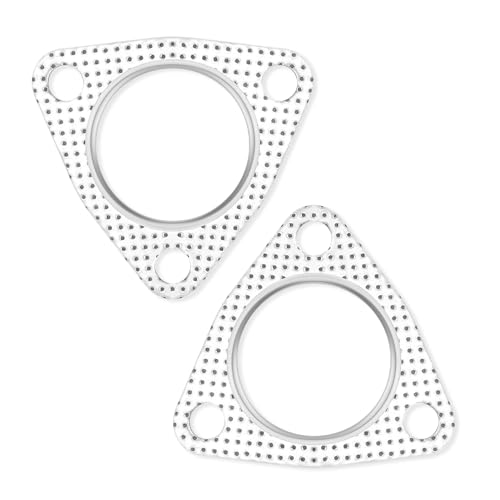 | 2PCS 2" Exhaust Gasket Set,3-Bolt Exhaust Flange GasketJunecarp | Budget pick | 2" · 3-bolt · composite graphite | $4.99 Price as of 3 Nov 2026 | View |
 | Michigan Motorsports LS Multi-Layer Steel (MLS) HeaderMichigan Motorsports | Upgrade pick | LS · MLS · header gasket | $22.99 Price as of 3 Nov 2026 | View |
 | 2-Pack Exhaust Flange Gaskets 2-Bolt Exhaust GasketPINYOUZJ | Also great | 1.75" · 2-bolt · graphite steel | $8.50 Price as of 3 Nov 2026 | View |
The best choice depends on the failure mode, not just the material label. A gasket that holds heat on a flat flange can still blow out on a warped one if clamp load is uneven or the bolt pattern does not match.
How we chose
The picks below are grouped by the failure environment they solve best: flat or warped flanges, repeat heat cycling, clamp load, bolt pattern, and engine family fitment. Heat resistance matters, and surface finish does too, along with flange flatness and whether the joint sees vibration or misalignment.
We also favored options that map cleanly to common use cases: OEM-style V8 replacement, LS swap fitment, 2-bolt performance flanges, and high-heat joints that need more compression recovery than a basic stamped gasket can offer.
Exhaust gasket decision matrix
| Use case | Temperature band | Vibration level | Flange type | Common failure mode | Best-fit gasket material |
|---|---|---|---|---|---|
| NA header | 300°F to 500°F | Low to moderate | Flat 2-bolt or 3-bolt header flange | Slow seepage from heat cycling and minor surface mismatch | MLS or OEM-style metal gasket for exact-fit, flat joints |
| Turbo outlet | Above 1000°F near turbine housings | High | Flat, heavy-clamped turbo flange | Blowout from thermal cycling and clamp loss | MLS with strong hardware, or a high-temp graphite design if the flange is not perfect |
| 2-bolt street exhaust | Moderate street heat | Moderate | 2-bolt flange, often 2-inch to 3-inch | Leak at the outer edge from uneven clamping | Graphite or composite gasket with enough compression recovery |
| 3-bolt performance flange | Moderate to high | Moderate | 3-bolt flange, often 3-inch or 3.5-inch | Misalignment and repeated loosening under heat cycles | Graphite composite or MLS if the flange is flat and clamp load is strong |
| Heavy-duty truck | High sustained load | High | Thicker manifold or downpipe flange | Compression set and fretting from long heat soak | Graphite-based gasket with high compression set resistance |
| Marine exhaust | Hot gas with repeated wet-dry cycling | High | Corrosion-prone flange surfaces | Seal loss from corrosion, vibration, and poor surface finish | Graphite or corrosion-tolerant composite, plus corrected flange surfaces |
YGQ 2 inch exhaust gasket: best for compact 2-bolt repairs
- 3-layer steel and graphite core
- Includes 2 gaskets
- Built for high heat and pressure
This 2-inch YGQ gasket fits a 2-bolt flange and uses a 3-layer steel and graphite core, so it suits small-diameter joints that see heat, pressure, and moderate vibration. It is a practical choice when you want a two-gasket pack for a compact manifold, muffler, or silencer joint.
The main strength is its high-heat positioning and the fire-ring style seal, which helps where a simple paper-like gasket would char or crush early. The drawback is fitment sensitivity: you still need to verify the 2-bolt spacing and 2-inch flange size before buying, because the wrong hole spacing will beat any material advantage.
Junecarp 2 inch 3-bolt gasket: best for alignment-friendly street repairs
- Comes with 2 matching gaskets
- 3 slotted bolt holes ease alignment
- Graphite asbestos composite for sealing
This Junecarp gasket is aimed at 2-inch, 3-bolt flanges and uses a composite graphite construction with three slotted bolt holes. That makes it useful where you need a little forgiveness in alignment, especially on street exhaust joints that do not clamp perfectly on the first pull-up.
The slotted holes are the main advantage because they can help during install when the flange is slightly off-center. The tradeoff is that a slotted design is not a cure for a warped flange or badly mismatched hardware; if the sealing faces are badly uneven, the flange still needs repair or a more compressible gasket.
Michigan Motorsports LS MLS gasket: best for LS header swaps
- Designed for GM LS-series engines
- MLS construction for better durability
- Direct OEM replacement fit
This MLS gasket is the strongest fit for LS-series header and manifold swaps when the flange is flat and the engine is expected to run hard. It is listed as a direct replacement for GM 12617944 and covers LS1, LS2, LS3, LS6, LQ4, and LQ9 applications, which makes it a sensible performance choice for high-output builds.
The stainless steel layer construction is the point here. MLS gaskets are built for heat and pressure, so they make sense on high-clamp, flat joints where thermal cycling is the enemy. The drawback is that MLS is less forgiving on warped or rough flanges, so it can leak if the mating faces are not flat enough for metal-to-metal sealing.
PINYOUZJ 1.75 inch gasket set: best for small-diameter replacement
- Galvanized steel with graphite
- Two-gasket kit
- Built for high heat resistance
This two-pack is a budget-friendly choice for a 1.75-inch 2-bolt flange when the goal is basic heat resistance and a fast replacement. Its galvanized steel with graphite puts it in the same general category as other composite replacement gaskets, with a focus on sealing rather than premium fitment features.
The low price is the appeal, especially for smaller exhaust joints where the alternative is a leak repair that needs to get done now. The drawback is the narrower size range: if your flange is 2 inches, 2.5 inches, 3 inches, or 3.5 inches, this is the wrong part and will not save you from mismatched bolt spacing.
Exhaust gasket decision matrix
Use the failure mode to choose the gasket, then verify the exact flange size and bolt pattern. A 3-inch 2-bolt joint that leaks from warped faces needs a different answer than a flat 3-bolt header that only needs a durable heat seal.
| Failure environment | Heat and vibration | Flange condition | Best gasket choice | Why it fits the failure mode |
|---|---|---|---|---|
| NA header on a flat manifold flange | 300°F to 500°F, low to moderate vibration | Flat, exact-fit | MLS or OEM-style manifold gasket | Holds clamp load well when the joint is square and the faces are smooth |
| Turbo outlet near the turbine housing | Above 1000°F, high vibration and pressure pulses | Flat, heavy-clamped | MLS with strong hardware | Best for heat and pressure when thermal cycling is severe and the flange is true |
| 2-bolt street exhaust | Moderate heat, moderate vibration | Minor misalignment or average surface finish | Graphite composite | Compressible enough to seal small imperfections and tolerate repeated heat cycles |
| 3-bolt performance flange | Moderate to high heat, moderate vibration | Usually flat, but often sees bolt-pattern stress | Graphite composite or MLS | Graphite covers small fit issues; MLS wins if clamp load and flatness are excellent |
| Heavy-duty truck exhaust | High sustained heat, high vibration | Large flange with long service intervals | Graphite-based gasket with strong compression set resistance | Handles repeated expansion and contraction without losing sealing pressure as quickly |
| Marine exhaust | Hot gas, corrosion exposure, repeated thermal cycling | Often imperfect after corrosion | Graphite or corrosion-tolerant composite | Better when surface finish is not perfect and vibration is constant |
Fel-Pro exhaust manifold gasket set: best for OEM-style V8 replacement
A Fel-Pro exhaust manifold gasket set is the baseline reliability choice for common V8 applications when you want OEM-style sealing rather than a race-focused part. It fits the job when the flange is serviceable, the bolt pattern is correct, and you want a conservative replacement that matches typical street exhaust conditions.
This is the kind of part that makes sense for normal manifold work, not for a warped flange that keeps blowing out. The advantage is predictable fit and broad acceptance on V8 replacements; the drawback is that it does not solve serious flange damage, so repeated leaks often mean the surface, bolts, or mating parts need attention too.
For ordinary V8 repair, this is often the better value than moving straight to an expensive performance gasket. If the joint is flat and the temperature is within the common 300°F to 500°F manifold range, a sensible OEM-style set can outlast a cheap “performance” part that does not fit well.
Remflex exhaust gasket: best for warped or irregular surfaces
Remflex-style graphite construction is the usual answer when the flange is warped, the surface is uneven, or the bolt pattern does not clamp evenly. It is designed to compress up to 50 percent, which helps it conform to irregular faces instead of relying on perfect metal-to-metal flatness.
That compression matters when repeated thermal cycling keeps opening the joint. The gasket can recover from minor movement better than a rigid seal, so it works well in collector and manifold applications where the flange has seen heat, rust, or years of uneven torque.
This is where graphite beats a generic metal gasket. If the flange is imperfect, a more compressible seal often lasts longer than a harder one that never seats fully. The drawback is simple: graphite is not a cure for badly damaged flanges. If the faces are deeply pitted or visibly bent, repair the flange first.
A common first-timer mistake is to keep replacing a blown gasket on a curved flange and tighten the bolts harder each time. That usually burns the new gasket faster. A compressible graphite design can help, but only if the surface damage is within range.
Vibrant Performance 1458: best for 2-bolt 3-inch flanges
Vibrant Performance 1458 is the right example of why bolt pattern and size matter together. It is a 2-bolt, 3-inch gasket in a performance aftermarket format, so it fits the kind of joint where exhaust flow, vibration, and heat call for a more capable seal than a generic universal part.
This is a strong choice when the flange is actually a 2-bolt 3-inch setup and you want a performance-oriented part for repeated heat cycles. The main value is fitment confidence: the correct diameter and bolt pattern reduce the chance of poor clamp load and edge leakage.
The drawback is the same warning that applies to every performance gasket. If your flange is not 3 inches or the center-to-center spacing is off, the part is wrong no matter how good the material is. Before buying, verify the size, the 2-bolt pattern, and the actual spacing between bolt centers.
Do you need an MLS exhaust gasket?
You need MLS when the flange is flat, the clamp load is high, and the engine is making enough heat and pressure that a softer gasket would lose shape. It is a smart answer for high-output engines, turbo hardware, and exact-fit LS header applications, but it is not the best choice for warped or rough surfaces.
When the flange is imperfect, graphite is usually the better answer because it can conform and recover. MLS works by holding a tight, layered seal under pressure; graphite works by filling in the flaws. That difference matters more than the material label itself.
Thermal cycling changes the choice. Repeated expansion and contraction is one of the main reasons exhaust gaskets blow out, because the joint keeps moving after each heat soak. Good compression set resistance helps maintain sealing pressure over time, which is why graphite and well-made MLS gaskets outperform cheaper one-time seals in harsh use.
Permatex Ultra Copper is often discussed as a sealant option because it is described as having three times more oil resistance than conventional silicones and eight times more flexibility than pre-cut gaskets. Even so, sealant should support the right gasket, not replace a badly mismatched flange.
Which one should you buy?
Start with the failure environment. If your flange is flat and the engine is a high-output LS or turbo build, the Michigan Motorsports MLS gasket is the cleanest fit. If the flange is warped, pitted, or uneven, Remflex-style graphite is usually the safer call. For a straightforward OEM-style V8 repair, a Fel-Pro exhaust manifold gasket set is the baseline choice.
For a 2-bolt 3-inch flange, Vibrant Performance 1458 is the most relevant pattern match in this list. For compact 2-inch repair work, the YGQ 2-inch gasket fits that lane better than a universal gasket that only claims heat resistance. For small-budget replacement on a 1.75-inch joint, the PINYOUZJ set is the least expensive option here, but it is also the narrowest fit.
If you keep blowing the same gasket, stop replacing only the seal. Recheck flange flatness, bolt-hole alignment, and center-to-center spacing. If the flange is bent, a gasket upgrade alone will not solve it.
Best pick by budget
Choose the least expensive gasket only when the flange is already flat and the joint is low risk. If the part is going on a warped surface or a high-heat joint, spending more on a graphite or MLS design is usually cheaper than tearing the exhaust apart twice.
Best pick for LS swaps
For LS1, LS2, LS3, LS6, LQ4, and LQ9 applications, the Michigan Motorsports MLS gasket is the direct-fit performance choice in this list. Verify exact fitment before buying, because LS engine coverage still depends on header style, flange shape, and the exact part number the manifold uses.
Best pick for repeated blowouts
If the gasket keeps failing in the same spot, move up to a graphite design and inspect the flange with a straightedge. Repeated blowouts usually point to thermal cycling, uneven clamping, or flange distortion, not simply a weak gasket.
When to repair the flange instead of buying another gasket
Repair the flange when the surface is visibly warped, the bolt holes are elongated, or the mating faces are so rough that a compressible gasket still cannot seal evenly. A gasket can compensate for minor mismatch. It cannot fix a badly distorted joint.
Say your 3-inch 2-bolt street exhaust leaks after a month because the flange is slightly bowed near one bolt hole. A graphite gasket may hold longer, but if the distortion is obvious, resurfacing the flange and replacing the bolts is the better long-term fix.
Suppose your turbo outlet runs extremely hot and the gasket fails after repeated heat soak. That is a different problem from a mild street leak. In that case, choose MLS for the flat joint, use the correct hardware, and confirm that the flange faces are true before reinstalling.
High-temperature exhaust bolt kit
A high-temperature exhaust bolt kit helps the gasket stay clamped after repeated expansion and contraction. Kits that use M10x1.5 hardware with springs can reduce vibration-driven loosening and help the joint keep its sealing load after thermal cycling.
Use new hardware when the old fasteners are rusty, stretched, or inconsistent in clamp force. Spring-loaded hardware does not replace a good gasket, but it does support seal retention in joints that live near heat and vibration.
How to choose the right flange size and bolt pattern
Measure the flange before ordering. Check the diameter, the bolt count, and the center-to-center spacing. The common sizes called out for exhaust gaskets are 2-inch, 2.5-inch, 3-inch, and 3.5-inch, but the exact hole spacing matters just as much as the nominal size.
- Count the bolts first. Confirm whether the joint is 2-bolt or 3-bolt.
- Measure the flange opening. Match the nominal size, such as 2-inch, 2.5-inch, 3-inch, or 3.5-inch.
- Measure bolt-center spacing. Do not guess from the outside diameter.
- Inspect the mating faces for warping, pitting, or corrosion.
- Choose a gasket based on the failure mode, not the marketing label.
- Replace damaged hardware if clamp load is uneven or inconsistent.
For example, a 3-inch gasket with the wrong center-to-center spacing can leak even if the material is excellent. The same is true for LS swaps: exact fitment matters because the gasket has to match both the engine family and the flange pattern.
Frequently asked questions
What is the best exhaust gasket for high heat?
For high heat on a flat, well-clamped flange, MLS is the strongest choice. It works best when the joint is true and the hardware can keep clamp load steady through repeated thermal cycling. If the flange is imperfect, graphite is usually the safer choice because it compresses and recovers better.
Which exhaust gasket works best for warped flanges?
Graphite-based gaskets, including Remflex-style designs, are usually the best answer for warped or irregular flanges. Their compressibility helps them seal surfaces that are not perfectly flat. If the warp is severe, though, you still need to repair the flange rather than rely on the gasket alone.
Are graphite exhaust gaskets better for performance builds?
They are often better when the build sees vibration, uneven clamping, or minor flange mismatch. For a flat, high-clamp performance joint, MLS can be better. So the real answer depends on the failure mode: graphite helps with imperfect surfaces, while MLS is stronger on true, rigid flanges.
What exhaust gasket should I use for an LS swap?
Use an exact-fit LS gasket that matches the header or manifold pattern, and verify LS1, LS2, LS3, LS6, LQ4, or LQ9 coverage before buying. For high-output or track-style use, an MLS gasket is often the right choice if the flange is flat and the bolt pattern matches exactly.
Can a gasket handle repeated heat cycles without blowing out?
Yes, but only if the material and the flange match the job. Good compression set resistance helps maintain sealing pressure over time. Repeated heat cycles are where weak gaskets fail, especially when clamp load is uneven or the flange is warped and keeps moving as it heats and cools.
How do I choose the right flange size and bolt pattern?
Measure the nominal size, confirm whether the flange is 2-bolt or 3-bolt, and check the center-to-center spacing before ordering. A 2-inch, 2.5-inch, 3-inch, or 3.5-inch gasket can all be wrong if the hole spacing does not match. Fitment comes first, material second.
Do I need an MLS exhaust gasket for a modified engine?
Not always. MLS makes sense for modified engines when the flange is flat, clamp load is strong, and heat is high, especially on LS or turbo applications. If the flange is warped or rough, graphite often seals better and may last longer than a harder metal gasket.
Which exhaust gasket is best for a 2-bolt 3-inch flange?
For a 2-bolt 3-inch flange, a dedicated 2-bolt 3-inch gasket is the right starting point. Vibrant Performance 1458 is the clearest performance-fit example in this list. If the flange is warped or the bolts do not pull evenly, a graphite design is usually safer than a rigid gasket.