How to Reset a Diesel Emissions Warning Light
Reset a diesel emissions warning light only after you fix the cause: clear the fault code with a scan tool, finish a parked regen if soot is high, or refill DEF/AdBlue if the tank is low or contaminated. Skip that step and the light usually returns, and continued driving can trigger limp mode, speed limits, or a costly repair. This guide shows how to identify which reset your truck needs and how to do it safely.
What the warning light means
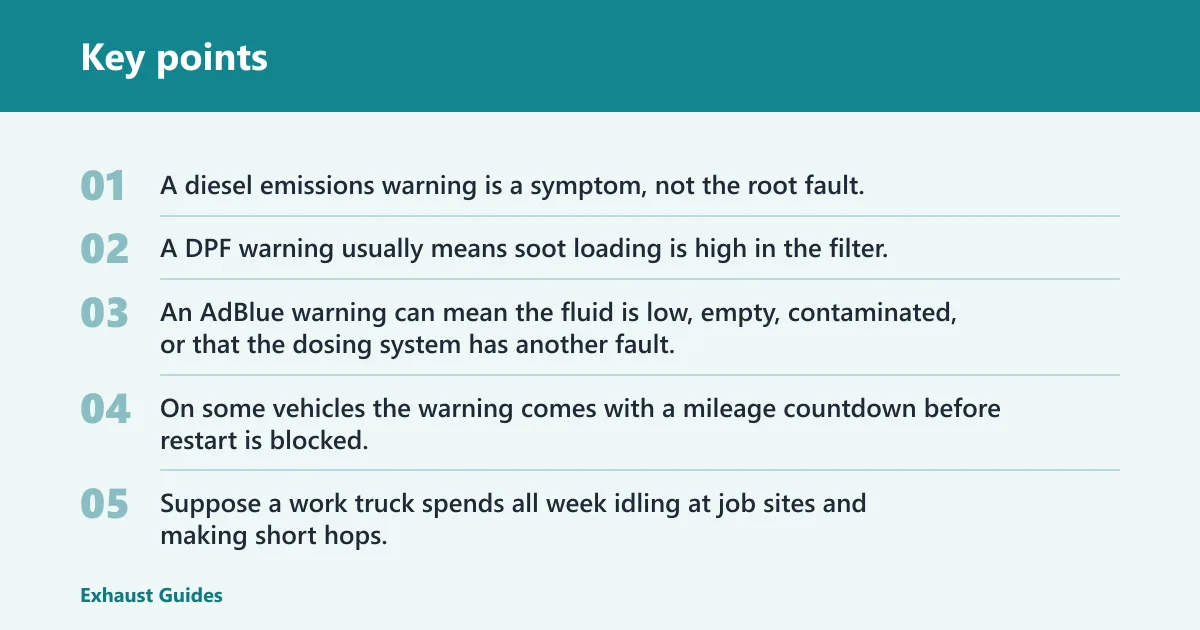


A diesel emissions warning is a symptom, not the root fault. A steady check engine light usually points to a non-emergency emissions or sensor issue, while a flashing check engine light means stop driving immediately. DPF and AdBlue warnings behave differently from a generic MIL, so the reset only works after you match the warning to the fault type.
A DPF warning usually means soot loading is high in the filter. That can happen after short trips, stop-start driving, or interrupted regens. An AdBlue warning can mean the fluid is low, empty, contaminated, or that the dosing system has another fault. On some vehicles the warning comes with a mileage countdown before restart is blocked.
Suppose a work truck spends all week idling at job sites and making short hops. A DPF light after that pattern points toward soot loading, not a random code that should be erased and forgotten. By contrast, a DEF countdown after a refill points more toward a system fault than an empty tank alone if the warning stays on.
Reset decision table
| Warning type | Likely cause | Safe next step | Scanner needed? | When the light should clear after driving |
|---|---|---|---|---|
| Steady MIL with emissions code | Non-emergency emissions fault, EGR issue, sensor issue, or DPF/DEF fault | Read stored codes first, repair the cause, then clear the code | Yes for a proper reset | After the fault is fixed and the drive cycle is completed |
| Flashing MIL | Severe engine problem | Stop driving immediately and diagnose before any reset | Yes | Do not drive to make it clear |
| DPF warning | Soot buildup, interrupted regen, bad pressure reading, or temperature sensor fault | Complete the needed regen, then clear codes if required | Usually yes | After regen finishes and the soot-load condition is resolved |
| AdBlue / DEF warning | Low fluid, empty tank, contaminated fluid, or dosing system fault | Refill with the correct fluid and confirm the system if the warning stays on | Often yes | After refill, driving, and any system check the vehicle requires |
Resetting diesel warning lights means matching the reset to the fault. A DPF warning may need a completed regeneration. A DEF warning may need a refill and a confirmation drive. A steady MIL may need a code clear after repair. A flashing MIL is urgent and should not be driven.
The safe rule is simple: do not clear first and ask questions later. Read the code, fix the fault, then clear it. If the code repopulates, the warning was telling you the repair was incomplete or the wrong path was chosen.
Can I reset a diesel emissions warning light without fixing the fault?
You can erase a code temporarily, but you cannot make a real repair by clearing it. If the soot load, DEF problem, EGR restriction, or sensor fault is still present, the warning comes back as soon as the monitor runs again or the truck completes the next drive cycle.
That is why code clearing should come after diagnosis, not before it. Read the stored codes and freeze-frame data first. A generic reader may show the obvious MIL code, but some diesel-specific faults can live in modules or data the basic tool cannot see. Cummins DEF and DPF faults often need a Chrysler-capable tool, not the key dance.
A common first-timer mistake is clearing a DPF warning after a short idle period and calling it fixed. If the filter is still loaded with soot, the warning can reappear after a few miles or after the next regeneration attempt.
How to tell if regeneration is the fix
Regeneration is the right next step when the problem is soot loading, not a broken sensor or failed dosing system. A DPF captures soot from diesel exhaust, and that soot has to burn off during passive, active, or forced regeneration. If the warning appeared after short-trip or stop-and-go use, regen is often part of the fix.
On many trucks, a completed drive at faster than 40 mph for 10 to 15 minutes may trigger a normal regeneration. That only helps if the truck already has the right conditions and no blocking fault. If the DPF warning stays red or the vehicle enters limp-home mode, stop treating it like a routine drive-cycle issue and scan it.
-
Check the warning type.
A steady MIL, amber DPF light, or DEF countdown each points to a different reset path. A flashing MIL means stop driving immediately. -
Read the stored codes.
Use an OBD-II scanner before replacing parts. Freeze-frame data can show whether the fault appeared during idle, cruise, or a regen attempt. -
Match the soot pattern.
If short trips, stop-start use, or interrupted regens caused the issue, complete the required drive cycle or a parked regen if the vehicle calls for one. -
Verify the sensors.
If the light returns quickly, check the differential pressure sensor and diesel exhaust temperature sensor data. Bad readings can mimic a blocked DPF and keep the warning alive. -
Clear only after repair.
Once the cause is fixed and the regeneration or service step is complete, clear the code with the proper tool and confirm the light stays off through the next drive cycle.
How long you need to drive depends on what the vehicle asks for. Some trucks need the regen to complete at highway speed, while others need a parked regen under scan-tool control. If the manual or scan tool says a parked regen is required, do not substitute a casual drive around town and expect the light to disappear.
How to reset after a DEF refill
Refilling AdBlue or DEF can clear a simple low-fluid warning, but it will not erase a stored dosing fault. AdBlue warnings can include a mileage countdown, and some vehicles will not restart once the tank is empty. A VW Group diesel can refuse to start once AdBlue is empty.
If the warning persists after refill, the system fault may be the real issue. That can mean a bad level sensor, heated tank fault, pump issue, or dosing problem. In that case the refill was necessary, but it was not the whole repair.
-
Refill the correct fluid.
Add the DEF or AdBlue specified for the vehicle. Do not guess at fluid type, and follow the manual for filler location and any waiting period after topping up. -
Cycle the ignition.
Many systems recheck the level after a key cycle and a short drive. If the truck has a countdown warning, note whether the miles remaining change after the refill. -
Drive long enough to recheck.
Give the vehicle the drive it needs to confirm the refill. If the warning clears after a short drive, the problem was likely low fluid; if it does not, keep diagnosing. -
Scan for stored faults.
If the message stays on, read the DEF system codes. A refill does not cancel a sensor or dosing fault by itself.
Picture a pickup that shows a 100-mile DEF countdown after a long tow, then still shows the message after a full refill. That points away from a simple empty tank and toward a fault that needs codes and live data, not another jug of fluid.
Why the light comes back after I clear it
The light comes back when the root cause remains. That is common with a differential pressure sensor that misreads soot load, a diesel exhaust temperature sensor that gives the wrong regeneration signal, or an EGR system that is restricted enough to trigger P0401-related warnings. Carbon buildup can keep the same fault returning.
These false-reset cases matter because the truck may appear fine for a short trip. Then the next monitor run sees the same bad data and the warning returns. If the DPF warning was red or flashing, treat it as more serious than an amber warning and do not keep driving it as though a reset solved the problem.
Ignoring a DPF light can force limp-home mode. That is a clue, not a nuisance. Once the truck limits power or speed, the better move is diagnosis, not repeated clearing.
When is a scanner needed?
A scanner is needed any time you want more than a temporary light clear. Basic OBD-II readers can clear many check engine lights, but they may miss diesel-specific modules or the data needed to confirm a successful regen or DEF repair. For Cummins DEF and DPF faults, a Chrysler-capable tool is the better choice than the key dance.
Older RAMs can display stored codes on the odometer without a scanner. The RAM key dance uses ignition ON-OFF-ON-OFF-ON within about five seconds. That method can help you read some stored codes, but it cannot clear codes or read diesel emissions modules. A basic reader can clear the light, but the key dance cannot.
-
Check what the vehicle supports.
See whether your truck has a built-in code display, a basic OBD-II port, or a manufacturer-specific scan path. Use the method that matches the fault system. -
Read codes before parts.
Save the codes and freeze-frame data first. That prevents guesswork on DPF, DEF, EGR, pressure-sensor, or temperature-sensor repairs. -
Clear after verification.
Use the scanner only after the underlying fault is fixed or the regeneration is complete. If the code returns right away, the problem is still present.
Frequently asked questions
How long do I need to drive after topping up AdBlue or completing a regen?
There is no single number for every diesel. Some systems recheck after a short drive, while DPF regeneration may need faster than 40 mph for 10 to 15 minutes. If the truck calls for a parked regen or a specific confirmation drive, follow that exact procedure instead of guessing.
Do I need a scanner to reset a diesel emissions warning light?
For a real reset, usually yes. A scanner reads stored codes, can capture freeze-frame data, and can clear the fault after the repair is verified. Older RAMs can show codes on the odometer with the key dance, but that method cannot clear codes or read diesel emissions modules.
What happens if the DPF or AdBlue system is actually faulty?
The warning returns, and the vehicle may limit power or refuse to restart. A bad differential pressure sensor, diesel exhaust temperature sensor, EGR restriction, or DEF dosing problem can make the same light reappear after every clear. At that point, diagnosis is the fix, not another reset.