Diesel Exhaust Fluid Tank Symptoms and Fixes
A bad DEF tank usually causes repeated low-DEF warnings, contamination faults, or pump and heater codes; a bad level sensor alone often gives false low-level readings with normal dosing. Ignore it, and you can end up in derate or no-start countdowns. This guide shows how to tell tank failure, sensor failure, frozen DEF, contamination, and pump or line problems apart.
What are the symptoms of a bad DEF tank?


A failing DEF tank often shows warnings that do not match the fluid level, slow or no refill recognition, heater faults in cold weather, or dosing problems after a clean refill. A bad tank can also leave visible clues at the cap, vents, or fittings, especially if contamination or freezing has stressed the system.
What the warning pattern means
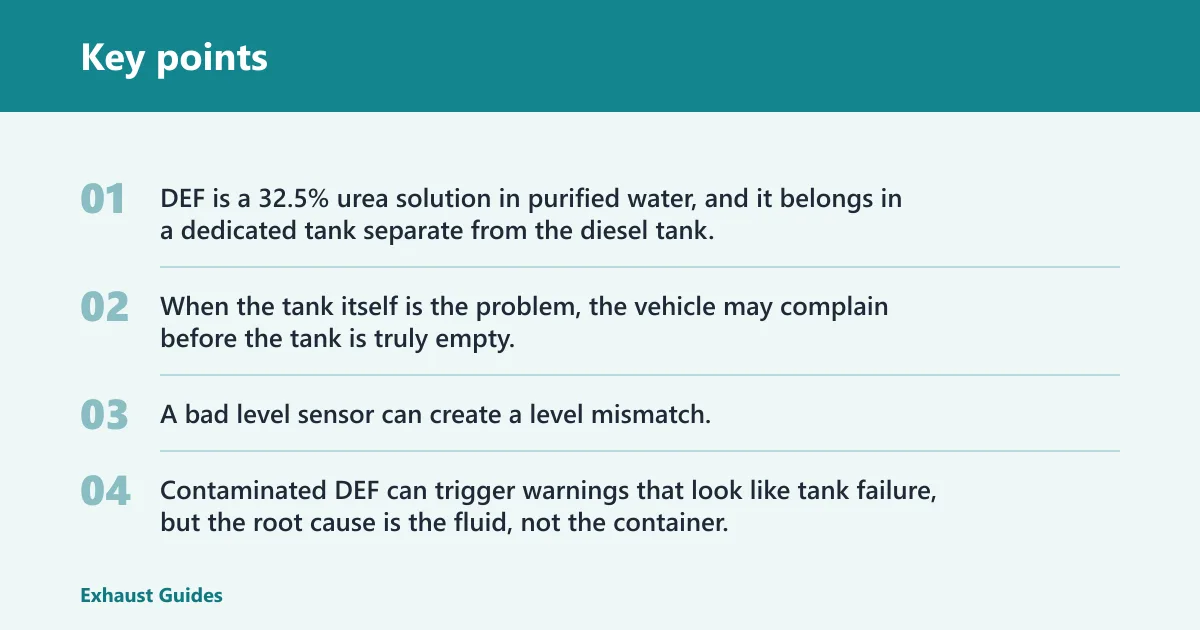
DEF is a 32.5% urea solution in purified water, and it belongs in a dedicated tank separate from the diesel tank. In SCR systems, the tank supplies fluid that is injected into the exhaust stream to help convert NOx into nitrogen and water vapor.
When the tank itself is the problem, the vehicle may complain before the tank is truly empty. A DEF warning light can show up early, then stay on after a proper refill if the sender, heater, pump, or module cannot confirm the level or move fluid normally.
When the problem is actually the sensor
A bad level sensor can create a level mismatch. The gauge may stay low even after a full refill, jump around on rough roads, or report empty while dosing still works and no contamination code is present. That pattern points more to a sender or wiring issue than to a cracked tank.
When contamination changes the symptom pattern
Contaminated DEF can trigger warnings that look like tank failure, but the root cause is the fluid, not the container. ISO 22241 matters here, because off-spec fluid or dirt introduced through a dirty funnel can damage emissions equipment and create codes that keep returning after top-offs.
| Symptom | Most likely cause | Likely DTC family | Does dosing usually still work? | Is it usually safe to drive? | Likely failed part | Quick check | Safe temporary action | Permanent fix |
|---|---|---|---|---|---|---|---|---|
| Low-DEF light stays on after refill | Stuck level sender or wiring fault | Level, plausibility, or communication faults | Often yes, at least at first | Usually only if no derate countdown is active | Sensor or wiring | Cycle key, check whether the display updates after a short drive | Keep the tank above half full if the system still drives normally | Inspect wiring, sender, and tank module; replace the failed part |
| Gauge reads empty but the tank was just filled | Bad level sensor | Level or signal plausibility faults | Usually yes if there are no dosing codes | Usually yes short-term, unless the vehicle starts derating | Sensor | Check for normal engine operation and any extra codes beyond level | Avoid panic refills until the reading is confirmed | Repair or replace the sender or integrated tank module |
| Light comes on in cold weather, then clears later | Frozen DEF or heater fault | Heater, temperature, or thawing faults | Usually not until the tank thaws | Usually limited until the fluid thaws and the system confirms operation | Heater or wiring | See whether the tank and lines thaw after warm-up | Let the vehicle warm before judging the reading | Check heater circuit, fuse, relay, and tank heating elements |
| Warning returns soon after a refill from a suspect container | Contaminated or off-spec DEF | Quality, dosing, or catalyst efficiency faults | May work at first, then fail again | Risky until the source is confirmed and the system is cleaned | Contamination, and sometimes the tank body if residue remains | Review where the DEF came from and whether the container was clean | Stop adding more from the same source | Drain, flush, inspect lines and dosing parts, then refill with compliant fluid |
| Repeated low-level warning with visible leaks | Cracked tank, cap seal, or filler neck issue | Level, pressure, or leak-related faults | Not reliably | Use caution; leaks can worsen quickly | Tank body, cap, or fill neck | Look for crusted residue, wet fittings, or odorless white deposits | Top off only if safe and do not overfill | Replace damaged tank parts and any failed seals |
| Derate or crawler mode after warnings | Empty tank, failed dosing, or serious tank fault | Range countdown, SCR performance, or no-start faults | Not always; some systems inhibit dosing | Only to reach service if the dash allows it | Pump, module, sensor, or tank body depending on the codes | Check remaining range and any active fault codes | Drive only as far as needed to service, if the vehicle still allows it | Repair the cause, clear codes, and verify dosing |
| Fuel smell or noxious odor near the tank area | Incorrect fluid, contamination, or unrelated leak nearby | Often contamination or leak-related codes | Uncertain | Not until the fluid is identified | Cap, fill neck, or contaminated tank contents | Confirm the fluid is DEF, not diesel or coolant | Stop adding fluid until the source is known | Clean the area, replace contaminated fluid, and inspect the system |
| Warning appears with no level change after fill | Pump, heater, or module fault | Pump, heater, pressure, or control faults | Often no if dosing cannot build pressure | Usually limited if the system cannot prime or dose | Pump, heater, wiring, or control module | Listen for priming, check for heater-related codes | Do not keep cycling the key for long periods | Test the pump circuit, heater circuit, and control module |
Where is the DEF tank on your diesel?
The DEF tank is usually mounted away from the diesel tank, often on the chassis of a truck or heavy-duty vehicle, and many vehicles use a blue filler cap or lid. On pickups, the tank is commonly tucked near the frame rail; on fleet trucks and RVs, it is often easier to see from underneath.
Pickup layouts
On many pickups, the tank sits near the rear of the frame or beside a frame rail to save bed space and protect the fill neck. Access can be tight, so a light and a clean funnel matter. If the cap seal is damaged or the fill area is dusty, contamination risk rises fast.
Fleet and heavy-duty layouts
Fleet trucks often place the tank where service access is straightforward from the side or under the chassis. That layout can make heater, level, and pump faults easier to inspect, but it also means road spray and impact damage should be checked after a warning or unexplained leak.
RV and motorhome chassis layouts
Motorhomes may hide the tank deeper in the chassis, which can make a level problem look worse than it is. Frozen fluid, a loose cap, or a pinched line can cause the same dash warning as a bad sender, so the fill point and underbody routing deserve a close look.
Can a bad DEF tank cause limp mode?
A low DEF condition can trigger reduced power or crawler mode, and a tank fault can do the same if the control system cannot confirm level or deliver fluid. If the issue is ignored, the truck may count down to stronger derate behavior or a no-start limit on some vehicles.
How low DEF can trigger power reduction
Running out of DEF may put a vehicle into crawler mode. That is not just a nuisance light; it is the SCR system reacting to missing fluid. Since DEF is used to reduce NOx in the exhaust stream, a true empty tank can force the vehicle into a restricted operating state until refilled and acknowledged.
How tank faults can lead to derate events
A pump fault, a heater fault, or a sender that never reports the refill can all lead to derate logic. The vehicle may see the tank as unavailable even when there is fluid onboard. That is why a full tank can still produce a warning if the module cannot trust the data.
What to do before the vehicle limits speed
- Confirm the fluid level. Check the tank fill point, the dashboard message, and any range countdown. If the vehicle was just filled, do not assume the first warning is correct.
- Look for freeze clues. In cold weather, see whether the warning clears after the truck warms up. DEF can freeze at 12°F (-11°C) in AUS 32 form, and thawing should not hurt standard-compliant fluid quality.
- Check for contamination signs. White crust, muddy residue, or a contaminated source point toward fluid problems, not an empty tank.
- Service before countdown ends. If the display shows reduced-power or crawl mode, get the truck to service promptly to avoid a harder derate or no-start event.
Why is the DEF warning light still on?
The light can stay on after refilling if the tank is still not being read correctly, if the fluid is frozen, or if a heater, pump, or wiring fault prevents normal operation. A warning can also remain active if the system needs a drive cycle before the level update is accepted.
Empty tank after refill
If the tank truly was empty, the warning may not clear immediately. Some systems may need a drive cycle and a valid level signal before the message goes away. If the light persists after a proper refill, move on to sender, heater, and contamination checks instead of adding more fluid blindly.
Bad level reading or stuck sender
A sender that sticks at empty or full is common enough to mimic a tank problem. The clue is inconsistency: one refill looks ignored, then a later fill suddenly “takes.” That points to a reading fault, not necessarily a dead tank.
Heater or pump fault preventing normal operation
Tank heaters keep cold-weather fluid moving, and the pump feeds dosing pressure. If either one fails, the system may hold the warning even though the tank contains clean DEF. A heater fault is especially common when the warning shows up only in freezing weather and clears later.
Say your pickup shows a low-DEF light at 10°F, the tank was topped off, and the message clears only after the cab warms and the engine runs for a while. That pattern points more to frozen fluid or a heater issue than to a cracked tank.
What causes DEF tank contamination?
Contamination usually comes from dirty handling, the wrong container, or off-spec fluid. Diesel, coolant, water, dirt, and even residue from a dirty funnel can change the fluid enough to damage emissions equipment. ISO 22241 and API Diesel Exhaust Fluid Certification matter because they signal proper quality control.
Wrong funnel or container
The easiest way to contaminate DEF is to pour it through a container or funnel that held something else. Even a small residue of diesel or oil can cause trouble. Keep fill tools clean, sealed, and dedicated to DEF only.
Diesel, water, dirt, or coolant contamination
Diesel contamination can come from a mislabeled container. Water contamination may dilute the fluid beyond spec. Dirt and coolant can create deposits or chemical mismatch, which may show up as fault codes that keep returning after refills. If contamination is suspected, stop topping off, sample or check the source, drain and flush as needed, and refill with certified DEF.
Off-spec fluid and storage problems
DEF shelf life is typically about one to two years at 75 degrees. Heat, sunlight, and open containers shorten usable life. AUS 32 is standardized to 32.5% urea by weight, while AUS 40 contains 40% urea by weight and is Marine DEF, so using the wrong product can be a real problem.
How do you fix a DEF tank that won’t read correctly?
Start with the fill point and cap, then move to the sensor, heater, pump, and wiring. A bad reading is often a sender issue, but a frozen or contaminated system can create the same symptom. The goal is to separate what the vehicle is reporting from what the tank is actually doing.
Cap seal and fill-point checks
A damaged cap seal or dirty fill neck can let contamination in and confuse the system. Inspect the blue cap or lid, look for crust, and make sure the neck is clean before adding any more fluid. If the cap does not seal, the tank can ingest moisture and debris.
- Inspect the filler neck. Look for dried residue, dirt, or damaged threads around the fill point. Clean only with lint-free material and keep contaminants out of the opening.
- Check the cap seal. Make sure the cap closes firmly and the seal is not split or swollen. A poor seal can admit moisture and dirt.
- Use known-good fluid. Refill with DEF that meets ISO 22241, and avoid mixed or unlabeled containers. Proper quality helps rule out contamination before parts are replaced.
- Drive and recheck. After refill, run a normal drive cycle and see whether the warning and level reading change. If they do not, move to electrical checks.
Sensor, heater, and wiring checks
Look for wiring damage near the tank, corrosion at connectors, and heater-related codes. In cold weather, a heater fault can keep the fluid from thawing fast enough for normal readings. If the pump or sender shares a module, one bad part may make the whole tank assembly act failed.
When the tank or module needs replacement
If the tank leaks, the sender is built into the failed module, or the pump and heater tests point to an internal fault, replacement is often the real fix. A tank replacement is more likely when multiple symptoms appear together: false readings, repeated low warnings, and confirmed contamination or internal damage.
Suppose a fleet truck refills from a sealed tote, then shows a low warning, a heater code, and no level change after 30 miles. That combination points away from empty fluid and toward a tank module or heater circuit fault.
Frequently asked questions
How do I know if my diesel exhaust fluid tank is empty or failed?
An empty tank usually follows a clear usage pattern and may respond after a normal refill and drive cycle. A failed tank often shows inconsistent readings, repeated warnings right after fill, or codes for the sender, heater, or pump. If the warning does not match the fluid level, suspect a fault.
Why is my DEF warning light on even after refilling?
The light may stay on because the tank is frozen, the sender is stuck, the heater is not working, or the refill came from contaminated fluid. Some vehicles also need a short drive cycle before the new level is accepted. If the warning persists, inspect the tank system next.
Can frozen DEF damage the tank or level sensor?
Standard-compliant DEF can freeze at 12°F (-11°C) in AUS 32 form without losing quality, but ice can block flow and confuse the level reading until it thaws. Freeze-thaw cycling should not harm compliant fluid, though repeated freezing can expose weak heaters, seals, or sensors in the tank.
Where is the DEF tank on a diesel truck?
It is usually a separate tank mounted on or near the chassis, often marked by a blue filler cap or lid. On pickups it may sit near a frame rail; on fleet trucks and RVs it is often placed where service access is easier. It is not the diesel fuel tank.
How long does DEF last in a tank?
A full DEF tank does not have one fixed mileage range because consumption depends on the vehicle, load, and SCR strategy. Some engines use far less than others. Shelf life is typically about one to two years at 75 degrees, so storage conditions matter too. Keep the tank sealed, refill before it runs empty, and avoid old or contaminated fluid.
What happens if I put DEF in the fuel tank?
Do not start the engine. If DEF goes into the fuel tank, have the vehicle towed, then drain and flush the fuel system and inspect for damage before any restart. This is a fuel-side contamination event, not a normal DEF service issue, and running the engine can spread the damage quickly.