Diesel Exhaust Fluid Cost: What You’ll Pay Per Gallon
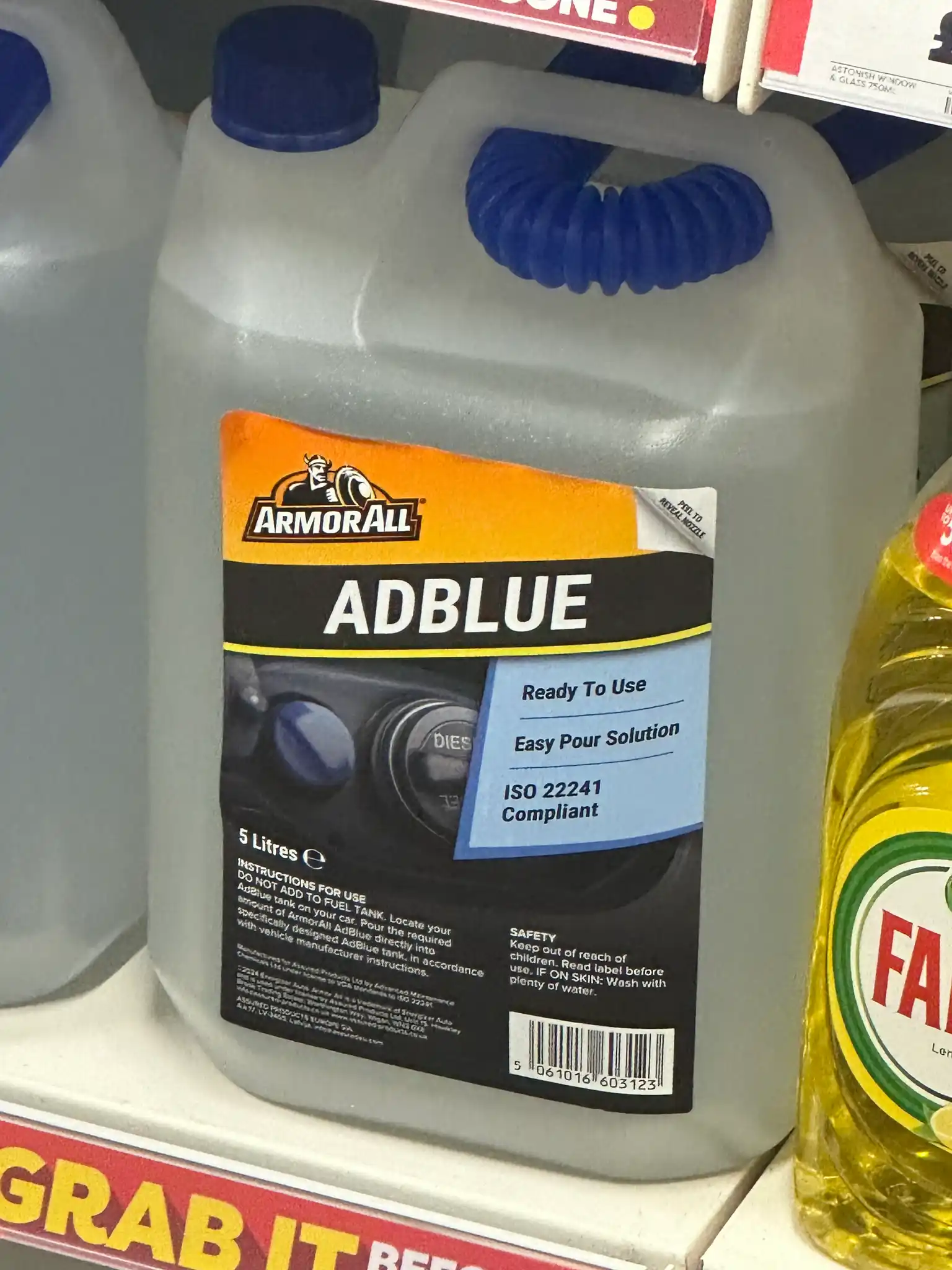
Diesel exhaust fluid usually costs about $2 to $5 per gallon, and many light-duty diesel trucks spend roughly $20 to $80 a year, depending on mileage and where you buy it. Pay dealer counter prices or buy oversized containers you cannot use fast enough, and your refill cost can jump fast. This guide breaks down DEF cost by retail channel, annual mileage, and vehicle type so you can choose the cheapest refill method without buying too much.
Diesel exhaust fluid cost at a glance
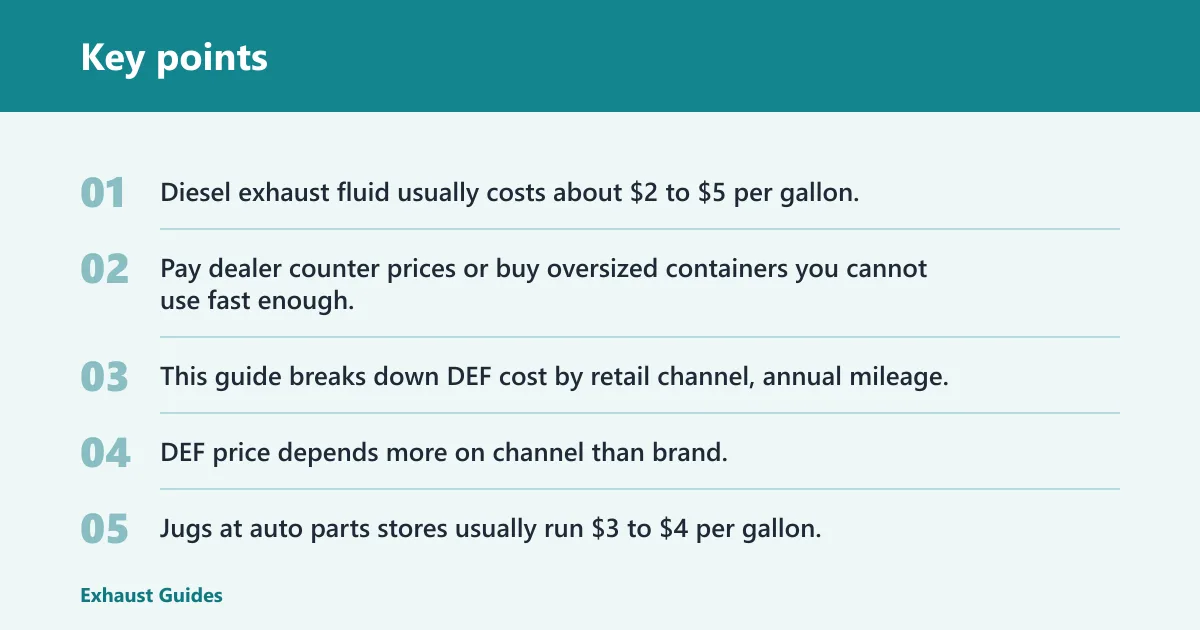

- Ready-to-use DEF in jug form
- Convenient for garage or home storage
- Bulk pack lowers trips to buy more
DEF price depends more on channel than brand. Jugs at auto parts stores usually run $3 to $4 per gallon, truck-stop pumps or bulk totes usually cost $2.50 to $3.50 per gallon, and fleet buyers with bulk tanks can pay as little as $2 to $2.50 per gallon. The package size, the trip you take to buy it, and spoilage risk change what you really pay.
DEF is a 32.5% urea and 67.5% deionized water solution that meets ISO 22241 and carries an API certification mark. It is used in SCR systems on nearly all on-road diesel trucks since 2010 to reduce nitrogen oxides. In other words, you are paying for compliance fluid, not an optional additive. (EPA)
What changes the price per gallon
The container matters first. A 2.5-gallon jug costs more per gallon because it includes packaging, filling, and shelf-ready convenience. A truck-stop pump removes most of that packaging cost. Bulk drums, totes, and tank delivery usually cut the unit price further, but only if you can store the fluid correctly and use it before it ages out.
Temperature matters too. DEF stored at room temperature is good for about 12 months, and DEF kept under 80°F can last up to 2 years. Heat shortens usable life, so a cheap gallon that spoils before you use it is not cheap anymore.
Quick answer for pickup owners versus fleets
For a pickup owner who drives moderate miles, a 2.5-gallon jug is handy, but a truck-stop pump usually gives you the better price if you already stop there. For fleets or very high-mileage users, bulk storage usually wins on price per gallon, provided the tanks stay clean and the fluid moves often enough to avoid spoilage.
📊 EPA notes nearly all on-road diesel trucks have used DEF since 2010. Source: EPA.
How much diesel exhaust fluid do you need?
Most diesel pickups burn DEF at about 2-3% of diesel fuel consumption, and a diesel pickup uses roughly 1 gallon of DEF per 300-500 miles. That means a typical light-duty truck does not need large weekly refills, but towing, idle time, and heavy load cycles can shorten the interval. A common pickup DEF tank is about 5 gallons.
Typical tank size in light-duty pickups
A 5-gallon tank is common on diesel pickups, and many owners refill every about 3,000 miles. That is only a rough rule, because actual use depends on how much diesel you burn, how hard you tow, and how often the truck idles while parked or working.
Say your pickup gets 18 mpg and you tow on weekends. Your DEF use is likely higher than a commuter truck with the same odometer reading, because the engine burns more fuel under load and the aftertreatment system doses more DEF to keep nitrogen oxides down.
How towing and idle time change refill frequency
Towing raises DEF use because it raises diesel use. Long idling does the same. If you tow a trailer through hills or let the truck idle for worksite heat or cab comfort, expect more frequent fills than the mileage alone suggests. The tank may still be only half full when the dashboard asks for attention.
A common first-timer mistake is to treat DEF like windshield washer fluid and ignore the gauge until the warning appears. That leaves less room to shop for the best price, and low-DEF warnings can arrive when you are far from a truck stop.
Simple mileage-based estimate for annual DEF use
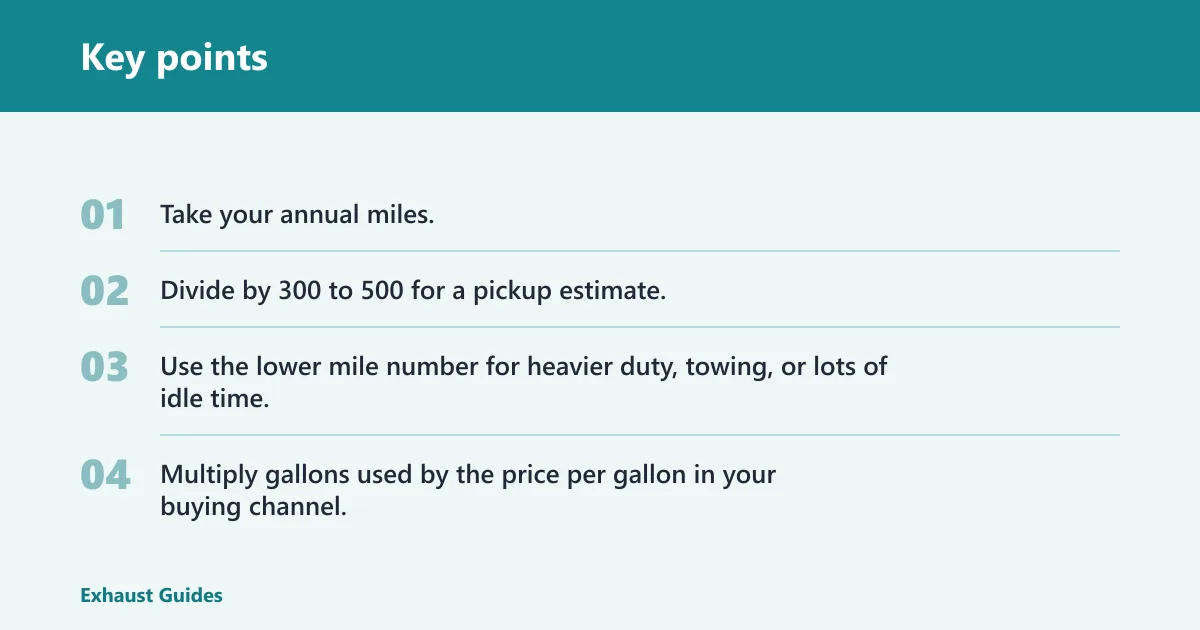
- Take your annual miles.
- Divide by 300 to 500 for a pickup estimate.
- Use the lower mile number for heavier duty, towing, or lots of idle time.
- Multiply gallons used by the price per gallon in your buying channel.
If you want a fast estimate, use 1 gallon per 400 miles for mixed pickup use. That lands near the middle of the 300-500 mile range and gives a practical planning number without pretending every truck behaves the same.
Annual DEF cost by vehicle type
The real annual bill depends on how much you drive, how hard you work the truck, and where you buy DEF. A light-duty pickup may burn only a few dozen gallons a year, while a towing-heavy truck or a high-mileage diesel can use several times that amount. Cost per mile is low, but the buying method still matters.
Pickup owner
For a typical pickup owner driving 12,000 miles a year, a middle estimate of 1 gallon per 400 miles equals about 30 gallons of DEF yearly. At a pump price near $3.00 per gallon, that is about $90 a year. At jug pricing near $3.50 per gallon, it is about $105.
Towing-heavy pickup owner
Suppose the truck tows often and uses 1 gallon per 250 miles. At 15,000 miles a year, that works out to about 60 gallons of DEF. That is roughly $150 a year at a truck-stop pump price of $2.50 per gallon, or about $210 a year at $3.50 per gallon jugs.
Fleet or high-mileage user
For a high-mileage user at 50,000 miles a year, using the Class 8-style benchmark of 1 gallon per 125 miles gives about 400 gallons of DEF yearly. That is roughly $1,000 a year at $2.50 per gallon bulk pricing, or about $1,400 at $3.50 per gallon jug pricing. Storage and turnover matter here.
DEF cost comparison table
| Buyer type | Yearly miles | Yearly DEF gallons | Refill count | Jug cost per gallon | Jug yearly spend | Pump cost per gallon | Pump yearly spend | Bulk cost per gallon | Bulk yearly spend | Cost per mile at bulk |
|---|---|---|---|---|---|---|---|---|---|---|
| Pickup owner | 12,000 | 30 | 6 fills of a 5-gallon tank | $3.50 | $105.00 | $3.00 | $90.00 | $2.50 | $75.00 | 0.63 cents |
| Towing-heavy pickup owner | 15,000 | 60 | 12 fills of a 5-gallon tank | $3.50 | $210.00 | $3.00 | $180.00 | $2.50 | $150.00 | 1.00 cent |
| Fleet or high-mileage user | 50,000 | 400 | about 8 refills of a 55-gallon tote | $3.50 | $1,400.00 | $3.00 | $1,200.00 | $2.50 | $1,000.00 | 2.00 cents |
The table uses middle-of-the-road channel prices from the ranges above. The pickup and towing examples assume a 5-gallon DEF tank, which is common on diesel pickups. The fleet row uses a 55-gallon tote because large users usually buy and store DEF in bulk.
Break-even note: At these example prices, bulk saves about $1.00 per gallon versus jugs. For a pickup owner, bulk only becomes the smarter buy if you can use the fluid before it ages, keep it under control storage-wise, and avoid leftover product sitting warm for months. For fleets, the savings usually justify the storage work much faster.
Is diesel exhaust fluid necessary?
Yes, on SCR-equipped diesels it is necessary for normal operation. DEF is injected into the exhaust stream by the selective catalytic reduction system, where it helps reduce nitrogen oxides. EPA notes nearly all on-road diesel trucks have used DEF since 2010, so for most modern diesel pickups and trucks, it is part of the emissions system, not an add-on.
How SCR systems use DEF
SCR systems dose DEF based on exhaust conditions, engine load, and emissions needs. The fluid is not burned in the cylinder. It is sprayed into the exhaust after the engine, where it helps the aftertreatment system lower NOx output.
What happens when DEF runs low
Low DEF usually triggers a warning when the tank is getting low, often around 10% remaining. If you ignore it, some systems limit power, and the EPA says DEF systems can reduce speed to nearly inoperable levels. In some trucks, that can mean a crawl speed near 5 mph. Sensor faults can also trigger a derate, so a warning does not always mean the tank is empty.
Why certification matters more than brand
Brand name matters less than spec compliance. Look for ISO 22241 compliance and the API certification mark. That matters because the aftertreatment system depends on fluid quality, not packaging marketing. If the fluid is out of spec, the truck may still complain even if the label looks familiar.
How long does diesel exhaust fluid last?
DEF stored at room temperature is good for about 12 months, and DEF kept under 80°F can last up to 2 years. Heat shortens life, so storage conditions matter almost as much as price. A bargain drum is not a bargain if it sits too long in a hot garage or yard.
Shelf life by storage temperature
Cool, shaded storage extends usable life. Warm storage shortens it. The fluid freezes at 12°F (-11°C), but freezing itself does not ruin it. The practical issue is repeated heat exposure after thawing, which can shorten shelf life faster than cold weather does.
How to avoid buying more than you can use
Match the package size to your burn rate. A pickup owner who uses about 30 gallons a year may be fine with jugs or a few pump fills. A 55-gallon drum can make sense only if you can consume it fast enough and keep the storage conditions reasonable.
Suppose a pickup owner buys a 55-gallon drum because the per-gallon price looks great. If only half the drum gets used before the storage clock runs out, the effective cost rises fast. The cheap gallon is only cheap when it stays usable.
What is the cheapest way to buy DEF?
The cheapest way to buy DEF is usually bulk, followed by truck-stop pumps, then retail jugs. But cheapest on paper is not always cheapest in practice. Your real answer depends on mileage, storage space, and whether you can use the fluid before it ages. For many pickup owners, the best value is the pump at a truck stop.
When jugs make sense
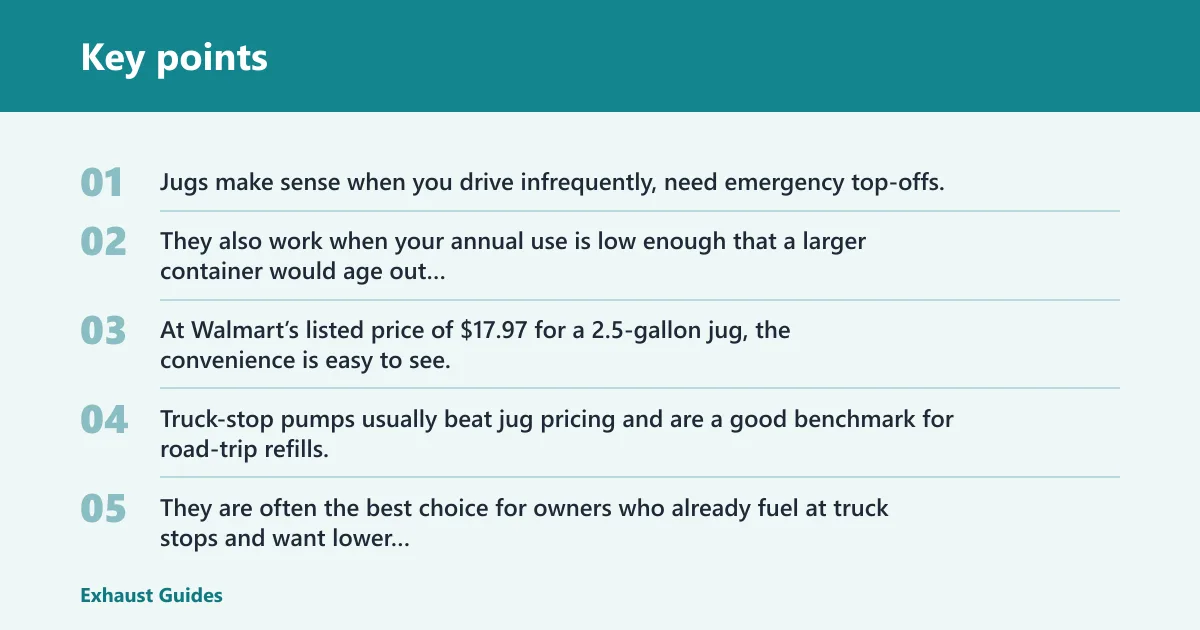
Jugs make sense when you drive infrequently, need emergency top-offs, or do not want to carry loose fluid in the truck. They also work when your annual use is low enough that a larger container would age out before it empties. At Walmart’s listed price of $17.97 for a 2.5-gallon jug, the convenience is easy to see.
When truck-stop pumps are the better buy
Truck-stop pumps usually beat jug pricing and are a good benchmark for road-trip refills. They are often the best choice for owners who already fuel at truck stops and want lower per-gallon cost without buying a drum. At $2.50 to $3.50 per gallon, they sit between retail jugs and fleet bulk pricing.
When bulk storage becomes cheaper than retail
Bulk storage starts to pay when your volume is high enough to move through the fluid before spoilage matters. For fleets, the math is easy. For a pickup owner, the savings can disappear if the drum sits too long. At Walmart’s listed 55-gallon drum price of $328.30, the unit price is much lower than the jug price, but only if the drum gets used on schedule.
Frequently asked questions
How much diesel exhaust fluid cost
Most drivers pay about $2 to $5 per gallon depending on channel. Jugs at auto parts stores usually run $3 to $4 per gallon, truck-stop pumps or bulk totes usually cost $2.50 to $3.50 per gallon, and fleet bulk tanks can go down to $2 to $2.50 per gallon.
How much does diesel exhaust fluid cost per gallon?
Per gallon, jugs are usually the highest cost because of packaging and convenience. Truck-stop pumps are usually cheaper. Bulk drums and tank delivery are usually the lowest, but you need enough turnover to avoid spoilage and enough storage space to manage the container safely.