How Much Does a Diesel DPF Replacement Cost?
A diesel DPF replacement is often reported to cost about $1,000 to $4,000 in parts and labor, while cleaning is commonly around $250 to $900 and a forced regeneration can be much cheaper if the filter is not cracked or melted. Paying for a new DPF without fixing the cause can clog the replacement fast and turn one repair into two. This guide shows how to compare quote lines, spot when cleaning or regeneration is the better buy, and identify upstream faults that make a replacement a waste.
Typical cost range


Expect a spread, not a single number. The part alone can run $1,800 to $4,500 depending on the truck, and with labor the total bill can reach $6,000. In 2026, DPF replacement cost runs $2,000 to $8,000 for most diesel trucks and cars, with access, diagnostics, and hardware driving the spread.
That range is wide because a DPF job is rarely only a filter swap. Shops often have to diagnose why the filter loaded up, check pressure and temperature sensors, inspect exhaust joints, and decide whether soot buildup, ash loading, cracking, or melting is the real problem.
What the quote usually includes
A quote that looks simple on paper often hides several line items. The DPF itself is only one part of the bill. Labor, seals, clamps, sensor work, and reset procedures can add a few hundred dollars or much more, depending on the vehicle and the shop’s rate.
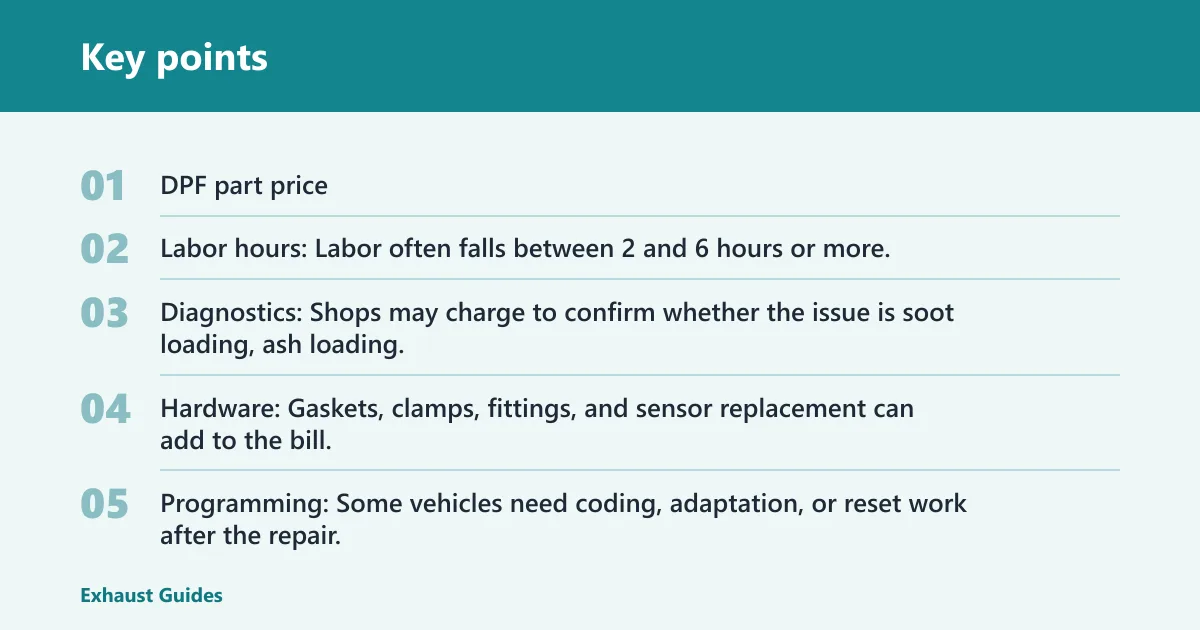
- DPF part price: OEM units usually cost more than aftermarket units, especially on newer or heavy-duty applications.
- Labor hours: Labor often falls between 2 and 6 hours or more, and access can push that higher.
- Diagnostics: Shops may charge to confirm whether the issue is soot loading, ash loading, a failed sensor, or a cracked core.
- Hardware: Gaskets, clamps, fittings, and sensor replacement can add to the bill.
- Programming: Some vehicles need coding, adaptation, or reset work after the repair.
Differential pressure and temperature sensors matter here. They help estimate soot load and control regeneration, so a bad sensor can create a false DPF warning or stop regens from happening at the right time. Replacing the filter before checking those parts can waste money.
DPF quote comparison matrix
Use this matrix to judge replacement quotes against cleaning, forced regeneration, or root-cause repair first. Compare the line items, not only the headline price.
| Vehicle segment | Likely part cost | Labor hours | Add-on parts | Diagnostic fees | Red-flag reason to challenge the quote | Clean first or replace now? |
|---|---|---|---|---|---|---|
| Diesel car | $800 to $2,000 | 2 to 4 | Gaskets, clamps, pressure sensor | $100 to $250 | No sensor scan or no proof the core is cracked | Clean first if soot or ash is the issue; replace now only if the core is damaged |
| SUV | $1,200 to $2,800 | 3 to 5 | Gaskets, fittings, temperature sensor | $100 to $300 | Quote skips upstream fault checks after repeated warnings | Clean first if regeneration history is poor; replace now if melting or cracking is confirmed |
| Pickup | $1,800 to $4,500 | 4 to 8 | Sensors, clamps, hardware, sometimes brackets | $150 to $400 | Part-only quote ignores labor and sensor diagnostics | Replace now only if the filter is cracked or melted; otherwise inspect cleaning and root cause first |
| Van | $1,200 to $3,200 | 4 to 7 | Gaskets, fittings, sensor pack | $100 to $350 | Access is tight but the quote omits labor time detail | Clean first if load is soot-based; replace now if ash loading is severe and permanent |
| Premium diesel | $2,000 to $4,500+ | 4 to 8+ | OEM hardware, sensors, coding items | $150 to $500 | Aftermarket fitment is not matched to emissions requirements | Clean first only if the core is intact and the system supports it; replace now if OEM fitment is required and damage is confirmed |
Say your diesel SUV keeps showing a DPF warning after short city trips. A shop that jumps straight to replacement without checking the differential pressure sensor, temperature sensors, and regen history is skipping the cheapest possible fixes. Challenge that quote first.
Can a clogged DPF be cleaned instead of replaced?
Yes, if the filter is clogged with soot or has manageable ash buildup, cleaning is often the cheaper move. A forced regeneration can sometimes clear early clogging, while professional DPF cleaning is often used when soot or ash buildup has gone beyond what a regen can fix. Cleaning will not repair a cracked or melted core.
When forced regeneration is enough
Forced regeneration is a shop-initiated service used for early clogging. It is usually cheaper than replacement and is often the first step when the filter is not physically damaged. It makes sense when the engine is healthy, the sensors are reading correctly, and the problem is soot loading rather than structural failure.
If a scan tool shows a buildup issue and the pressure readings are plausible, a forced regen can restore function without removing the filter. If regen fails or the warning returns quickly, the shop should look for the cause instead of repeating the same service.
When professional cleaning makes sense
Professional DPF cleaning costs $300 to $600 in many cases, and another guide puts DPF cleaning at $200–$900. Either way, it usually costs far less than replacement. Cleaning fits situations where soot or ash has built up but the filter core is still intact and the substrate has not cracked or melted.
Cleaning can be a good buy after repeated short-trip use, failed regens, or ash accumulation from normal engine wear. It is not a fix for broken hardware. If the DPF matrix is damaged, cleaning money is usually wasted.
When cleaning will not work
Cleaning is a dead end when the core is cracked, melted, or physically broken. It also fails when ash loading is so severe that the filter’s capacity is permanently reduced. In those cases, the DPF cannot be restored to normal function by removing soot alone.
Suppose a pickup has repeated limp-mode events and the shop finds a melted substrate after an overfueling fault. Cleaning that unit would not solve the problem. The better next step is repair of the cause, then replacement if the filter damage is confirmed.
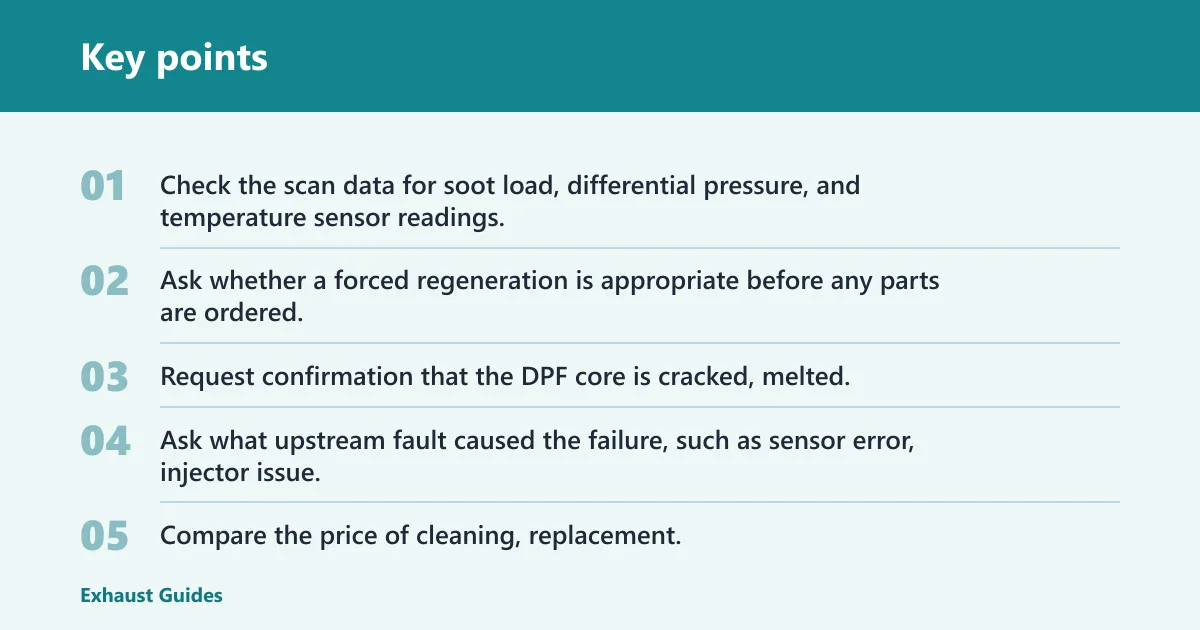
- Check the scan data for soot load, differential pressure, and temperature sensor readings.
- Ask whether a forced regeneration is appropriate before any parts are ordered.
- Request confirmation that the DPF core is cracked, melted, or ash-packed before approving replacement.
- Ask what upstream fault caused the failure, such as sensor error, injector issue, or failed regeneration strategy.
- Compare the price of cleaning, replacement, and any required hardware before choosing the repair path.
When is replacement the only option?
Replacement is the only practical option when the filter core is cracked or melted, or when ash loading has become permanent. It is also the right call if the filter housing or substrate is damaged beyond cleaning. A DPF that is physically broken cannot be rescued by regeneration or washing.
Cracked or melted filter cores
Cracking and melting are hard stop failure modes. The filter may still look intact from the outside, but the internal substrate can be damaged enough to stop filtration or trigger immediate faults. Cleaning cannot rebuild missing material or fix heat damage.
This is where a quote should clearly show evidence of damage. If the shop cannot explain why the core is unusable, ask for inspection photos or scan data before accepting a replacement bill.
Severe ash loading that cleaning cannot reverse
Ash is the non-burnable residue that remains after soot burns off. Over time, it collects inside the filter and reduces capacity. Professional cleaning can remove a lot of it, but not every filter can be recovered if the buildup is too deep or the substrate is too restricted.
That matters for high-mileage diesels, especially those that have spent years on the wrong oil or on repeated failed regens. Low-ash engine oil helps slow permanent buildup, while the wrong oil can accelerate failure.
Repeat failure from an unfixed root cause
If the upstream cause is still there, a new filter can fail fast. Common causes include bad sensors, faulty regeneration control, injector issues, leaks, and frequent short trips that never let the system reach proper burn-off conditions. Replacing the DPF before fixing that cause is the fastest way to pay twice.
A common first-timer mistake is approving a new DPF after one warning lamp and no scan review. The replacement may clear the code briefly, then clog again because the temperature sensor is still faulty or the engine is still overproducing soot.
Why DPF replacement quotes get expensive
DPF replacement gets expensive because the part is only one piece of the job. OEM units cost more, access can be awkward, and the repair often includes sensors, hardware, diagnostics, and calibration. Labor also changes sharply by vehicle layout, which is why truck and van quotes often jump faster than passenger-car quotes.
OEM versus aftermarket DPF cost
OEM DPFs usually carry the highest part cost because they are vehicle-specific and often required for newer or heavy-duty applications. Aftermarket DPFs can cost less, but they still need to match emissions standards and the exact vehicle application. Quality varies widely, so the cheapest option is not always the safest one.
For some trucks, the part alone runs $1,800 to $4,500 depending on the model. A new OEM DPF with installation is listed at $2,000 to $4,500, and diesel pickup owners typically pay $3,000 to $7,000 for an OEM DPF replacement.
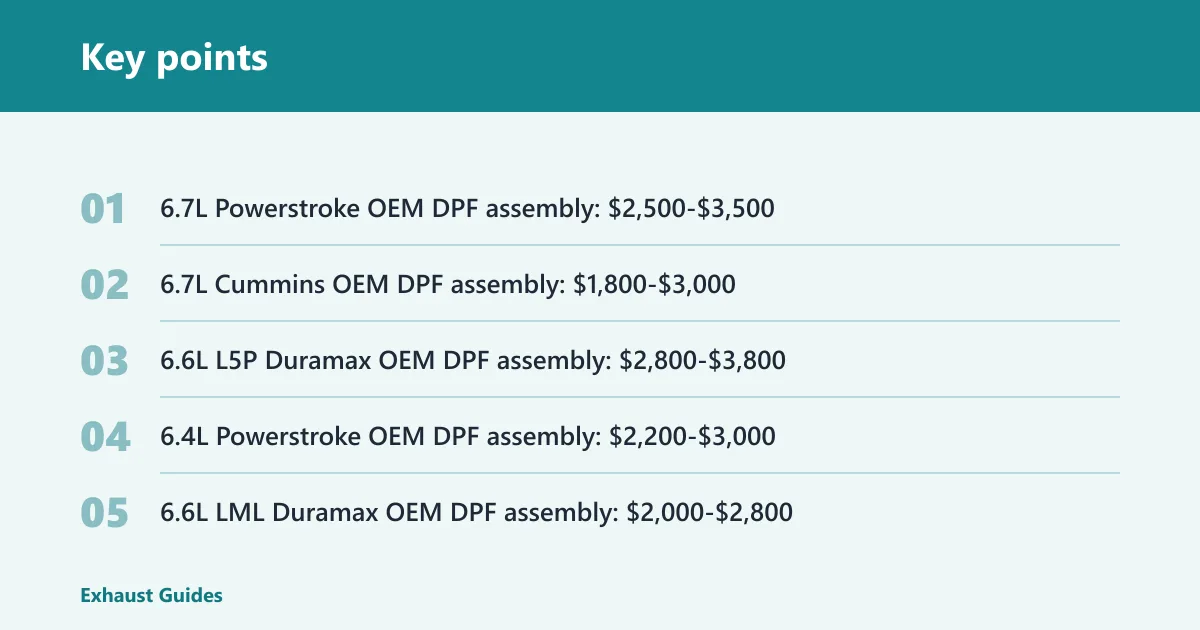
- 6.7L Powerstroke OEM DPF assembly: $2,500-$3,500
- 6.7L Cummins OEM DPF assembly: $1,800-$3,000
- 6.6L L5P Duramax OEM DPF assembly: $2,800-$3,800
- 6.4L Powerstroke OEM DPF assembly: $2,200-$3,000
- 6.6L LML Duramax OEM DPF assembly: $2,000-$2,800
Access and labor on different vehicle layouts
Labor often falls between 2 and 6 hours or more, but that range can widen when the filter sits deep in the exhaust path or when surrounding parts must come out first. Pickups, vans, and premium diesels often take longer than compact cars because the packaging is tighter and the exhaust system is more involved.
Shop rate matters as much as labor time. A vehicle that needs 6 hours at a high hourly rate can cost much more than a simpler car with the same DPF fault.
Sensors and hardware that often fail together
Pressure sensors, temperature sensors, gaskets, clamps, and fittings are common add-ons. They are not always optional. If a sensor is sending bad data, the DPF may regenerate at the wrong time or not at all, which can create repeat failures and another tow bill.
That is why a replacement quote should show whether these parts are included. A low headline price can become expensive once the shop adds the hardware needed to complete the job correctly.
Low-ash oil and preventing repeat damage
Low-ash engine oil helps slow permanent ash buildup inside the filter. The wrong oil can shorten DPF life by leaving more residue behind after combustion. That does not mean oil choice fixes every DPF problem, but it matters when the goal is avoiding another expensive replacement later.
Regional pricing also matters. Most UK replacements fall between £1,000 and £3,500, and the US and UK markets should not be compared one-to-one because labor rates, parts supply, and vehicle mix are different. A UK quote can look lower in pounds and still be expensive for that market.
Frequently asked questions
How much is a DPF replacement?
A DPF replacement usually falls in the $1,000 to $4,000 range for many vehicles, but heavy-duty trucks and premium diesels can cost more. Part price, labor access, diagnostics, sensors, and hardware all change the bill, so the best comparison is a line-by-line quote rather than a single headline number.
How much does a new DPF cost?
A new DPF can cost far less or far more depending on the vehicle and whether it is OEM or aftermarket. Some OEM assemblies are reportedly listed around $1,800 to $3,800 on certain truck platforms, while a new OEM DPF with installation is commonly cited at about $2,000 to $4,500 overall.
How much is a DPF replacement in the UK?
Most UK replacements fall between £1,000 and £3,500. That range still depends on the vehicle, parts supply, and labor rates. A quote should show whether it includes sensors, gaskets, and any coding or reset work, because those extras can change the final price quickly.
How much does a DPF clean cost?
Cleaning is usually much cheaper than replacement when the problem is soot or ash buildup, but it will not fix a cracked or melted core.
Is cleaning cheaper than replacing a DPF?
Yes. Cleaning is almost always cheaper when the filter can still be saved. It is the better buy for soot loading, mild ash buildup, or a clogged filter that has not been physically damaged. Replacement only makes sense once the core is cracked, melted, or permanently restricted.
What makes DPF replacement so expensive?
The cost rises because the filter itself can be expensive, especially as an OEM part, and the job often includes labor, diagnostics, sensors, gaskets, clamps, and programming. Access also matters. A truck or van with tight packaging usually takes longer than a simpler passenger car.