Dpf Cost to Replace
DPF replacement commonly costs about $1,500 to $4,000 for many diesel passenger vehicles, while cleaning is often a few hundred dollars. Do not treat every blocked-DPF quote as a failed filter. A blocked pressure hose, a drifting pressure sensor, or a failed regeneration routine can trigger the same warning and cost less to fix. This guide shows how to compare replacement, cleaning, forced regeneration, and sensor repair before you approve work. Figures below are supported by OEM service guidance, emissions guidance, and major workshop pricing guides where noted.
| Option | Who it fits | Typical cost band | Fast read on when to approve |
|---|---|---|---|
| Replace | Cracked, melted, or contaminated filters; repeated failed regens; high ash that cleaning cannot recover | Many diesel passenger vehicles: about $1,500-$4,000 installed; UK fitted examples: £600 to £3,200 (Bosch/garage pricing guides and UK workshop networks) | Approve if the substrate is damaged or the filter still restricts after verified sensor checks and cleaning |
| Off-car clean | Intact filter with soot and moderate ash buildup | UK: £150 to £400 for an on-car professional clean; £250 to £500 plus VAT for off-car ultrasonic cleaning (UK workshop and parts-supplier pricing guides) | Approve if the housing is intact and ash/soot levels suggest recoverable airflow |
| Forced regeneration | Soot-loaded filter on a vehicle that can complete a regen cycle; no physical damage | UK: £80 to £250 (major workshop pricing guides) | Approve if soot is the main issue and ash is still within a serviceable range |
| Pressure sensor / hose fix | Implausible readings, split hose, blocked port, or repeat codes that do not match the filter condition | Usually much cheaper than a full DPF; exact price depends on vehicle and sensor type | Pause a replacement quote until sensor behavior is verified at idle and raised rpm |
DPF replacement cost basics

- Supports parked/forced DPF regeneration on compatible engines
- Reads multiple vehicle systems and live data
- Wi-Fi updates without a subscription
The installed price usually includes the filter itself, labor, diagnostics, and any coding or adaptation work after the part is fitted. A diesel particulate filter sits downstream of the turbocharger and DOC in the exhaust path, where it traps soot and needs regeneration to burn soot off while ash stays behind.
The bill varies because the part is only one piece of the job. Vehicle size, engine family, chassis layout, part source, and whether the workshop has to replace sensors or hoses can move the total far more than most owners expect.
What the installed price usually includes
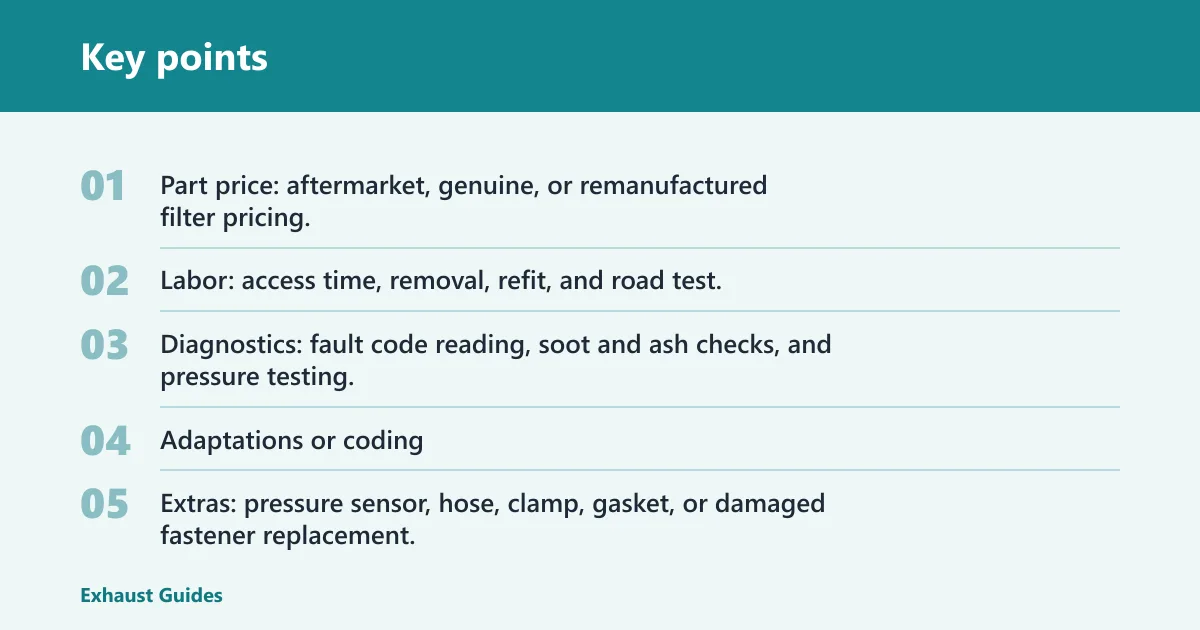
- Part price: aftermarket, genuine, or remanufactured filter pricing.
- Labor: access time, removal, refit, and road test.
- Diagnostics: fault code reading, soot and ash checks, and pressure testing.
- Adaptations or coding: reset or relearn steps after replacement.
- Extras: pressure sensor, hose, clamp, gasket, or damaged fastener replacement.
Why the bill varies by vehicle and market
Small cars usually cost less than SUVs, vans, pickups, and heavy-duty trucks because the part is smaller and access is simpler. A dealer quote often lands above an independent workshop quote, and genuine parts usually cost more than aftermarket parts.
In the UK, DPF replacement can range from roughly £600 to £3,200 fitted (Bosch service guides and major UK workshop networks). That spread is normal, not a typo. The same platform can price very differently once you move from aftermarket to genuine parts or add more labor time.
When a quote is for the filter versus the full job
Ask whether the quote includes diagnostics, installation, reset work, and any sensor or hose replacement. A low headline part price can turn into a much larger invoice once the workshop adds the work needed to make the new filter function correctly.
DPF cost decision table
This table helps you read the quote line by line. Use soot load, ash load, pressure readings, and fault codes together. Do not treat every blocked-DPF quote as a failed filter.
| Option | Best fit symptom set | Likely fault codes | Pressure behavior at idle vs 2,500 rpm | Soot / ash clues | Approve / pause quote guidance | Expected cost band |
|---|---|---|---|---|---|---|
| Replacement | Repeated limp mode, warning light returns after regen, cracked or melted substrate, fuel or coolant contamination | P2463, P2002, manufacturer-specific regeneration or efficiency codes | High restriction that does not clear after regen or cleaning; pressure remains abnormal at idle and raised rpm | High ash load, soot may be high or low, substrate damage makes cleaning poor value | Approve if the filter is physically damaged or still restricted after verified sensor/hose checks | UK: £600 to £3,200 fitted; many passenger vehicles: about $1,500-$4,000 installed |
| Off-car cleaning | Filter is intact but loaded with soot and ash; no cracking, melting, or fluid contamination | P2463, P2002, soot load or differential-pressure plausibility codes | Restriction improves after cleaning; readings should fall if the substrate is sound | Moderate to high soot, ash not beyond serviceable range, airflow can usually be restored | Approve if the filter is intact and the pressure trend improves with a controlled test | UK: £250 to £500 plus VAT for ultrasonic cleaning; other methods may sit below that or slightly above it |
| Forced regeneration | Mostly soot loading, short-trip use, active regen has been interrupted, no substrate damage | Soot load high, regeneration incomplete, engine management codes tied to interrupted regen | Pressure should drop if soot is the main issue; if not, suspect ash or a sensor fault | High soot, ash still acceptable; ash will not be removed | Approve if soot is the main issue and the vehicle can safely complete the cycle | UK: £80 to £250 |
| Pressure sensor replacement | Good driving symptoms but implausible readings, hose damage, repeat codes that do not match the filter condition | Sensor plausibility, circuit, or range/performance codes | Idle and raised-rpm readings are inconsistent, stuck, or do not track engine load | Soot and ash may be normal or only mildly elevated | Pause a DPF replacement quote until hose, port, wiring, and sensor behavior are verified | Usually much cheaper than a full DPF; exact price depends on vehicle and sensor type |
A common first-timer mistake is to replace the filter because the scan tool says “DPF full,” then discover the pressure hose was blocked. Another is to buy a new DPF when the sensor had drifted out of range and made the readings look worse than they were.
How much does a DPF cost to replace?
The short answer is that cost depends on the vehicle, part source, and how much installation work the car needs. For many diesel passenger vehicles, the installed price often lands in the $1,500-$4,000 range, but larger platforms and dealer quotes can go higher.
In the UK, the fitted price commonly runs from £600 to £3,200 (Bosch service information and UK workshop pricing guides). A Ford Focus, Kuga, or Mondeo TDCi is quoted at £600 to £1,000 aftermarket fitted. A Nissan Qashqai or X-Trail dCi is also listed at £600 to £1,000 aftermarket fitted. A Land Rover Discovery Sport can cost £900 to £1,500 aftermarket fitted.
Aftermarket versus genuine part pricing
Aftermarket parts usually reduce the invoice, especially on common platforms. Genuine parts can cost more, and on some vehicles the parts price alone can be a major share of the bill. That gap matters most when the substrate is still serviceable and you are deciding between a clean and a replacement.
Why labor and diagnostics move the total
Access can be straightforward on one chassis and far tighter on another. Rear underbody packaging, rusted fasteners, heat shielding, and a crowded exhaust route all add time. Diagnostics also matter because the workshop may need to verify soot load, ash load, and pressure behavior before and after the repair.
How do you know the DPF needs replacement?
You do not decide from a warning light alone. Read soot load and ash load together, check differential pressure at idle and at raised rpm, and pull the fault codes before you buy parts. If the substrate is cracked, melted, or contaminated, replacement moves from optional to likely.
Reading soot load and ash load together
Soot is the material the filter is designed to burn off during regeneration. Ash is non-combustible residue that builds over mileage and stays behind. The original design expectation for DPF service life was around 150,000 miles (OEM service guidance and parts supplier literature), but ash loading can make a serviceable filter act worn out before the substrate fails.
If soot is high but ash is still manageable, a regen or clean may recover the filter. If ash is high and the filter has already seen repeated failed regens, replacement becomes more likely because cleaning has less material to work with.
Using differential pressure at idle and raised rpm
Differential pressure helps show how restricted the filter is. A healthy system should show a clear change between idle and higher engine speed. If the readings stay implausible, that can point to a pressure sensor, hose, or wiring fault rather than a blocked filter.
Suppose a compact diesel shows a DPF warning after short city trips, but the pressure reading barely changes between idle and a raised-rpm check. That pattern is a clue to inspect the sensor circuit before ordering a new filter.
Checking fault codes before buying parts
Fault codes can confirm a DPF-related restriction, but they should be read beside soot, ash, and pressure data. Manufacturer-specific codes can point to regeneration failure, pressure sensor plausibility, or excessive loading. A code alone should not decide the repair.
- Read all engine and emissions codes.
- Check soot load and ash load values.
- Compare differential pressure at idle and raised rpm.
- Inspect pressure hoses, connectors, and the sensor body.
- Confirm whether the filter substrate is cracked, melted, or contaminated.
Cleaning, regen, or replacement?
Forced regeneration burns soot only. It does not remove ash. That makes it useful when the filter is soot-loaded but still structurally sound, and less useful when ash has built up or the filter has another fault.
When soot can be burned off
Passive regeneration happens around 550–600°C under highway conditions (OEM emissions guidance and major workshop training material). Active regeneration cycles typically run 20–40 minutes and can occur every 300–500 miles depending on duty cycle (OEM service guidance and workshop network references). If the vehicle mostly does longer runs and the substrate is intact, a regen path may still work.
Forced regeneration in the UK is often quoted at £80 to £250 (major workshop pricing guides). That is much cheaper than replacement, but it only buys time if the filter has substantial ash loading or if the driving pattern keeps interrupting normal regens.
When ash buildup pushes you toward cleaning or replacement
Off-car cleaning is usually the next step when the filter is intact and ash is the main limiter. In the UK, an on-car professional clean is quoted at £150 to £400, and off-car ultrasonic cleaning is quoted at £250 to £500 plus VAT. Ultrasonic cleaning is described as restoring 90–98% of original airflow (parts suppliers and cleaning-service literature).
If ash is beyond what cleaning can recover, or if the filter has cracked or melted, cleaning becomes poor value. A forced regen cannot remove ash, so it should not be sold as a cure for a worn-out substrate. If you are weighing a sensor issue instead of a full clean, compare that against sensor diagnostics before authorizing the DPF itself.
Why do DPF quotes get so high?
Quotes climb because the job is often more than a part swap. Engine family and chassis layout can make access slow. Dealer, independent, and aftermarket pricing can differ sharply. Hidden extras like sensors, hoses, coding, and follow-up checks add up quickly.
Engine family and chassis layout
A VW TDI, Nissan Qashqai, or Discovery Sport may each have different packaging, service access, and part pricing. Even within one model line, trim and engine choice can change the parts list and the amount of labor needed to reach the filter.
Dealer, independent, and aftermarket pricing
Dealer pricing usually brings higher part and labor rates. Independents may be cheaper, especially if an aftermarket filter fits the vehicle well. The lowest quote is not always the best one if it leaves out diagnostics, adaptation, or sensor work.
Hidden extras: sensors, hoses, coding, and follow-up checks
A bad pressure sensor can mimic a blocked DPF. A blocked hose can do the same. If the workshop replaces the filter without checking those items, the warning light can return and the bill doubles. That is why the cheapest quote can end up expensive later.
Picture a midsize SUV that keeps entering limp mode after short school-run use. If soot is high but ash is moderate, the filter may still be cleanable. If the sensor hose is split, though, a new DPF will not fix the false reading, and the driver pays for the wrong repair.
Choose DPF cleaning if… / Choose replacement if…
Use cleaning when the substrate is intact and the problem is mainly soot or moderate ash. Use replacement when the filter is cracked, melted, or contaminated, or when the ash load and repeated regen failures point to a filter that has reached the end of service.
Choose DPF cleaning if…
- The filter housing and substrate are intact.
- Soot load is high, but ash load is still within a serviceable range.
- Differential pressure suggests restriction that should improve after soot is removed.
- The fault is linked to short-trip driving or interrupted regens, not physical damage.
Choose replacement if…
- The substrate is cracked, melted, or contaminated with oil, fuel, or coolant.
- Ash loading is severe and cleaning will not recover enough airflow.
- The filter still shows excessive restriction after proper cleaning and verified sensor readings.
- The quote follows repeated failed regens and a confirmed failed filter, not just a warning light.
Frequently asked questions
Is a DPF expensive to replace?
Yes, compared with many other exhaust repairs, it can be. The part is costly, labor can be awkward, and the workshop may need to reset adaptations or replace related sensors. A cleaning job is usually far cheaper when the filter itself is still sound.
How much does it cost to replace a DPF in the UK?
The UK range commonly runs from £600 to £3,200 fitted. Genuine parts can push higher.
How much does it cost to replace a DPF filter in Australia?
Australian pricing varies by vehicle, engine, and supply chain, so a single exact figure is less useful than a workshop quote that lists the part, labor, diagnostics, and any sensor work separately. For many diesel passenger vehicles, the total is often in the several-thousand-dollar range.
How much does it cost to replace a DPF on a Nissan Qashqai?
A Nissan Qashqai or X-Trail dCi is listed in the UK at £600 to £1,000 aftermarket fitted. That figure can move with engine version, part source, and whether the quote includes diagnostics, adaptation, and any pressure sensor or hose repair.
How do I know if my DPF needs to be replaced?
Start with soot load, ash load, differential pressure, and fault codes. If the substrate is cracked, melted, or contaminated, replacement is likely. If soot is the main issue and the hardware is intact, cleaning or regeneration may still recover the filter.
Why are DPFs so expensive?
They are expensive because the part is specialized and the job is often not a simple swap. Access can be tight, diagnostics take time, and the final bill may include adaptions, sensors, hoses, and follow-up checks. Vehicle size and brand pricing also matter.
What is the difference between DPF cleaning and replacement cost?
Cleaning is usually cheaper and is meant for an intact filter with soot or moderate ash loading. Replacement costs more because you are buying a new or remanufactured filter plus the labor and setup work needed to install it. Cleaning cannot fix a cracked or melted substrate.
How much does it cost to replace a DPF pressure sensor?
A DPF pressure sensor replacement is usually much cheaper than a full DPF replacement. The exact price depends on the vehicle and sensor type, but it is a separate repair and should be priced separately from the filter. Faulty sensor readings can mimic a blocked DPF.
Will a forced regen fix my DPF or do I need a new one?
A forced regen can fix a soot-loaded filter if the substrate is intact and ash is not severe. It will not remove ash, and it will not repair cracking, melting, or contamination. If the fault returns quickly, the filter may need cleaning, a sensor repair, or replacement.
Is a DPF expensive to replace?
It can be, especially on SUVs, vans, pickups, and premium diesel platforms. The part price is only part of the bill. Labor, access time, diagnostics, adaptations, and related sensor faults can make the repair much more costly than a basic exhaust job.