DPF vs EGR System: What’s the Difference in Diesel Engines?
The DPF traps soot, while the EGR lowers combustion temperatures by sending exhaust back into the intake. If the EGR sticks open or the cooler leaks, soot output rises and can overload the DPF. Ignoring either fault can trigger limp mode, repeated regeneration cycles, and expensive filter or turbo damage. This guide explains how the two systems differ, how they interact, and which fault usually causes which warning light.
| Decision factor | dpf | egr system | Winner |
|---|---|---|---|
| Main job | Catches soot and fine particles in the exhaust before they leave the vehicle. | Routes some exhaust back into the intake to lower combustion temperature. | dpf |
| Typical failure pattern | Restriction from soot loading, ash buildup, or a regen problem. | Soot sticking, valve movement faults, or excess soot output from poor recirculation control. | dpf |
| Common owner clues | Frequent regens, warning lights, loss of power, limp mode, higher idle during active regen. | Rough idle, black smoke, low-speed hesitation, and repeated soot-related warning lights. | egr system |
| First test to run | Check differential pressure readings, regen history, and exhaust temperature sensor data. | Inspect the valve for sticking, soot buildup, and commanded versus actual movement. | egr system |
| Best repair order | Work after the soot source is understood, especially if repeated cleanings have failed. | Inspect first when soot loading keeps returning after DPF service. | egr system |
What the dpf does in the exhaust
The DPF sits downstream of the turbocharger in the exhaust path and captures soot and particulate matter before they reach the atmosphere. It uses a honeycomb-like ceramic structure with thousands of tiny channels, so exhaust has to pass through the filter walls while soot is trapped.
That trapping is only half the job. The filter also has to clean itself, and when soot loading gets too high, it can trigger warning lights, limited power, or limp mode.
What the egr system does in the intake
The EGR valve returns part of the exhaust gases back into the intake. That lowers combustion temperatures and helps reduce emissions, but it also leaves the intake side more vulnerable to soot buildup.
If the EGR sticks, leaks, or moves poorly, soot output can rise. That extra soot moves downstream and can load the DPF faster than normal.
Why they are linked but not the same part
These systems work in the same emissions chain, but they do different jobs in different places. The EGR changes what the engine makes, while the DPF cleans what the engine sends out.
That difference matters in diagnosis. If the soot source is still present, repeated DPF cleaning alone often wastes time and money.
Are DPF and EGR the same thing?
No. The DPF is an exhaust filter, and the EGR is an intake-side valve that recirculates exhaust gas. They are connected through soot flow and engine control, but they are separate parts with separate failure modes.
That distinction matters because the warning light often points to the system that feels the effect, not always the system that started the problem. Treating them as one generic emissions fault can hide the root cause.
How the two systems interact
The EGR can increase soot production when it malfunctions, and that soot moves into the exhaust stream where the DPF has to trap it. The DPF then has to regenerate more often, which can raise heat stress and downtime if the loading keeps returning.
Related guides: DPF regeneration guide, EGR valve cleaning, diesel differential pressure sensor diagnostics, and clogged DPF symptoms.
Why the distinction matters during diagnosis
If you replace or clean the DPF first and the EGR is still sticking, the same fault often comes back. That is why the repair order matters: identify the soot source before treating the filter as the only problem.
Can a bad egr cause dpf problems?
Yes. A faulty EGR can increase soot production, and that extra soot can load the DPF faster than normal. Repeated DPF regens can be a clue that the intake-side fault has not been fixed.
Service literature and emissions guidance consistently tie excessive soot loading to EGR flow faults and cooler or valve problems, because the engine is making dirty exhaust before the filter ever sees it.
How extra soot reaches the dpf
When EGR flow is wrong, combustion can get dirtier. The soot then moves through the turbo and exhaust system until the DPF traps it, and the filter has to work harder to burn it off.
If a truck starts asking for active regens every few hundred miles after a rough-idle complaint, the upstream cause deserves attention first. The filter is reacting to extra soot rather than creating it.
Why repeated regens can point to egr trouble
Frequent active regenerations can indicate a failing sensor or excessive soot buildup. If the vehicle keeps requesting regens soon after a cleaning, the source may be intake soot from the EGR system rather than a permanently bad filter.
That is also where cost and downtime stack up. Treating the DPF alone can mean repeat shop visits, while fixing the EGR source first can prevent the next clog from forming so quickly.
When to suspect intake-side faults first
Start with the EGR if you see rough idle, black smoke, or soot-heavy intake parts along with DPF warnings. Those clues suggest the engine is making too much soot before the exhaust filter ever gets a chance to clean it.
Stop-and-go driving and low exhaust heat can stress the DPF, but a sticking EGR can make the problem return even after a forced regeneration.
How regeneration works
The DPF cleans itself in three main ways. Passive regeneration happens during sustained higher-speed driving when exhaust heat is high enough; active regeneration is computer-triggered and may add fuel or change timing to raise exhaust temperature; forced regeneration is a mechanic or scan-tool procedure used when soot loading is too high for normal regen.
Passive regeneration
Passive regeneration can happen during steady highway driving when exhaust temperatures are high enough. SAE literature and OEM regeneration strategies commonly place soot oxidation in the neighborhood of 932°F (500°C), though the exact threshold depends on the catalyst, fuel strategy, and engine calibration. Ash does not burn off and stays behind until the filter is cleaned.
This is why longer runs help, but only when the engine and sensors allow the temperature to rise properly. Passive regen cannot remove ash.
Active regeneration
Active regeneration is typically computer-controlled. The engine management system changes operating conditions to raise exhaust temperature, and the driver may notice a higher idle speed or a faint smell.
If active regens keep happening, that often means the filter is loading too fast or a sensor is lying about the conditions. Differential pressure sensor faults and incorrect exhaust temperature readings can interrupt the process or make it repeat too often.
Forced regeneration
Forced regeneration is commonly used when normal regen cannot keep up. A mechanic uses a scan tool or service procedure to command a cleanup because the soot level is too high for passive or active regen to handle safely.
That is a sign to look beyond the filter itself. If forced regens become routine, check whether the EGR, pressure sensor, or temperature sensor is causing the same soot problem again.
DPF symptoms vs EGR symptoms
DPF faults usually show up as restriction and failed regeneration. EGR faults more often show up as rough running and soot creation, then later as DPF loading if the problem is left alone.
Frequent regens and restriction signs
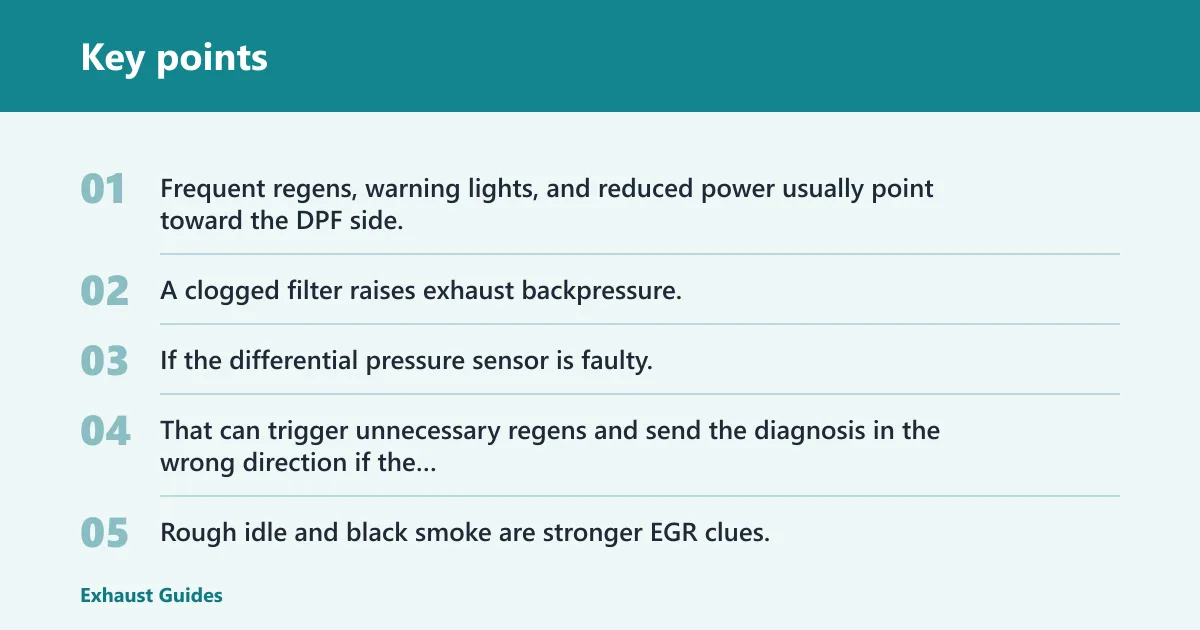
Frequent regens, warning lights, and reduced power usually point toward the DPF side. A clogged filter raises exhaust backpressure, which can push the vehicle into limp mode and shorten the time between active regens.
If the differential pressure sensor is faulty, it may make the system think the filter is more restricted than it really is. That can trigger unnecessary regens and send the diagnosis in the wrong direction if the reading is not confirmed.
Rough idle and black smoke
Rough idle and black smoke are stronger EGR clues. They often mean the engine is not managing recirculation correctly, so soot formation rises before the exhaust filter is overloaded.
Those symptoms can still end with a DPF warning, but the intake-side fault is usually the earlier cause. Fixing the valve or related soot buildup first helps avoid repeat filter service.
Loss of power and limp mode
Loss of power can happen with either fault, but the reason differs. A DPF restriction limits exhaust flow, while an EGR problem can distort combustion enough to cut performance and then load the filter.
That overlap is why scan data matters. Exhaust temperature sensor readings, differential pressure data, and commanded EGR position help separate the two instead of guessing.
Recurring warning lights and sensor faults
Recurring warning lights after service may suggest a sensor or flow problem, not just soot. A bad differential pressure sensor can cause frequent regens, and incorrect exhaust temperature readings can stop the regen from finishing.
If the fault keeps coming back after a clean filter, the repair likely missed the cause. Check the sensors and the EGR path before ordering another DPF cleaning.
DPF and EGR diagnostic decision table
Use this table as a first-pass guide. It is not a substitute for scan data, but it helps you decide whether to start on the exhaust filter or the intake-side valve.
| Symptom | More likely dpf | More likely egr system | First test to run |
|---|---|---|---|
| Frequent regens | Yes, especially if soot loading or differential pressure is high. | Yes, if the regens return quickly after cleaning. | Check differential pressure sensor data and regen history. |
| Rough idle | Sometimes, if restriction is severe. | Yes, especially with soot buildup or stuck valve movement. | Inspect EGR operation and soot deposits in the intake. |
| Black smoke | Less likely as the first cause. | Yes, this often points to excess soot production. | Look at EGR flow, valve movement, and intake soot. |
| Loss of power | Yes, if the filter is restricted or in limp mode. | Yes, if combustion control is off and soot is rising. | Scan for fault codes and compare pressure readings. |
| Recurring warning lights | Yes, especially with failed regeneration or sensor error. | Yes, if soot source issues keep loading the filter. | Check pressure and exhaust temperature sensor data first. |
How to read the table
A DPF pattern points to restriction, failed regen, or sensor trouble tied to filter loading. An EGR pattern points to soot creation, rough running, and repeated DPF complaints after service.
Do not stop at the light on the dash. The first test should tell you whether the problem is the filter, the sensors, or the system that is making the soot in the first place.
Choose dpf if… / Choose egr system if…
Choose dpf if the fault points to exhaust restriction, failed regeneration, or limp mode after the filter has already been serviced. Choose egr system if the fault points to rough idle, black smoke, repeated soot buildup, or DPF problems that keep returning after cleaning.
Use a few concrete checks to separate them. Choose dpf first when differential pressure stays high under load, active regens are happening unusually often, or the vehicle cannot complete a regen even after normal highway driving. Choose egr system first when the engine shows rough idle plus smoke, when soot returns quickly after a DPF clean, or when commanded EGR position does not match actual movement.
- Choose dpf if the vehicle has frequent regens with high restriction readings.
- Choose dpf if passive or active regeneration keeps failing despite normal driving.
- Choose egr system if the engine idles roughly and smokes before the DPF warning appears.
- Choose egr system if soot returns soon after a DPF clean or forced regen.
What maintenance keeps both systems from clogging?
Use driving habits, sensor checks, and cleaning on schedule. Highway driving helps passive regeneration, while repeated short trips and idling raise soot risk and make the filter work harder. EPA diesel maintenance guidance and OEM service information both point to short-trip duty as a major contributor to incomplete regeneration and soot buildup.
Check the differential pressure sensor and exhaust temperature sensor when regens become frequent or incomplete. Those sensors tell the engine when to start and stop regeneration, and bad readings can make a healthy filter look clogged or a clogged filter look normal.
- Drive long enough for exhaust heat to rise regularly.
- Avoid repeated short trips when possible.
- Watch for frequent active regens or new warning lights.
- Inspect the EGR valve for soot buildup and sticking.
- Check differential pressure and exhaust temperature sensor data.
- Arrange cleaning before ash and soot loading create limp mode.
Ash does not burn off during regeneration and must be removed by cleaning or replacement. That is why even a well-driven vehicle still needs periodic service, especially if the engine duty cycle is mostly city use.
Frequently asked questions
Does EGR and DPF work together?
Yes, in the sense that they affect the same soot path. The EGR changes combustion output, and the DPF captures what remains in the exhaust. If the EGR makes too much soot, the DPF has to clean that load more often.
What is the difference between a DPF and an EGR valve?
The DPF sits in the exhaust and traps soot and particulate matter. The EGR valve sits on the intake side and recirculates exhaust gas back into the engine. One cleans exhaust; the other changes combustion conditions.
Which causes more soot buildup, a bad EGR or a clogged DPF?
A bad EGR usually causes more soot buildup because it changes how the engine burns fuel. A clogged DPF is often the result of that soot or of failed regeneration, not the original source of it.
Can a failed EGR valve trigger DPF problems?
Yes. A malfunctioning EGR valve can cause excessive soot accumulation, which then overloads the DPF. That can lead to frequent regens, warning lights, and eventually limp mode if the cycle continues.
Can short trips damage both the DPF and EGR system?
Yes. Short trips are a leading cause of DPF problems because they keep exhaust heat too low for clean burn-off. They also leave more soot in the intake and EGR path, which can make sticking and loading worse.
What maintenance keeps the DPF and EGR system from clogging?
Regular highway driving, timely sensor checks, and cleaning before soot loading gets severe help both systems. Also watch for ash buildup, because ash cannot be burned off during regeneration and eventually needs cleaning or replacement.