Diesel Exhaust Systems Explained
A diesel exhaust system handles three jobs in one chain: it pushes hot gas out, keeps noise down, and helps remove soot and NOx, with DEF used on many newer diesels that use SCR. Ignore a fault and you can wind up with poor mileage, failed regens, limp mode, or a no-start countdown after shutdown. I’ve seen all four. This guide ties each major part to its job, explains DEF and SCR in plain language, and points out the first symptom most owners notice when a part quits doing its work.
The three jobs a diesel exhaust system has to do
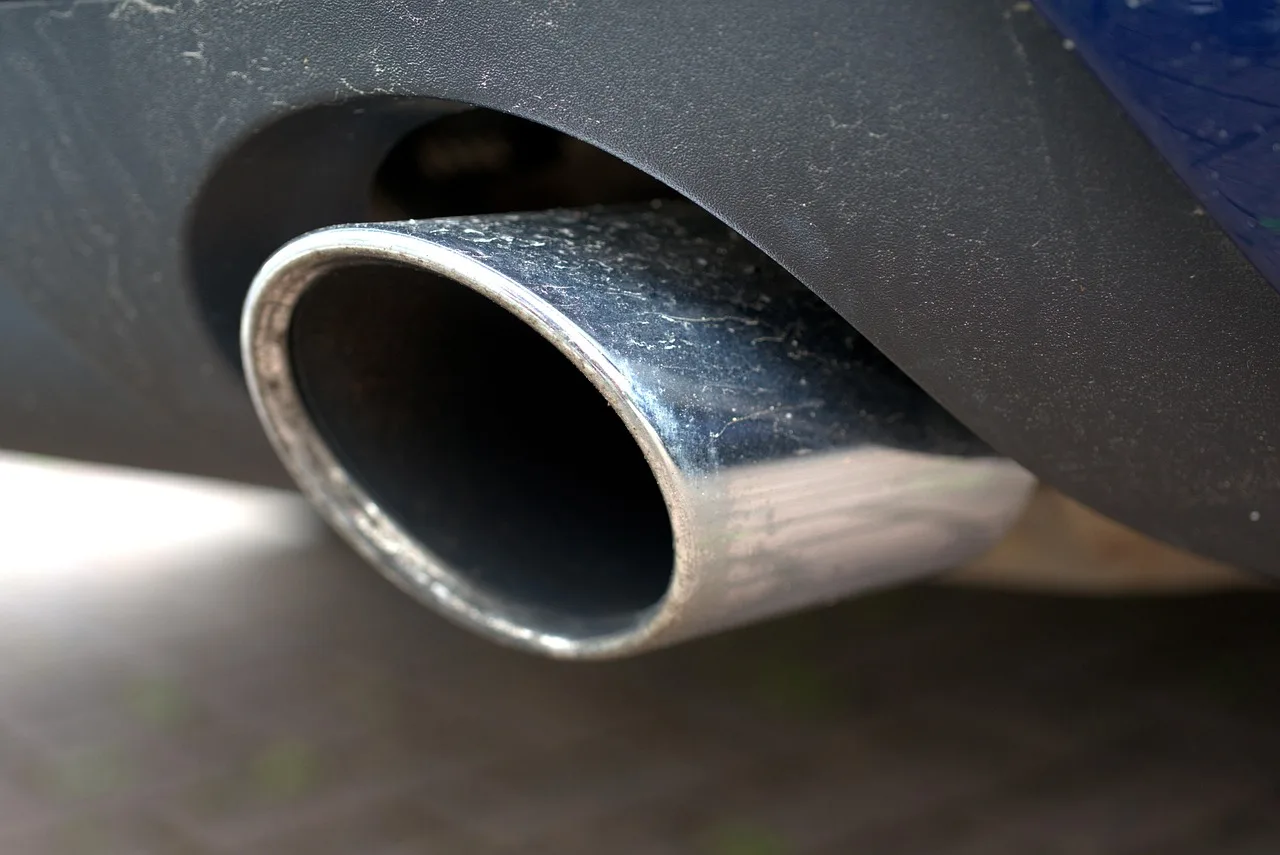


The simplest way to read a modern diesel exhaust system is to break it into three jobs. First, it has to carry hot exhaust from the cylinders to the tailpipe. Second, it has to clean that exhaust before it leaves the truck. Third, it has to manage sound and, on some trucks, add braking force.
That split matters in the shop. Owners often lump the parts together. A muffler deals with sound. A DPF deals with soot. SCR deals with NOx. An exhaust brake helps control speed on descents. When one fails, the first symptom usually fits that part’s job.
Move exhaust out safely
The path starts at the exhaust manifold, the first collection point for exhaust gas leaving the engine cylinders. From there, gas flows through the upstream pipes and often through the turbocharger turbine housing before it reaches the aftertreatment section.
Leaks here usually show up as ticking, hissing, soot marks, or exhaust smell near the engine bay. Restrictions show up as weak response, extra heat, and failed regeneration farther down the line.
Clean soot, HC, CO, and NOx
A modern diesel exhaust system uses DOC, SCR, and DPF treatment stages. That layout became far more common after U.S. diesel exhaust regulations were significantly reduced beginning in the 2007 model year. Each stage targets a different pollutant, so one warning light can still point to several possible causes.
The DOC oxidizes hydrocarbons and carbon monoxide as the exhaust stream passes through its catalyst. The DPF traps soot and can remove more than 90% of particulate matter from exhaust gases. The SCR reduces NOx by converting it to nitrogen and water.
Control noise and add braking on some trucks
The cold end handles most sound control. That is where the muffler, resonator, tailpipe, and hangers do their work. Some diesel trucks also use an exhaust brake to increase backpressure for braking, a feature seen more often on medium-duty and heavy-duty applications.
That is why a loud exhaust and an SCR fault should be treated as two different problems unless the truck has a major leak tying them together.
📊 U.S. diesel exhaust regulations were significantly reduced beginning in the 2007 model year. Source: Understanding diesel exhaust aftertreatment systems.
How does a diesel exhaust system work?
A diesel exhaust system routes hot gas from the exhaust manifold, through the turbo and emissions parts that need heat to work, then out through the quieter downstream sections to the tailpipe. In practice, the front of the system does the heat-driven cleanup work, and the rear mostly handles noise and final discharge.
The basic flow path from manifold to tailpipe
In many layouts, the order is often manifold or turbo outlet, DOC, DPF, DEF injector, SCR, muffler, and tailpipe. Some systems package parts together in one canister. Others spread them out under the truck.
Light-duty pickups often place the DOC and DPF close to the engine because heat helps both catalyst activity and DPF regeneration. Medium-duty and heavy-duty trucks may have larger aftertreatment assemblies and longer pipe runs, with more visible sensors and pressure lines.
Hot end versus cold end
The hot end and cold end are common names for different exhaust sections. The hot end includes the manifold, turbo outlet area, and front-end aftertreatment, where heat is important for catalyst light-off and regeneration. The cold end sits farther downstream, where the muffler and tailpipe mainly handle sound and final gas discharge.
If the hot end never gets hot enough, the DOC may work poorly, the DPF may struggle to regenerate, and the SCR dosing strategy can set faults. If the cold end is damaged, the driver usually hears it before the dash says anything.
Why temperature decides whether the system works
Temperature drives nearly every emissions step. The DOC needs heat to treat HC and CO and to support downstream conditions. The DPF needs enough heat to burn stored soot during regeneration. SCR also depends on proper conditions because DEF is injected into the exhaust stream as tiny droplets before the SCR catalyst, and the DEF droplet diameter ranges from 100 to 200 µm.
Too cold, and treatment is weak. Too hot, and parts need protection. That is why exhaust gas temperature sensors are spread through the system.
Pickup layout versus heavier-truck layout
On a pickup, the owner may see one compact unit under the cab that contains multiple treatment sections. On a heavier truck, the parts may be easier to spot separately: a front canister, a DEF doser, an SCR section, then downstream noise-control hardware.
The job order stays broadly similar even when packaging changes. What changes is service access, thermal mass, and how obvious a failure feels in day-to-day driving.
What parts make up a diesel exhaust system?
A diesel exhaust system includes gas-carrying parts, emissions-cleanup parts, monitoring parts, and sound-control parts. The main pieces are the exhaust manifold, piping, DOC, DPF, DEF dosing hardware, SCR catalyst, sensors, muffler, tailpipe, and an exhaust brake where the truck is equipped with one.
Upstream flow parts
The exhaust manifold collects exhaust from the engine cylinders and feeds the rest of the system. Upstream pipes, flex sections, and clamps carry that flow toward the aftertreatment parts while allowing movement as the engine and chassis twist.
The first symptom of trouble here is often physical: a cold-start tick, a hiss under load, soot at a flange, or an exhaust smell near the hood or firewall.
Front-end aftertreatment parts
The DOC sits at the front end of aftertreatment in many systems. Behind or near it sits the DPF, the main soot-trapping device. Many modern layouts place the SCR section downstream of the DPF, with DEF dosing hardware upstream of the SCR catalyst.
This order matters because each part sets up the next stage. The DOC treats HC and CO first. The DPF stores soot. The SCR then handles NOx after DEF dosing.
Sensors, pressure tubes, and control inputs
Aftertreatment systems use temperature sensors, differential pressure sensing, NOx sensing, and related monitoring inputs to regulate operation and confirm proper treatment. When readings fall outside expected ranges, the control system can log DTCs, turn on warning lights, and in some cases start a power-limiting strategy.
A failed sensor can mimic a failed filter or catalyst. That is why a warning for one part does not always mean that part is physically damaged.
Muffler, tailpipe, and exhaust brake
The muffler is usually part of the cold end and reduces exhaust noise through silencing methods that are separate from emissions cleanup. The tailpipe exits the cleaned gas. Where fitted, the exhaust brake uses exhaust gas pressure for braking and helps reduce wheel brake wear.
What does the DPF do in a diesel exhaust system?
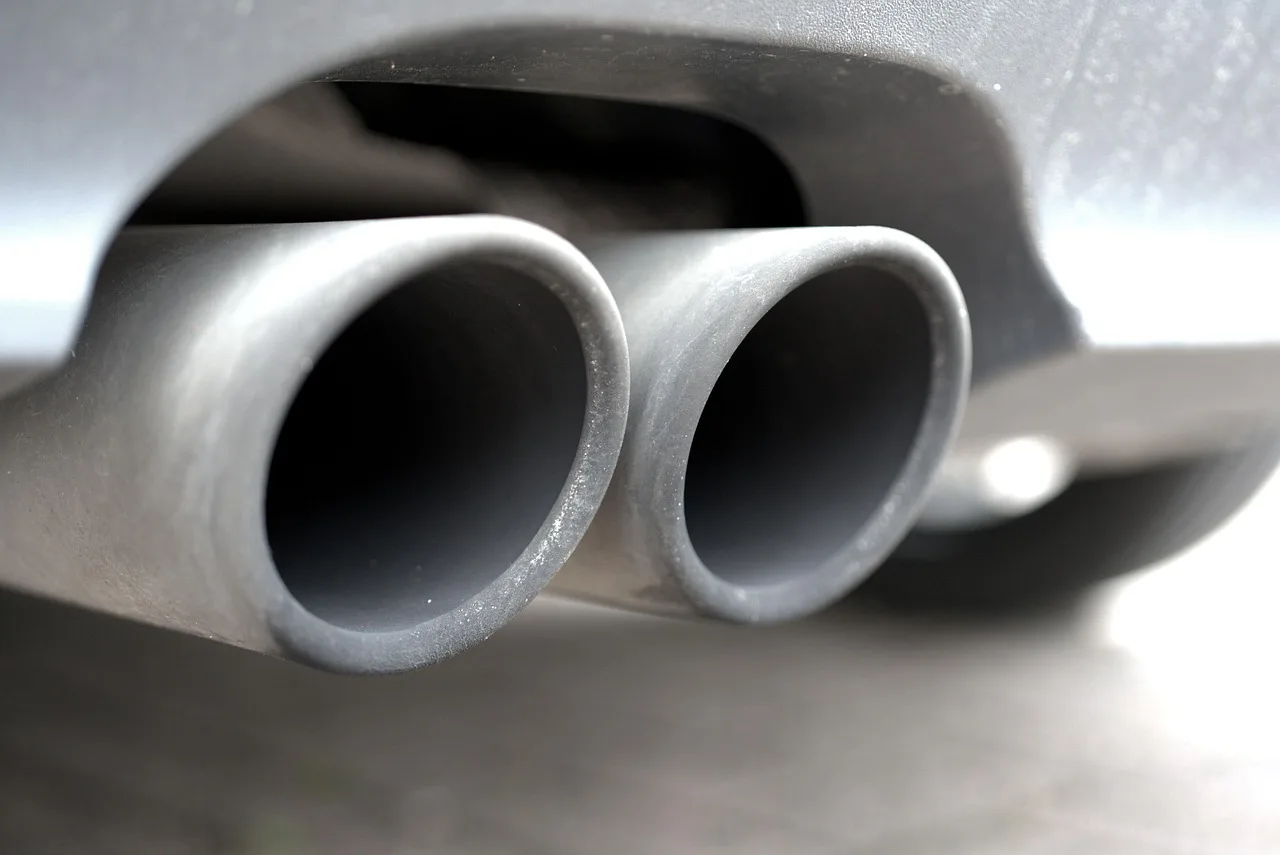
The DPF traps soot, also called particulate matter, before it can leave the tailpipe. It is the main soot-reduction component in the system, and it must regenerate at intervals so the stored soot burns off instead of blocking exhaust flow and raising backpressure.
How the DPF traps soot
The DPF catches soot that older diesels would have blown out as black smoke. On a healthy late-model diesel, that is a big reason the tailpipe stays much cleaner than older trucks. The DPF can remove more than 90% of particulate matter from exhaust gases.
Why regeneration matters
As the filter fills, the truck must clear it through regeneration. Passive regeneration happens when exhaust heat is already high enough. Active regeneration happens when the truck adds heat on purpose because normal driving was not enough.
The driver often notices a hot smell after parking, more fan activity, a slightly different idle, or a temporary fuel-economy drop during active regen. If those events become too frequent, the truck is usually warning of a DPF-side problem before a harder fault shows up.
The first symptom when DPF operation starts slipping
The first real-world symptom is usually shortened time between regens, not instant limp mode. After that come filter messages, reduced power, and eventually stronger protection steps if the soot load continues to rise.
What is the difference between DOC, DPF, and SCR?
The DOC, DPF, and SCR each do a different emissions job in a different place in the exhaust flow. DOC treats HC and CO first, DPF traps soot, and SCR reduces NOx after DEF is dosed ahead of the catalyst. They work in sequence, not as interchangeable parts.
DOC: the front-end cleanup stage
The diesel oxidation catalyst is usually near the front of the aftertreatment assembly. Its main job is to reduce hydrocarbons and carbon monoxide. It also helps create conditions that support downstream treatment, especially DPF regeneration.
When DOC performance drops, the owner may notice more regeneration trouble than sound or smell changes. In some cases, an acrid exhaust odor appears before a clear dashboard message.
DPF: the soot catcher
The DPF is the soot filter. Its job is storage first, then burn-off during regeneration. It does not reduce NOx, and it does not use DEF directly.
When it starts losing control of soot loading, regen frequency is usually the first clue. A warning light comes later if the pattern continues.
SCR: the NOx stage
The SCR catalyst reduces NOx by using ammonia formed from DEF in the exhaust stream. DEF is sprayed ahead of the SCR, then heat helps the chemistry happen across the catalyst surface.
SCR faults usually show up first as messages, inducement warnings, or NOx efficiency codes rather than a loud sound or obvious smoke.
Side-by-side difference chart
| Component | Main job | Usual place in flow | Needs heat for best operation | First symptom many drivers notice |
|---|---|---|---|---|
| DOC | Reduces HC and CO | Front end of aftertreatment | Yes | Failed or weak regen pattern, odor change |
| DPF | Traps soot and particulate matter | After DOC in many layouts | Yes, for regeneration | More frequent regens, filter warning later |
| SCR | Reduces NOx | After DEF injection and downstream of DPF in many layouts | Yes | DEF or emissions warning, countdown risk |
What is the purpose of diesel exhaust fluid?
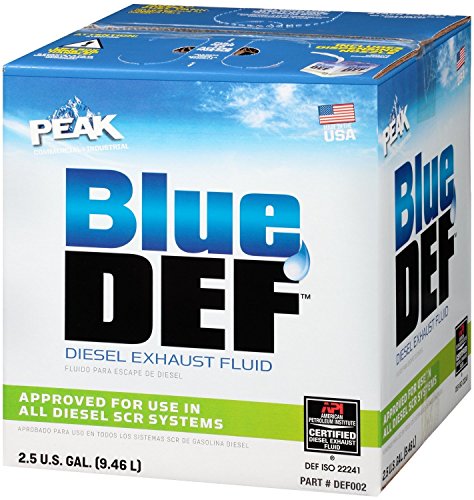
The purpose of diesel exhaust fluid is to support SCR NOx control. DEF is a 32.5% urea and 67.5% deionized water solution, and it is injected before the SCR catalyst so the system can form ammonia and convert NOx into nitrogen and water.
What DEF is and where it goes
DEF is a 32.5% urea and 67.5% deionized water solution. It goes into a separate DEF tank, never the diesel fuel tank. The standard DEF nozzle diameter is 19 mm, smaller than the diesel nozzle, while the diesel fuel nozzle diameter is 22 mm.
That size difference helps prevent mix-ups, but mistakes still happen. DEF in the fuel tank is a major contamination event.
How DEF supports SCR
DEF is injected into the exhaust stream as tiny droplets before the SCR catalyst. The droplets range from 100 to 200 µm. Once the exhaust is hot enough, the DEF breaks down and supplies ammonia for SCR chemistry.
That is why DEF does not clean the DPF and does not mix with diesel fuel. Its job is NOx control inside the SCR process.
Why many diesels need DEF
Many modern diesels need DEF because SCR is the main NOx-control stage on those vehicles. Without DEF, SCR cannot do its job, and the control system will react with warnings, faults, and eventually an inducement strategy. A final reduced-power level can limit top speed to about 8 km-h.
Low, old, frozen, or contaminated DEF
DEF freezes at -11 degrees C. Storage guidance is -12 degrees C to 32 degrees C, and stored at room temperature, DEF can last two years. Frozen DEF is expected in cold weather, and the system is built around that fact, but contamination or long-stored fluid can still cause quality faults.
The beginner-safe rules are simple: keep DEF sealed, use clean containers, avoid dirt or fuel contact, and do not assume any clear fluid is good fluid. Underfilled tanks trigger low-level warnings. Old or contaminated fluid tends to trigger quality or dosing faults.
Why do I need diesel exhaust fluid?
You need diesel exhaust fluid if the truck uses SCR, because SCR depends on DEF to reduce NOx. Without it, the truck cannot meet its programmed emissions strategy, and the result is usually warning messages, restart countdowns, reduced power, or speed limits.
What the driver usually notices first
Low DEF usually starts with a message or level warning. Poor DEF quality often brings an emissions-system warning. A frozen tank heater fault may first appear during cold weather. Contamination can trigger a cluster of DEF, SCR, and NOx-related codes.
These are usually dash-first problems, not sound-first problems.
How do sensors control the aftertreatment system?
Sensors control aftertreatment by measuring heat, pressure, and NOx levels across the system. The control module uses those signals to regulate regeneration, DEF dosing, and catalyst checks, then confirms whether exhaust treatment is happening properly or whether a DTC and warning light are needed.
Temperature sensors
Temperature sensors tell the control system whether the DOC can light off, whether the DPF can regenerate, and whether DEF dosing conditions are appropriate. If a sensor reading is wrong, the system may skip regen or flag implausible temperature faults.
The driver usually notices a check-engine light, canceled regens, or repeated filter warnings.
Differential pressure sensing
The pressure sensor compares pressure before and after the DPF to estimate restriction and soot loading. Split hoses, soot-plugged tubes, or a bad sensor can mimic a plugged filter.
The first symptom is often false DPF loading behavior: too many regens, warnings that do not match how the truck feels, or a filter message after recent service.
NOx monitoring and fault detection
NOx sensors before and after SCR help confirm that the system is actually reducing NOx. When those readings drift out of range, the truck may set efficiency faults even if the engine still feels normal.
That is why owners sometimes see an SCR warning before they notice any drivability change.
Where does exhaust brake function fit into a diesel exhaust system?
Exhaust brake function fits into the exhaust system as a separate braking role, not an emissions role. It uses exhaust gas pressure for braking, helps reduce wheel brake wear, and is more common on medium-duty and heavy-duty diesels than on smaller diesel vehicles.
How the exhaust brake works
Some diesel trucks use an exhaust brake to increase backpressure for braking. On long grades, that added resistance helps hold vehicle speed and reduces service-brake heat.
This function is separate from DOC, DPF, and SCR. The exhaust brake manages vehicle control, not pollutant cleanup.
What failure looks like
The first symptom is usually weaker hold-back on descents or a change in how the truck slows when the brake is commanded. In some cases, the owner may hear a different exhaust note during braking if the actuator or valve is sticking.
What symptom shows up first when a part stops doing its job?
The first symptom usually matches the failed part’s main job. Hot-end leaks tend to show up as ticking, hiss, or smell. DPF trouble usually starts with regen pattern changes. SCR and DEF trouble usually start with dash messages. Cold-end damage usually starts with louder exhaust or vibration.
Hot-end parts: manifold, pipes, DOC
A leaking manifold often makes a ticking sound during cold starts. A cracked flex section or clamp leak often hisses under load. DOC trouble tends to show up as poor regen support rather than loud noise, sometimes with an odor change.
DPF and regeneration faults
The most common early clue is more frequent regeneration. After that come hot smells after parking, more fan run-on, and then filter messages. If ignored, backpressure rises and power limits follow.
SCR and DEF faults
SCR trouble usually starts with a dash warning, then quality or efficiency codes, then stronger inducement steps if the fault remains. Low fluid, old fluid, contamination, or failed dosing hardware can all start this chain.
Cold-end sound and braking changes
A muffler or tailpipe problem usually gets louder before it gets technical. Broken hangers bring rattles and vibration. Exhaust brake faults change downhill control before they trigger anything dramatic on the dash.
Ownership checklist: what you can inspect safely without tools
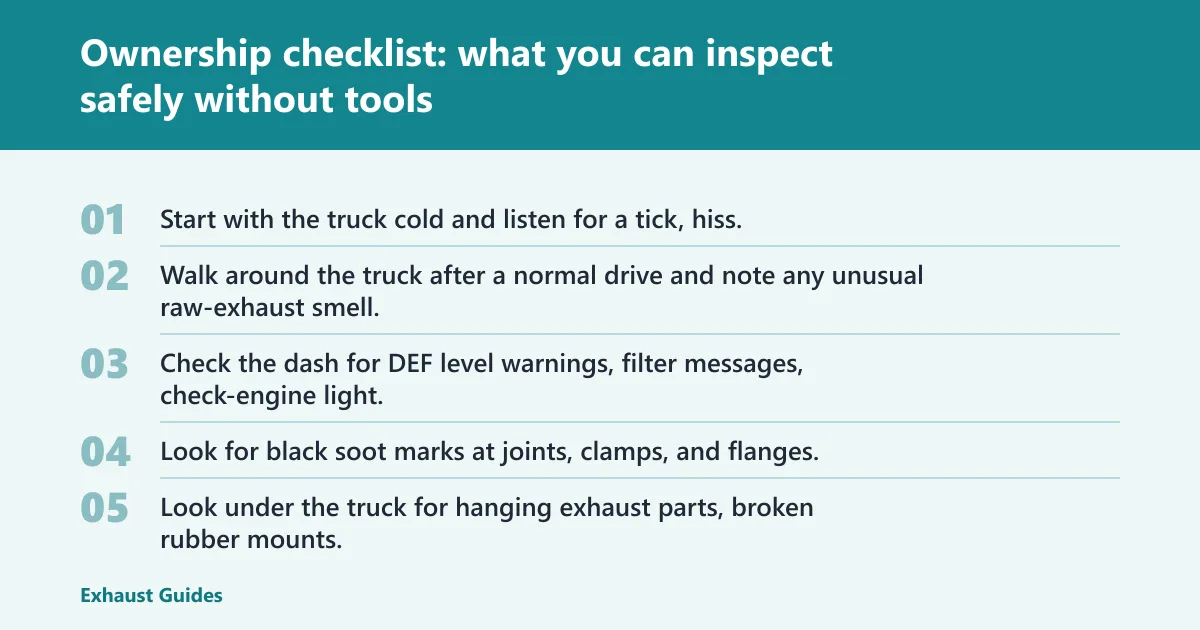
This one-page checklist gives a beginner-safe way to separate normal operation from an early fault. It maps each major component to normal sound, smell, likely dashboard symptom, and what can be inspected without touching hot parts, opening canisters, or doing tool-based diagnosis.
Beginner-safe inspection steps
- Start with the truck cold and listen for a tick, hiss, or sudden loudness near the engine bay or underbody.
- Walk around the truck after a normal drive and note any unusual raw-exhaust smell, hot regen smell, or DEF odor near the tank area.
- Check the dash for DEF level warnings, filter messages, check-engine light, or reduced-power notices.
- Look for black soot marks at joints, clamps, and flanges. Fresh soot often points to a leak.
- Look under the truck for hanging exhaust parts, broken rubber mounts, damaged pressure tubes, or loose shields.
- Check the DEF fill area for dirt, crusting, or signs of contamination. Keep the cap fitted correctly.
- Record when regen-related smells or fan activity happen, especially if the truck is doing short-trip use.
One-page ownership checklist
| Component | Normal sound | Normal smell | Usual dashboard symptom if failing | What a beginner can inspect safely without tools |
|---|---|---|---|---|
| Exhaust manifold and upstream joints | Even exhaust note, no sharp tick | No strong smell in engine bay | Often none at first | Look for soot marks near flanges, listen on cold start from outside the vehicle |
| DOC | No distinct sound change | Normal hot-exhaust smell only | Possible check-engine light or regen-related fault later | Track whether regens seem to be happening too often |
| DPF | No rattle, no whistle | Occasional hotter smell during regen can be normal | Filter or regen warning | Record fan activity, hot smell after parking, and how often warnings return |
| DEF tank and fill area | No sound concern | No fuel smell, no dirty residue | Low DEF or poor-quality DEF warning | Check fluid level message, cap fit, and cleanliness around the fill neck |
| DEF injector and SCR | No distinct noise to the driver in normal use | No strong ammonia-like odor near the tailpipe in normal use | SCR, NOx, or inducement warning | Record warning wording and outside temperature when it appeared |
| Sensors and pressure tubes | No sound concern | No smell concern | Check-engine light, regen fault, SCR or DPF codes | Look for disconnected, melted, or cracked visible hoses and wiring from a safe distance |
| Muffler, tailpipe, and hangers | Controlled exhaust note, no rattle | Normal tailpipe smell only | Usually none at first | Check for loose hangers, contact marks, and sudden loudness |
| Exhaust brake | Predictable change in note only when commanded | No smell change | Sometimes none at first | Note whether downhill slowing feels weaker than usual |
What to record before a shop visit
Record the exact warning text, outside temperature, DEF fill date if known, whether the truck had been doing short trips, and whether the symptom happened during towing, highway driving, or idle-heavy use.
Frequently asked questions
How do diesel exhaust aftertreatment systems reduce emissions?
They reduce emissions in stages. The DOC treats hydrocarbons and carbon monoxide, the DPF traps soot, and the SCR reduces NOx after DEF is injected ahead of the catalyst. Sensors monitor the process so the control system can confirm treatment and trigger faults when it falls out of range.
What parts make up a diesel exhaust system?
The main parts are the exhaust manifold, upstream piping, DOC, DPF, DEF dosing hardware, SCR catalyst, sensors, muffler, tailpipe, and on some trucks an exhaust brake. Exact packaging differs by vehicle, but those are the major parts owners most often hear about in service messages.
What does the DPF do in a diesel exhaust system?
The DPF traps soot before it exits the tailpipe, then clears itself through regeneration when exhaust conditions allow or when the truck commands added heat. If it cannot regenerate often enough, the first clue is usually frequent regen activity, followed by filter warnings and reduced power.
What is the difference between DOC, DPF, and SCR?
DOC reduces HC and CO near the front of aftertreatment. DPF traps soot and needs regeneration. SCR reduces NOx after DEF is sprayed into the exhaust ahead of the catalyst. They are three separate emissions stages with different jobs, temperatures, and fault patterns.
what is the purpose of diesel exhaust fluid
The purpose of diesel exhaust fluid is to let the SCR system reduce NOx. DEF is stored in its own tank, injected into the exhaust before the SCR catalyst, and then used to form ammonia for the NOx-reduction reaction. It never belongs in the diesel fuel tank.
why do i need diesel exhaust fluid
If the truck uses SCR, it needs DEF to carry out its NOx-control strategy. Without DEF, the truck will usually warn the driver, then apply stronger limits if the problem continues. That can include restart countdowns, reduced power, and in severe cases a very low road-speed limit.