Are Universal Diesel Exhaust Kits Worth It?
Universal diesel exhaust kits are often worth considering when custom routing, a tighter budget, or fitment flexibility matter; if bolt-on reliability matters more, a direct-fit kit is often the better buy. A bad fit can mean leaks, rattles, extra labor, and early corrosion. This guide compares value, sound, corrosion resistance, install difficulty, and the fitment tradeoffs that decide the purchase.
Verdict
Buy a universal diesel exhaust kit when you can accept cutting, measuring, and possible rework in exchange for more layout freedom and lower parts cost. Skip it when you want predictable fit, minimal labor, and the least risk around emissions hardware, bed clearance, and rear suspension travel.
Universal kits make the most sense on older trucks, custom builds, and budget projects where routing matters more than a perfect box-to-truck match. A direct-fit system is often the safer buy when you want a shorter install path and fewer chances for exhaust leaks, drone, or hanger problems.
Best-fit scenarios
A universal system can be worth it if your truck has nonstock exhaust routing, a modified rear suspension, or a layout that defeats off-the-shelf tubing. It also works when you want a specific tip style, a dual layout, or a larger diameter than the standard direct-fit options for your truck.
When a direct-fit kit wins
A direct-fit kit is the safer buy when you want the shortest install path and the least chance of touching up fitment after the first mock-up. That matters on newer diesel trucks with emissions-era packaging, where DPF, SCR, and DEF hardware leave less room for improvisation.
Pros and cons of universal diesel exhaust kits
Pros
- Lower entry price than many vehicle-specific systems.
- More routing freedom for custom bed, axle, or bumper layouts.
- Useful when you need a specific diameter or tip style that is not offered as a direct-fit part.
- Can support single or dual layouts for custom builds.
Cons
- More measuring, cutting, and test-fitting.
- Higher chance of leaks at slip joints if clamps and reducers are not matched well.
- Possible cabin drone if pipe length and hanger placement are off.
- Rust and soot can build up faster at poorly finished joints on aluminized systems.
- Modern emissions equipment can make universal fitment a poor choice or an illegal one if you alter controlled parts.
Sound gains and appearance gains are easy to buy. Real performance gains are harder. On a diesel, exhaust diameter, turbo setup, and emissions hardware matter more than the marketing around a tip or a shiny tailpipe.
Who it’s for
Universal kits suit owners who want layout control, can tolerate fabrication, and care more about price or custom routing than a guaranteed bolt-in path. They are a poor match for drivers who want a straightforward weekend install with minimal tools and minimal risk.
Daily driver
A daily driver benefits most from predictability. If the truck sees frequent cold starts, road salt, and stop-and-go use, a direct-fit stainless system is usually the cleaner buy because you reduce fitment risk and long-term corrosion concerns.
Tow rig
A tow rig needs stable hangers, proper clearance, and no surprise drone under load. Universal kits can work, but only if the routing keeps the pipe away from the axle, rear suspension, and trailer-related heat exposure.
Work truck
A work truck can justify a universal kit when downtime matters less than parts cost and the truck already has custom bed or bumper equipment. If the vehicle needs to be back in service fast, the extra fabrication often erases the savings.
Budget build
A budget build is the strongest case for a universal system, especially when you can do the measuring and mock-up yourself. The bargain disappears quickly if you have to buy extra clamps, reducers, hangers, or welding time after the kit arrives.
Universal diesel exhaust kits value matrix
This matrix uses a 1 to 5 score, where 1 is low and 5 is high. Lower fitment risk is better. Lower install effort and lower total installed cost are better too.
| Buyer scenario | Fitment risk | Install effort | Sound gain | Corrosion resistance | Total installed cost |
|---|---|---|---|---|---|
| Daily driver | 4 | 4 | 2 | 3 | 2 |
| Tow rig | 3 | 3 | 3 | 3 | 3 |
| Work truck | 3 | 2 | 2 | 3 | 3 |
| Budget build | 2 | 2 | 3 | 2 | 4 |
Daily drivers score poorly on fitment risk because the owner usually wants a clean, low-drama install. Budget builds score well on total installed cost because the base kit can be cheaper, but that savings fades if you need reducers, hangers, or welding to finish the job.
Will it fit your diesel truck?
Maybe, but only if the inlet, outlet, pipe diameter, and routing match your truck’s layout. Universal fitment is not automatic. You still need to check tailpipe length, axle clearance, cab and bed configuration, lift height, and the space taken up by emissions hardware.

Diameter and routing checks
Measure the existing exhaust path before buying anything. Check inlet and outlet sizes, the straight sections available for clamps, and where the pipe has to turn around crossmembers, the frame, or rear suspension components. A universal diesel exhaust kit can still fail if the bends land in the wrong place.
Cab, bed, and wheelbase fitment
Wheelbase and bed length change the amount of tailpipe you need. A short-bed truck may need a different exit point than a long-bed truck, and a cab-and-chassis layout can complicate hanger placement. The universal tag only means the kit is adaptable, not that it fits every truck without trimming.
Lifted trucks and clearance
Lifted trucks can create extra space around the axle, but they can also change the angle of the tailpipe and the position of the hanger points. Suppose a lifted diesel needs a side exit to clear larger tires. The extra space helps, but only if the pipe still clears the bed, shocks, and spare tire location.
DPF, SCR, and DEF packaging
Modern diesel trucks with DPF, SCR, and DEF hardware are the hardest fitment case. Those parts leave little room for a universal layout, and changing emissions-controlled exhaust components can be illegal and can create compliance issues. On those trucks, a universal kit is often the wrong answer unless it is meant to stay behind all emissions equipment.
Size, material, and bend quality
Diameter, steel choice, and bend quality all affect whether a universal diesel exhaust kit is worth the effort. The right answer depends on engine output, turbo setup, packaging, and how much corrosion exposure the truck sees.
2.5 inch and 3 inch kits
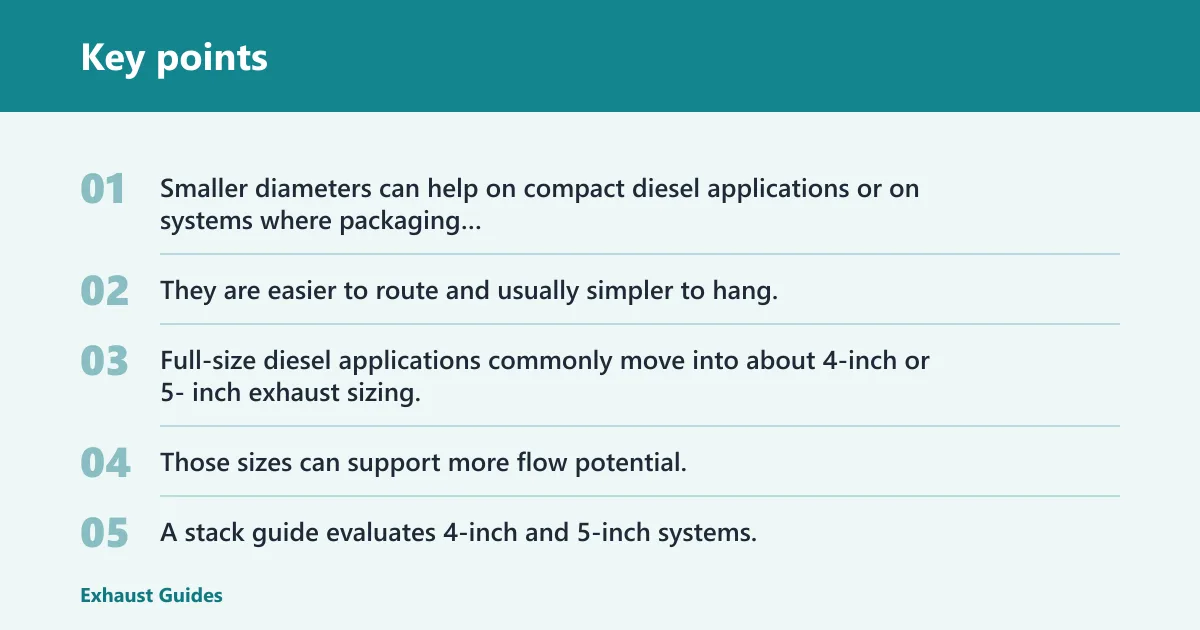
Smaller diameters can help on compact diesel applications or on systems where packaging is tight. They are easier to route and usually simpler to hang, but they may be too small for some full-size diesel setups that need more room for exhaust flow.
4 inch and 5 inch kits
Full-size diesel applications commonly move into about 4-inch or 5-inch exhaust sizing, especially when the goal is a performance-oriented aftermarket exhaust for diesel trucks. Those sizes can support more flow potential, but they also demand more space and more attention to hanger placement, bumper clearance, and axle routing.
A stack guide evaluates 4-inch and 5-inch systems, and one stack kit is described as universal fit with a 4-inch inlet. That is useful context: the diameter that works on paper still has to fit the truck under real packaging limits.
Aluminized steel vs stainless steel
Aluminized steel usually gives you lower cost and acceptable durability for a truck that lives in a mild climate or a budget build. Stainless steel costs more, but it gives better corrosion resistance and a longer service life when road salt, water, and short-trip driving attack the exhaust system.
A diesel exhaust systems guide includes an entry-level aluminized steel exhaust solution, while another guide features a 4-inch Duramax turbo-back exhaust system. That split is typical: budget options often use aluminized steel, while longer-life systems lean stainless.
Mandrel-bent vs non-mandrel-bent tubing
Mandrel-bent tubing keeps the inside diameter more consistent through the bend, which helps exhaust flow compared with crushed or flattened bends. Non-mandrel tubing is usually cheaper and more common in basic kits, but it can add restriction where the pipe turns sharply.
That does not mean every mandrel-bent universal kit is automatically better. A well-routed non-mandrel system can still fit a truck better than a poorly planned mandrel kit that needs rework.
Are universal diesel exhaust kits actually worth the money?
Yes, but only in the right use cases. They are worth the money when the savings survive the added cost of clamps, hangers, adapters, cutting, and possible welding. If you want the simplest route from box to truck, they are usually not the best value.
Say your truck needs a 4-inch tailpipe, but the available direct-fit option does not clear your rear suspension after a lift. A universal kit can solve that layout problem. If the same truck is stock height and emissions-complete, the direct-fit part is usually the smarter buy.
Single vs dual universal layouts
Single exhaust is easier to package, easier to support, and usually cheaper to finish. Dual exhaust can add a more aggressive look and a different sound character, but it increases routing complexity and can create clearance problems at the bed, tailgate, and rear axle.
Dual outlet packaging
A universal dual exhaust kit needs more planning because both pipes must clear the frame, spare tire area, and rear suspension travel. Tip alignment matters too. If one side sits lower or closer to the tire, heat and vibration can become long-term problems.
Tailpipe and tip clearance
Diesel exhaust tips are often the visible part that owners notice first, but the tip alone does not turn a basic system into a performance upgrade. One universal diesel tip can fit 4-inch outlet diesel trucks and pickups, and one example uses a 4-inch inlet and 6-inch outlet. That same tip is 15 inches long, made from stainless steel, and described as easy to install with screws.
A polished or chrome tip can improve appearance, but it will not fix a bad routing choice or a leaking clamp. A tip-only upgrade is cosmetic unless it is part of a full exhaust system.
Sound and appearance tradeoffs
Dual setups often sound fuller than a single exit, but that does not guarantee better drivability. On some trucks, the added pipe length and bends can increase drone or make the system harder to keep quiet at highway speed.
What installation really costs
The sticker price of a universal exhaust kit is only part of the bill. The real cost includes hangers, clamps, reducers, adapters, cutting, welding, and the time needed to correct fitment after the first mock-up.
Hangers, clamps, and adapters
Universal kits often need extra support points. If the kit does not land on factory hanger locations, you may need new hangers or bracket work. Clamps and adapters also matter because mismatched diameters can cause leaks or force you into a poor overlap at the joint.
Cutting, welding, and rework
Cutting is common. Welding may be optional, but it often becomes the cleanest way to solve a bad slip fit or secure a hanger in the right spot. Rework is the hidden cost most buyers miss, and it usually shows up when the first assembly does not clear the axle, bumper, or spare tire.
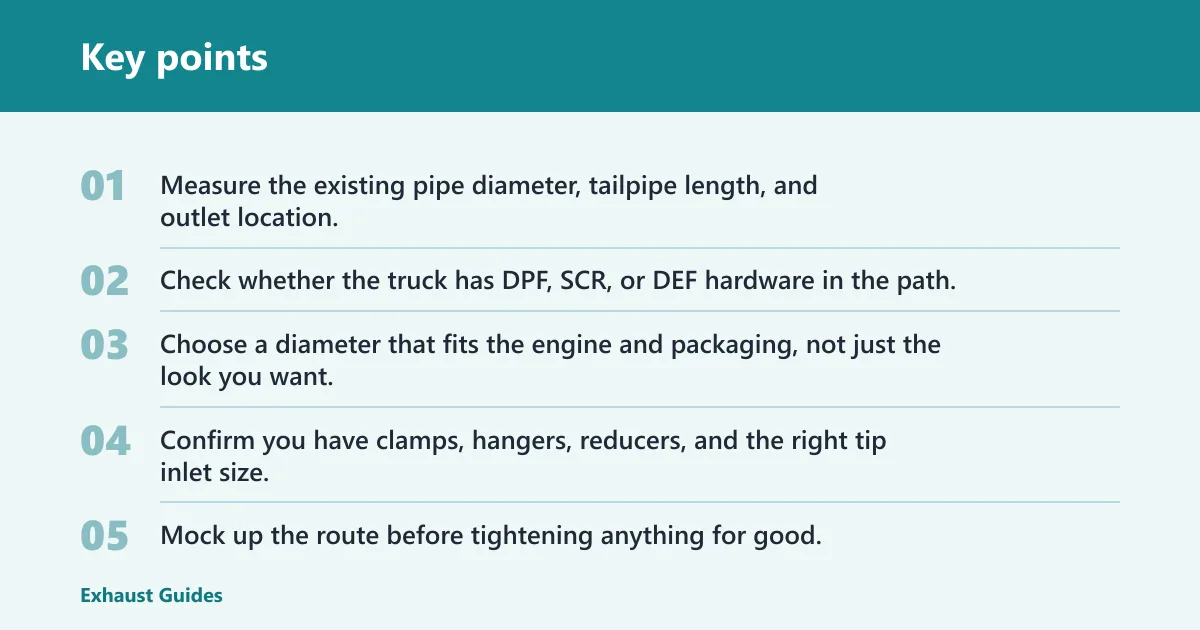
- Measure the existing pipe diameter, tailpipe length, and outlet location.
- Check whether the truck has DPF, SCR, or DEF hardware in the path.
- Choose a diameter that fits the engine and packaging, not just the look you want.
- Confirm you have clamps, hangers, reducers, and the right tip inlet size.
- Mock up the route before tightening anything for good.
Total installed cost
A universal kit can still save money, but only if the install stays simple. Once you add fabrication labor and replacement hardware, the gap between universal and direct-fit narrows fast. That is why universal kits are a value play, not a guaranteed bargain.
Frequently asked questions
Will a universal exhaust kit fit my diesel truck without major fabrication?
Sometimes, but not often enough to assume it. Fit depends on inlet and outlet size, tailpipe length, cab and bed configuration, lift height, axle clearance, and existing emissions hardware. If those points are not checked first, major fabrication can become part of the job.
What’s the difference between a universal 2.5 inch and 3 inch exhaust kit?
The main difference is flow capacity versus packaging ease. A 2.5-inch kit is easier to route in tight spaces, while a 3-inch kit gives more room for exhaust flow on some diesel applications. The right choice still depends on engine output, turbo setup, and chassis clearance.
Do universal exhaust kits improve diesel performance or just sound?
Both are possible, but sound and appearance are the easier wins. Performance gains depend on whether the diameter, bend quality, and routing reduce restriction in a way that matches the engine and emissions setup. A poorly fitted kit can sound louder without improving drivability.
How do I know if I need an aftermarket diesel exhaust system instead of stock?
Choose aftermarket when the stock system is corroded, restrictive for your build, damaged, or unable to support the routing you need. If the truck is modern and emissions-complete, keep the factory emissions components in place and make sure any replacement part stays compliant.
Are universal dual exhaust kits better than single exhaust setups for diesel trucks?
Not automatically. Dual exhaust can improve appearance and give you more layout choices, but it also adds routing complexity, clearance concerns, and more parts to align. Single exhaust is usually simpler, cheaper, and easier to fit cleanly on a diesel truck.
What are the tradeoffs between aluminized steel and stainless steel universal kits?
Aluminized steel costs less and can work well on a budget, but it is less resistant to rust. Stainless steel costs more up front, and it is the better pick when corrosion resistance and longer service life matter more than initial price.
Do universal exhaust kits work on lifted diesel trucks or only stock-height trucks?
They can work on lifted trucks, but lift height changes the angle, hanger placement, and clearance needs. A lift may help with axle space and tire clearance, yet it can also create new routing problems. Stock-height trucks usually have the simpler installation path.