What Black Exhaust Smoke Means Under Acceleration
Black exhaust smoke under acceleration often points to too much fuel, too little air, or reduced boost; if it appears with hard throttle, a common first check is the air filter and intake tract, then fuel delivery, then turbo control. EPA aftertreatment guidance and diesel technical references consistently tie soot output to incomplete combustion and oxygen shortfall, which is why repeated black smoke can foul the catalytic converter, DPF, and EGR system rather than just “look bad” at the tailpipe. This guide sorts the symptoms by acceleration pattern, then gives a fault-order checklist, likely causes for gasoline, diesel, and turbocharged engines, and a code-first way to narrow the problem.
Running rich: why soot forms under load

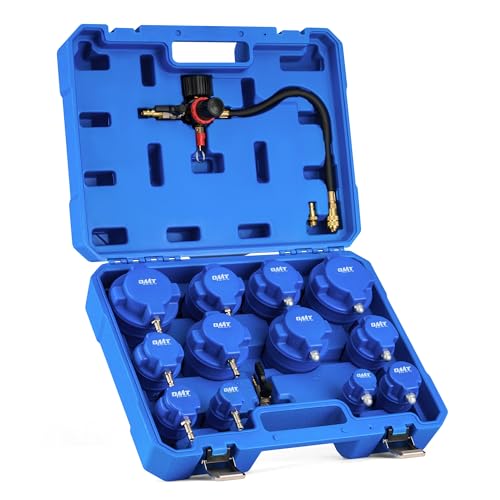

Black smoke under acceleration means the engine is running rich, with more fuel than the available air can burn cleanly. Under load, the engine demands more air and fuel at the same time; when the air side cannot keep up, soot rises. That can happen from a clogged filter, a bad sensor reading, a fuel system fault, a turbo leak, or diesel aftertreatment problems that are affecting airflow and exhaust backpressure.
A light puff that clears after the shift can point to a smaller imbalance. A heavy cloud, constant smoke under load, or smoke plus strong power loss can point to a deeper fault. If the smoke appears only during hard throttle, start with the intake path, then move to fuel metering and boost supply; OEM service information commonly follows the same order because it separates air restriction from command-and-control faults before parts are replaced.
How acceleration changes the diagnosis
Acceleration makes black smoke show up because the engine needs more air at the same time it asks for more fuel. When that extra air does not arrive, soot rises. That can happen from a clogged filter, a MAF or MAP reading error, a fuel delivery fault, a boost leak, or a turbo control problem.
Picture a 2.0-liter gasoline car that only puffs black smoke at full throttle merging onto a highway. That pattern is different from a diesel that smokes black under steady hill load for the whole climb. The first suggests an airflow or fueling error that appears only at high demand; the second points more toward sustained boost, EGR, injector, or DPF trouble. For a better way to describe exactly when the smoke appears, see how to document a smoke pattern for a mechanic.
Why does my car smoke black only when I press the gas?
Smoke that appears only when you press the gas usually means the fault shows up under load, not at idle. The engine may look fine in the driveway because airflow demand is low there. Once you ask for torque, a weak air supply, bad fuel control, or boost loss becomes visible as black exhaust.
Light puff versus heavy cloud
A brief light puff often points to a borderline issue, such as a slightly dirty air filter, a small boost leak, or a sensor that is drifting. A heavy cloud suggests a larger imbalance, such as excessive fuel pressure, leaking injectors, or a major air leak.
Smoke only at full throttle
Smoke only at full throttle often means the engine can manage light load but fails when demand peaks. That pattern is common with restricted airflow, a MAF sensor that misreports intake air, or a boost leak that opens wider as pressure rises. It can also happen with injector over-fueling at load, especially when the fault is intermittent and the warning light has not yet set.
Constant smoke during load
Constant smoke during a hill climb or hard pull usually points to a fault that does not come and go with throttle position. On gasoline engines, think rich fueling, sensor error, or pressure control. On diesels, think boost supply loss, EGR problems, injector wear, or DPF restriction before you jump to major engine damage.
Gasoline vs diesel diagnosis
Gasoline and diesel engines need separate diagnosis paths because their common causes overlap less than many guides suggest. Both can smoke black from too much fuel for the air available, but the usual failure points differ. Diesel engines add EGR, turbo, and DPF issues more often under load, while gasoline engines more often show fuel-trim or airflow-sensor faults first.
Common gasoline causes
On gasoline engines, the usual list commonly starts with the air filter, the MAF sensor, leaking or clogged injectors, a faulty fuel pressure regulator, and oxygen sensor input problems. A bad airflow reading can enrich the mixture. A pressure fault can do the same by feeding too much fuel to the injectors. Bosch technical materials on air-mass measurement and mixture control emphasize that the ECU’s fuel correction depends on believable sensor data, not guesswork from tailpipe smoke alone.
Common diesel causes
On diesels, black smoke under load often points to restricted air, injector wear, turbocharger trouble, EGR valve faults, or a blocked DPF. Some diesel black smoke on cold start can be normal for a very short period. Black smoke that persists under acceleration is not the same as that brief cold-start haze, and diesel aftertreatment references from EPA and OEM service literature stress that soot loading, EGR flow errors, and low boost can raise particulate output quickly.
What symptoms separate the two
Gasoline problems often come with fuel smell, rough running, and a check engine light tied to mixture control. Diesel problems more often show boost loss, soot buildup, limp mode, or a DPF warning. A diesel that smokes only after boost builds has a different path from a gasoline engine that runs rich at the same point. Turbo gasoline systems often split the difference: they can show boost-leak symptoms like a diesel, but still set gasoline mixture and airflow codes like a naturally aspirated car.
Black smoke diagnosis matrix
This matrix connects the smoke pattern to fuel type, smell, power loss, warning-light status, likely system, and a safe next step. Use it to pick the cheapest, safest check first. It is a triage tool, not a parts list, and it is most useful when you match it to whether the engine is naturally aspirated gasoline, turbo gasoline, or modern diesel.
| Smoke color | Fuel smell | Power loss | Warning light | Likely system | Common OBD-II codes | Safest next check |
|---|---|---|---|---|---|---|
| Black, brief puff on tip-in | None or mild fuel odor | Little or none | Often off | Gasoline: intake restriction, MAF drift, transient enrichment; Turbo gasoline: early boost leak | P0101, P0102, P0172, P0300 | Inspect air filter, intake ducting, and any loose clamps before swapping sensors |
| Black, heavy cloud on sustained throttle | Strong fuel smell | Noticeable | May be on | Gasoline: injector over-fuel, fuel pressure control, MAF/MAP input error | P0172, P0300, P0101, injector circuit/performance codes | Scan live data, then check fuel trims, fuel pressure, and injector balance |
| Black, smoke builds during hill load | Diesel odor, sometimes acrid | Noticeable | May be on | Modern diesel: turbo underboost, charge-pipe leak, EGR fault, DPF restriction | P0299, EGR codes, P2002, P2452/P2453 family, injector performance codes | Inspect boost hoses and intercooler plumbing, then scan for diesel-specific fault data |
| Black, smoke with rough running | Strong fuel smell | Yes | Often on | Any fuel type: injector fault, misfire, or sensor input error | P0300, injector circuit codes, P0102, P0172 | Stop hard driving and scan for stored and pending codes before further load testing |
| Black, smoke plus limp mode or low boost | Fuel smell or hot exhaust odor | Yes | Often on | Turbo gasoline or diesel: boost leak, charge-pipe split, turbo control fault | P0299, P0101, P0102, EGR codes, DPF-related codes | Inspect charge pipes and pressure hoses before replacing the turbo or sensors |
| Black, smoke with aftertreatment warning | Acrid exhaust odor | Often yes | Often on | Diesel aftertreatment: DPF loading, EGR flow imbalance, sensor bias | P2002, P2452, P2453, EGR codes, P0101 | Check DPF soot loading and EGR data before forcing a regen or clearing codes |
Ranked first-5 inspection order
- Air filter: Check for dirt, collapse, water damage, or a blocked intake path.
- Visible intake leaks: Look for loose clamps, split hoses, cracked resonators, or disconnected vacuum lines.
- Charge pipes and boost hoses: On turbo engines, inspect for oil mist around joints, splits, or popped couplers.
- Basic code scan: Look for mixture, airflow, boost, injector, EGR, and aftertreatment codes before replacing parts.
- Live symptom clues: Note whether smoke appears only at full throttle, under hill load, on tip-in, or across the whole rpm range.
First checks in order
Start with the cheapest checks because they are the fastest way to rule out simple airflow loss. The air filter is a good first look because it is visible, inexpensive, and can reduce airflow under acceleration. After that, inspect boost plumbing and obvious leaks before buying sensors or injectors. OEM service flows generally treat visible intake faults and code confirmation as the fastest path to a reliable diagnosis.
Air filter and intake path
A dirty or clogged air filter can restrict airflow and cause black smoke. Remove the filter and inspect it against light. If it is packed with dust, oil-soaked, or collapsed, replace it. Also check for leaves, torn ducts, or a blocked snorkel that can choke intake air.
Boost pipes and obvious leaks
On turbo engines, a split or loose charge pipe can leak pressurized air before it reaches the cylinders. That can mimic a turbo fault because the engine loses the air it needs under load. Look for clamps that have slipped, hoses that have oily residue, and pipes that move under hand pressure.
Code scan and live symptom clues
A basic scan helps separate sensor faults from airflow or fueling problems. Codes tied to the MAF, oxygen sensor, boost control, injector performance, EGR, or DPF can point you in the right direction. Save freeze-frame data if the tool provides it, since engine load, rpm, calculated load, and fuel trims matter more than the code label alone.
Fuel and sensor causes
Once the air side checks out, move to the parts that control fueling. Black smoke can come from bad input data or from fuel delivery that is too high at load. On gasoline engines, that often means sensor or pressure issues. On diesels, the injector, boost, and EGR path often matters more, because soot control depends on clean air charge and accurate metering.
Mass air flow sensor fault
A faulty mass air flow sensor can miscalculate intake air and enrich the mixture. That can happen if the sensor is dirty or failing. If the engine how to document a smoke pattern for a mechanic shows that the smoke appears only under a certain throttle position or rpm band, the sensor deserves close attention because intermittent airflow data errors often show up first under load rather than at idle.
Fuel injectors and fuel pressure regulator
Leaking or clogged fuel injectors are common causes of black smoke. Poor atomization and over-fueling at load both leave soot behind. A faulty fuel pressure regulator can create excessive fuel pressure, which can push the mixture rich even when the command looks normal. Injector circuit or performance codes do not automatically prove a failed injector, but they do tell you the ECU saw a delivery or response problem in that cylinder or bank.
Oxygen sensor fuel-trim errors
The oxygen sensor is one of the sensors responsible for maintaining air-fuel balance. If it sends a faulty signal, the ECU can add too much fuel. That may show up first during acceleration, when the system is already working harder to keep the mixture stable. A code like P0172 indicates the ECU has learned a rich condition, but it does not prove the sensor itself is bad; it can also reflect a fuel pressure issue, leaking injector, or airflow misread.
Suppose a gasoline sedan smokes black only when merging, smells strongly of fuel, and has a check engine light after a long highway run. That pattern points more toward fuel trim, injector, or MAF trouble than toward a dead engine. The safest next step is a code scan, not a guess at random parts. If P0102 or P0101 appears, the engine may have a believable airflow problem; if P0172 appears alone, the fault may be richer fueling, not a sensor failure by itself.
Can turbo or DPF faults cause this?
Yes. Turbocharger faults and boost leaks can create black smoke by reducing the air supply under acceleration. On diesel engines, EGR valve faults and DPF restriction can add backpressure or disturb airflow enough to make the smoke worse. These faults are more relevant on diesel and turbo gasoline engines than on naturally aspirated ones, and the failure pattern often changes with tip-in, sustained boost, or hot-soak conditions.
Turbocharger and charge-pipe leaks
Black smoke under load can point to turbocharger failure. Slow spool, seal trouble, or poor boost control lowers air supply, and the engine can soot under demand. Before blaming the turbo itself, inspect charge pipes and couplers for leaks, because a boost leak can mimic a turbo fault. A P0299 under acceleration supports underboost, but it does not prove the turbo is mechanically bad; it can also come from a split hose, sensor issue, or control-valve fault.
EGR valve faults on diesel engines
An EGR valve with carbon buildup or a stuck-open fault can upset the fresh-air charge on a diesel. That reduces available oxygen under load and can contribute to black smoke. If smoke arrives with rough running and low boost response, EGR becomes a more likely suspect. EGR-related codes prove that flow was outside the expected range; they do not always prove the valve is stuck, because wiring faults, carbon loading, and control issues can all trigger the same complaint.
DPF restriction and backpressure
A blocked or restricted DPF adds backpressure and can distort engine behavior under load. It does not create every black-smoke complaint, but it can worsen them and hide the real airflow issue. On diesel vehicles, a DPF warning alongside smoke deserves a careful scan before more driving. EPA diesel aftertreatment guidance treats elevated soot loading and failed regeneration as reasons to verify the underlying engine fault, not just clear the warning and continue driving.
Common OBD-II codes and what they do and do not prove
Codes help narrow the likely system, but they rarely prove the failed part by themselves. Use them as a clue to the direction of testing, not as a replacement for inspection or live data. The examples below are common with black smoke under acceleration, especially when the problem shows up only under load or during boost.
P0101 and P0102
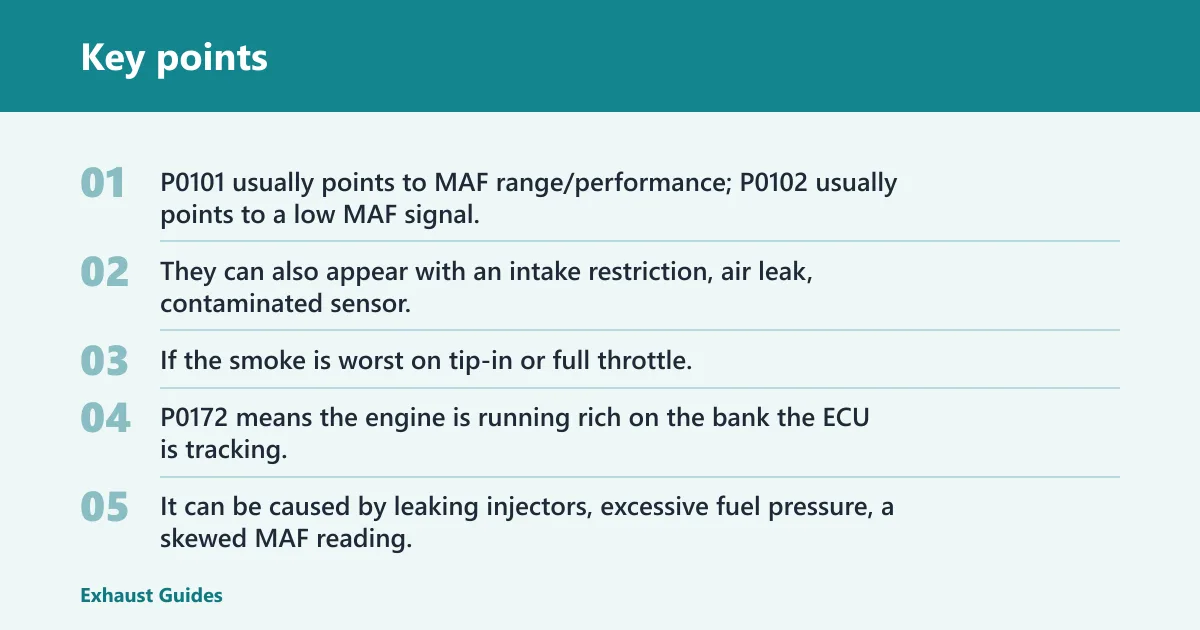
P0101 usually points to MAF range/performance; P0102 usually points to a low MAF signal. They do not prove the MAF is bad. They can also appear with an intake restriction, air leak, contaminated sensor, wiring fault, or a load condition that makes the airflow reading implausible. If the smoke is worst on tip-in or full throttle, these codes deserve a close look at the ducting before parts replacement.
P0172
P0172 means the engine is running rich on the bank the ECU is tracking. It does not prove a bad oxygen sensor. It can be caused by leaking injectors, excessive fuel pressure, a skewed MAF reading, or evaporative or calibration issues. If smoke is heavy and the fuel smell is strong, P0172 helps confirm a rich condition, but it still leaves the root cause open.
P0300
P0300 is a random or multiple-cylinder misfire code. It does not prove a spark plug problem by itself. Under acceleration, a misfire can dump unburned fuel into the exhaust and make smoke or odor worse. On gasoline engines, a misfire can look like a fuel problem; on diesels, it may show up as uneven running or shake rather than a classic spark misfire.
P0299
P0299 indicates underboost. It does not automatically mean the turbocharger is failed. A split intercooler hose, loose clamp, stuck wastegate, control-solenoid problem, or pressure-sensor issue can trigger it. When black smoke appears with limp mode or weak acceleration, P0299 is especially important because it connects the smoke to lost air supply under load.
Injector circuit and injector performance codes
Injector circuit codes and injector performance codes can point to wiring, driver, control, or delivery problems. They do not prove the injector is clogged or mechanically leaking. A circuit code can be electrical; a performance code can be fuel, compression, or control related. If the engine smokes under load and one cylinder is flagged, the next step is to confirm the circuit, not just replace the injector blindly.
EGR codes
EGR codes can indicate flow that is too high, too low, or not responding as expected. They do not by themselves prove the valve is stuck open or stuck closed. Carbon buildup, cooler restriction, wiring faults, and pressure-sensing errors can all lead to the same complaint. On modern diesels, EGR faults often pair with smoke because they change how much fresh air reaches the cylinders.
Common DPF-related codes
DPF-related codes commonly involve soot loading, differential pressure, regeneration problems, or sensor plausibility. They do not prove the filter is physically blocked beyond repair. A failed pressure sensor, a bad temp sensor, or an upstream fueling problem can trigger the code. If the vehicle is still making black smoke, fix the root combustion problem first or the DPF fault will often return.
Frequently asked questions
Is black smoke under acceleration dangerous to keep driving?
It can be. A brief puff with no warning light is less urgent than thick, constant smoke with fuel smell and power loss. If the smoke is heavy, the engine feels weak, or the light is flashing, stop hard driving and diagnose the fault before it damages aftertreatment parts or masks a turbo or injector problem.
What should I check first if I see black smoke at full throttle?
Check the air filter, then the intake ducting, then any visible boost hoses or charge pipes. After that, scan for codes. Those first checks are cheap, fast, and they often separate a simple air restriction from a more expensive fuel or turbo problem.
Can a clogged air filter cause black smoke on acceleration?
Yes. A dirty or clogged air filter can restrict airflow and cause black smoke, especially when engine demand rises under acceleration. It is one of the first things to inspect because it is easy to see and cheaper than most sensor or fuel repairs.
Can bad injectors cause black smoke under load?
Yes. Leaking or clogged fuel injectors can cause poor atomization or over-fueling at load, both of which leave soot in the exhaust. If the smoke comes with rough running, fuel smell, or misfire-like behavior, injector testing becomes more important.
Does black smoke mean a turbo problem or fuel problem?
It can be either. On turbo engines, lost boost or a charge-pipe leak can reduce air supply and create black smoke. On gasoline engines, fuel delivery and sensor faults are common. The smoke pattern, fuel type, and warning lights help separate the two paths.
How do I tell if the smoke is from rich fueling or oil burning?
Rich fueling usually looks black and often smells strongly of fuel. Oil burning is more likely to look blue-gray and leave an oily odor. If the smoke is black only under throttle, think air-fuel imbalance first. If it is blue at idle or after deceleration, look elsewhere.
What OBD codes can black smoke under acceleration cause?
Common codes often involve MAF, oxygen sensor, fuel trim, injector, boost, EGR, or DPF faults. The exact code depends on the system that lost control first, so the scan result should guide the next inspection, not replace it.
Is black smoke normal for a diesel when accelerating?
A short puff can happen on some diesels, especially during cold start or a sudden load change. Persistent black smoke under acceleration is not normal. If it keeps happening, inspect the air filter, boost plumbing, injector condition, EGR operation, and DPF status.