How Long Does a Flex Pipe Last?
A flex pipe often lasts about 5 to 10 years, but real-world life varies a lot by climate, alignment, and engine movement. OEM service information and major exhaust manufacturers generally treat flex joints as wear items, and emissions programs may flag leaks or related fault codes depending on state rules and vehicle setup. Ignore a failing flex pipe and you risk louder exhaust noise, exhaust leaks, failed emissions tests, and broken pipes that cost more to fix. This guide explains lifespan by use case, the usual failure causes, and how to tell whether the flex pipe is near the end or being damaged by another exhaust problem.
What a flex pipe does and where it sits


A flex pipe adds movement to the exhaust so engine motion and chassis movement do not crack the rest of the system. It is usually installed in the front or middle section of the exhaust, close to the engine, where heat and vibration are highest.
That location helps the system move, but it is hard on the part. The flex section sees hot exhaust flow, engine twist under acceleration, and road splash from below. If the pipe is too short, too long, or installed under side load, the bellows and braid take the stress instead of the hangers and mounts.
Most braided stainless steel flex joints use an outer braid over the bellows. The braid helps protect the moving inner section from road debris and repeated bending. Once the braid is damaged, the pipe is often close to leaking or separating.
How long does a flex pipe last?
A flex pipe usually lasts several years, and 5 to 10 years is a practical general range, but not a promise. Exhaust manufacturers and service literature describe flex joints as parts that wear with heat, movement, corrosion, and fitment stress. A mild-climate commuter with healthy mounts may last near the upper end, while a salt-belt car or misaligned exhaust can fail much sooner.
City driving, short trips, and stop-and-go use put the exhaust through more heat cycles. Highway use can be easier on the part if the engine and exhaust stay aligned, but long hot runs still age the bellows and welds. The fastest failures are often caused by vibration paired with corrosion, not by age alone.
A flex pipe on a car that lives in road salt may rust from the outside in, especially at the braid, welds, and nearby pipe ends. A performance car with stiff mounts may move less overall, but the motion that remains can be sharper and harder on the joint. A truck or SUV that tows or carries heavy loads can also stress the front section more often.
For emissions or inspection purposes, a leaking flex pipe can matter even when the vehicle still runs. State inspection rules vary, but many programs check for exhaust leaks, visible damage, or emissions-related faults that can be triggered by a front-exhaust leak. For example, [New York State inspection requirements] include exhaust system and emission-related checks, and [California BAR guidance] explains that inspection results depend on the vehicle and test type.
| Driving condition | Typical wear driver | Likely life impact | Visible warning signs | Repair or replace? |
|---|---|---|---|---|
| Daily commuter | Heat cycling, normal engine movement, minor road splash | Often near the longer end of the usual range if mounts and hangers are sound | Light soot, small ticking noise, faint odor near the engine bay | Check first; replace if the braid is frayed or the bellows is split |
| Winter or salt-belt car | Corrosion, moisture, salt spray, rust at welds and braid | Shorter life; outer rust can spread into the joint and nearby pipe | Rust flakes, braid thinning, pinholes, staining around welds | Usually replace; patches tend to be short-lived on rusted metal |
| Performance car | Sharper engine movement, higher exhaust heat, modified hangers or exhaust routing | Life depends on fitment; misfit parts fail early even when new | Cracks near the welds, repeat leaks after replacement, rattling under load | Replace and recheck alignment and mount condition |
| High-mileage truck or SUV | Repeated heat cycles, load changes, corrosion near the front section | Wear rises with mileage, especially if the exhaust has sagged | Rattle on acceleration, exhaust smell, visible braid wear | Replace if the wall is thin or the braid is separating |
| Bad mounts or exhaust misalignment | Excess engine or exhaust movement, side loading, hanger stress | Can destroy a new flex pipe quickly | Fresh cracks, stretched braid, pipe that moves too much by hand | Fix the mount, hanger, or alignment before replacing the pipe again |
What wears out a flex pipe faster?
Heat cycling and engine movement do most of the damage. Every cold start, warm-up, acceleration, and shift bends the bellows a little. Over time, that motion can crack the bellows, split the welds, or separate the outer braid if the system is pushed beyond its design.
Road salt, moisture, and rust also shorten life. Rust often starts at the braid, welds, and nearby pipe sections, then spreads until the metal is thin enough to leak or tear. A flex pipe in a salt-belt climate may look fine from a distance while the outer braid is already weakening.
Poor hanger support and exhaust misalignment can be just as harmful as corrosion. If the exhaust hangs low, touches the body, or pulls against the flex joint, the pipe has to carry load it was never meant to handle. Bad motor mounts do the same thing from the engine side.
Say your compact car has a new flex pipe, but the engine rocks hard in Drive because a mount is torn. The pipe may start leaking again within months, even though the part itself was not defective. In that case, the root problem is movement, not the replacement pipe.
Braid damage is a warning sign, not a cosmetic issue. Once the outer braid is cut, crushed, or unraveling, the bellows underneath is exposed to debris and repeated bending. That is often the point where a leak or separation is close.
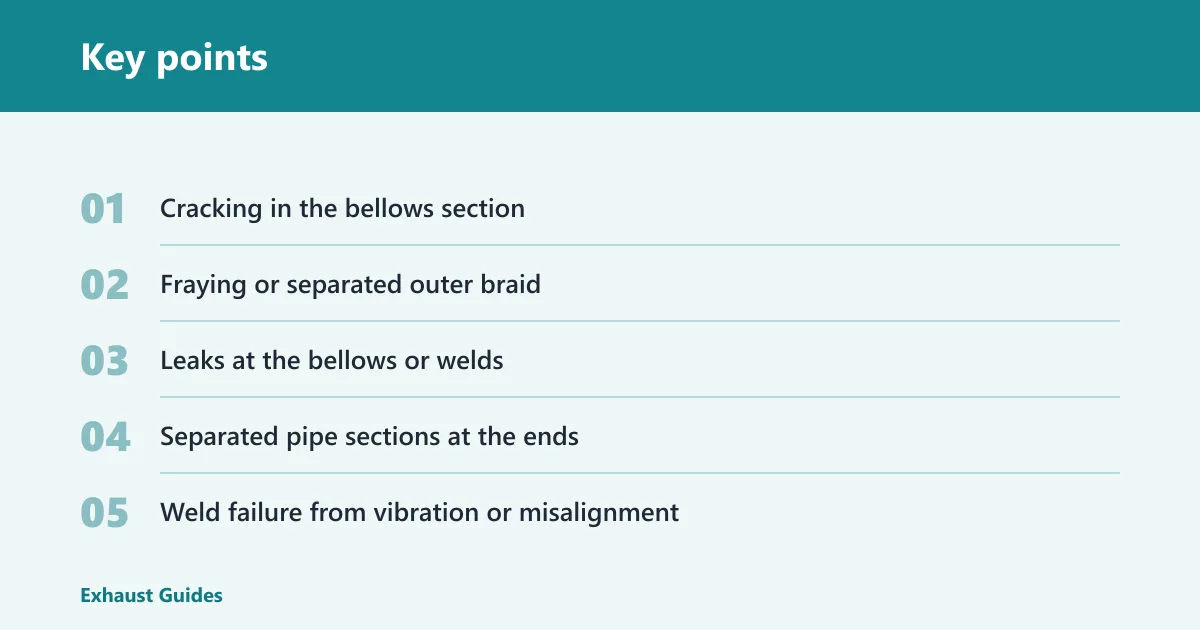
Common failure modes
- Cracking in the bellows section
- Fraying or separated outer braid
- Leaks at the bellows or welds
- Separated pipe sections at the ends
- Weld failure from vibration or misalignment
How do you know if it is bad?
A bad flex pipe usually announces itself with noise, fumes, soot, or rattling. A sharp ticking or puffing sound near the front of the exhaust often shows up under acceleration or cold start. Exhaust smell in the cabin, black soot around a joint, or a metallic buzz can point to a leak or split.
Visible damage matters too. Look for cracks in the bellows, separated braid, rust holes, or movement at the joint that seems larger than the rest of the exhaust. A leak near the front of the system can also affect oxygen sensor readings and readiness on some vehicles, which matters at emissions inspection.
A leak is not always the only problem. If the flex pipe failed because the engine moved too much, replacing the pipe alone may work for a short time and then fail again. If the surrounding pipe is thin, warped, or rusted through, the repair needs to cover more than the single split.
Simple check you can do
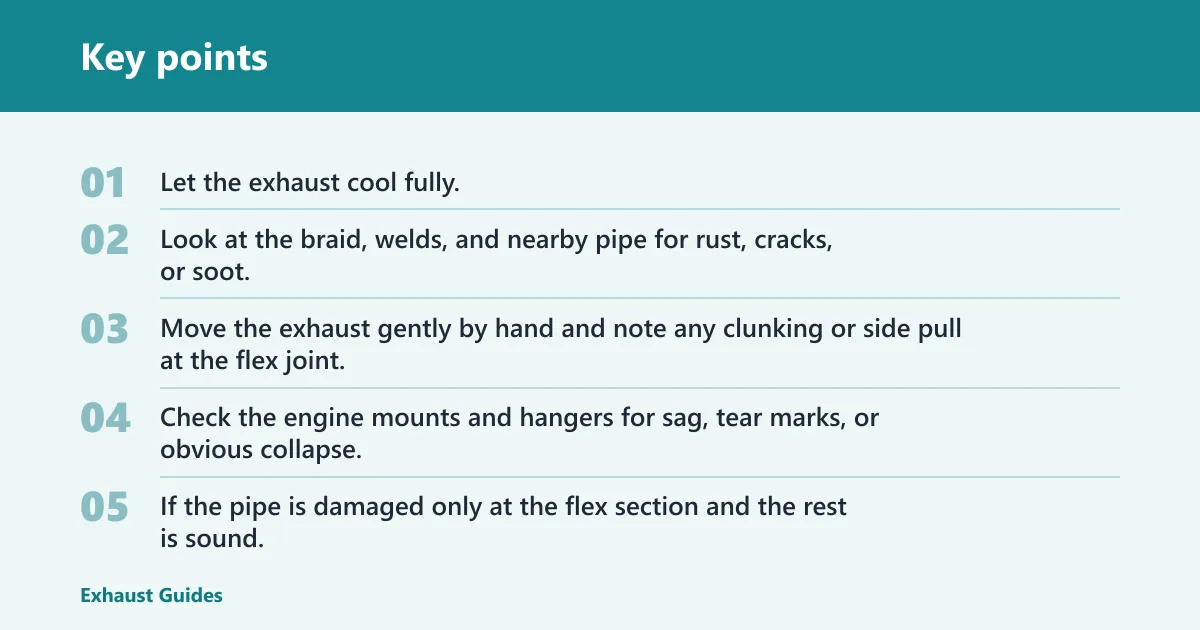
- Let the exhaust cool fully.
- Look at the braid, welds, and nearby pipe for rust, cracks, or soot.
- Move the exhaust gently by hand and note any clunking or side pull at the flex joint.
- Check the engine mounts and hangers for sag, tear marks, or obvious collapse.
- If the pipe is damaged only at the flex section and the rest is sound, repair may be possible; if the braid is separating or the pipe wall is thin, plan on replacement.
Is it the flex pipe or another exhaust problem?
Use a quick yes/no check to separate the flex pipe from related issues. If the exhaust is misaligned, a hanger is broken, or a mount has collapsed, the flex joint may be the victim rather than the cause. That matters because a new pipe will fail again if the real source of movement is still there.
- Bad mount? Does the engine rock excessively when shifting or blipping the throttle?
- Broken hanger? Does the exhaust sag or contact the body, crossmember, or shield?
- Manifold leak? Is the ticking sound strongest near the engine rather than at the flex section?
- Exhaust misalignment? Does the pipe pull sideways or show a visible bend before the flex joint?
- Flex-pipe failure? Is the braid frayed, the bellows split, or soot concentrated on the flex section itself?
Suppose a sedan has a loud tick at idle, soot near the flex section, and a braid that is already unraveling. That combination points to a worn-out joint, not a minor leak. If the mount and hanger checks are normal, replacement is the safer call than a patch.
Can a flex pipe be repaired or should it be replaced?
A flex pipe repair can sometimes work, but many failures need replacement. Repair suitability depends on where the leak is, how much of the pipe wall remains sound, and whether local inspection rules allow a temporary fix. Small pinholes or a tiny edge leak may be patched, but a split bellows or separated braid usually means replacement.
Temporary patch options include exhaust wrap, clamp-on sleeves, and weld repairs on solid metal near the joint. Those fixes are limited. If the flex section itself is torn, the braid is gone, or the surrounding pipe is rusted thin, a patch is likely to fail again.
Replacement flex pipe cost depends on vehicle layout, pipe size, material, and whether the part is weld-in or clamp-on. Labor can also vary with rust and access, so the same job may be simple on one car and much slower on another. Some shops replace the entire front section if the pipe ends are too thin to weld reliably.
Repair vs. replace decision rule
- Repair can work when the leak is small, the bellows is intact, and the surrounding pipe is thick and clean.
- Replace when the braid is frayed, the bellows is split, or the pipe wall is thin from rust.
- Replace when the leak is at the flex section itself, not a nearby seam.
- Fix the cause first if the exhaust is misaligned or the mounts are bad.
How to prevent repeat failure
Start with the rest of the exhaust system. Check the motor mounts, exhaust hangers, and routing before installing a new part. If the engine moves too much, the exhaust is hanging crooked, or a bracket is bent, the new flex pipe will keep taking the load.
Match diameter and length correctly. A flex pipe that is too short or too stiff can put the joint in constant tension. A part that is too long can sag or flex in the wrong place. The installation style must also match the vehicle, since weld-in and clamp-style designs are not interchangeable in every layout.
Watch the nearby metal during inspection. Rust around the joint often means the problem is broader than the flex section alone. If the pipe ends or weld areas are thinning, replacing only the middle part may leave weak metal behind.
A common mistake is replacing the flex pipe and ignoring a broken hanger two inches away. The new part then takes the same side load as the old one. The fix lasts longer when the support system is corrected at the same time.
Frequently asked questions
How long does a flexi pipe last?
A flexi pipe often lasts 5 to 10 years, but its life depends on heat, vibration, rust, and how the vehicle is driven. Mild climates and healthy mounts help it last longer. Salt, misalignment, and heavy exhaust movement can cut that span sharply.
How long does a flex pipe last on a car?
On a car, a flex pipe can last several years if the exhaust is aligned and the engine mounts are in good shape. City driving, winter salt, and repeated short trips usually shorten life. A car with worn mounts can wear out a new pipe much faster.
How long does exhaust flex pipe last?
Exhaust flex pipe life is usually measured in years, not a fixed mileage number. A common service range is 5 to 10 years, but that can be shorter on vehicles with corrosion, heat stress, or movement problems. The best clue is the condition of the braid and bellows.
How do I know if my flex pipe is bad?
Look for ticking or puffing noise, exhaust smell, soot, rattling, visible cracks, and separated braid. If the flex section moves too much, is rusty around the welds, or leaks near the front of the exhaust, it is likely failing. A leak there can also affect emissions readiness.
What makes an exhaust flex pipe wear out faster?
Bad motor mounts, poor hanger support, exhaust misalignment, road salt, and repeated heat cycling are the main causes of early wear. A pipe can also fail early if the replacement size is wrong or if the exhaust pulls sideways on the joint. Braid damage is a strong warning sign.
How long does it take to fix a flex pipe?
Most flex pipe repairs are a same-day job, but the exact time depends on access, rust, welding needs, and whether the cause of failure also has to be corrected. A straightforward replacement can be quick; a heavily corroded or misaligned exhaust can take much longer.
How much does it cost to fix a flex pipe?
Repair cost varies by vehicle, part style, labor rate, and how much rust or extra exhaust damage is present. A simple patch is usually cheaper than replacement, while replacing the flex section and correcting mounts or hangers costs more. Pricing also changes with pipe diameter and whether the job is weld-in or clamp-on.
How long does the broader exhaust pipe last versus the flex section?
The broader exhaust pipe often lasts longer than the flex section because the straight tubing is less exposed to repeated movement. The flex joint is designed to move, so it usually wears first. In rusty climates, though, the surrounding exhaust pipe can fail at the same time or even sooner.