How to Diagnose Exhaust Drone at Highway Speeds
To diagnose exhaust drone at highway speeds, hold the car at the problem speed, then change one variable at a time: gear, throttle, and load. If the hum changes with engine rpm more than road speed, the exhaust or powertrain is the likely source, not tire noise. Misdiagnosis can waste money on mufflers, tires, hangers, or heat shields that do nothing. This guide shows how to isolate the frequency, separate exhaust drone from other underbody noise, and choose the least invasive fix first.
Exhaust drone is a steady low-frequency boom or hum that shows up most clearly at cruise and highway speeds. Exhaust drone is often reported in a fairly narrow rpm band, so the noise can appear at one speed in one gear and disappear when the transmission shifts.
What exhaust drone sounds like


It usually sounds deeper than tire roar and less rhythmic than a wheel bearing growl. Many drivers also feel it as a pressure-like vibration in the seat, steering wheel, or floor rather than hearing a sharp metallic noise.
Why the sound changes with speed, gear, and throttle
The same exhaust system can drone at one rpm band because exhaust pulses, pipe length, muffler design, and cabin volume line up at that frequency. Change gear or throttle, and the engine leaves that band even if road speed stays similar.
That is why speed alone is a weak clue. A vehicle that drones at about 62 mph in overdrive may be quiet at the same road speed after a manual downshift if engine rpm rises out of the resonant window.
Why cabin resonance can make the same exhaust sound worse
Cabin resonance is the interior amplification of low frequencies. Body style, wheelbase, seat position, and rear cargo area all affect how strongly the cabin hears a given exhaust tone.
A coupe, hatchback, or short-wheelbase truck may sound louder than a longer sedan with the same exhaust system because the cabin reinforces that band more effectively.
Road test conditions that reproduce drone
Use a steady-throttle road test on a level road. Hold top gear or overdrive, keep speed constant, and repeat the run with windows up and down so you can separate cabin amplification from outside noise.
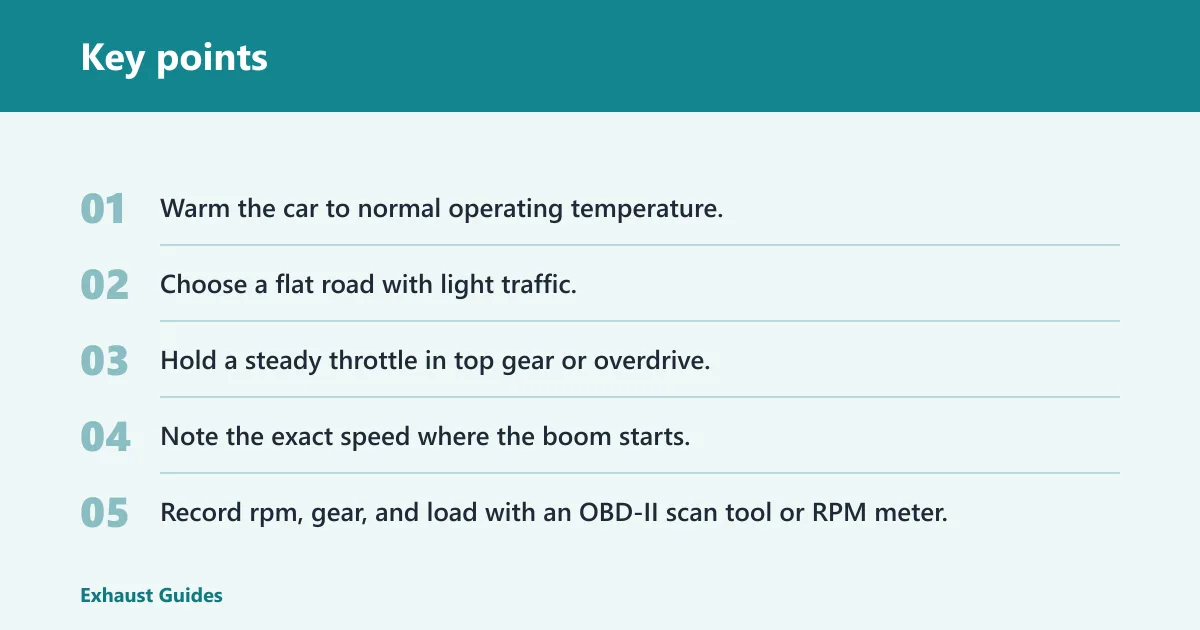
- Warm the car to normal operating temperature.
- Choose a flat road with light traffic.
- Hold a steady throttle in top gear or overdrive.
- Note the exact speed where the boom starts.
- Record rpm, gear, and load with an OBD-II scan tool or RPM meter.
- Repeat at the same speed with the transmission forced into a different gear.
- Repeat again with windows up and then slightly open.
Say your car drones at 58 mph in eighth gear at 1,850 rpm, but the noise drops when it downshifts to 2,300 rpm at the same road speed. That points away from tire noise and toward a resonance band tied to engine speed or exhaust length.
Exhaust drone diagnosis matrix
Use this matrix to match symptom, speed, rpm band, gear, and quick test before replacing parts. The goal is to identify the source component, not to guess at the loudest part under the car.
| Symptom | Speed | RPM band | Gear | Likely cause | Quick test | Recommended fix |
|---|---|---|---|---|---|---|
| Deep boom that appears only at steady cruise | 50 to 75 mph | 1,500 to 2,200 rpm | Top gear / overdrive | Exhaust drone from system resonance | Downshift at the same speed; if the sound shifts or fades, rpm is the key variable | Add or retune a resonator; change muffler type if needed |
| Humming that gets louder with windows closed | 45 to 70 mph | Any repeatable band | Any steady cruise gear | Cabin resonance amplifying a low frequency | Compare windows up and down; cabin volume changes point to interior amplification | Repair source first, then add sound-deadening if needed |
| Buzz with a sharp edge near acceleration | Any speed under load | Often changes with throttle | Any | Exhaust leak at flange, clamp, gasket, or flex pipe | Listen on light acceleration and steady cruise; leaks often get louder under load | Repair leak, then retest for remaining drone |
| Rattle over bumps plus cruise buzz | Any | May overlap drone band | Any | Loose heat shield or contact at hanger | Tap shields; inspect for metal-to-metal contact and worn rubber isolators | Retighten, rehang, or replace shield hardware and isolators |
| Roar that rises with vehicle speed more than rpm | Higher with road speed | Varies less with shifts | Any | Tire roar or wheel bearing noise | Swerve gently and compare left versus right load; rotate tires if needed | Repair tire or bearing issue, not the exhaust |
| Low hum that changes with throttle but not much with speed | Any steady road speed | Tracks engine load | Any | Exhaust or driveline resonance | Hold speed, then vary throttle slightly; note whether rpm or load changes the tone | Check muffler, resonator, pipe length, mounts, and drivetrain sources |
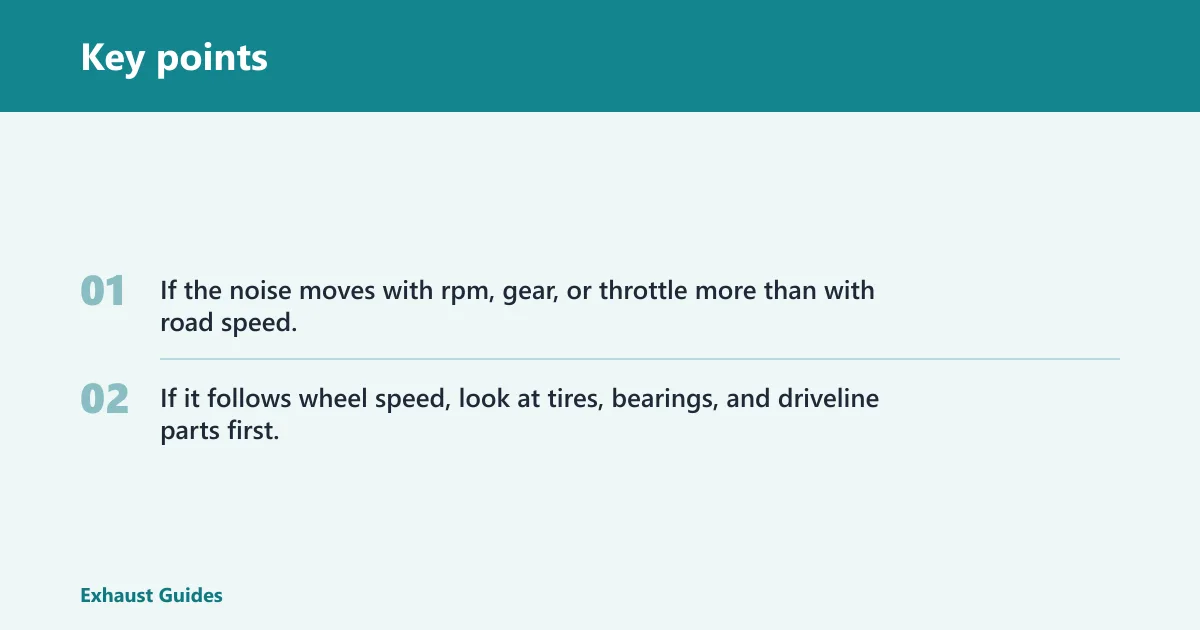
Use the matrix as a filter. If the noise moves with rpm, gear, or throttle more than with road speed, keep working on the exhaust or engine-related path. If it follows wheel speed, look at tires, bearings, and driveline parts first.
How do I diagnose exhaust drone versus tire noise or wheel bearing noise?
Exhaust drone changes most with rpm, gear, and load. Tire noise and wheel bearing noise track road speed much more closely, so they stay similar when you change gears at the same speed.
That difference is the fastest way to separate the complaints. If the sound stays the same at 60 mph in two different gears, tire or bearing noise is more likely. If the tone changes with rpm, keep the exhaust in the frame.
Pattern clues that point away from the exhaust
Tire roar usually gets louder on coarse pavement and often has a broad, rushing character. Wheel bearing noise is often a growl or hum that changes when you load one side of the car in a gentle lane change.
Differential noise can also confuse the diagnosis, especially if it changes with throttle lift or coast. It may rise and fall with driveline load instead of matching the exhaust’s narrow resonance band.
Simple checks for wheel bearing and tire-related noise
- Hold a steady speed and lightly swerve left, then right.
- Listen for a change when one side of the vehicle carries more load.
- Compare the same speed on smooth pavement and coarse asphalt.
- If available, rotate tires front to rear and see whether the sound follows a tire position.
A common first-timer mistake is replacing a muffler because the cabin hum grows on rough pavement. If the noise follows road texture more than rpm, the exhaust is probably not the first part to change.
When a vibration points to driveline or differential noise instead
If the sound comes with a floor vibration that changes under acceleration and deceleration, the source may be farther upstream or downstream than the muffler. Check for differential whine, driveshaft issues, or contact between the exhaust and body before ordering a muffler.
Check for leaks, shields, and hangers
Exhaust leaks, loose heat shields, and worn hangers can change tone and raise cabin noise. They do not all sound the same: a leak often adds a buzzy edge, while a shield or hanger problem can create buzz, tick, or contact noise over a narrow speed range.
Flange, clamp, gasket, and flex-pipe leak points
Look at flanges, slip joints, clamps, gaskets, and flex pipes. Even a small leak can alter exhaust tone and amplify cabin noise under load or at cruise, especially if the leak sits upstream of a resonator or muffler.
Check under the same steady-throttle conditions where the drone appears. A leak may be quiet in the bay at idle but much more obvious when exhaust flow and pressure rise on the highway.
Loose heat shields and contact buzz
Heat shields can buzz when their fasteners loosen or when a shield touches the pipe, body, or undertray. That sound is often metallic and can sit on top of a low boom, making the problem seem worse than it is.
Flexible hangers and isolators
Flexible exhaust hanger and isolator condition matters. Cracked or hardened rubber transmits more vibration, while incorrect preload can make the exhaust sit against a bracket or crossmember and create a steady buzz.
Inspect the hanger angle and the available clearance at idle and during a light throttle blip. If the system sits under tension, it may only contact the body when the engine rocks under load.
Muffler and resonator clues
Mufflers and resonators do different jobs. The muffler controls overall sound attenuation, while the resonator targets specific frequencies that cause drone. A fix aimed at the wrong component can leave the problem unchanged.
Chambered versus straight-through mufflers
Chambered mufflers use internal passages to cancel and redirect sound waves. They often control drone better than a straight-through design, but they can add restriction and change tone more noticeably.
Straight-through mufflers usually flow well and can sound clean at higher rpm, but they may leave a narrow resonance band untouched if the system length and frequency line up with the cabin.
How resonators cancel specific frequencies
Resonators, including tuned or Helmholtz-style designs, cancel a narrow frequency band that causes boom. That is why a resonator is often the right first fix on an aftermarket exhaust that drones at one repeatable speed.
If the noise appears only in a narrow rpm window, a resonator change is often more targeted than a muffler swap. If the whole system is simply too loud, a different muffler may matter more.
When a resonator change fixes drone better than a muffler swap
Choose the resonator path when the exhaust sounds fine elsewhere but drones at one steady cruise condition. Choose the muffler path when the system is generally too loud, or when the current muffler design leaves little attenuation at the offending frequency.
Aftermarket exhaust changes and cabin resonance
Aftermarket exhaust modifications often shift the resonance frequency rather than remove it. Axle-back, cat-back, muffler delete, and straight pipe setups can all change the pipe length, diameter, and sound control enough to move the drone band into a new rpm range.
How axle-back, cat-back, muffler delete, and straight pipe changes shift the drone band
An axle-back change usually alters the rear section and can reduce or increase drone depending on muffler volume. A cat-back changes more of the system length, so it can move the resonance point farther than a rear muffler change alone.
Muffler delete and straight pipe setups remove sound control and often create the strongest low-frequency boom. They may sound aggressive outside the car while being tiring inside the cabin at highway speed.
Pipe diameter and length as resonance variables
Pipe diameter changes gas velocity and the frequencies that survive to the rear of the system. Pipe length matters too, because a small change in total length can move a resonance band into the rpm range used for daily cruising.
That is why two exhausts that look similar can behave very differently on the road. The same vehicle may drone with one muffler and stay quiet with another if the total system geometry no longer matches the cabin’s resonant band.
What changes help on V6, V8, and turbo cars
V6, V8, and turbo cars need different checks because their firing pulses and exhaust layouts place drone in different bands. A V6 may drone in a lower, steady cruise band, while a V8 can produce a deep boom that aligns with the cabin at a different rpm window.
Turbo engines can mute some high-frequency sound but still drone if the pipe length and muffler choice line up with a narrow low-frequency band. The fix still depends on the exact rpm band, not the badge on the valve cover.
Suppose a turbo four drones at 2,100 rpm in seventh gear after a cat-back install. If the same speed in sixth gear moves the engine to 2,500 rpm and the boom fades, a tuned resonator is a more precise fix than removing more muffler material.
How to reduce drone in exhaust on a daily driver
Start with the source. Repair leaks, correct hanger preload, and fix contact points before changing mufflers or adding sound-deadening. If the exhaust is still within acceptable volume, a resonator or chambered muffler is usually the cleaner next step.
Sound-deadening material such as mass-loaded vinyl, closed-cell foam, and butyl mats can reduce what you hear in the cabin, but it does not fix the exhaust source. Use it as a cabin-only measure when the source is difficult to change or when a mild drone remains after repairs.
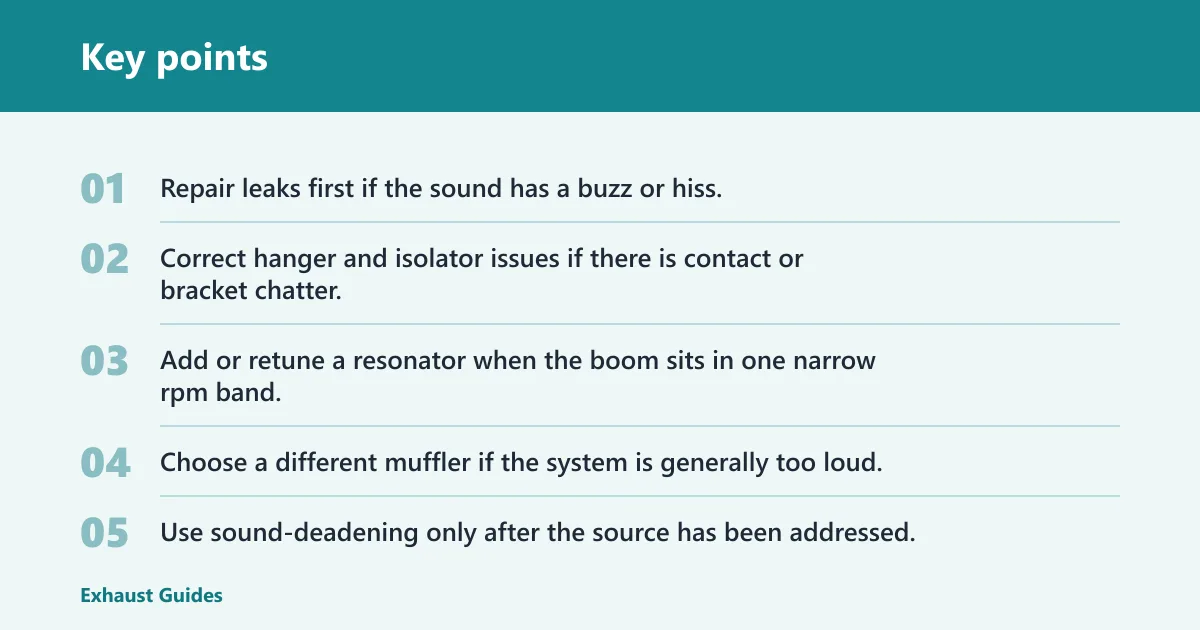
- Repair leaks first if the sound has a buzz or hiss.
- Correct hanger and isolator issues if there is contact or bracket chatter.
- Add or retune a resonator when the boom sits in one narrow rpm band.
- Choose a different muffler if the system is generally too loud.
- Use sound-deadening only after the source has been addressed.
Frequently asked questions
What is exhaust drone and what does it sound like at highway speeds?
Exhaust drone is a low-frequency boom or hum that becomes obvious during steady highway cruising. It often sounds like a pressure wave in the cabin, with a deep resonance that changes little with throttle but shifts when engine rpm moves out of the affected band.
What RPM range causes exhaust drone in my car?
There is no single rpm range for every car. The problem usually appears in a narrow cruise band, often around the rpm used for top-gear highway driving. An OBD-II scan tool helps you record the exact band so you can reproduce it consistently.
How do I test whether my muffler or resonator is causing drone?
Repeat the same highway test at the same speed, then change only the gear or rpm. If a resonator change would help, the drone usually sits in one narrow band. If the whole exhaust is too loud, the muffler is the more likely place to change.
How to eliminate exhaust drone without making the exhaust too quiet
Repair leaks, loose shields, and hanger issues first, then target the drone frequency with a resonator before replacing the muffler. That approach keeps the exhaust character while reducing the one band that booms in the cabin, which is usually better than muffling everything.
Can exhaust drone be caused by leaks, hangers, or heat shields?
Yes. A flange, clamp, gasket, or flex-pipe leak can add buzz and cabin noise. Loose heat shields can rattle or buzz, and worn hangers or bad isolator preload can let the exhaust touch the body and create a steady vibration.
What changes help get rid of exhaust drone on a V6, V8, or turbo car?
The same tools apply, but the target band differs by engine and exhaust layout. Use rpm-based testing to find the exact drone window, then choose a resonator, muffler, or repair that addresses that band rather than swapping parts at random.