Do Mustang Resonators Reduce Exhaust Flow? Critical Secrets
Yes, Mustang resonators do reduce exhaust flow, but the effect is extremely minimal and often unnoticeable in terms of real-world performance. They are designed primarily to cancel out specific, unpleasant sound frequencies (like drone), not to restrict the overall flow of exhaust gases in a significant way.

SR Performance
SR Performance Cut and Clamp Resonator Delete…
- Converts Factory "Resonator" Mid-Pipe To An "X" Pipe
- Improves Exhaust Flow And Sound
- Raspy Race Car Growl
As an Amazon Associate I earn from qualifying purchases.
If you own a Mustang, you have probably thought about your exhaust. It is a big part of the car’s personality. You hear people talk about “resonator deletes” and getting a more aggressive sound. But then the worry starts. Will changing it hurt your car? Does that factory resonator slow things down? It can feel confusing, but don’t worry. You are in the right place.
We are going to clear up all the confusion. I will show you exactly what a resonator does and how it affects your Mustang’s performance. We will look at the facts without any complicated jargon. By the end of this guide, you will understand your exhaust system better and feel confident about making the right choice for your car. Let’s dive in and uncover the secrets behind your Mustang’s sound.
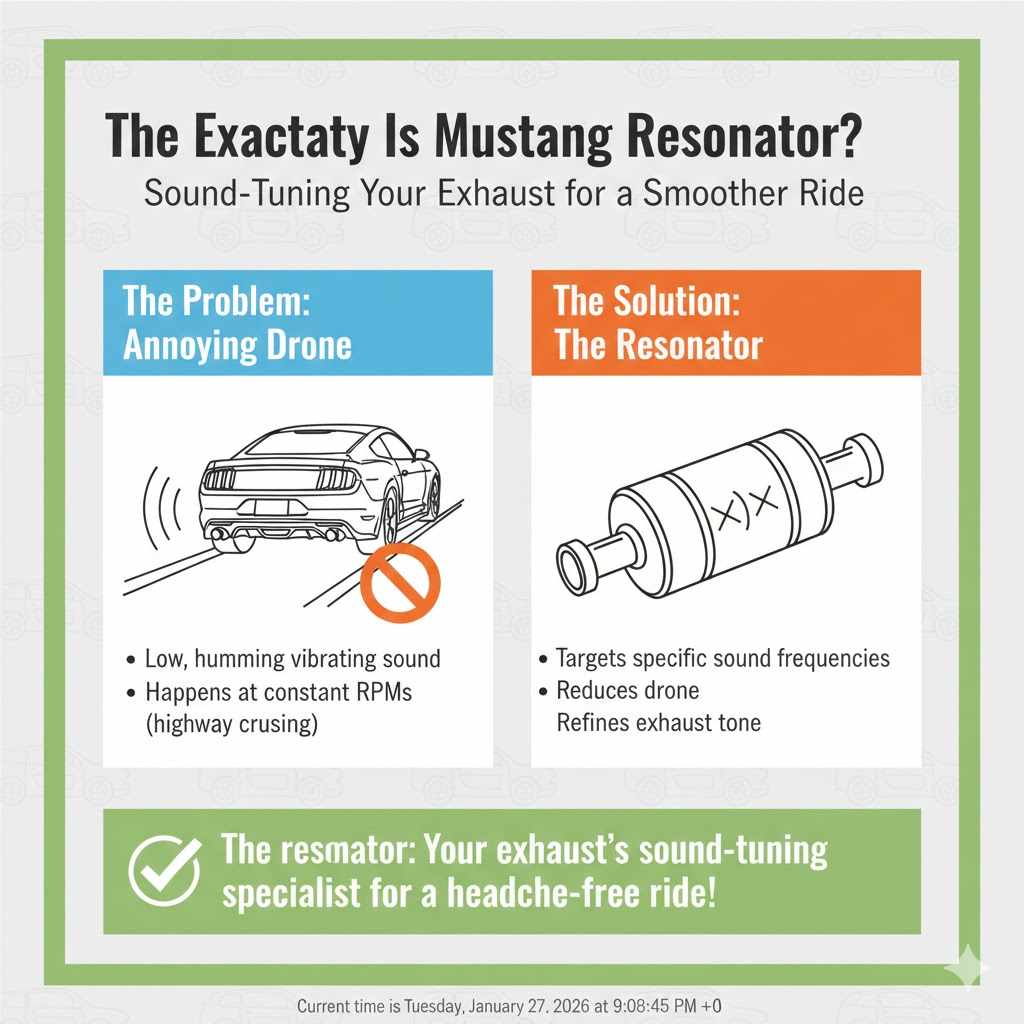
What Exactly Is a Mustang Resonator?
Think of a resonator as a specific type of hearing protection for your car. Its main job has nothing to do with power or flow. Its one and only purpose is to target and cancel out very specific sound frequencies. Carmakers use resonators to eliminate annoying noises that can happen at certain RPMs, most notably “drone.”
Drone is that low, humming, vibrating sound you might hear when cruising at a steady speed on the highway. It can be tiring and give you a headache. The resonator is a small chamber in your exhaust system designed to act like an echo chamber. Sound waves from the engine enter the resonator, bounce around inside, and cancel each other out. The result is a smoother, more pleasant exhaust note without that irritating drone.
Key Functions of a Resonator:
- Targets Specific Frequencies: It’s tuned like a musical instrument to cancel out a narrow range of sounds.
- Reduces Drone: Its primary goal is to eliminate the humming noise during steady cruising.
- Refines Exhaust Tone: It helps shape the final sound, making it cleaner and less harsh.
Unlike a muffler, which quiets the entire exhaust sound, a resonator is a specialist. It’s a sound-tuning tool, not a silencing tool.
The Big Question: Do Resonators Reduce Exhaust Flow?
Now for the main event. The short answer is yes, any object in the path of the exhaust gas will technically reduce flow. But the key word here is minimally. A factory Mustang resonator is designed to have a very small impact on exhaust flow, so small that you would likely never feel it while driving.
Imagine your exhaust system is a wide, open hallway. The exhaust gases are people trying to walk down it quickly. A resonator is like a smooth, slightly wider section of the hallway with soft walls. While it changes the shape of the hallway, it doesn’t create a bottleneck or a door that everyone has to squeeze through. The people (or gases) can still move through it almost as fast as they did before.
Most modern resonators are a “straight-through” design. This means there is a perforated pipe running straight through the center of the resonator’s chamber. The exhaust gas flows mainly through this pipe, while the sound waves escape through the holes into the chamber to be canceled out. Because there are no sharp turns or blockages, the impact on flow is negligible for most stock or lightly modified cars.
How Much Flow Is Really Lost?
On a stock Mustang, removing the resonator might gain you 1 to 3 horsepower at the very peak of the power band. For daily driving, this difference is impossible to notice. The primary change you will experience is sound, not speed.
A Simple Look Inside: How a Resonator Works
Understanding how a resonator is built makes it clear why it doesn’t choke your exhaust. Most factory resonators on cars like the Mustang use a simple but effective design.
- The Outer Shell: This is the can or chamber you see on the outside.
- The Inner Pipe: A pipe runs from one end to the other. This pipe is covered in many small holes, or perforations.
- The Sound-Absorbing Material: The area between the inner pipe and the outer shell is often packed with sound-deadening material, like fiberglass or steel wool.
Here’s what happens:
- Exhaust gas flows mostly straight through the perforated inner pipe. This is why the flow restriction is so low.
- As the gas flows, sound waves travel out through the holes into the main chamber.
- These sound waves bounce around in the chamber and get absorbed by the packing material, canceling out the specific drone frequency the resonator was designed to target.
This is a type of resonator known as an absorptive resonator. Some others work on the principle of a Helmholtz chamber, which is an empty chamber of a specific size that cancels sound waves as they bounce back and reflect, similar to how blowing over the top of a bottle creates a specific tone.
Resonators vs. Other Exhaust Parts: What’s the Difference?
It’s easy to get confused between the different parts of your exhaust system. Each one has a very different job. Here is a simple breakdown to help you tell them apart.
| Exhaust Part | Primary Function | Impact on Sound | Impact on Flow |
|---|---|---|---|
| Resonator | Tunes sound, cancels specific frequencies (drone). | Removes rasp and drone, refines the tone. | Very low / minimal restriction. |
| Muffler | Reduces overall exhaust volume (quiets the car). | Makes the entire exhaust system significantly quieter. | Moderate to high restriction (depending on design). |
| Catalytic Converter | Cleans exhaust gases to reduce pollution. | Slightly muffles the sound. | Moderate restriction (designed to force gas through a filter). |
As you can see, the catalytic converter and the muffler are the main sources of flow restriction in a stock exhaust system. The resonator plays a very small role in comparison.
The “Resonator Delete” Craze: Is It a Good Idea?
One of the most popular and affordable modifications for Mustang owners is the “resonator delete.” This simply means cutting out the factory resonator and welding a straight piece of pipe in its place. People do this for one main reason: sound.
Removing the resonator makes the exhaust louder and adds a more aggressive, raw character to the note. However, it’s not always the perfect solution. Let’s look at the pros and cons.
Pros of a Resonator Delete:
- More Aggressive Sound: This is the number one reason people do it. It unlocks more of the V8 or EcoBoost’s natural growl.
- Low Cost: It’s one of the cheapest exhaust mods you can do. An exhaust shop can typically do it for a small fee.
- Slight Weight Reduction: Resonators have some weight, so removing them sheds a few pounds, though not enough to make a difference in performance.
Cons of a Resonator Delete:
- Potential for Drone: Remember that annoying hum the resonator was designed to remove? It might come back, especially at highway speeds.
- Added Rasp: Sometimes, removing the resonator can introduce a raspy or tinny sound, which some people don’t like.
- It Can Be Too Loud: What sounds cool in a video might be too loud for your daily commute or your neighbors.
A resonator delete is a great starting point if you want more sound on a budget. But if you are sensitive to drone or want a more refined, high-quality tone, a full aftermarket exhaust system might be a better choice.
Resonator Delete vs. Aftermarket Exhaust System
So, should you just remove the resonator, or save up for a full cat-back or axle-back exhaust system? It depends on your budget, your goals, and how much you care about the quality of the sound.
| Factor | Resonator Delete | Aftermarket Exhaust System |
|---|---|---|
| Cost | Low ($100 – $250) | High ($500 – $2,500+) |
| Sound Quality | Louder, but can be droney or raspy. Simply an “unfiltered” version of the stock sound. | Engineered for a specific tone (deep, aggressive, refined). Often designed to be loud without drone. |
| Performance Gain | Negligible (maybe 1-3 HP). | Small to moderate (typically 5-15 HP), as they often use higher-flow mufflers and wider pipes. |
| Installation | Requires cutting and welding. Best done by a professional shop. | Usually a bolt-on installation that can be done at home with basic tools. |
| Reversibility | Difficult. You would need to weld the old resonator back on. | Easy. You can keep your stock system and bolt it back on anytime. |
If you’re just dipping your toes into modifications and want more sound for less money, a resonator delete is a fine option. If you are serious about performance and want a perfectly tuned sound without any compromises, saving up for a quality aftermarket system is the way to go.
How to Check if Your Resonator Is Bad
While resonators are simple, they can fail over time, especially due to rust or road debris. A failing resonator can actually cause a flow restriction or an exhaust leak. Here’s what to look and listen for:
- Rattling Noises: If the internal components or packing material come loose, you might hear a rattling or buzzing sound from under your car, especially at certain RPMs.
- Louder or Different Exhaust Sound: If the resonator’s shell rusts through, it will create an exhaust leak, making your car sound much louder and harsher than usual.
- Visible Damage: A quick look underneath can reveal large rust holes, cracks, or dents that could be affecting its performance.
Step-by-Step Guide: How to Safely Inspect Your Resonator
You don’t need to be a mechanic to give your resonator a quick health check. Just follow these simple, safe steps.
- Safety First: Make sure your car is parked on a flat, level surface and that the engine is completely cool. Never work under a car supported only by a jack. Use proper jack stands. Wear safety glasses to protect your eyes.
- Lift the Vehicle: Use a jack to lift the side of the car and securely place jack stands under the manufacturer’s recommended lift points.
- Locate the Resonator: Slide under your car and look at the exhaust system. The resonator is typically located in the middle of the car, between the catalytic converters and the mufflers at the back. It usually looks like a small, round or oval can.
- Perform a Visual Check: Look closely at the resonator’s body. Do you see any major rust spots, holes, or cracks? Check the welds where the pipes connect to the resonator. Are they intact?
- Check for Looseness: Carefully (as it might still be warm) grab the resonator and gently try to shake it. It should be solid. If it feels loose or you hear rattling, something inside may have broken.
- Listen for Leaks: If you suspect a leak, you can have a friend start the car while you are safely out from under it. Listen for any hissing or ticking sounds from the resonator area, which could indicate a leak. Be extremely careful around a running car.
If you find any issues, it’s best to take your car to a trusted exhaust shop. They can tell you if it needs to be repaired or replaced.

FAQs: Your Mustang Resonator Questions Answered
1. What’s the difference between a resonator and a muffler?
A muffler is designed to quiet the entire exhaust sound by a large amount. A resonator is designed to cancel out a very specific, narrow range of sound frequencies, primarily drone. Think of the muffler as the volume knob and the resonator as the equalizer.
2. Will removing my resonator void my Mustang’s warranty?
It can. Under the Magnuson-Moss Warranty Act, a dealer must prove that your modification directly caused a failure. However, modifying the exhaust could give them a reason to deny a warranty claim on any part of the exhaust system or potentially even the engine if they can argue a connection. It’s best to check with your dealer.
3. Is a resonator delete legal?
This depends on your state and local laws. Some areas have strict laws about modifying a factory exhaust system or exceeding certain noise levels. While resonator deletes are less likely to cause legal issues than removing a catalytic converter, it’s always a good idea to check your local regulations. The EPA has clear rules about tampering with emissions equipment, which primarily applies to catalytic converters.
4. How much does a resonator delete typically cost?
A resonator delete is usually an affordable modification. You can expect to pay an exhaust shop anywhere from $100 to $250 for the labor and the small piece of pipe needed to replace the resonator.
5. What is exhaust drone and will a resonator delete cause it?
Exhaust drone is a low-frequency, monotonous humming or vibrating noise that occurs at a constant cruising speed (usually between 1,800 and 3,000 RPM). Since the resonator’s main job is to eliminate this noise, removing it will very likely re-introduce drone to your exhaust system.
6. Can I just replace my resonator with an H-pipe or X-pipe?
Yes! On many V8 Mustangs, the factory resonator is actually an “H-pipe” built into a resonator housing. Replacing it with an aftermarket H-pipe or X-pipe is a very common and effective upgrade. An X-pipe typically creates a higher-pitched, raspier sound, while an H-pipe provides a deeper, classic muscle car rumble.
7. Will a resonator delete make my car fail an emissions test?
No. A resonator has no impact on emissions. It only affects sound. As long as your catalytic converters are in place and functioning correctly, you will pass an emissions test without a resonator.
Conclusion: To Delete or Not to Delete?
So, do Mustang resonators reduce exhaust flow? Yes, but by an insignificant amount. They are not a performance bottleneck on your car. Their job is to refine sound and eliminate the annoying drone that can ruin a long drive. The decision to remove yours should be based entirely on the sound you want, not on a search for more power.
A resonator delete is a fantastic, budget-friendly way to make your Mustang sound more like it should. It’s a simple change that can make your daily drive more exciting. However, be prepared for the trade-offs, like the potential for drone. If you demand the perfect tone without compromise, a well-engineered aftermarket exhaust system is your best bet.
Ultimately, you now have the knowledge to make an informed decision. You understand what the resonator does, how it works, and what happens when you remove it. Trust your ears, consider your budget and tolerance for noise, and you’ll find the perfect exhaust setup to make you smile every time you turn the key.
Related pick: Check today's price on Amazon