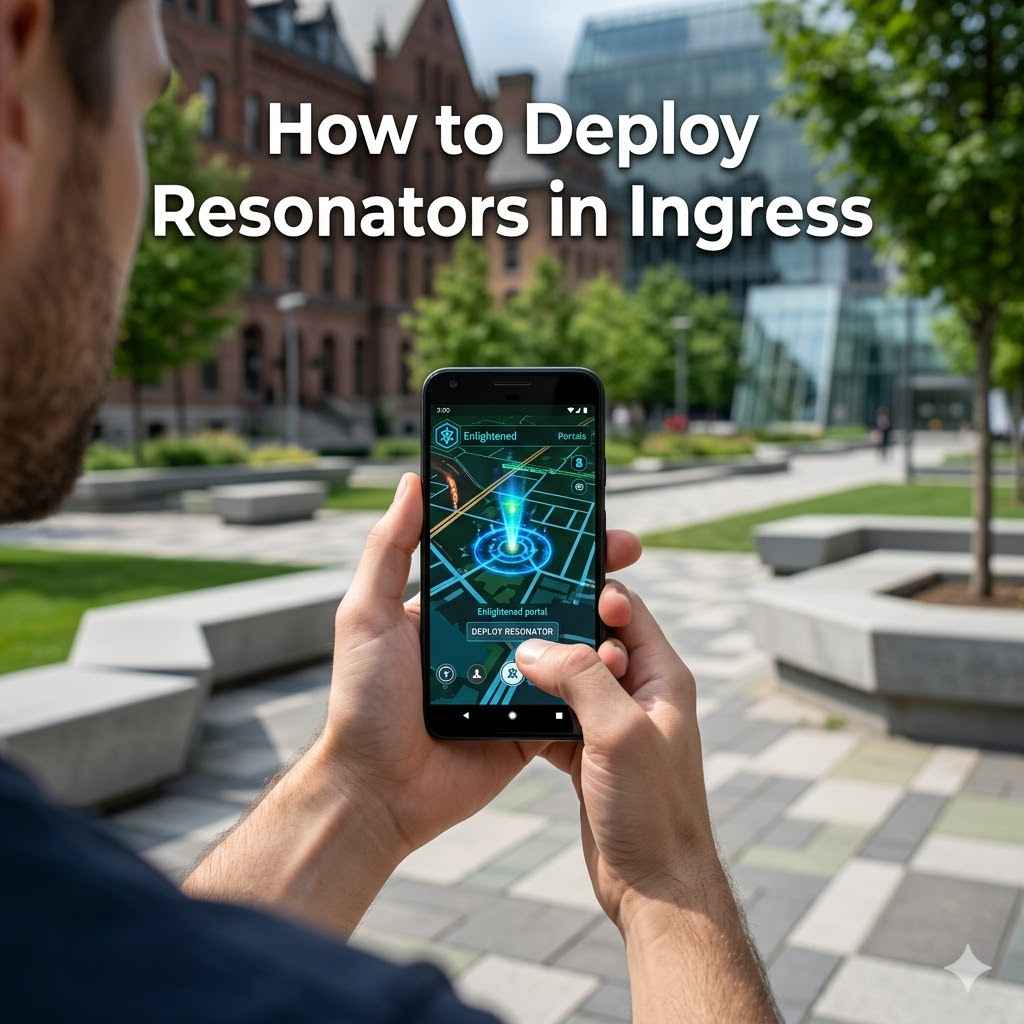
How to Deploy Resonators in Ingress
So, you’re new to Ingress and want to know How to Deploy Resonators in Ingress Game? It sounds tricky at first, but it’s really quite simple once you know the steps. Many players find it a bit confusing when they start.
Don’t worry, this guide will walk you through it step-by-step so you can start claiming territory and linking portals in no time. We’ll make it easy to grasp.
Understanding Ingress Resonators
Resonators are the building blocks of control in Ingress. They are essentially energy devices that players place on Ingress portals to claim them for their faction, either the Enlightened (green) or the Resistance (blue). The more resonators you place on a portal, the stronger your faction’s control over that portal becomes.
Higher level resonators also extend the portal’s reach, making it easier to create larger control fields.
When a portal is captured, it starts with a low level of energy. Placing your own resonators fills this portal with your faction’s energy. You can also hack portals to acquire items, which include resonators and other useful tools for gameplay.
The game encourages players to work together, so coordinating with teammates to capture and fortify portals is a common strategy. Understanding how to deploy these is the first step to becoming an active player.
This section will cover the basics of what resonators are, why they are important, and the fundamental rules governing their deployment. We will explain the different types of resonators you might encounter and how their levels impact gameplay. This foundational knowledge is key to your success on the Ingress battlefield.
What Are Resonators in Ingress
Resonators are the primary items used to capture and hold Ingress portals for your faction. Think of them as flags planted on territory. Each portal can hold up to eight resonators, and these are placed in specific slots around the portal.
When you place a resonator, you are essentially infusing the portal with your faction’s energy. The level of the resonator you deploy (from Level 1 to Level 8) determines its strength and how much energy it contributes to the portal.
Higher level resonators not only contribute more energy but also have a longer “reach.” This reach is important because it determines how far out from the portal you can draw your faction’s influence. When a portal has eight resonators of the same faction and high enough levels, it becomes a highly valuable asset, capable of being linked to other friendly portals to create large Ingress Control Fields. These fields are the ultimate goal, as they score points for your faction based on the enclosed area.
Understanding resonator levels is crucial. A portal filled with Level 1 resonators is much weaker and easier for the opposing faction to capture than a portal filled with Level 8 resonators. Players often work together to upgrade portals by replacing lower-level resonators with higher-level ones, a process called “upgrading.” This collaborative effort is a core part of Ingress gameplay.
Why Deploying Resonators Matters
Deploying resonators is fundamental to playing Ingress. Without them, you cannot capture or hold any portals. Captured portals serve as the basis for creating Control Fields, which are how your faction earns points and dominance over the map.
Control Fields are like borders drawn on the game map, signifying your faction’s territory.
The more portals your faction controls, and the larger the Control Fields you create, the higher your faction’s score will be in the ongoing game. This is vital for winning the “Anomalies” and “Missions” that shape the Ingress narrative. Deploying resonators allows you to directly contribute to this effort.
It’s your primary way to expand your faction’s influence and deny the enemy access to key locations.
Furthermore, placing resonators on portals allows you to generate “XM” (Exotic Matter), the primary in-game resource. You can recharge your deployed resonators to gain XM, which you then use to perform other actions like attacking enemy portals or deploying more items. Therefore, a well-deployed network of resonators not only secures territory but also ensures you have a steady supply of XM to keep playing.
It’s a cycle of action and resource management.
Resonator Levels and Their Impact
The level of a resonator in Ingress is its most critical attribute. Resonators come in levels 1 through 8. When you deploy a resonator, you choose which level to deploy, provided you have that resonator in your inventory.
The level dictates its strength, its XM capacity, and its range. Higher level resonators are more powerful and contribute more to the portal’s overall strength and reach.
A Level 1 resonator has a lowXM capacity and a short range. A Level 8 resonator, on the other hand, has a very high XM capacity and a much longer range. When a portal has eight resonators of the same faction, the portal’s level is determined by the average level of its resonators.
For example, a portal with eight Level 7 resonators would be considered a Level 7 portal.
The level of a portal directly affects its defensive strength and its potential for creating Control Fields. Higher level portals are harder for opponents to capture, requiring more powerful XMP Bursters or more dedicated attacks. They also contribute more AP (Action Points) when captured and generate more XM when recharged.
Players often strive to place the highest level resonators they can on their portals to maximize their faction’s advantage.
How to Deploy Resonators in Ingress Game
Now let’s get into the practical steps of deploying resonators. This is the core of claiming territory. The game interface is designed to be intuitive once you know where to look and what actions to take.
We will break down the process into simple, actionable steps so that even someone completely new to the game can follow along easily. This guide focuses on the most common and straightforward method of resonator deployment.
The main objective here is to get those resonators onto a portal you want to control. You’ll need to be physically near the portal in the real world, and the game uses your device’s GPS to track your location. Once you’re within range, the portal will become interactive, allowing you to perform various actions, including deploying your resonators.
Follow these steps carefully.
This section will detail the exact sequence of taps and selections you need to make within the Ingress app. We will also discuss some common situations and potential issues you might encounter, offering solutions to ensure a smooth deployment experience every time. This is where you learn the “how-to”.
Finding and Interacting with Portals
The first step to deploying resonators is finding a portal. Portals are marked on your Ingress scanner map as distinct icons. They are often located at points of interest in the real world, such as statues, historical markers, unique architecture, or public art.
You’ll need to physically travel to these locations to interact with them.
Once you are close enough to a portal (usually within about 40-50 meters), its icon on your scanner will become highlighted, indicating you are in range. Tapping on a portal icon will bring up its details screen. This screen shows the portal’s name, faction controlling it (if any), the current resonators deployed, and the portal’s level.
If the portal is neutral (no resonators deployed), it will be grayed out and available for capture.
To capture a neutral portal, you’ll need to deploy at least one resonator. If the portal is controlled by the enemy faction, you’ll first need to attack and neutralize it before you can deploy your own resonators. This involves using your XMP Bursters or other offensive items.
For the purpose of this guide, we assume you are either near a neutral portal or have just neutralized an enemy portal and are ready to claim it.
Initiating Resonator Deployment
After tapping on a portal icon and viewing its details screen, you’ll see several buttons or options available. To deploy a resonator, you need to find the “Deploy” button. This button is usually prominent on the portal details screen, often located at the bottom or side.
Tapping the “Deploy” button will open a new screen or menu where you can select which item you wish to deploy. Since you want to deploy a resonator, you will see a list of your available resonators. These will be categorized by level, for example, “Resonator L1,” “Resonator L2,” and so on.
If the portal is neutral, you’ll be able to deploy any level of resonator you possess. If you are attempting to upgrade a portal owned by your faction, you will see options to deploy higher-level resonators than what is currently on the portal, provided you have them. For now, we are focused on capturing a neutral or recently neutralized portal.
Selecting and Placing Your Resonator
On the resonator selection screen, tap on the level of resonator you wish to deploy. For beginners, it’s common to start with Level 1 resonators to capture a neutral portal. Once you select a resonator level, you’ll see a confirmation prompt or the option to directly place it.
Tapping “Deploy” or confirming the deployment will then take you to the placement screen.
This placement screen shows the portal at the center and eight empty slots arranged around it. Each slot is designated for a resonator. You need to tap on one of these empty slots to place your chosen resonator.
The game often suggests placing resonators in specific positions to optimize portal strength and reach, but for a first capture, any empty slot will do.
After tapping on an empty slot, you’ll see a final confirmation before the resonator is placed. Once confirmed, the resonator will appear on the portal map, occupying that slot and visually showing your faction’s color. You have now successfully deployed your first resonator and contributed to claiming that portal for your team.
Completing the Portal Capture
To fully capture a neutral portal, you need to deploy at least one resonator. However, to make the portal stronger and more useful, you will want to deploy more resonators until all eight slots are filled. Each resonator you deploy increases the portal’s level and its defensive capabilities.
If you are capturing a portal for the first time, you will want to deploy as many resonators as you have available, ideally up to eight. This process involves repeating the steps of selecting a resonator level, choosing a slot, and confirming the deployment for each resonator you place. The higher the level of resonators you deploy, the more AP you will earn.
Once all eight slots on the portal are filled with resonators of your faction, the portal is considered fully captured and fortified. This portal can then be used to create links to other friendly portals, forming Control Fields. Successfully deploying resonators until a portal is full is a key skill for any Ingress player, allowing you to actively participate in factional control and strategic map play.
Keep deploying to expand your reach!
Advanced Resonator Deployment Strategies
Once you’ve mastered the basics of deploying resonators, you’ll want to explore more strategic ways to use them. Effective deployment goes beyond just filling all the slots. It involves thinking about portal levels, resonator decay, and how your placements contribute to larger faction goals.
This section delves into how experienced players think about resonator placement to maximize their impact.
Consider the map as a chessboard; each portal is a piece, and resonators are how you move and control that piece. Smart deployment can create strong defensive positions, build large Control Fields, and support your teammates. We will discuss how to upgrade portals efficiently, the concept of resonator decay, and how to use resonator deployment for tactical advantage.
This is about playing smarter, not just harder.
Understanding these strategies will elevate your gameplay from simply placing items to actively shaping the game world for your faction. You’ll learn to use your resonators as tools of strategic control, not just basic building blocks. Let’s explore how to make your resonator deployments count.
Upgrading Portals with Higher Level Resonators
Upgrading a portal means replacing existing, lower-level resonators with higher-level ones. This is crucial for strengthening your faction’s control and increasing the portal’s range. When a portal is owned by your faction, and you are within range, you can tap on the portal and select “Deploy.” Unlike capturing a neutral portal, when upgrading, the system will show you available slots and the option to deploy a resonator of a higher level than what is currently present in that slot.
The process is similar to initial deployment: select the resonator level you want to deploy, tap on the slot you wish to upgrade, and confirm. You will gain AP for deploying higher-level resonators. The key is having access to these higher-level resonators, which are typically acquired through hacking higher-level enemy portals or receiving them from teammates.
A common strategy is for players to coordinate to bring a portal to Level 8. This often involves multiple players contributing their highest-level resonators. For example, if a portal has Level 6 resonators, players might bring Level 7 and Level 8 resonators to replace them.
A portal at Level 8 is very difficult for the opposing faction to capture and has the maximum possible range, making it ideal for connecting to other Level 8 portals to create vast Control Fields.
Understanding Resonator Decay and Recharging
Resonators in Ingress don’t last forever. They have a lifespan, and after a certain period, they will begin to “decay.” This means they lose energy and eventually become inactive and disappear if not maintained. This decay mechanic is designed to encourage active play and prevent portals from being permanently locked down without effort.
Your deployed resonators will show a remaining lifespan. When this lifespan gets low, you need to “recharge” them. To recharge, you tap on the portal, then tap on the specific resonator you want to recharge.
You’ll see a “Recharge” button. Tapping this will allow you to use XM from your inventory to replenish the resonator’s energy and reset its decay timer. Recharging also grants you XM.
The decay rate and recharging mechanics are important. Resonators decay faster when the portal is under attack or when it’s part of a large, active Control Field. Regularly recharging your resonators is essential to maintain control over portals.
Players often set reminders or use Ingress community tools to keep track of their resonators’ decay timers, ensuring their territory remains secure. It’s an ongoing responsibility of being an Ingress agent.
Strategic Portal Placement and Linking
The true power of Ingress lies not just in deploying resonators but in how you connect portals to form Control Fields. The goal is to create triangles (or larger polygons) of your faction’s color. To do this, you need to establish links between friendly portals.
A link can only be created between two portals if there are no enemy “neutralized” portals or enemy links blocking the path between them.
The range of a link is determined by the levels of the resonators on the two connecting portals. Higher level portals can create longer links. Therefore, deploying high-level resonators on key portals is vital for creating large and valuable Control Fields.
Strategic placement means choosing portal locations that are geographically advantageous for forming these links and fields, often spanning across significant real-world areas.
Experienced players scout locations to find portal clusters that can be linked efficiently. They aim to build “anchors” – strong, often Level 8 portals – at the corners of their desired fields. By carefully planning the deployment of resonators and the creation of links, factions can dominate large territories, score significant points, and achieve strategic objectives in the game.
This aspect turns resonator deployment into a tactical game of territory control.
Using Resonators for Defensive and Offensive Play
Resonators are not just for offense; they are also crucial for defense. When you deploy resonators on a portal, you make it harder for the enemy to capture. The higher the level of your resonators, the more XM damage it takes to destroy them.
Defending a portal means ensuring it stays under your faction’s control, often by keeping its resonators recharged and upgraded.
Conversely, when attacking an enemy portal, you must first destroy their resonators. This involves using your offensive items, like XMP Bursters, to deplete the enemy resonators’ energy. Once a resonator’s energy is depleted, it is destroyed.
After all resonators are destroyed, the portal becomes neutral, and you can then deploy your own resonators to capture it for your faction.
The strategy here involves understanding the enemy’s setup. Are they deploying high-level resonators? Are their portals well-charged?
By assessing the defense, you can determine the best attack strategy. Similarly, when defending, you can anticipate enemy attacks and focus your efforts on recharging and upgrading your most critical portals. This constant push and pull makes Ingress a dynamic game of strategic control, with resonators at its heart.
Tools and Tips for Effective Resonator Deployment
Mastering how to deploy resonators in Ingress involves more than just knowing the in-game steps. There are external tools, community resources, and personal habits that can significantly enhance your efficiency and effectiveness. This section will provide practical advice and introduce resources that can help you become a more proficient Ingress agent when it comes to resonator management.
Think of these as your tactical gear. Just like a soldier needs good equipment, an Ingress agent needs good information and tools. We will cover helpful third-party apps that can assist in planning, discuss community collaboration, and offer personal tips for optimizing your resonator deployment and management on a daily basis.
This is about maximizing your impact.
By implementing these tips and leveraging available resources, you can ensure your resonator deployments are not only successful but also strategically sound, contributing more effectively to your faction’s overall goals and helping you achieve your personal Ingress objectives. Let’s improve your game.
Useful Third-Party Ingress Tools
While the official Ingress scanner is your primary tool, several third-party applications and websites can greatly assist with resonator deployment and overall strategy. These tools are not part of the official game but are used by players to gain insights and plan operations.
For example, some tools can show you heatmaps of portal density, highlight optimal locations for linking, or help you track the decay timers of your deployed resonators across the map. Others might allow you to plan large-scale linking operations or identify areas where your faction needs more presence. One popular type of tool helps visualize potential Control Fields based on existing portals.
Using these tools requires careful adherence to Ingress Terms of Service, as any form of botting or spoofing is strictly prohibited and can lead to account bans. However, planning and analysis tools that simply display publicly available game data are generally accepted within the community. Always check the latest community guidelines before using any third-party tool.
Community Collaboration and Communication
Ingress is fundamentally a team-based game. Effective resonator deployment, especially for creating large Control Fields or defending key areas, relies heavily on collaboration with your faction members. Communication channels are vital for coordinating efforts.
Most factions have dedicated communication platforms, such as Telegram groups or Discord servers. Here, agents can share intel, request assistance, organize meetups for portal upgrades, and plan large-scale operations. For example, one agent might report an enemy portal that needs to be neutralized, while others coordinate to deploy high-level resonators once it’s captured.
Sharing resonator caches (items) is also a common practice. If you have an abundance of Level 8 resonators and a teammate needs them to upgrade a critical portal, you can meet up and drop them for them. This mutual support is what makes coordinated resonator deployment so powerful and successful.
Effective teamwork amplifies individual efforts.
Personal Habits for Resonator Management
Beyond tools and community, personal habits play a big role in effective resonator deployment and management. Staying organized and proactive is key to success in Ingress.
- Regularly check your deployed resonators: Make it a habit to glance at your Ingress scanner map at least once a day to see the status of your deployed resonators. Note which ones are getting low on energy and need recharging.
- Plan your routes: When you’re out and about, mentally or physically plan your routes to pass by portals. This allows you to deploy new resonators or recharge existing ones opportunistically.
- Manage your inventory: Keep an eye on the types and levels of resonators you have. Try to maintain a balanced inventory of different levels, and always aim to collect higher-level resonators when possible.
- Set goals: Whether it’s to capture a specific portal, create a new Control Field, or upgrade a cluster of portals to Level 8, having clear goals will guide your resonator deployment efforts.
These habits might seem small, but they add up. Consistent attention to your deployed resonators and strategic planning will ensure you are always contributing effectively to your faction’s efforts, making your resonator deployment both efficient and impactful.
Understanding Portal Decay Timers
Portal decay timers are a critical aspect of resonator management. Each resonator has a lifespan that starts from the moment it is deployed or last recharged. After 7 days, a resonator will decay to 50% of its maximum energy.
After 14 days, it will decay to 25%. If not recharged within 14 days, it will eventually disappear entirely.
The decay rate can be influenced by various factors, including whether the portal is under attack or part of a large Control Field. However, the 7-day and 14-day marks are consistent milestones for significant energy loss. It is therefore crucial to recharge your resonators before they reach these critical decay points to maintain their strength and prevent them from disappearing.
Players often use community tools or in-game alerts (though the in-game alerts are limited) to remind themselves when their resonators are approaching these decay thresholds. Proactively recharging your resonators ensures your portals remain strong and your faction’s control is maintained without any unexpected loss of territory due to inactive resonators. This constant maintenance is a key part of the game.
Frequently Asked Questions
Question: How do I capture a neutral portal in Ingress?
Answer: To capture a neutral portal, you need to be within range of the portal, tap on its icon, select “Deploy,” choose a resonator from your inventory, tap on an empty slot on the portal’s deployment screen, and confirm the placement. You need at least one resonator to claim it.
Question: What is the maximum number of resonators a portal can have?
Answer: A portal can have a maximum of eight resonators deployed on it.
Question: Can I deploy resonators on enemy-controlled portals?
Answer: No, you cannot deploy resonators on a portal controlled by the opposing faction. You must first neutralize the portal by destroying its existing resonators before you can capture it with your own.
Question: How long do resonators last before they decay?
Answer: Resonators begin to decay after 7 days and will disappear completely if not recharged within 14 days. They lose energy at these intervals.
Question: What happens if I deploy a resonator on a portal owned by my faction?
Answer: If you deploy a resonator on a portal owned by your faction and the resonator is of a higher level than what’s currently in that slot, you are upgrading the portal. This increases its overall level and strength.
Wrap Up
Deploying resonators is fundamental to Ingress. You learned how to find portals, tap to interact, select your resonators, and place them in available slots. Mastering this process allows you to capture territory and build for your faction.
Remember to recharge them and aim to upgrade to higher levels for stronger control. Keep playing, and you’ll become a master strategist in no time.