Do Resonators Affect Cam Chop? A Genius, Essential Guide
Yes, resonators do affect cam chop, but not by removing it. Instead, a resonator refines the exhaust note by canceling out harsh, high-pitched frequencies (drone). This process can make the deep, rhythmic sound of the cam chop sound cleaner, more defined, and more noticeable. It doesn’t kill the chop; it cleans up the noise around it.
Have you ever heard a car with that incredible, lumpy idle? That aggressive, rhythmic “thump-thump-thump” sound is called cam chop, and it’s music to any car enthusiast’s ears. But when you start modifying your exhaust, you might worry about losing that perfect sound. A common question I get is whether adding a resonator will ruin the chop. You’re in the right place for an answer!
Don’t worry, this isn’t as complicated as it sounds. We are going to break down exactly what cam chop is, what a resonator does, and how they work together. I’ll guide you through everything you need to know to make your car sound amazing without any annoying side effects. Let’s dive in and tune your car’s voice perfectly.
First, What Exactly is Cam Chop?
Before we can talk about how an exhaust part affects a sound, let’s understand the sound itself. Cam chop” is the term for that aggressive, rhythmic idle you hear from a performance engine. It’s not just noise; it’s a direct result of how the engine is built to make power.
Think of your engine’s camshaft as its brain for breathing. It opens and closes the valves that let air and fuel in, and exhaust out. In a standard car, the timing is smooth and efficient for everyday driving.
However, in a high-performance engine, you use an “aggressive” or “lumpy” camshaft. This type of cam is designed to keep the intake and exhaust valves open for longer, and sometimes they are both open at the same time for a split second. This is called valve overlap.
- Why does it happen? At high RPMs, this overlap helps to shove more air and fuel into the engine, making a lot more power.
- What’s the effect at idle? At low RPMs, like when you’re stopped at a light, this overlap gets a little messy. A tiny bit of the fresh air/fuel mix escapes into the exhaust. This creates an uneven, powerful pulse in the exhaust flow.
That pulse is what you hear as cam chop. It’s the signature sound of a powerful, modified engine that’s ready to go. It’s not a fake sound—it’s the sound of raw potential.

Understanding the Role of a Resonator
Now, let’s look at the exhaust system. Many people confuse resonators and mufflers, but they do two very different jobs. A muffler’s main job is to reduce the overall volume of your exhaust. A resonator, on the other hand, is a sound-tuning device.
Imagine you’re listening to a song, but there’s a really annoying, high-pitched buzzing sound in the background. A resonator is like an audio engineer that specifically removes that one annoying buzz, letting you hear the music more clearly.
Inside your exhaust, the resonator is basically a steel tube with sound-absorbing materials. It’s designed to target and cancel out a very specific range of sound frequencies. The most common frequency it targets is what we call “drone” or “rasp.”
What is Exhaust Drone?
Exhaust drone is that irritating, low-humming vibration you hear when you’re cruising at a steady speed on the highway, usually between 2,000 and 3,000 RPM. It can be so annoying that it gives you a headache and makes conversations in the car impossible. This is the exact problem a resonator is built to solve.
By eliminating these unwanted frequencies, the resonator “cleans up” the overall exhaust sound, leaving behind the more desirable tones—like the deep rumble and, you guessed it, the cam chop.
The Main Event: How Resonators and Cam Chop Interact
So, we’ve established that cam chop is a deep, rhythmic pulse and a resonator is a tool for removing annoying, high-pitched drone. How do they work together?
A resonator does not eliminate cam chop. In fact, it often makes it sound better.
Here’s why: Cam chop is a low-frequency sound. Exhaust drone is typically a mid-to-high-frequency sound. Since a resonator is designed to cancel out those higher frequencies, it leaves the low-frequency chop untouched. Think of it like this:
- Your engine with a performance cam produces a wide range of sounds: the deep thump of the chop, the mid-range roar, and some raspy, high-pitched notes.
- Without a resonator, all these sounds mix together. The rasp and drone can sometimes overpower the clean sound of the chop, making the exhaust sound messy or “tinny.
- When you add a resonator, it filters out that raspy drone.
- What’s left? The pure, deep, and powerful sound of your cam chop, now much clearer and more defined because the annoying static has been removed.
By removing the sonic clutter, the resonator effectively “unmasks” the cam chop, allowing its rhythm and depth to be the star of the show.
Resonators vs. Mufflers: A Clear Comparison
To really understand this, it helps to see how resonators and mufflers differ. Both are key parts of your exhaust system, but they have different goals. Using the wrong one can completely change your car’s sound, for better or worse.
Here’s a table breaking down their differences:
| Feature | Resonator | Muffler |
|---|---|---|
| Primary Job | To tune the sound and eliminate specific, unwanted frequencies (like drone and rasp). | To reduce the overall volume (loudness) of the exhaust. |
| Effect on Volume | Slightly reduces overall volume, but its main effect is on tone. | Significantly reduces overall volume. This is its main purpose. |
| Effect on Tone | Removes high-pitched, harsh noises, making the sound deeper and cleaner. | Muffles all frequencies, which can sometimes dull the character of the sound. |
| Impact on Cam Chop | Preserves and often enhances the clarity of the low-frequency chop by removing drone. | Can soften or quiet the cam chop along with all the other sounds. A high-flow muffler will have less impact. |
As you can see, if your goal is to have a loud and clear cam chop without the annoying highway drone, a resonator is your best friend. A muffler controls how loud the party is, while a resonator is the bouncer that kicks out the annoying guests.
Choosing the Right Resonator for Your Cammed Engine
Not all resonators are created equal. The type you choose can have a big impact on the final sound. When you have a cammed engine, you want to pick a resonator that is good at killing drone without affecting that beautiful chop.
Key Factors to Consider:
- Type of Resonator: The most common type is a “straight-through” or “perforated-core” resonator. These look like a simple glasspack and allow exhaust to flow freely while the perforations and packing material absorb unwanted sound waves. They are excellent for performance and preserving low-frequency sounds.
- Size Matters: The length and diameter of the resonator affect which frequencies it targets.
- Longer/Larger Body: A longer resonator generally targets a broader range of frequencies, including some lower ones. It will do a better job of quieting things down but might slightly soften the chop.
- Shorter/Smaller Body: A smaller, “bottle-style” resonator is usually better at targeting only the highest-pitched rasp and drone, leaving the deep cam chop virtually untouched. For most people wanting to preserve chop, this is the way to go.
- Build Quality: Look for resonators made from high-quality stainless steel (like T304). They will last much longer and resist rust, which is crucial for an under-car part. Reputable brands like MagnaFlow, Borla, or Vibrant Performance are known for their quality.
For a cammed V8, a popular choice is a small-to-medium-sized straight-through resonator. It will kill the highway drone that can make long drives unbearable while making your cam chop sound even cleaner and more aggressive at idle.
What About a “Resonator Delete”?
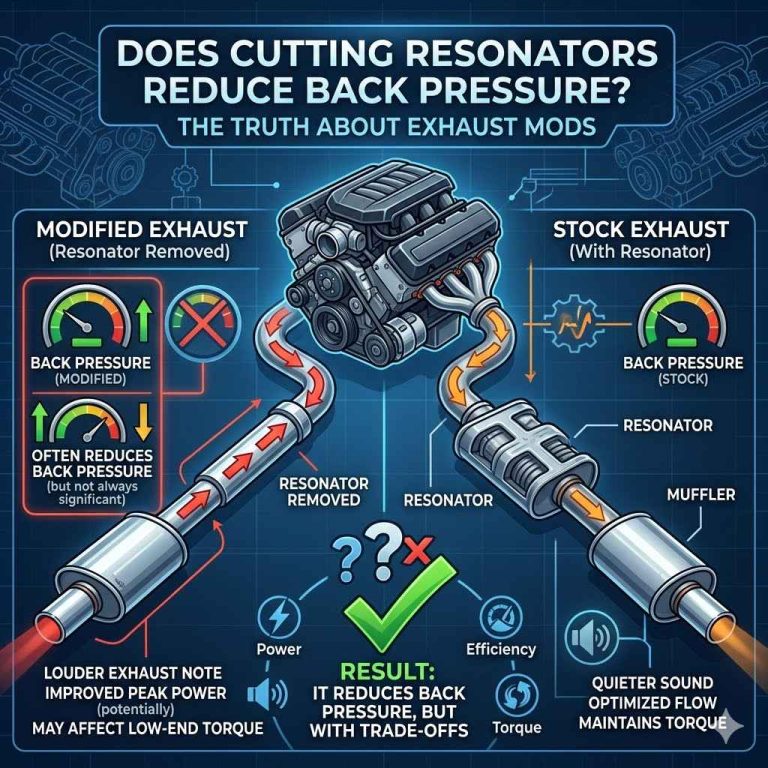
You may have heard about people doing a “resonator delete,” which is simply cutting the resonator out and replacing it with a straight piece of pipe. This is a popular and inexpensive modification, but is it a good idea for a car with cam chop?
Let’s look at the pros and cons.
Resonator Delete: Pros vs. Cons
| Pros | Cons |
|---|---|
| Increased Volume: Your exhaust will be noticeably louder across the board. | Adds Significant Drone: This is the biggest drawback. You will likely get that annoying highway drone. |
| Low Cost: It’s one of the cheapest exhaust mods you can do. | Adds Rasp and Harshness: The sound can become tinny, raspy, and unrefined, especially at high RPMs. |
| Simple to Do: An exhaust shop can do it very quickly. | Can Sound “Cheap”: Without the resonator’s sound tuning, the exhaust can sound less like a performance car and more like a car with a broken exhaust. |
For a cammed vehicle, a resonator delete will certainly make your chop louder, but it will also introduce all the sounds you probably don’t want. Most people find that the drone and rasp created by a resonator delete are not worth the extra volume. A well-chosen resonator gives you the best of both worlds: a clean, defined chop without the headache-inducing drone.
Additionally, it’s important to be aware of local laws. Modifying your exhaust system can affect whether your vehicle complies with noise ordinances. The U.S. Environmental Protection Agency (EPA) and state authorities set regulations on vehicle noise levels, so a resonator delete could potentially cause legal issues.
A Beginner’s Overview: How to Install a Resonator
If you’re comfortable with some basic tools, installing a resonator can be a rewarding DIY project. However, keep in mind that this involves cutting your exhaust, so if you’re not confident, there’s no shame in having a professional exhaust shop do it for you.
Safety First: Always work on a cool car. The exhaust gets extremely hot. Use proper jack stands on a level surface and wear safety glasses and gloves.
Tools You Might Need:
- Jack and Jack Stands
- Safety Glasses and Gloves
- Wrench/Socket Set
- Exhaust Pipe Cutter or a Reciprocating Saw with a metal-cutting blade
- Measuring Tape
- Marker or Crayon
- Exhaust Clamps (if not welding)
- Exhaust Sealant (for clamped connections)
Simplified Step-by-Step Guide:
- Lift and Secure the Vehicle: Use a jack to lift the car and securely place it on jack stands. Never work under a car supported only by a jack.
- Locate and Measure: Find a straight section of your exhaust pipe to install the resonator, usually in the mid-pipe area. Measure the body of your new resonator (not including the inlet/outlet pipes).
- Mark the Pipe: Transfer that measurement to the exhaust pipe and mark where you need to cut. Double-check your measurements! You can always cut more, but you can’t add pipe back.
- Cut the Pipe: Carefully cut out the section of pipe you marked. An exhaust pipe cutter will give you the cleanest cut, but a reciprocating saw will also work. Try to make your cuts as straight as possible.
- Test Fit the Resonator: Slide the new resonator into place. Make sure it fits snugly and is aligned correctly with the rest of the exhaust.
- Secure the Resonator:
- Using Clamps: Slide exhaust clamps over each end and tighten them securely. Applying a bit of exhaust sealant before clamping can help prevent leaks. This is the most beginner-friendly method.
- Welding: For a permanent, leak-free seal, welding is the best option. If you’re not an experienced welder, this is a job for a professional.
- Check for Leaks: Once everything is tight, lower the car and start it up. Feel around the connections (be careful, it will get hot!) for any puffs of air. If you find a leak, you may need to tighten the clamps or apply more sealant.
And that’s it! You’ve successfully tuned your exhaust sound. Take it for a drive and listen to that clear, deep cam chop without the annoying drone.

Frequently Asked Questions (FAQ)
1. Will a resonator make my car quieter?
A resonator will make your car slightly quieter, but its main job isn’t to reduce volume—that’s what a muffler does. A resonator’s purpose is to cancel out specific annoying sound frequencies, like rasp and drone, which makes the exhaust sound deeper and more pleasant, not just quieter.
2. Is a resonator the same as a muffler?
No, they are different. A muffler is designed to reduce the overall loudness of the exhaust by slowing down and redirecting exhaust gases through chambers or sound-absorbing material. A resonator is designed to cancel out a specific range of sound waves to tune the exhaust note and remove drone.
3. Will adding a resonator hurt my car’s performance?
A high-quality, straight-through resonator will have almost no negative impact on performance. Because they don’t restrict exhaust flow like a heavily chambered muffler, the effect on horsepower is negligible. In some cases, a well-designed exhaust system with a resonator can even improve performance by optimizing exhaust flow.
4. Can I have both a resonator and a muffler?
Yes, absolutely! Most factory and high-end aftermarket exhaust systems use both a resonator and a muffler. They work together as a team: the resonator refines the tone and removes drone, and the muffler controls the final volume. This combination gives you a powerful sound that is also comfortable for daily driving.
5. How much does it cost to have a resonator installed?
The cost can vary widely. The resonator part itself can range from $50 to over $200, depending on the brand and quality. Professional installation at an exhaust shop typically costs between $75 and $150, depending on their labor rates and the complexity of the job. It’s usually a quick job for an experienced technician.
6. Can I pass emissions testing with a resonator?
Yes. A resonator is installed after the catalytic converter and has no effect on your vehicle’s emissions. It only modifies sound, so it will not cause you to fail an emissions test.
7. Does deleting my resonator void my car’s warranty?
It can. While modifying your exhaust won’t void your entire vehicle warranty, a manufacturer can deny a warranty claim for any part of the exhaust system or anything connected to it if they can prove that your modification caused the failure. It’s always a good idea to check with your dealer or review your warranty policy.
Conclusion: The Smart Way to Perfect Your Sound
So, do resonators affect cam chop? The answer is a clear and resounding yes—in a good way. A resonator doesn’t silence that aggressive, lumpy idle you love. Instead, it acts like a fine-tuning tool for your exhaust. By canceling out the harsh, droney frequencies that ruin the driving experience, it allows the deep, powerful rhythm of your cam chop to shine through more clearly than ever before.
Think of it as the difference between listening to a great song on cheap, tinny speakers versus a high-quality sound system. The song is the same, but the experience is worlds apart. The resonator is your exhaust’s premium sound system.
Whether you’re looking to tone down highway drone or simply refine your car’s voice, adding the right resonator is one of the smartest upgrades you can make. You get to keep the muscle car sound where it counts—at the stoplight and under acceleration—without punishing your eardrums on the daily drive. Now you have the knowledge to go out and build an exhaust system that sounds as good as your car performs.