Do Resonators Help With Drone: The Proven Answer
Yes, resonators are specifically designed to help with and eliminate exhaust drone. They act as an echo chamber that cancels out the specific, annoying sound frequencies that cause the droning noise inside your car, especially at cruising speeds. Installing the correct resonator is one of the most effective and proven ways to solve this problem.
Have you ever been driving on the highway, trying to enjoy the ride, but a constant, deep humming sound fills the cabin? That annoying, vibrating noise is called exhaust drone, and it can turn a pleasant drive into a headache-inducing chore. Many car owners, especially after installing a new exhaust system, run into this frustrating issue. You wanted a better sound, not a constant buzz!
Don’t worry, you’re not alone, and there is a fantastic solution. This guide is here to help you understand exactly what causes that drone and how a simple component—the resonator—is the hero you need. We’ll walk through everything in simple, clear steps. You’ll learn what a resonator is, how it works, and why it’s the best tool for the job. Let’s get your car sounding great again!
What is Exhaust Drone? (And Why is it So Annoying?)
Before we can fix the problem, let’s quickly understand what it is. Exhaust drone isn’t just noise; it’s a specific type of sound that happens at a certain engine speed (RPM). Think of it like blowing across the top of a bottle. When you blow just right, you get a single, resonant note. Your exhaust system can do the same thing.
At a particular RPM—usually the speed you cruise at on the highway—the sound waves from your engine perfectly match the natural frequency of your exhaust system. This creates a resonance, a low-frequency humming or buzzing sound that seems to vibrate through the entire car. It’s not about how loud your exhaust is overall; it’s about this one specific, persistent, and deeply annoying tone.
Why does it happen? It’s most common in vehicles with:
- Aftermarket or performance exhaust systems.
- “Straight-pipe” exhausts with no muffler or resonator.
- A “resonator delete,” where the factory resonator was removed.
This drone can cause headaches, make conversations difficult, and ruin the experience of listening to music. Thankfully, there’s a part made just to stop it.

Meet the Resonator: Your Drone-Fighting Hero
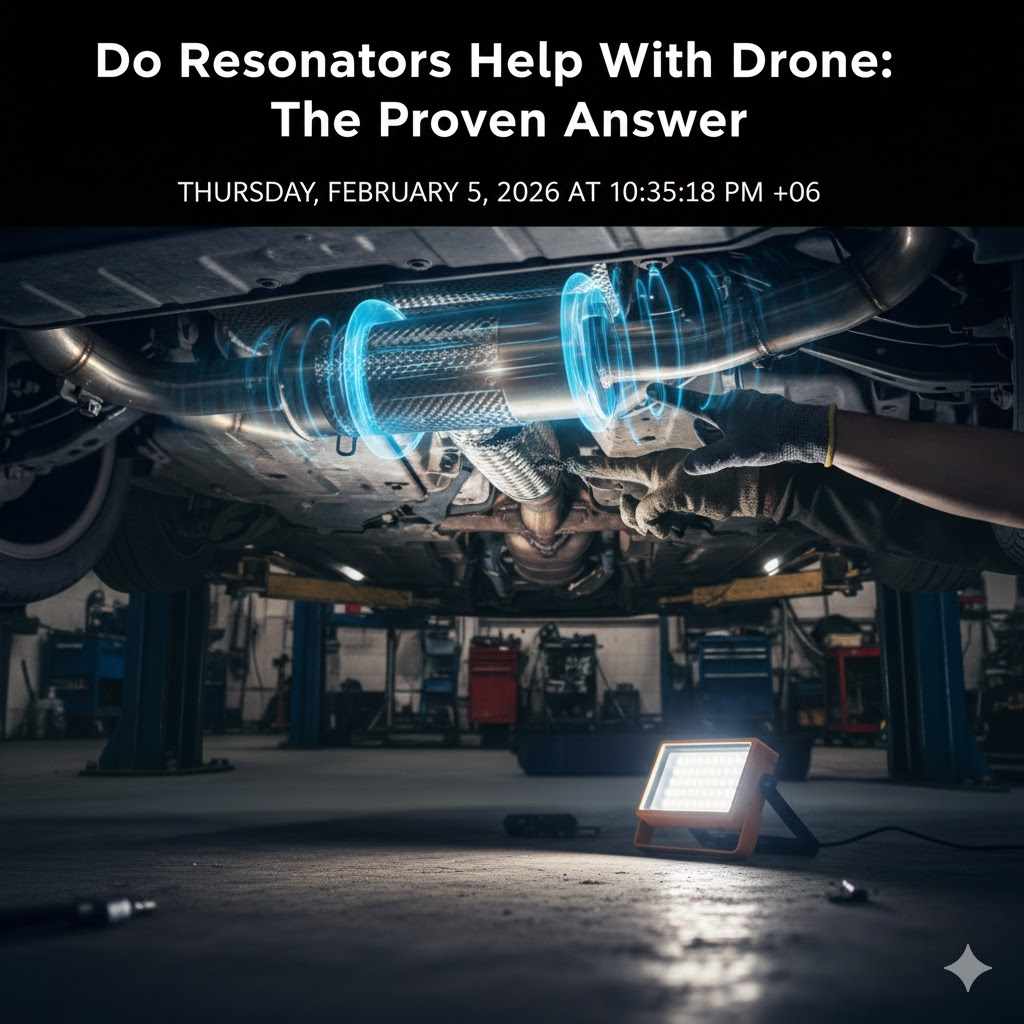
So, what is this magic part? A resonator is a component of your exhaust system that looks like a small, round or oval canister. Its one and only job is to target and cancel out specific, undesirable sound frequencies—namely, exhaust drone.
Think of it as a pair of noise-canceling headphones for your car’s exhaust. It doesn’t just muffle all sounds. Instead, it’s tuned to listen for that one annoying drone frequency and eliminate it before it ever reaches your ears.
How Does a Resonator Work?
A resonator works using a clever bit of science called destructive interference. Inside the resonator is a chamber designed to bounce sound waves around. When the exhaust sound wave causing the drone enters the resonator, it is reflected back on itself. The reflected wave is timed perfectly to be the exact opposite of the incoming wave.
When these two opposite waves meet, they cancel each other out. The drone frequency is eliminated, while other, more desirable exhaust notes are allowed to pass through. This is why a resonator can kill the drone without making your car silent.
Resonator vs. Muffler: What’s the Difference?
This is a common point of confusion for beginners. While both resonators and mufflers deal with sound, they have very different jobs. A muffler’s job is to reduce the overall volume of the exhaust, making the car quieter across all RPMs. A resonator’s job is to target and eliminate a specific frequency (drone).
Here’s a simple table to break it down:
| Feature | Resonator | Muffler |
|---|---|---|
| Primary Job | Cancels specific sound frequencies (drone) | Reduces overall exhaust volume (loudness) |
| How it Works | Sound wave cancellation (destructive interference) | Baffling and absorption of sound waves |
| Effect on Sound | Cleans up the tone, removes humming/buzzing | Makes the entire exhaust system quieter |
| Common Shape | Usually a straight, round, or oval canister | Often a larger, more complex-shaped box |
Most cars come from the factory with both a resonator and a muffler. They work together as a team: the resonator eliminates drone, and the muffler controls the final volume.
The Proven Answer: Yes, Resonators Absolutely Help With Drone
Let’s get straight to the point: Yes, resonators are the number one proven solution for fixing exhaust drone. This is not just an opinion; it’s the entire purpose of their design. When automakers design an exhaust system, they use resonators to fine-tune the sound and ensure there are no annoying drones at cruising speeds for a comfortable ride.
When you install an aftermarket exhaust or remove the factory resonator, you disrupt that careful tuning, and drone often appears. By adding a resonator back into the system, you are restoring the vehicle’s ability to cancel out those problem frequencies.
However, there’s a catch: not just any resonator will do. The effectiveness depends heavily on choosing the right size, type, and placement for your specific vehicle and drone problem. A resonator that’s too small, too large, or in the wrong spot might not fully solve the issue.
How to Choose the Right Resonator to Eliminate Drone
Fixing drone is all about matching the right resonator to your specific problem. It’s a straightforward process if you follow these steps. Think of it as finding the perfect key for a lock.
Step 1: Identify Your Drone RPM Range
The first and most important step is to know your enemy. You need to figure out exactly when the drone is happening. Go for a drive and pay close attention to your tachometer (the gauge that shows engine RPMs).
- Find a safe, open road where you can maintain a steady speed.
- Drive normally and listen for when the drone is at its worst. Is it at 2,000 RPM? 2,500 RPM?
- Note the exact RPM range where the drone is loudest. For most cars, this is between 1,800 and 3,000 RPM, right where you cruise on the highway.
This information is crucial because different resonators are designed to work best at different frequencies. Knowing your drone RPM helps you or your exhaust shop select a resonator that is tuned to that specific range.
Step 2: Understand Different Resonator Types
There are a few common types of resonators, each with its own strengths. For drone, you’ll mainly be looking at two kinds.
| Resonator Type | How it Works | Best For |
|---|---|---|
| Helmholtz / Chambered | Uses a specific air chamber to target and cancel a very narrow frequency range. Highly precise. | Killing a very specific and severe drone without changing the overall exhaust tone much. |
| Perforated / Glasspack | A straight pipe with perforations, wrapped in sound-absorbing material (like fiberglass). | Reducing drone and raspiness across a broader RPM range. It will also slightly mellow the overall exhaust sound. |
For most beginners trying to fix a common highway drone, a high-quality perforated or “glasspack-style” resonator from a reputable brand like Vibrant Performance or MagnaFlow is an excellent and effective choice. They are great all-rounders for cleaning up sound.
Step 3: Measure Your Exhaust Pipe Diameter
This is a simple but critical step. Your new resonator must match the diameter of your existing exhaust pipe. If your pipe is 2.5 inches in diameter, you need a resonator with a 2.5-inch inlet and outlet.
You can easily measure this by sliding a wrench or caliper under the car and measuring the outside diameter of the pipe. If you’re unsure, an auto parts store or exhaust shop can tell you in seconds. An incorrect fit will cause exhaust leaks and prevent the resonator from working properly.
Step 4: Plan the Installation and Placement
Where the resonator goes matters. The ideal placement is typically in a straight section of your exhaust pipe, as far forward as possible. Common locations are:
- Before the muffler: This is the most common and often most effective spot.
- In place of a deleted resonator: If your car had a factory resonator that was removed, putting the new one in the same spot is a great idea.
- In the mid-pipe: The long, straight section of pipe between your catalytic converter and your rear axle is also a prime location.
The further forward the resonator is placed, the earlier it can treat the exhaust gases and cancel the sound waves. Make sure there is enough straight pipe available to fit the length of the resonator you choose.
A Beginner’s Guide to Resonator Installation
While installing a resonator can be a DIY job for those with the right tools and experience, it often involves cutting and welding metal. For most beginners, we highly recommend having this done by a professional exhaust shop. It’s usually a quick and affordable job for them.
However, understanding the process is empowering. Here’s a high-level overview of what’s involved.
Safety First: Working under a car can be dangerous. Never work under a vehicle supported only by a jack. Always use sturdy jack stands. For more information on automotive workshop safety, please refer to official guidelines like those from the U.S. Occupational Safety and Health Administration (OSHA).
Tools and Materials Needed:
- The new resonator
- Safety glasses and gloves
- Jack and jack stands
- Exhaust pipe cutter or a reciprocating saw with a metal-cutting blade
- Measuring tape
- Deburring tool or metal file
- Exhaust clamps (for a temporary or no-weld fit) or a welder
- Exhaust sealant (for clamped connections)
The Installation Process:
- Lift the Vehicle Safely: Use a jack to lift the car and secure it firmly on jack stands on level ground.
- Measure and Mark: Hold the resonator up to the chosen section of exhaust pipe. Measure the body of the resonator (not including the inlet/outlet pipes) and mark that length on your exhaust pipe. This is the section you will cut out. Double-check your measurements!
- Cut the Pipe: Using your pipe cutter or saw, carefully cut out the marked section of the exhaust pipe. Try to make the cuts as straight as possible.
- Prepare the Ends: Use a file or deburring tool to clean up the cut ends of the pipe, removing any sharp burrs. This ensures a tight fit.
- Install the Resonator: Slide the resonator into place. You can secure it in one of two ways:
- Clamping: Slide exhaust clamps over each end and tighten them securely. This is a good option for DIYers without a welder, but it can be prone to leaks over time. Use exhaust sealant for a better seal.
- Welding: This is the preferred method for a permanent, leak-free connection. A professional will weld the resonator directly to the pipe for a rock-solid fit.
- Check for Leaks: Once secured, lower the car and start the engine. Feel around the connections (be careful, it will be hot!) for any puffs of air. You can also use soapy water—if it bubbles, you have a leak that needs to be sealed.
Resonators vs. Other Drone Solutions
A resonator is the best tool for the job, but it’s helpful to know about other options you might hear about.
| Solution | How It Works | Pros | Cons |
|---|---|---|---|
| Resonator | Cancels specific drone frequencies using sound wave interference. | Highly effective, affordable, targets the root cause of drone. | Requires cutting/welding for best results. |
| J-Pipe / Helmholtz Chamber | A sealed, L-shaped tube welded to the exhaust. It’s a type of Helmholtz resonator. | Extremely precise at targeting one specific RPM drone. | More complex and expensive to build and install; requires precise calculations. |
| Different Muffler | Some mufflers have built-in chambers or technologies to help reduce drone. | Can solve drone and change exhaust note at the same time. | More expensive than just a resonator; may not be as effective as a dedicated resonator. |
| Sound Deadening | Applying material like Dynamat to the car’s floor and trunk. | Reduces all types of road and cabin noise, not just drone. | Masks the problem, doesn’t fix it. Can be expensive and labor-intensive to install. |
For a straightforward, effective, and budget-friendly fix, adding a traditional resonator is almost always the best first step.
What to Expect After Installing a Resonator
Once your new resonator is installed, you should notice an immediate and dramatic improvement. The annoying drone that used to appear at highway speeds will be gone or significantly reduced to a point where it’s no longer bothersome.
Here’s what you can realistically expect:
- Drone Elimination: The primary goal will be achieved. Your cabin will be much quieter and more comfortable during cruising.
- A Smoother Exhaust Note: Resonators often remove harsh, raspy sounds from the exhaust, leaving a deeper, cleaner, and more refined tone. Many people find their exhaust sounds even better after adding one.
- Maintained Performance: A good quality, straight-through resonator will have virtually no impact on your car’s performance or horsepower.
It will not make your car silent. Your performance muffler will still give you that aggressive sound when you accelerate, but the annoying, constant hum during normal driving will be a thing of the past.

Frequently Asked Questions (FAQ)
1. Will a resonator make my car quieter?
A resonator’s main job isn’t to make your car quieter overall, but to remove specific annoying frequencies (drone). It may slightly reduce the total volume, but its primary effect is on the tone and quality of the sound, making it smoother and cleaner.
2. Can I have a resonator and a muffler at the same time?
Absolutely! Most cars come from the factory with both. They perform different jobs and work together perfectly. The resonator cancels drone, and the muffler controls the overall volume. This combination gives you a great sound without the annoying hum.
3. How much does it cost to have a resonator installed?
The cost varies, but generally, you can buy a quality resonator for $50 to $150. Installation at a local exhaust shop typically costs between $75 and $200, depending on their labor rates. It’s often a one to two-hour job for a professional.
4. I did a “resonator delete.” Is that why my car drones?
Yes, this is one of the most common causes of exhaust drone. The factory put that resonator there for a reason—to eliminate drone at cruising speeds. Removing it often introduces that exact problem. Adding an aftermarket resonator back in is the perfect fix.
5. What’s the difference between a resonator and a catalytic converter?
They may look similar, but they have completely different functions. A catalytic converter is an emissions control device that converts harmful gases into less harmful ones. A resonator is purely for sound tuning. They are not interchangeable, and removing your catalytic converter is illegal and harmful to the environment.
6. Can a resonator fix all exhaust noises?
No, a resonator is a specialist. It is designed to fix drone, which is a low-frequency hum at a specific RPM. It will not fix other noises like high-pitched rasp, rattling from a loose heat shield, or backfiring.
7. Does the length of the resonator matter?
Yes, it does. Generally, a longer resonator will have a greater effect on drone and will help mellow the exhaust tone more than a shorter one. When choosing, you must ensure it will physically fit in the available space under your car.
Conclusion: The Clear Path to a Drone-Free Drive
That constant, buzzing drone on the highway doesn’t have to be a permanent feature of your car. As we’ve seen, the answer to the question “do resonators help with drone?” is a resounding yes. They are the purpose-built, proven, and most effective solution for eliminating that frustrating noise.
By understanding what drone is, how a resonator works, and how to choose the right one for your vehicle, you have all the knowledge you need to take back your driving experience. You can enjoy the performance sound you wanted when you step on the gas, and a comfortable, quiet cabin when you’re just cruising.
Whether you decide to tackle the installation yourself or take it to a trusted shop, you’re now equipped to make an informed decision. Say goodbye to the headache-inducing hum and hello to a car that sounds exactly the way you want it to—powerful, clean, and best of all, drone-free.