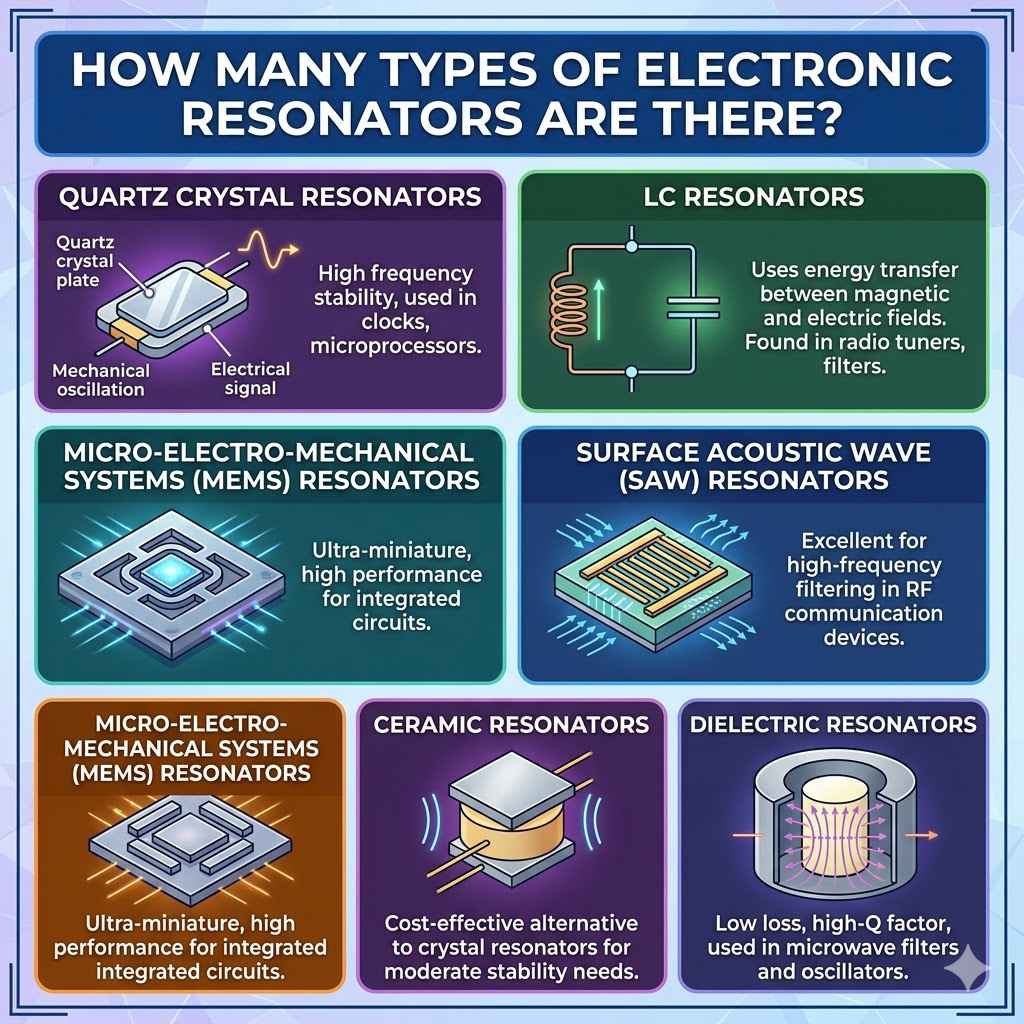
How Many Types of Electronic Resonators Are There?
Many people new to electronics wonder, How Many Types of Electronic Resonators Are There? It can seem confusing because there are different ways to classify them. Don’t worry, it’s not as hard as it looks! We’ll break it down into simple steps so you can easily see the main kinds.
We’ll explore what makes each one special and where you might find them working their magic in everyday devices.
Understanding Electronic Resonators and Their Purpose
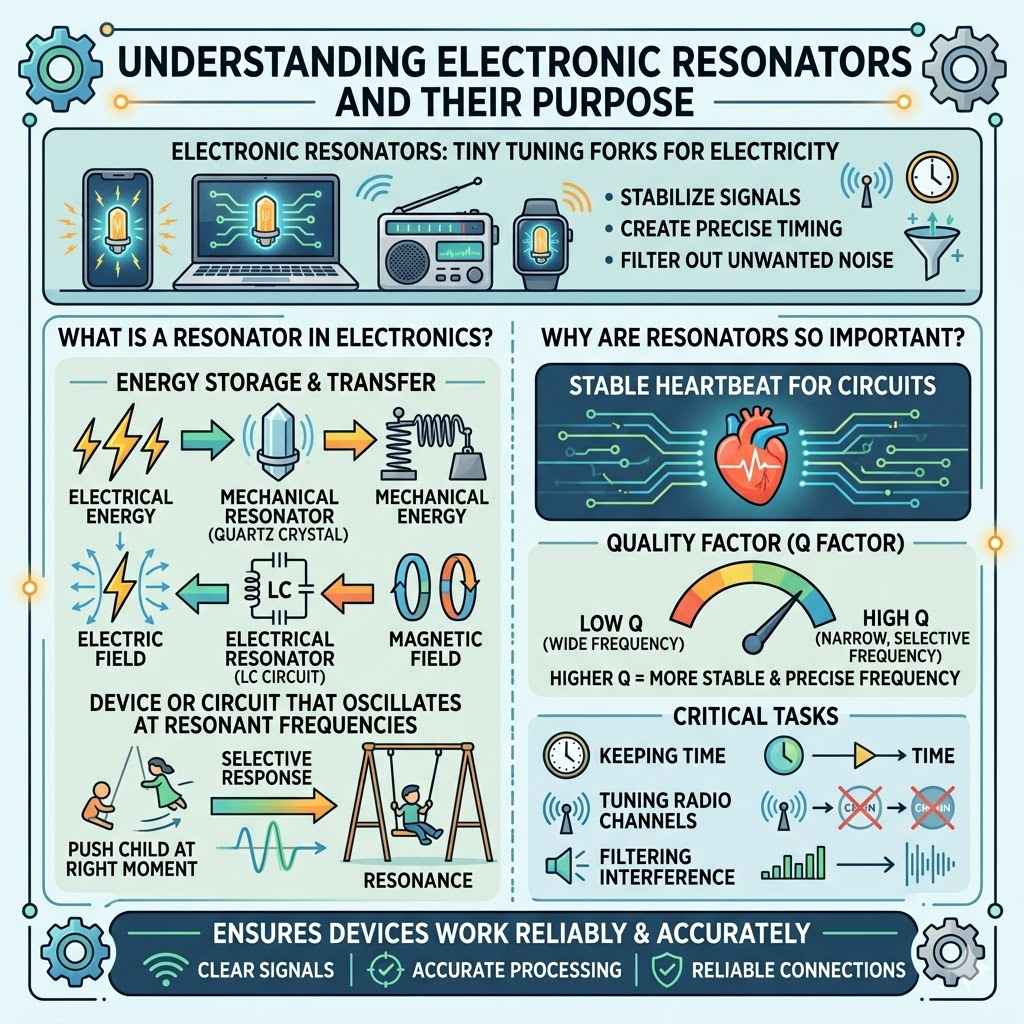
Electronic resonators are super important parts in many gadgets we use every day. They help control and stabilize signals in electronic circuits. Think of them like tiny tuning forks for electricity.
When you “strike” them with the right energy, they vibrate at a very specific frequency. This makes them excellent for creating precise timing and filtering out unwanted noise. Their ability to maintain a steady frequency is what makes them invaluable for stable electronic performance.
What is a Resonator in Electronics?
A resonator is a device or circuit that oscillates at specific frequencies. These are known as resonant frequencies. At these frequencies, energy can be stored and transferred efficiently between different forms, like electrical energy and mechanical energy, or between different parts of an electrical circuit.
This resonance phenomenon is key to their function. It allows them to amplify signals at their natural frequency and ignore signals at other frequencies.
For example, imagine pushing a child on a swing. If you push at just the right moment, the swing goes higher and higher. This is like resonance.
An electronic resonator works similarly, responding strongly when the input signal matches its natural vibration frequency. This precise response is vital for many electronic applications, from radios to computers.
Why Are Resonators So Important?
Resonators are critical for ensuring that electronic devices work reliably and accurately. They provide a stable “heartbeat” for many circuits. Without them, signals could drift, leading to errors or device failure.
They are essential for tasks like keeping time, tuning into specific radio channels, and filtering out unwanted interference. They help make sure that your phone calls are clear and your computer processes information correctly.
Their stability is often measured by their quality factor, or “Q factor.” A higher Q factor means the resonator is more selective and less prone to losing energy, leading to a more stable and precise frequency. This is why engineers spend a lot of time selecting the right resonator for the job.
The Main Types of Electronic Resonators
When we talk about How Many Types of Electronic Resonators Are There?, we usually group them into a few main categories based on how they create that stable vibration. The most common ones use mechanical vibrations to achieve electrical resonance. These mechanical resonators are then converted into electrical signals.
We’ll explore the most widely used types, explaining what makes each one unique and useful.
Crystal Resonators
Crystal resonators are perhaps the most well-known type. They use a piece of piezoelectric crystal, most commonly quartz, cut into a precise shape. When an electric voltage is applied to the crystal, it vibrates.
Conversely, when it vibrates, it produces an electric voltage. This effect, called the piezoelectric effect, is what makes them work. The crystal’s physical properties and shape determine its exact resonant frequency.
These resonators are incredibly stable and accurate, making them ideal for applications where precise timing is crucial. For instance, they are used in wristwatches to keep time accurately. They are also found in computers, microcontrollers, and communication equipment to provide a stable clock signal.
The quality factor (Q factor) of a good crystal resonator can be very high, meaning it vibrates with very little energy loss, which translates to high precision.
Piezoelectric Effect Explained
The piezoelectric effect is a property of certain materials, like quartz, to generate an electric charge in response to applied mechanical stress. It works in reverse, too: applying an electric field causes the material to deform mechanically. This dual nature is what allows a crystal to act as both a sensor and an actuator in an electronic circuit, creating continuous oscillation when properly connected.
This effect is fundamental to many electronic components, not just resonators.
Common Applications of Crystal Resonators
Crystal resonators are the backbone of accurate timing in countless devices. In your smartphone, they provide the clock signals that synchronize all the internal operations. In radios and televisions, they help tune into specific frequencies with high fidelity.
Even in simple digital alarm clocks, a crystal resonator ensures that the time displayed is accurate to within seconds per month. Their reliability and precision make them a preferred choice for these critical functions.
Advantages of Crystal Resonators
The primary advantage of crystal resonators is their exceptional frequency stability and accuracy. They can maintain their resonant frequency over a wide range of temperatures and conditions, with very low drift. Their high Q factor means they can produce a very pure sine wave output at their resonant frequency, with minimal unwanted harmonics or noise.
This makes them perfect for applications where signal integrity is paramount.
Ceramic Resonators
Ceramic resonators are another popular type, often used in less demanding applications where cost and size are more critical than the extreme precision of crystals. They also rely on the piezoelectric effect but use ceramic materials instead of quartz. These ceramic materials are shaped into a small disc or bar.
Ceramic resonators are generally less expensive and more compact than crystal resonators. They are widely used in applications where a stable frequency is needed but absolute precision isn’t paramount. You’ll often find them in simple electronic devices like remote controls, toys, and some audio equipment.
While they don’t offer the same level of accuracy as crystals, their affordability and small size make them a practical choice for many consumer electronics.
How Ceramic Resonators Work
Similar to crystal resonators, ceramic resonators utilize the piezoelectric property of ceramic materials. An electrical signal is applied to the ceramic element, causing it to vibrate mechanically at its natural resonant frequency. This vibration then generates an electrical signal.
The specific frequency is determined by the material composition, shape, and size of the ceramic element. They are often housed in small, sealed packages to protect them from environmental factors.
Where Ceramic Resonators Are Used
Ceramic resonators are common in devices that require a stable frequency but don’t need atomic clock precision. Examples include washing machines and other home appliances that use electronic controls, as well as simple timers and alarm systems. They are also frequently found in older telephones and some types of audio filters.
Their cost-effectiveness makes them suitable for mass-produced goods.
Comparison With Crystal Resonators
While both types use piezoelectricity, ceramic resonators typically have lower Q factors than crystal resonators. This means they are less precise and more susceptible to environmental changes like temperature. However, they are significantly cheaper to manufacture and come in smaller packages.
Crystal resonators are chosen for critical timing functions, while ceramic resonators are a good choice for general-purpose oscillation where cost and size are key considerations.
Other Types of Resonators
Beyond crystals and ceramics, there are other types of resonators that serve specific purposes. These might include mechanical resonators that use different materials or structures, or even purely electronic circuits that mimic resonance. Understanding these helps paint a fuller picture of How Many Types of Electronic Resonators Are There?, showing the breadth of solutions available in electronics.
Mechanical Resonators (Other Than Crystal and Ceramic)
There are also mechanical resonators that use different materials or designs for specific needs. For example, tuning fork resonators are sometimes used, though less commonly in modern electronics than crystals. Some very high-frequency applications might use specially designed micro-mechanical structures.
These types are often chosen for unique performance characteristics or when extreme reliability in harsh conditions is needed.
Electronic Oscillators
While not strictly resonators in the mechanical sense, electronic oscillators are circuits designed to produce a repeating electronic signal, often at a stable frequency. These circuits use active components like transistors or operational amplifiers along with passive components like resistors and capacitors. They create oscillations through feedback loops.
Some oscillator designs are specifically engineered to achieve high stability, effectively mimicking the behavior of a mechanical resonator.
These electronic oscillators can be tuned more easily than crystal or ceramic resonators, making them useful in applications where the frequency needs to be adjusted. They are fundamental building blocks in radios for tuning in stations and in communication systems for generating carrier frequencies.
MEMS Resonators
Micro-Electro-Mechanical Systems (MEMS) resonators are tiny mechanical structures fabricated using semiconductor manufacturing techniques. They can be made from silicon or other materials and operate on principles similar to crystal resonators. MEMS resonators offer the potential for very high frequency operation, small size, and integration with other semiconductor devices.
They are seen as a future technology for many timing and sensing applications.
LC Oscillators
An LC oscillator is a fundamental type of electronic oscillator that uses an inductor (L) and a capacitor (C) to create its resonant circuit. The energy oscillates back and forth between the inductor’s magnetic field and the capacitor’s electric field. The frequency of oscillation is determined by the values of L and C.
These are simpler and cheaper than crystal oscillators but generally less stable.
RLC Circuits as Resonant Systems
An RLC circuit includes a resistor (R) in addition to an inductor (L) and capacitor (C). While the LC circuit oscillates indefinitely in a theoretical ideal world, the resistor in an RLC circuit causes the oscillations to decay over time. However, RLC circuits are fundamental for understanding resonance and are used in tuning circuits for radios and filters to select specific frequencies.
The resistor affects the damping of the oscillation and the sharpness of the resonance.
How Resonators Are Used in Everyday Devices
The answer to How Many Types of Electronic Resonators Are There? is less important than understanding where they make a difference. Resonators are hidden away in most electronic devices, working tirelessly to ensure they function correctly. From the phone in your pocket to the car you drive, these small components play a huge role in modern technology.
Their stability and precision are what allow complex digital systems to operate reliably.
In Your Smartphone
Your smartphone relies heavily on resonators, primarily crystal resonators, for its accurate timing. The main clock signal that synchronizes all the processor’s actions often comes from a high-frequency crystal oscillator. This ensures that all the different parts of your phone communicate and operate at the correct speed.
Without this stable clock, your apps would crash, calls would drop, and your phone would be unusable.
Other resonators, like surface acoustic wave (SAW) resonators, are used in radio frequency (RF) modules. These are crucial for filtering signals and ensuring your phone can connect to cellular networks and Wi-Fi with clarity. They help select the specific radio frequencies needed for communication while rejecting others, which is vital in a crowded radio spectrum.
In Computers and Laptops
Computers are packed with resonators. The central processing unit (CPU) has a clock speed determined by a crystal oscillator. This clock signal dictates how many operations the CPU can perform per second.
A faster clock speed generally means a faster computer. This stable frequency is essential for the millions of calculations a CPU performs every moment.
Beyond the main CPU clock, many other components in a computer use resonators. Sound cards use them for audio signal generation and processing. Network interfaces use them for data communication timing.
Even simple devices like computer mice might use them for reliable signal transmission.
In Home Appliances and Other Electronics
Even simple devices use resonators. Your microwave oven uses a resonator to generate the microwaves that cook your food, typically a magnetron that contains a resonant cavity. Washing machines and dishwashers use ceramic resonators for their control circuits to ensure timers and cycles run correctly.
Remote controls for TVs and other entertainment systems often use ceramic resonators to generate the carrier frequency for the infrared signals that change channels or adjust volume. These resonators provide the stable signal needed for the remote to communicate reliably with the device.
Choosing the Right Resonator for Your Needs
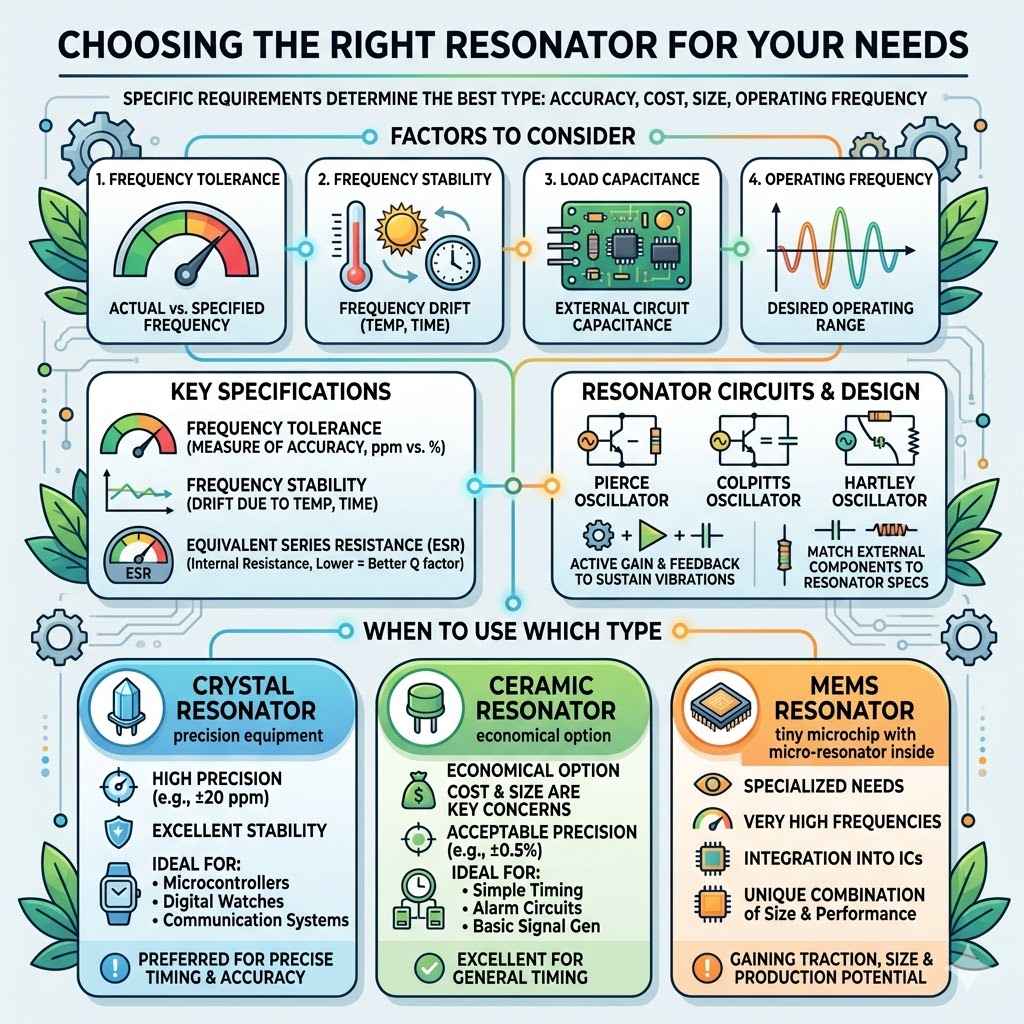
Deciding which type of resonator to use depends on the specific requirements of your electronic project or device. The key factors are usually accuracy, cost, size, and operating frequency. For applications needing the highest precision, like in precise measurement equipment or high-speed digital systems, crystal resonators are the go-to choice.
For more general timing needs where cost and space are limiting, ceramic resonators are often preferred.
Factors to Consider
When selecting a resonator, engineers look at several critical specifications. Frequency tolerance is how much the actual frequency can deviate from the specified frequency. Frequency stability describes how much the frequency changes with temperature, voltage, or time.
The load capacitance is the capacitance that the resonator “sees” from the circuit it’s connected to, which affects its operating frequency.
Frequency Tolerance
This is a measure of how close the resonator’s actual operating frequency is to its marked frequency. A lower tolerance percentage means higher accuracy. For example, a ±20 parts per million (ppm) tolerance is very tight and suitable for critical timing applications.
A ±0.5% tolerance might be acceptable for less sensitive tasks.
Frequency Stability
This refers to how much the resonator’s frequency drifts due to changes in its environment, especially temperature. Some high-precision crystals are designed to have excellent temperature stability, ensuring consistent performance across different operating conditions. Less expensive resonators may have significant frequency drift with temperature changes.
Equivalent Series Resistance (ESR)
ESR is a measure of the internal resistance within the resonator. A lower ESR generally leads to a higher Q factor and better oscillation performance. It’s an important parameter for ensuring that the oscillator circuit has enough gain to start and sustain oscillations reliably.
Resonator Circuits and Their Design
Simply placing a resonator in a circuit is not enough. It needs to be part of an oscillator circuit that provides the necessary amplification and feedback to keep it vibrating. Common oscillator circuits include the Pierce oscillator, Colpitts oscillator, and Hartley oscillator.
The design of these circuits is crucial for achieving stable and reliable oscillation at the desired frequency.
The components connected to the resonator, such as capacitors and resistors, are carefully chosen to match the resonator’s specifications. These external components help set the load capacitance and the operating point of the active components, which together determine the final frequency and stability of the oscillator.
When to Use Which Type
For applications requiring very precise timing signals, such as in microcontrollers, digital watches, and communication systems, crystal resonators are almost always the preferred choice due to their superior accuracy and stability.
If the application requires a stable frequency but cost and size are the primary concerns, and high precision is not critical, ceramic resonators are an excellent and economical option. They are ideal for simple timing functions, alarm circuits, and basic signal generation where slight frequency variations are acceptable.
For specialized needs, such as very high frequencies or integration into integrated circuits, MEMS resonators are gaining traction. They offer a unique combination of size, performance, and potential for mass production.
Frequently Asked Questions
Question: Are all resonators mechanical?
Answer: No, not all electronic resonators are purely mechanical. While the most common types like crystal and ceramic resonators rely on mechanical vibrations, there are also electronic oscillator circuits that use passive components like inductors and capacitors, or active components, to create and maintain oscillations at a stable frequency, effectively acting as electronic resonators.
Question: What is the Q factor of a resonator?
Answer: The Q factor, or quality factor, is a measure of how efficiently a resonator stores energy versus how much energy it loses over one oscillation cycle. A higher Q factor means the resonator is more selective and resonates more sharply at its specific frequency, leading to greater accuracy and stability.
Question: Can I use a ceramic resonator instead of a crystal resonator?
Answer: You might be able to, but it depends on the application. If your device requires high precision and frequency stability, like for accurate timing in a microcontroller, a ceramic resonator likely won’t be accurate enough. For simpler applications where cost is a major factor and less precision is needed, a ceramic resonator might be a suitable alternative.
Question: How do I find the resonant frequency of a circuit?
Answer: For an LC circuit, the resonant frequency is calculated using the formula f = 1 / (2 pi sqrt(L * C)), where f is frequency, L is inductance, and C is capacitance. For RLC circuits, the resistor affects the damping but the basic resonant frequency calculation is similar. For mechanical resonators, the frequency is determined by their physical properties like size, shape, and material.
Question: Why are crystal resonators more expensive than ceramic ones?
Answer: Crystal resonators are more expensive because they require more precise manufacturing processes and materials. The cutting, lapping, and sealing of quartz crystals to achieve specific, highly stable frequencies are complex and costly. Ceramic resonators, while also needing precision, are generally made from more common materials and can be manufactured in larger volumes with less intricate processes, making them more affordable.
Summary
So, How Many Types of Electronic Resonators Are There? We’ve seen the main ones are crystal and ceramic resonators, both using piezoelectricity. There are also other mechanical and electronic oscillator types. Each has its own strengths for different jobs, from precise timing in your phone to basic functions in appliances.
You can pick the right one by looking at accuracy, size, and cost.