Do Pie Tins Work As Resonators? The Essential Secret
A pie tin should never be used as a resonator. While it might seem like a creative, low-cost fix, it is extremely dangerous. The thin metal cannot handle exhaust heat, creating a severe fire hazard, a risk of carbon monoxide poisoning from leaks, and potential engine damage. Always use proper, purpose-built exhaust parts for safety and performance.
Have you heard the strange rumor about using a pie tin to fix a noisy exhaust? It pops up in online forums and garage chats. You might be dealing with an annoying drone or a loud rumble from your car. You want a quick and cheap solution. The idea of a simple kitchen item fixing the problem sounds too good to be true.
Well, you’ve come to the right place. I’m Monowar Shohag, and I’m here to guide you through the world of exhaust systems without the confusing jargon. It’s my mission to help you understand your car and make safe, smart choices. We’re going to uncover the truth behind this myth. I’ll explain exactly what a resonator does and why using a pie tin is a terrible idea. Let’s get to the bottom of this together.
First, What Is a Real Exhaust Resonator?
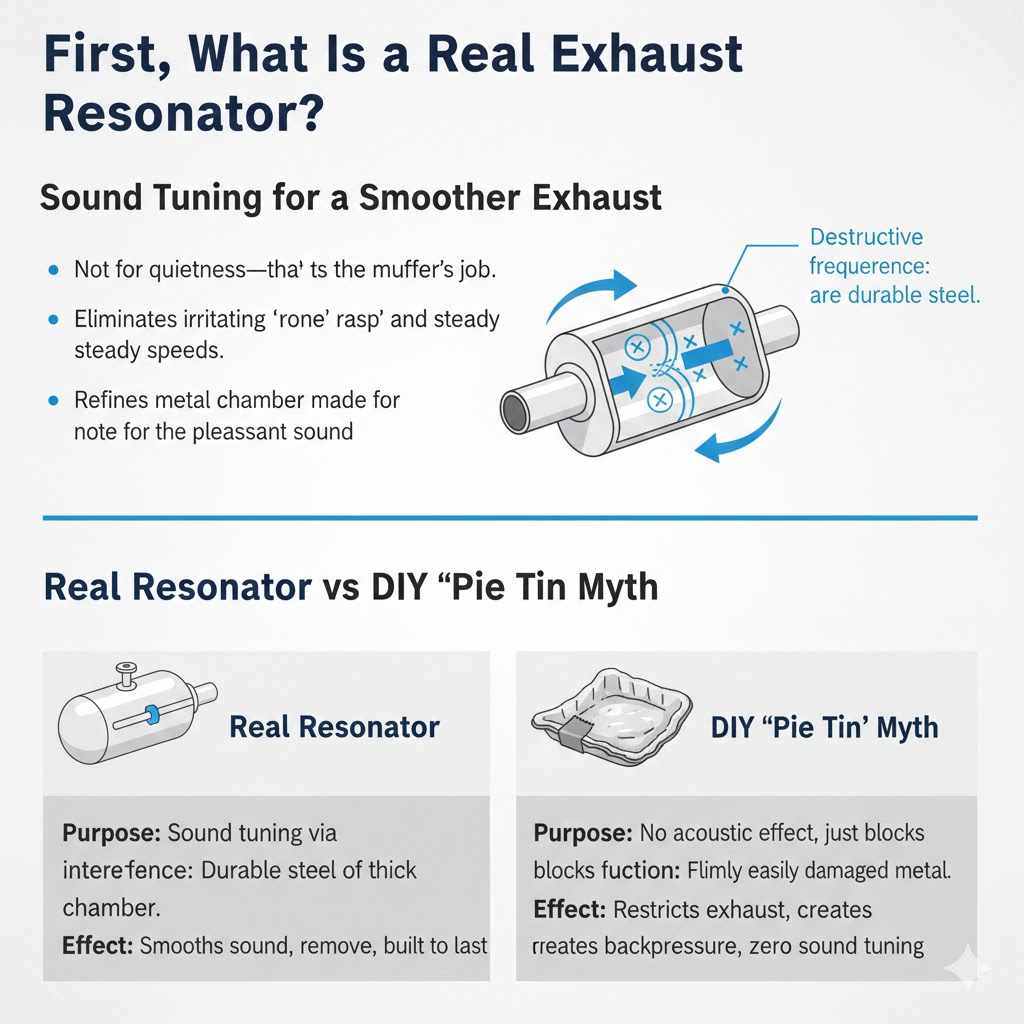
Before we can debunk the pie tin myth, we need to understand what a real resonator does. Think of it as your exhaust system’s sound tuner. It’s not designed to make your car quiet—that’s the muffler’s job. Instead, the resonator’s main purpose is to cancel out specific, annoying sound frequencies.
You know that irritating “drrrrrone” sound you sometimes hear when driving at a steady speed on the highway? That’s what a resonator is built to eliminate. It’s an empty metal chamber that looks like a small muffler. Hot exhaust gases and sound waves flow into it.
Here’s how it works in simple terms:
- Sound waves from the engine enter the resonator chamber.
- They bounce off the walls inside.
- As they bounce, they collide with other sound waves.
- This collision causes certain frequencies to cancel each other out, a process known as destructive interference.
The result? The harsh, droning noises are filtered out, leaving a smoother, more pleasant exhaust note. It refines the sound without significantly quieting it. Real resonators are made from thick, durable steel (like aluminized or stainless steel) designed to withstand immense heat, pressure, and constant vibration for years.
The Pie Tin “Hack”: Where Does This Myth Come From?
The idea of using a pie tin, a soup can, or other random metal objects as an exhaust fix comes from a desire for a cheap and immediate solution. When your car starts making a new, loud noise, it’s natural to want to fix it without spending a lot of money. The internet is full of “life hacks,” and unfortunately, automotive repair has its share of dangerous ones.
The flawed logic goes something like this: “My exhaust is loud. If I clamp a piece of metal around the pipe, it should change the sound, right?”
While technically true—adding any obstruction will change the sound—it doesn’t fix the problem. It creates new, much more serious ones. People who suggest this are often trying to patch a hole or replicate a part they don’t understand. They see an empty space where a resonator used to be and think any metal container can do the job. This misunderstanding is what makes the pie tin myth so persistent and dangerous.
Why a Pie Tin is a Terrible and Dangerous Idea
Let’s be perfectly clear: using a pie tin as a resonator is one of the worst things you can do to your vehicle. It is not a clever trick; it is a serious safety hazard. Here are the essential reasons why you should never, ever attempt this.
1. Extreme Fire Hazard
Your car’s exhaust system gets incredibly hot. Gases leaving the engine can easily reach temperatures of 1,200°F (650°C) or even higher under load. A pie tin is made from very thin aluminum or tin-plated steel, designed only for baking temperatures around 450°F (232°C).
When you attach this flimsy metal to a scorching-hot exhaust pipe, it will fail. It can melt, glow red hot, and easily ignite anything it touches. Dry leaves, grass, dripping oil, or plastic underbody panels can all catch fire. Vehicle fires are incredibly dangerous and can spread in seconds. According to the U.S. Fire Administration, vehicle fires are a common and serious threat, often caused by mechanical failures or modifications.
2. Risk of Carbon Monoxide Poisoning
A pie tin cannot create a gas-tight seal on an exhaust pipe. It’s impossible. It will be clamped on, leaving gaps and cracks. These gaps will leak exhaust gases directly underneath your vehicle’s cabin.
These gases contain carbon monoxide (CO), a colorless, odorless, and deadly poison. When you are stopped at a light or driving slowly, CO can seep into the cabin through small openings in the floorboard or ventilation system. Exposure can cause dizziness, headaches, nausea, and, in high enough concentrations, unconsciousness and death. This is not a risk worth taking.
3. Severe Engine Damage
An exhaust system is carefully engineered to allow gases to flow out of the engine efficiently. This flow is called “scavenging,” and it’s critical for performance and engine health. When you clamp a pie tin around the pipe, you create a massive restriction.
This blockage increases “backpressure,” forcing the engine to work much harder to push the exhaust gases out. This can lead to:
- Reduced Performance: Your car will feel sluggish and weak.
- Terrible Fuel Economy: The engine has to burn more fuel to overcome the pressure.
- Overheating: The engine and exhaust manifolds can overheat, potentially damaging critical components.
- Long-Term Damage: Over time, high backpressure can damage exhaust valves, pistons, and the catalytic converter.
4. It Will Disintegrate and Cause More Damage
A pie tin is not built to handle the intense vibrations of a running car. Between the extreme heat and the constant shaking, the thin metal will crack and break apart very quickly. When it does, sharp metal fragments will be sent flying down your exhaust system.
These shards can become lodged in your catalytic converter or muffler. A clogged catalytic converter is a very expensive repair, often costing over a thousand dollars. A clogged muffler will also cause performance issues. The “free” fix could end up costing you dearly.
Real Resonator vs. Pie Tin: A Clear Comparison
To make it even clearer, let’s look at a direct comparison. Seeing the differences side-by-side highlights why one is an essential automotive part and the other is a dangerous piece of kitchenware.
| Feature | Real Exhaust Resonator | A Pie Tin |
|---|---|---|
| Material | Thick aluminized or stainless steel, designed for high heat and corrosion resistance. | Thin, flimsy aluminum or tin-plated steel, designed for baking. |
| Purpose | To cancel specific sound frequencies (drone) through acoustic engineering. | To bake pies. It has no engineered acoustic properties. |
| Safety | Designed to safely handle 1,200°F+ exhaust gases and contain them completely. | Will melt, burn, and leak deadly carbon monoxide gas. Extreme fire hazard. |
| Performance Impact | Designed for minimal airflow restriction to maintain engine performance. | Creates a major blockage, increasing backpressure and harming engine performance. |
| Durability | Lasts for many years and tens of thousands of miles. | Will likely disintegrate from heat and vibration in a matter of minutes or hours. |
| Legality | A legal, standard factory or aftermarket part. | An illegal and unsafe modification that will fail any vehicle inspection. |
The Right Way to Fix Your Loud Exhaust or Drone
Now that we know what not to do, let’s talk about the proper way to solve your exhaust problems. Fixing it correctly will not only make your car sound better but also ensure it is safe and reliable.
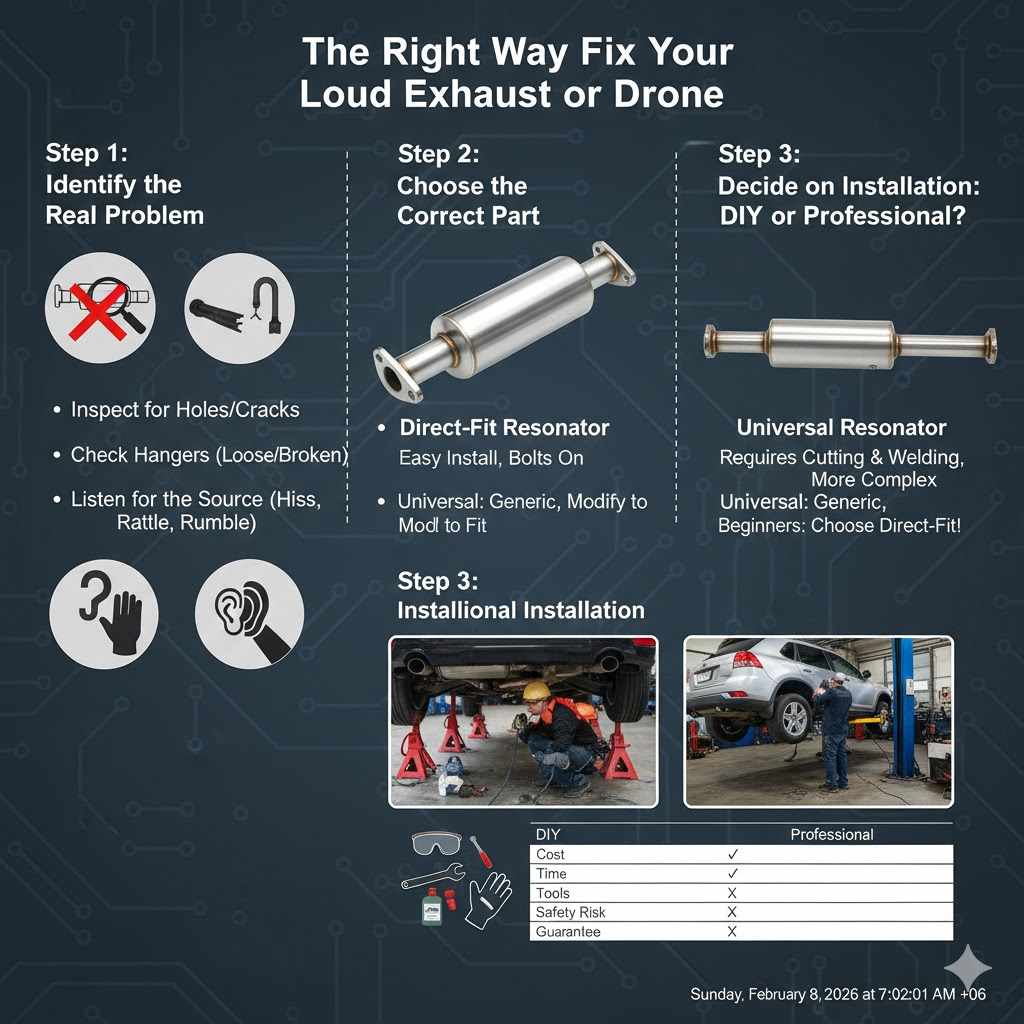
Step 1: Identify the Real Problem
First, you need to figure out what’s causing the noise. Safely park your car on a level surface and wait for the exhaust to cool down completely before you inspect it. A hot exhaust can cause severe burns.
- Look for Holes or Cracks: Carefully inspect the entire exhaust system, from the engine all the way back to the tailpipe. Look for any visible rust spots, holes, or cracks.
- Check the Hangers: Broken or loose rubber hangers can cause the exhaust to rattle against the car’s frame.
- Listen for the Source: If it’s safe to do so, have a friend start the car while you listen (from a safe distance) to pinpoint where the noise is coming from. Is it a hiss from a leak, a rattle from a loose part, or a deep rumble from a failed muffler?
Step 2: Choose the Correct Part
Once you’ve found the issue, you need the right part. If your resonator is rusted out or missing, you need to replace it with a new resonator.
- Direct-Fit Resonators: These are designed specifically for your car’s make and model. They are the easiest to install because they bolt right into place without any modification.
- Universal Resonators: These are more generic and can fit a wide range of vehicles, but they often require cutting and welding to install properly. They can be cheaper, but the installation is more complex.
For beginners, a direct-fit part is always the best choice. It removes the guesswork and ensures a proper fit.
Step 3: Decide on Installation: DIY or Professional?
You have two choices for installation: do it yourself or take it to a professional. Both have their pros and cons.
DIY Installation:
If you are comfortable working on your car and have the right tools, you might be able to replace a bolt-on resonator yourself. You will need:
- A good jack and sturdy jack stands (never work under a car supported only by a jack).
- A set of wrenches or sockets.
- Penetrating oil to loosen rusty bolts.
- Safety glasses and gloves.
Remember, this can be a tough job. Exhaust bolts are often rusted solid and difficult to remove.
Professional Installation:
For most beginners, this is the recommended path. A local exhaust shop has the tools, lifts, and experience to do the job quickly and safely. They can handle rusted bolts, perform any necessary welding, and ensure there are no leaks. The peace of mind is often worth the labor cost.
DIY vs. Pro Installation at a Glance
| Factor | DIY Installation | Professional Installation |
|---|---|---|
| Cost | Lower (you only pay for the part). | Higher (you pay for the part and labor). |
| Time | Can take several hours, especially with rusty parts. | Usually done in under an hour. |
| Tools Required | Requires jack stands, wrenches, and other specialized tools. | No tools needed from you. The shop has everything. |
| Safety Risk | Higher risk. Working under a car can be dangerous without proper precautions. | Very low risk. The work is done by experienced technicians. |
| Guarantee | No guarantee on your own labor. | Most shops offer a warranty on their parts and labor. |
Frequently Asked Questions (FAQ)
1. What’s the difference between a resonator and a muffler?
A resonator is designed to cancel out specific sound frequencies, primarily the “drone” you hear at constant speeds. A muffler is designed to reduce the overall volume of the exhaust across all frequencies. Most cars have both to create a sound that is both quiet and pleasant.
2. Will removing my resonator make my car louder?
Yes, removing the resonator will likely make your exhaust sound louder, raspier, and introduce that annoying highway drone that it was designed to eliminate. Some people like this sound, but many find it tiresome on long drives.
3. How much does it cost to replace a resonator?
The cost varies greatly depending on your vehicle. The part itself can range from $50 to $200. Professional installation labor might add another $75 to $150. In total, you can expect to pay somewhere between $125 and $350 for a complete replacement.
4. Can I just use a straight pipe instead of a resonator?
You can, and this is often called a “resonator delete.” It will make your exhaust louder and more aggressive. However, it will also almost certainly add a significant amount of drone inside the cabin, which can be very unpleasant for daily driving.
5. How do I know if my resonator is bad?
The most common signs of a bad resonator are a sudden increase in exhaust noise, a new rattling sound coming from underneath the car (from broken internal parts), or a visible hole or crack in the resonator’s body.
6. Is exhaust drone dangerous?
While the sound itself isn’t physically dangerous, it can be very fatiguing for the driver on long trips. This fatigue can reduce concentration and awareness, which can be a safety concern. The real danger comes from what causes the drone, such as a leak that could also be releasing carbon monoxide.
7. Why is my exhaust suddenly so much louder?
A sudden increase in loudness is almost always caused by a new hole or a broken component in the exhaust system. This could be a failed gasket, a crack in a pipe, or a rusted-out muffler or resonator. It needs to be inspected and repaired right away to prevent dangerous fumes from entering the car.
Conclusion: Trust a Real Part, Not a Kitchen Utensil
So, do pie tins work as resonators? The essential secret is that they absolutely do not. It’s a dangerous myth that can lead to vehicle fires, toxic gas leaks, and expensive engine damage. Your car’s exhaust system is a finely tuned and critical component that requires parts built to handle extreme conditions.
When you’re faced with a loud exhaust, the answer is never found in your kitchen cabinet. The right solution is to diagnose the problem correctly and replace the failed component with a proper, purpose-built part. Whether you choose to tackle the job yourself or trust a professional, you are making a smart investment in your vehicle’s safety, performance, and reliability.
Driving with confidence means knowing your car is in good shape. By avoiding dangerous “hacks” and using the right parts, you can enjoy the road ahead safely and quietly. Take care of your car, and it will take care of you.