Do Resonators Create Back Pressure? Proven, Essential Facts
Yes, resonators create a very small amount of back pressure, but it’s far less than a muffler or catalytic converter. Their main job is to cancel out specific annoying sound frequencies (drone), not to restrict exhaust flow. A well-designed resonator balances sound quality with minimal impact on performance.
Have you ever heard car enthusiasts talk about “back pressure” and “resonators” and felt a little lost? It’s a common point of confusion. Many drivers worry that adding or changing any part of their exhaust system might hurt their car’s performance. You might think that anything you put in the path of your exhaust will slow it down and rob you of power.
I’m here to tell you that it’s much simpler than it sounds. Understanding how these parts work together is the first step to making your car sound and run exactly how you want it to. In this guide, I’ll break down everything you need to know about resonators and back pressure. We’ll separate the myths from the facts, so you can feel confident about your exhaust system. Let’s dive in!
To get to the bottom of our big question, we first need to understand the key players involved. Think of your exhaust system as a team, where each member has a specific job. The resonator is one of the most misunderstood members of that team.
What Is a Resonator, Anyway?
Imagine you have a pair of noise-canceling headphones. They don’t block out all sound; instead, they listen for specific, annoying background noises and create an opposite sound wave to cancel them out. A resonator does almost the exact same thing for your car’s exhaust note.
Its one and only job is to target and eliminate a very specific sound frequency. This unpleasant, humming sound is often called “exhaust drone,” and it usually appears when you’re cruising at a steady speed on the highway. It’s that low, vibrating hum that can give you a headache on a long drive.
Resonator vs. Muffler: What’s the Difference?
This is where most people get confused. While both parts manage your car’s sound, they do it in very different ways.
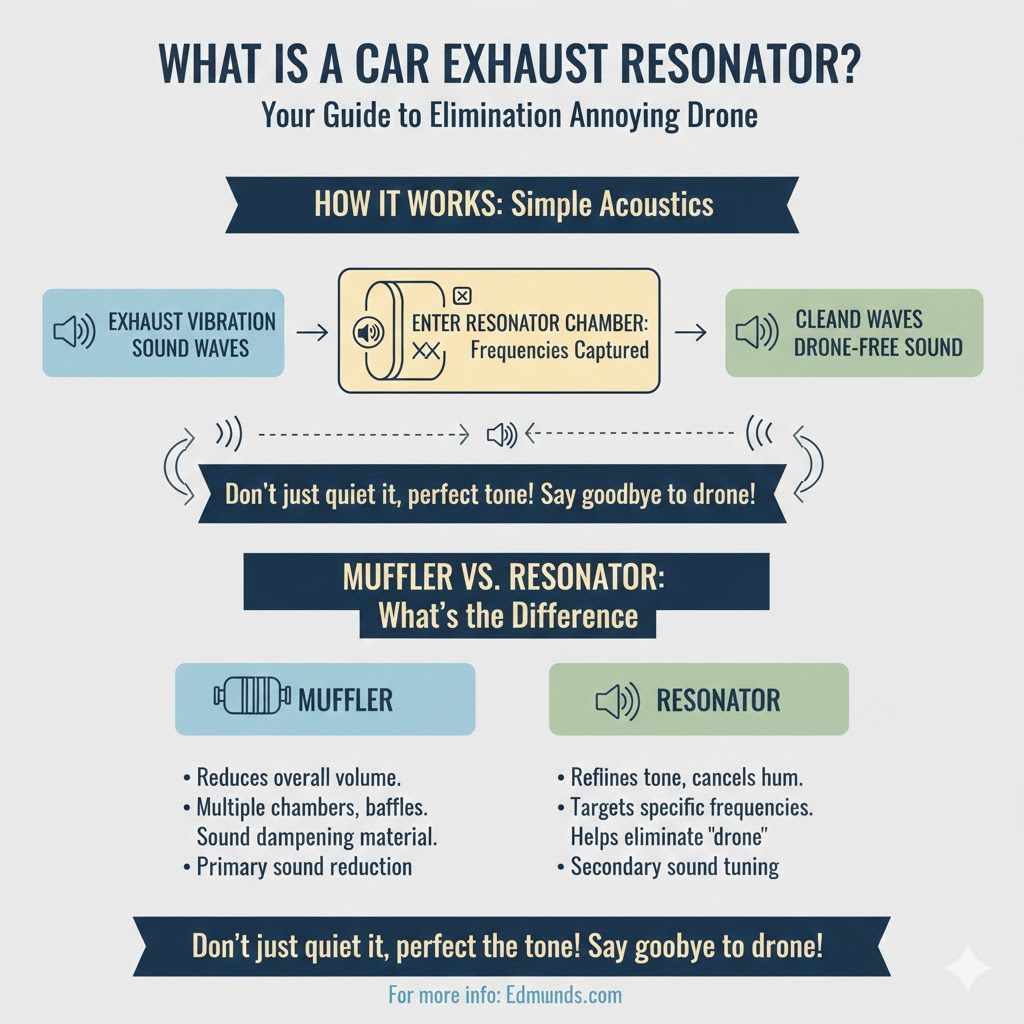
- A Muffler: A muffler’s job is to reduce the overall volume of your exhaust. It uses a series of chambers and perforated tubes to bounce the sound waves around and absorb them, making the car much quieter across the entire RPM range.
- A Resonator: A resonator is a specialist. It targets and cancels out only a narrow band of sound frequencies that create drone. It doesn’t significantly lower the overall volume of the exhaust note.
Think of it like this: a muffler turns the volume knob down, while a resonator acts as an equalizer, cutting out one annoying frequency without affecting the others.
Understanding Exhaust Back Pressure in Simple Terms
Now, let’s talk about the other half of our question: back pressure. The term sounds technical, but the concept is easy to grasp.
Back pressure is the resistance that exhaust gases face as they try to exit your engine and flow through the exhaust system.
Imagine trying to quickly empty a full water bottle. If you just turn it upside down, it gurgles and drains slowly. That gurgling is resistance. But if you swirl the water to create a vortex, it flows out smoothly and quickly. Your exhaust system wants that smooth, fast flow.
Too much back pressure is like a traffic jam for your exhaust gases. It forces the engine to work harder to push the gases out, which can lead to:
- Loss of horsepower and torque
- Reduced fuel efficiency
- Increased engine temperature
The goal of a performance-oriented exhaust system is to get exhaust gases away from the engine as quickly and efficiently as possible. This means minimizing back pressure.
The Final Answer: Do Resonators Add Back Pressure?
So, we come back to the core question. The direct answer is: Yes, but the amount is almost always negligible.
Technically, any object placed in the path of the exhaust flow will create some level of resistance. Even a perfectly straight, smooth pipe creates a tiny bit of back pressure from friction. A resonator is no different. However, its design is focused on minimizing this effect.
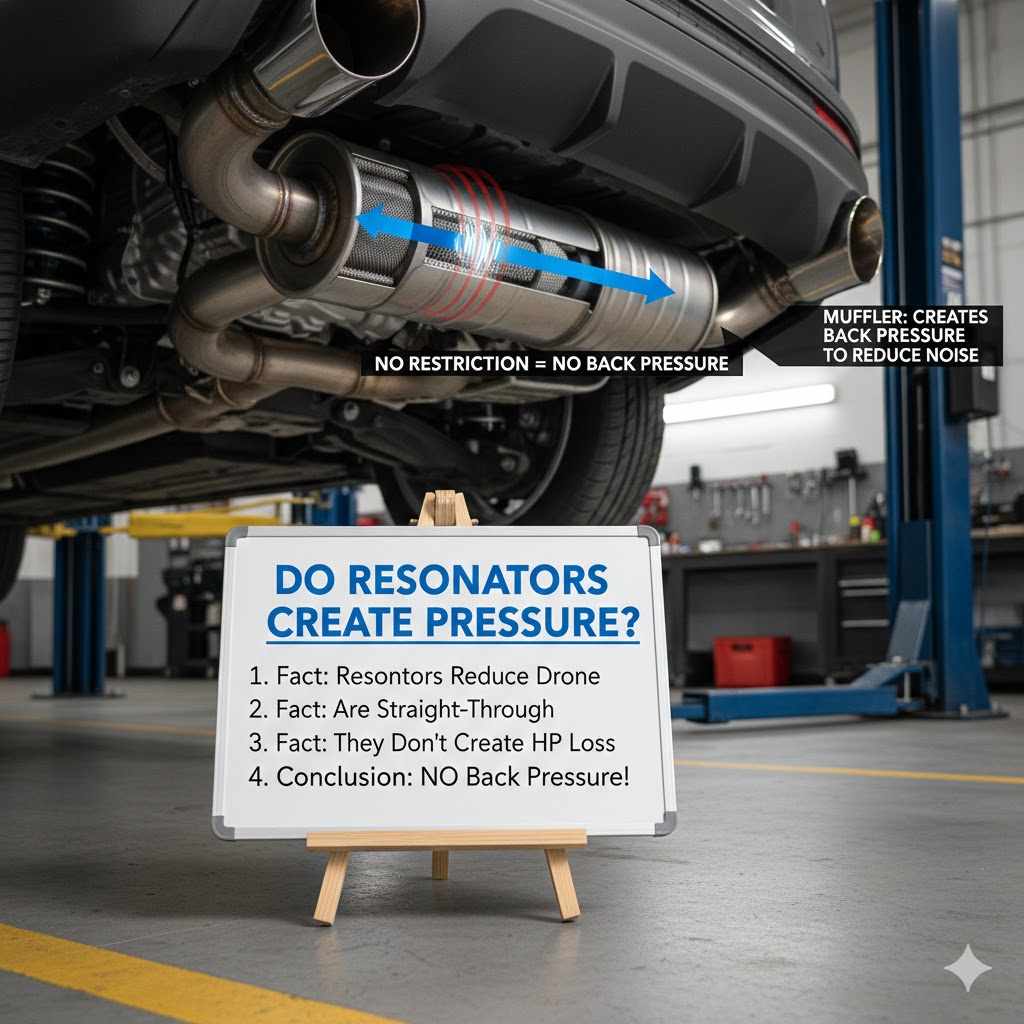
Most resonators are built with a “straight-through” design. This means there’s a perforated pipe running directly through the center. Exhaust gases can flow almost completely unrestricted right through the middle, while the annoying sound waves escape through the holes into a chamber where they are canceled out.
Because the main path for the gas is a straight shot, a resonator adds very little back pressure—far less than a muffler or a catalytic converter.
Comparing Back Pressure Across Exhaust Components
To put it in perspective, let’s see how a resonator stacks up against other parts of your exhaust system. The biggest creators of back pressure are the components designed to heavily manipulate either the gases themselves or the sound.
| Exhaust Component | Primary Function | Typical Back Pressure Level |
|---|---|---|
| Catalytic Converter | Reduces harmful emissions by forcing gases through a dense catalyst honeycomb. | High |
| Muffler (Chambered) | Quiets overall exhaust volume by forcing gases through a maze of chambers. | Moderate to High |
| Muffler (Straight-Through) | Quiets exhaust volume with sound-absorbing material around a perforated pipe. | Low |
| Resonator | Cancels specific sound frequencies (drone) using a straight-through design. | Very Low |
| Straight Pipe | Provides a direct path for exhaust gases with no sound or emission control. | Extremely Low |
As you can see, the resonator is at the very bottom of the list when it comes to creating performance-robbing back pressure. Its impact is so small that in most street-driven cars, it’s completely unnoticeable.
How Different Resonator Designs Affect Flow
Not all resonators are created equal, but most are designed with airflow in mind. Here are the two most common types you’ll encounter:
1. Absorption Resonators (Perforated Core)
This is the most popular type, especially in the aftermarket world. It looks like a simple canister from the outside. Inside, it contains a straight pipe with hundreds of small holes (perforations) punched into it. This pipe is wrapped in sound-absorbing material, like steel wool or fiberglass.
- How it works: Exhaust gases flow straight through the center pipe with minimal restriction. The harsh sound waves, however, exit through the holes and are absorbed and broken up by the packing material, canceling out the drone.
- Back Pressure: Extremely low. This design is the best for maintaining high exhaust velocity.
2. Helmholtz Resonators (Chambered)
This type is a bit more scientific and is often found on stock exhaust systems from manufacturers who spend millions on sound engineering. It works on the principle of resonance.
- How it works: A Helmholtz resonator is essentially a side chamber connected to the main exhaust pipe. It’s engineered to a specific size and shape to resonate at the exact same frequency as the unwanted drone. When the drone sound wave enters the chamber, the resonator produces an identical, out-of-phase sound wave that cancels it out. Think of it as fighting fire with fire.
- Back Pressure: Very low. Since it’s a side branch, the main flow of exhaust gas is not significantly disturbed.
In both cases, the primary goal is to treat the sound without creating a roadblock for the exhaust gases.
The Myth of “Good” Back Pressure
You may have heard someone say that engines need “a little bit of back pressure” to run properly, especially to maintain low-end torque. For most modern, fuel-injected cars, this is largely a myth that comes from a misunderstanding of a different concept: exhaust gas velocity.
What engines truly want is high exhaust velocity. A fast-moving column of exhaust gas creates a vacuum effect behind it, which helps pull the next puff of exhaust out of the cylinder. This is called “scavenging.”
Sometimes, installing a huge, oversized exhaust pipe on a small engine can reduce back pressure too much, causing the exhaust velocity to drop. The slow, lazy flow of gas hurts performance, and people mistakenly blame the lack of back pressure. In reality, the problem was the drop in velocity. As the U.S. Department of Energy notes, optimizing the flow of these hot gases is key to engine efficiency.
A properly sized exhaust system with a well-designed resonator maintains high exhaust velocity while keeping restrictive back pressure to an absolute minimum.
The “Resonator Delete”: What Really Happens?
A common and inexpensive modification is the “resonator delete,” where a mechanic simply cuts the resonator out and welds a straight piece of pipe in its place. People often do this hoping for more power and a more aggressive sound.
So, what are the actual effects?
- Sound: The exhaust will get slightly louder, but the most noticeable change will be the return of that annoying drone at cruising speeds. The car might sound great when you’re accelerating hard, but it can become very tiring on the highway.
- Back Pressure: You will technically reduce back pressure by a minuscule amount.
- Performance: Will you feel a difference? For 99% of cars, the answer is no. The reduction in back pressure from removing a well-designed resonator is so small that it won’t result in any measurable or seat-of-your-pants power gain.
The primary result of a resonator delete is a change in sound, not a boost in performance. For many, the added drone isn’t worth it.
Pros and Cons of a Resonator Delete
| Pros | Cons |
|---|---|
| Inexpensive modification. | Introduces annoying exhaust drone, especially on the highway. |
| Slightly increases overall exhaust volume for a more aggressive tone. | Can make the exhaust sound raspy or “tinny” instead of deep. |
| Technically reduces a tiny amount of weight and back pressure. | Offers no noticeable performance gains for most vehicles. |
| May violate local noise ordinances if it makes the car too loud. |
Choosing the Right Aftermarket Resonator
If you’re upgrading your exhaust and want to ensure a great sound without drone, installing a quality aftermarket resonator is a great idea. Here’s what to look for:
- Match Your Pipe Diameter: Always choose a resonator with an inlet/outlet diameter that matches your exhaust piping. Using a different size can create turbulence and disrupt flow.
- Straight-Through Design: For the best performance, look for a straight-through absorption-style resonator. Brands like MagnaFlow, Vibrant, or Borla are known for high-flow designs.
- Body Length: The longer the resonator’s body, the more drone it can cancel out. If you have a particularly drone-prone setup, a longer resonator can be more effective.
- Build Quality: Look for resonators made from stainless steel (like T304 or T409). They will resist rust and last much longer than those made from cheaper aluminized steel.
Adding the right resonator to a loud aftermarket exhaust system can be the perfect finishing touch. It keeps the aggressive tone you want when you step on the gas but eliminates the fatiguing drone during your daily commute.

Frequently Asked Questions (FAQ)
1. Will removing my resonator damage my engine?
No, removing your resonator will not cause any damage to your engine. The change in back pressure is far too small to have any negative mechanical effect. The only real impact is on the sound of your exhaust.
2. Is a resonator the same as a muffler?
No. A muffler is designed to reduce the overall volume of the exhaust note. A resonator is a tuning device designed to cancel out a specific, narrow range of sound frequencies that cause an unpleasant “drone” at cruising speeds.
3. Do I need a resonator to pass an emissions test?
No. The resonator has no impact on your car’s emissions. That is the job of the catalytic converter, which is a completely different component located closer to the engine.
4. Can a resonator increase horsepower?
No, a resonator’s purpose is purely acoustic. It’s designed to improve the sound quality of your exhaust, not to increase power. A poorly designed, restrictive resonator could technically rob power, but any well-made unit is designed for minimal flow disruption.
5. Is a resonator delete legal?
In most places, yes. Laws are typically focused on emissions equipment (like the catalytic converter) and overall vehicle noise levels. As long as removing the resonator doesn’t make your vehicle exceed the legal decibel limit in your area, it is usually permissible. However, it’s always wise to check your local and state regulations.
6. What is that rattling sound coming from under my car?
A rattling or buzzing sound from your exhaust could be a sign of a failing resonator. The internal perforated pipe or the packing material can break down over time and come loose. It could also be a loose heat shield, so it’s best to have it inspected by a trusted mechanic.
7. How much does it cost to replace a resonator?
The cost can vary widely depending on your vehicle and labor rates in your area. An aftermarket resonator part can cost anywhere from $50 to $150. A muffler shop might charge an additional $75 to $150 for the labor to cut out the old one and weld in the new one.
Conclusion: Sound Control Without Sacrifice
So, let’s bring it all home. Do resonators create back pressure? Yes, they create an incredibly small amount, but it’s so minimal that it has no real-world effect on your car’s performance. They are expertly designed to prioritize exhaust flow while tackling their true mission: eliminating annoying drone.
Worrying about the back pressure from a resonator is like worrying about the weight of a feather on a truck. The much bigger players—your catalytic converter and muffler—are the primary sources of restriction in your exhaust system.
Now you know that a resonator is your best friend for achieving a powerful exhaust sound that doesn’t punish you with a headache on the highway. Whether you’re keeping your stock system or planning an upgrade, understanding the role of each component gives you the power to make smart, confident decisions for your vehicle. Drive safe, and enjoy the sound of your ride!