How Exhaust Resonators Affect Sound and Drone Levels
Exhaust resonators target more specific frequencies, so they often cut rasp and highway drone better than a muffler swap; if the boom sits at one steady rpm, add or retune a resonator before changing anything else. I have seen people guess wrong, spend twice, lose the tone they liked, and still end up with a cabin boom in roughly the 1,800-2,400 rpm range on their commute. This guide explains what a resonator changes, how it differs from a muffler, and which fix matches boom, rasp, or overall volume.
How a resonator changes exhaust sound


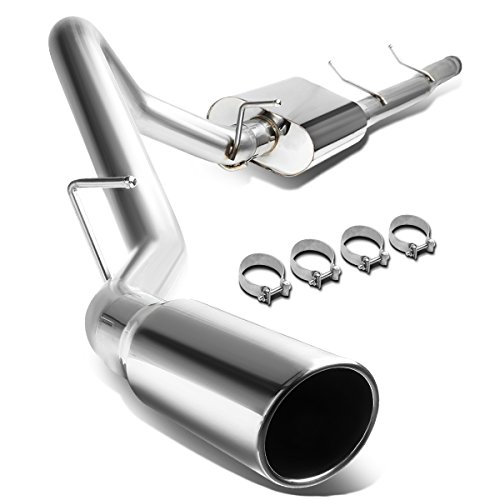
Where the resonator sits in the exhaust path
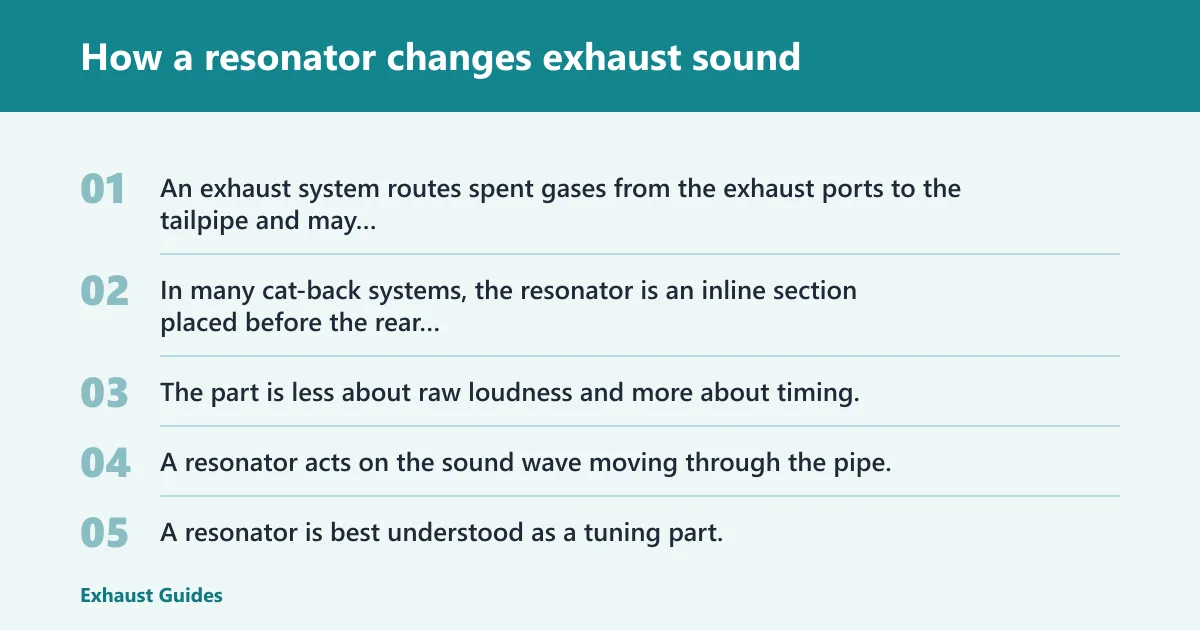
An exhaust system routes spent gases from the exhaust ports to the tailpipe and may include a catalytic converter, a middle silencer, a rear silencer, and a muffler to reduce noise. In many cat-back systems, the resonator is an inline section placed before the rear muffler or in the mid-pipe, where it can work on pressure pulses before they turn into cabin boom. (en.wikipedia.org)
That location matters. The part is less about raw loudness and more about timing. A resonator acts on the sound wave moving through the pipe, so placement changes which frequencies it trims and which ones keep going.
Frequency shaping versus overall volume reduction
A resonator is best understood as a tuning part. It works on a narrow part of the sound spectrum, often smoothing a raspy edge, trimming a metallic ring, or reducing a steady low-frequency cabin note that shows up in one rpm band.
A muffler usually does most of the broad noise reduction, because it knocks down sound energy across a much wider range of frequencies and operating conditions. If the complaint is “the whole car is too loud all the time,” a muffler change is often the first move. If the complaint is “it only booms on light throttle in top gear,” the resonator is often the better starting point.
Why one system gets smoother while another gets boomier
Two cars can run the same nominal pipe size and still react differently because resonance frequency depends on more than the resonator alone. Engine firing pattern, exhaust length, cabin volume, rear-floor shape, and where the tips exit all change what the driver hears.
This is why generic advice falls apart. A resonator that cleans up rasp on one 2.5-inch cat-back can leave a 3-inch setup boomy, while a chambered unit that fixes a narrow drone band on one car can make another sound flat without touching the real problem.
What causes exhaust drone at highway speed?
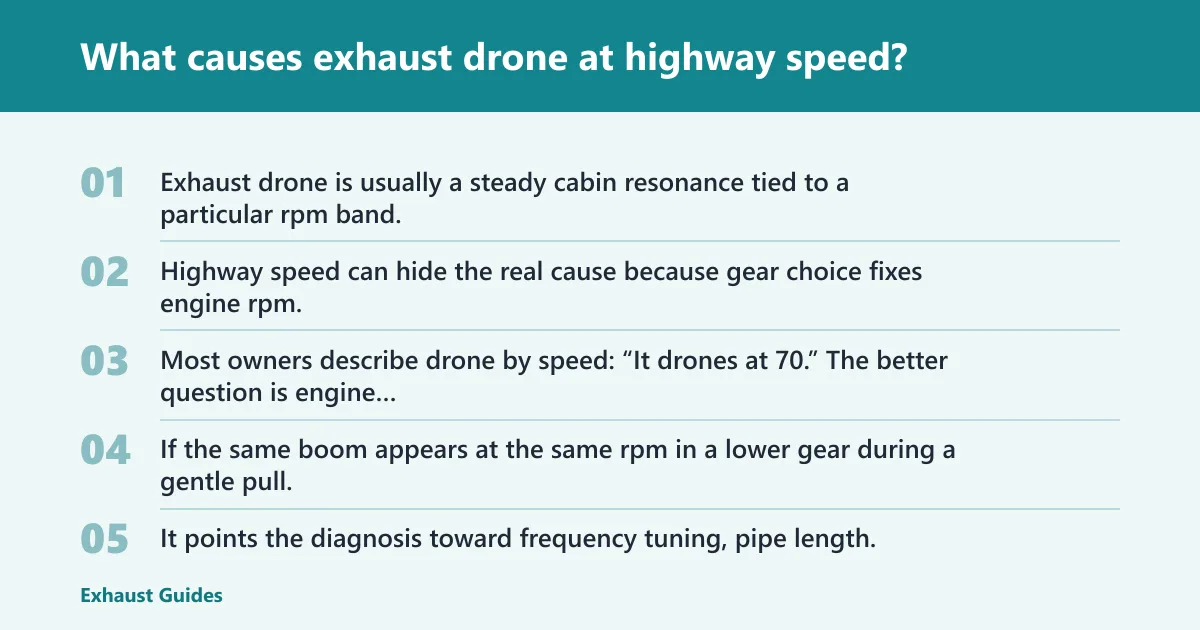
Exhaust drone is usually a steady cabin resonance tied to a particular rpm band, even if drivers notice it mainly at one road speed. Highway speed can hide the real cause because gear choice fixes engine rpm; the boom often follows rpm more than mph, and vehicle length plus exhaust length help determine where that boom lands.
RPM-dependent resonance versus road-speed diagnosis
Most owners describe drone by speed: “It drones at 70.” The better question is engine rpm in the gear used at that speed. If the same boom appears at the same rpm in a lower gear during a gentle pull, the issue is exhaust resonance, not tire noise or general road hum.
That distinction saves money. It points the diagnosis toward frequency tuning, pipe length, or muffler behavior instead of random parts swapping.
How exhaust length, cabin volume, and firing frequency interact
Internal combustion exhaust systems should be tuned for efficiency, and that tuning also affects sound behavior. Pressure pulses leave the engine at a rate tied to firing events, travel through the piping, reflect at bends and terminations, and can line up with a cabin resonance. When that happens, a low, steady boom fills the cabin.
Longer wheelbase vehicles and longer tail sections often shift the complaint lower in character. Shorter systems can move the annoyance upward into a buzzier range. Neither is “better.” The goal is to break the alignment between exhaust pulse behavior and the cabin’s natural tendency to amplify that note.
Low-frequency boom versus rasp and harshness
Low-frequency boom feels like pressure in the ears or chest and is often strongest in the rear seat, trunk floor, or under the cargo area. Rasp is different. It is higher in pitch, more metallic, and usually heard during throttle transitions or upper-rpm pulls rather than steady cruising.
That matters because a resonator that helps boom is not always the same one that helps rasp. Straight-through packed units usually smooth harshness well. Chambered resonators are often stronger when the complaint is a narrow, repeatable drone band.
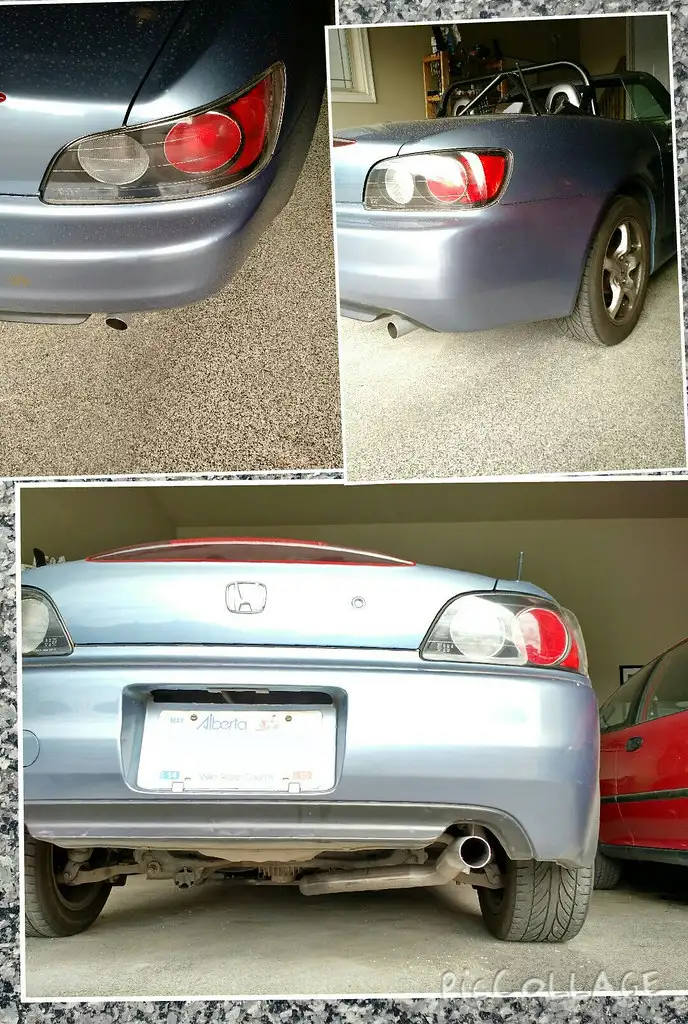
What is the difference between a resonator and a muffler?
A resonator targets selected frequencies and shapes tone, while a muffler is the primary noise-reduction part and cuts a broader spread of sound. If the problem is one annoying rpm band, start with resonator logic. If the whole exhaust is too loud everywhere, change the muffler first or pair both parts.
The resonator’s tuning job
Resonators are frequency tools. They are commonly installed in cat-back systems to trim a narrow boom, remove edge from a straight-through muffler setup, or calm a system that got coarse after a diameter increase.
Good resonator choices keep the character the owner likes. The car can keep its basic volume and still lose the cabin note that makes highway driving tiring.
The muffler’s primary noise-control job
An exhaust system can include a muffler to reduce noise, and that remains the main component for broad attenuation. Changing the muffler usually changes both volume and tone more than changing the resonator alone.
That wider effect can help or hurt. A quieter muffler may cure drone simply because it drops overall energy, but it can also remove the sharper, more open tone the owner wanted in the first place.
When one part can fix the problem and when both are needed
If the system is reasonably quiet except for a narrow drone band, a resonator is the cleaner fix. If the exhaust is loud at idle, loud on throttle, and still drones on the highway, the muffler is likely too aggressive for the layout and needs help or replacement.
Some combinations need both because the source is split: a broad-volume issue from the muffler and a narrow-frequency issue from the pipe and cabin interaction.
Which resonator type works best for drone control?
Straight-through resonators usually work best for smoothing rasp and taking the edge off a loud cat-back, while chambered resonators usually work better when drone sits in a narrow, repeatable rpm band. The better choice depends on engine character, pipe diameter, exhaust length, and whether the complaint is boom, rasp, or both.
Straight-through resonators
A straight-through resonator uses a perforated core with packing around it, commonly fiberglass or basalt-style packing. Gas flow stays relatively direct, so restriction is milder than with many reflection-based designs.
These units are often the right answer when the system sounds hard, tinny, or raspy after deleting a mid-pipe section or stepping from 2.25-inch to 2.5-inch pipe. They also help when the owner wants to keep a free-flowing muffler but remove the upper-frequency harshness that makes the car sound cheap.
Chambered resonators
Chambered resonators use reflection and cancellation to attack selected frequencies. They are more tone-specific and often more effective when the complaint is a steady boom in one band rather than a general roughness.
The tradeoff is narrower behavior. If the diagnosis is wrong, a chambered unit can miss the target and leave the owner with the same drone plus a changed overall note.
How engine type and system character change the choice
Small-displacement engines with short gearing often suffer from harshness and buzz before they suffer from deep boom. Those setups usually respond well to a straight-through resonator placed in the mid-pipe. Larger displacement setups, long-wheelbase cars, and some wagons or SUVs more often produce a lower cabin boom that points toward a chambered fix or a pipe-length change.
Layout matters outside passenger cars too. Truck exhaust systems can use a flexible metal section to reduce vibration transfer, and that idea carries over here: if the noise is partly structure-borne, a resonator alone may not solve it. The system also has to stop sending vibration into the body.
How pipe diameter and exhaust layout change tone and drone
What 2.25-inch, 2.5-inch, and 3-inch systems tend to do
Pipe diameter affects gas speed, backpressure, and sound character. A 2.25-inch system often keeps velocity up and tends to sound tighter. A 2.5-inch system is the common middle ground on many street builds. A 3-inch system often carries a bigger, slower-moving note that can tip into boom if the muffler and resonator pairing are too open.
Diameter alone does not decide quality. A well-matched 3-inch system can be calmer than a badly chosen 2.5-inch setup. But when diameter overshoots engine output and the rest of the cat-back stays simple, low-frequency energy often gets harder to control.
Cat-back routing, axle sections, and tip placement
Cat-back routing includes everything from the catalytic converter back. The axle section, over-axle bends, rear can location, and tip exit point all affect how sound reflects and leaves the car.
Rear exits that stop under the floor can feed more sound under the cabin. Longer tail sections can shift the perceived note. Small changes in where the resonator sits relative to the axle or muffler can move the bad band enough to matter.
Why diameter mismatch can beat any resonator choice
Some systems are noisy because the basic sizing is off for the engine and use case. Daily drivers and long-distance cruisers usually tolerate moderate sizing better than oversized pipe paired with a thin-wall straight-through muffler.
If the owner tows, carries family, or spends hours at fixed highway rpm, the system should be biased toward civility. That can mean stepping back from a 3-inch tail section, using a fuller muffler, or revising pipe length before trying multiple resonators.
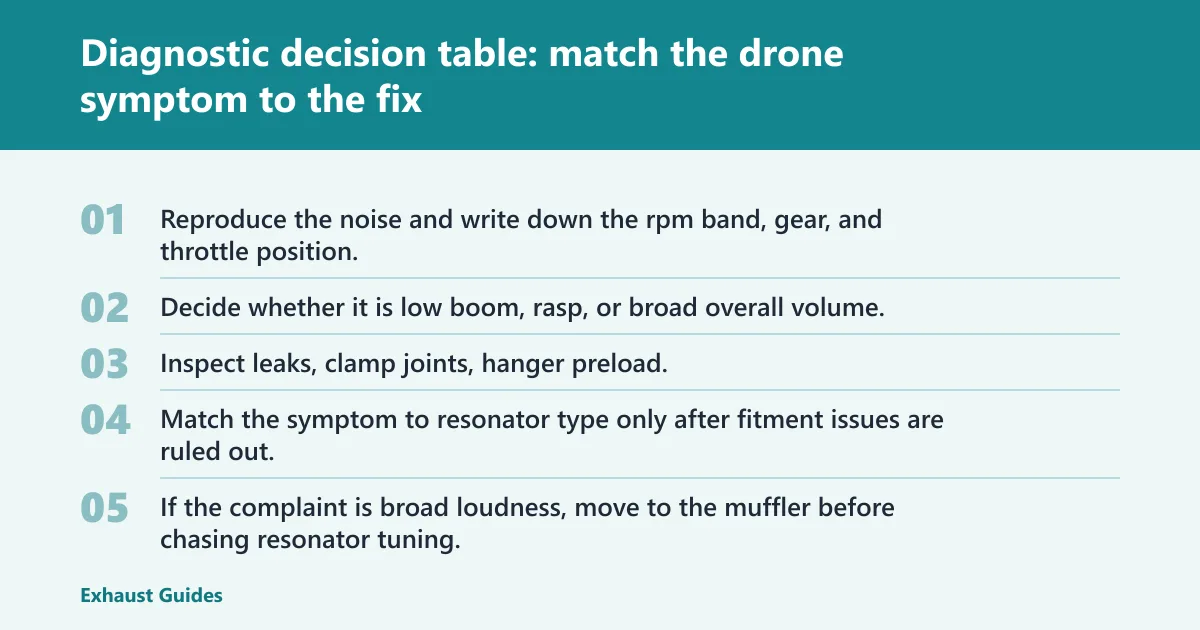
Diagnostic decision table: match the drone symptom to the fix
How to read the table
Use rpm band first, then cabin location, then layout. If the complaint repeats in the same rpm window across gears, it is a frequency problem. If the noise moves with road surface or appears only over bumps, inspect mounts and body contact before ordering any sound-control part.
| RPM band | Cabin location of boom | Exhaust layout | Likely cause | Resonator type to try | When to change muffler or pipe length instead |
|---|---|---|---|---|---|
| 1,800-2,200 | Rear seat and trunk floor | 2.5-inch cat-back, straight-through rear muffler, rear exit | Narrow low-frequency cabin resonance | Chambered resonator in mid-pipe ahead of axle | If the system is loud at all rpm, change to a fuller muffler first |
| 2,000-2,400 | Whole cabin with ear pressure | 3-inch cat-back, minimal resonation control | Pipe size and muffler combination pushing too much low-frequency energy | Large straight-through resonator only if volume is otherwise acceptable | If boom stays broad, revise muffler and consider smaller rear section or length change |
| 2,400-3,000 | Front floor and shifter area | 2.25-inch or 2.5-inch system with mid-pipe delete | Harsh upper-mid resonance and rasp | Straight-through packed resonator | If noise is still sharp under load, muffler is too open or too small |
| 1,500-1,900 | Cargo floor on wagon, hatch, or SUV | Long rear overhang, rear muffler close to bumper | Body cavity amplifying a low note | Chambered resonator placed farther forward | If boom changes with tip position, revise tailpipe length before muffler swap |
| 2,100-2,700 | Right under driver seat | Clamp-on add-on section, recent exhaust work | Leak, hanger preload, or pipe contact mimicking drone | None until fitment is corrected | Change parts only after leak-free alignment and hanger reset |
| 3,000 and up | Mostly audible outside, not a cabin boom | Small engine, free-flow cat-back, straight muffler | Rasp rather than drone | Straight-through packed resonator | If overall volume is excessive, pick a quieter muffler as well |
Practical troubleshooting flow
- Reproduce the noise and write down the rpm band, gear, and throttle position.
- Decide whether it is low boom, rasp, or broad overall volume.
- Inspect leaks, clamp joints, hanger preload, and any pipe touching the body or heat shields.
- Match the symptom to resonator type only after fitment issues are ruled out.
- If the complaint is broad loudness, move to the muffler before chasing resonator tuning.
- If a narrow drone survives, adjust resonator placement or pipe length next.
Can you add a resonator to an existing exhaust system?
Yes, a resonator can usually be added to an existing stock or aftermarket cat-back if pipe diameter, length, and clearance are checked first. Weld-in versions give the cleanest fit. Clamp-on versions work when space is tight or future reversibility matters, but alignment and leak control become even more important.
Weld-in versus clamp-on
Weld-in units are easier to package cleanly and usually reduce the chance of small leaks at the joints. Clamp-on versions make sense for owners still tuning the system or keeping the option to revert later.
Either style can work. The key is a straight, centered install with enough insertion depth, no twisting preload on the hangers, and no section pulled into the tunnel under tension.
Placement strategy on a stock or aftermarket cat-back
Mid-pipe placement is common because it gives the resonator a broad influence before the sound reaches the rear section. On systems with axle-back changes only, adding a resonator farther forward often works better than stuffing another can at the back.
Placement is part of the tune. A chambered resonator too far rearward may miss the rpm band that matters, while a straight-through resonator too close to the muffler may smooth tone without touching the boom.
Fitment checks that matter
Pipe diameter must match. The common street sizes of 2.25-inch, 2.5-inch, and 3-inch are close enough to tempt bad adapters, but poor transitions can create noise and flow problems that a resonator cannot fix.
Check clearance around crossmembers, heat shields, the axle path, and the floor. Hanger and clamp fitment matters because misalignment can load the system sideways, transfer vibration, or leave a tiny leak that sounds like drone. Weld-in or clamp-on, the result must be leak-free.
Does a resonator hurt performance or horsepower?
On typical street cars, a properly sized resonator changes sound far more than it changes power. Straight-through designs usually have milder restriction than chambered designs, but sizing and layout matter more than the presence of a resonator alone. Poor diameter choices and bad transitions create bigger performance penalties than a well-chosen tuning section.
What changes on normal street setups
Most owners will hear the acoustic difference first and may never feel a measurable power change from the resonator itself. The larger effect comes from whether the whole system is matched to the engine and whether the exhaust system is tuned for efficiency.
That is why chasing peak-flow thinking on a daily driver often backfires. A barely controlled 3-inch system can sound tiring and offer no useful street benefit over a calmer 2.5-inch setup.
Straight-through versus chambered restriction
Straight-through resonators keep the path more direct, which is why they are favored when the goal is to preserve the current character and trim harshness. Chambered units trade some of that simplicity for stronger cancellation in a narrower range.
Neither is automatically wrong. The better part is the one that fixes the real complaint without forcing a bigger compromise elsewhere.
When sizing matters more than the resonator
If the system necks down abruptly, uses poor adapters, or has a muffler and resonator combination that fights the engine’s needs, the resonator gets blamed for a problem it did not create. Start with the basics: diameter match, smooth routing, and enough clearance.
What to do when drone remains after a resonator install
If drone remains after a resonator install, first confirm the rpm band did not simply move. Then separate acoustic drone from structure-borne vibration by checking hangers, clamps, leaks, and pipe-to-body contact. If the symptom is still true exhaust resonance, adjust placement next, then consider a muffler swap or pipe-length revision.
Recheck the symptom before buying again
A failed fix is sometimes a shifted fix. The boom that was at 2,000-2,300 rpm may now sit slightly lower or higher, which means the resonator did something but did not center on the problem frequency.
Record the new band and compare it to the old one. That tells the next step.
Inspect structure-borne vibration points
Look for hanger rods pulled sideways, clamps clocked against brackets, a pipe resting near the subframe, or a heat shield buzzing under load. Some truck exhausts use a perforated metal sheath around the silencer, and some also use a flexible metal section to reduce vibration transfer. The lesson carries over: vibration control is part of noise control.
If the noise is strongest through the seat or floor rather than the ears, do not assume the resonator choice was wrong. The exhaust may be touching the car.
Escalate in the right order
Start with install cleanup. Then move the resonator strategy. Then change the muffler or pipe length if needed.
- Fix leaks, clamp alignment, and hanger preload.
- Verify the resonator matches the symptom: straight-through for rasp, chambered for a narrow boom band.
- Change resonator placement if the rpm band shifted but did not disappear.
- Swap the muffler if the system is too loud broadly, not just in one band.
- Revise pipe length or rear section sizing if the drone is baked into the layout.
Frequently asked questions
What does a resonator do to exhaust sound?
A resonator changes specific parts of the exhaust note rather than simply making the whole system quieter. It can smooth rasp, trim metallic harshness, and reduce a narrow highway drone band. In most cat-back setups, it acts like a frequency filter placed inline in the pipe.
Does removing the resonator make the car louder?
Usually, yes. Removing the resonator often increases volume, adds edge, and can bring back rasp or boom that was previously controlled. Whether the result is tolerable depends on muffler design, pipe diameter, and layout, but resonator deletes commonly make daily driving less pleasant at steady cruise.
Will a resonator reduce exhaust drone at highway speed?
Often, yes, if the noise is true exhaust drone tied to a repeatable rpm band. A resonator works best when the complaint is a steady cabin boom during light-throttle cruising. It works less well when the real problem is broad muffler loudness, a pipe touching the body, or a clamp leak.
What is the difference between a resonator and a muffler?
A resonator is mainly a tuning part that targets selected frequencies and shapes tone. A muffler is the main noise-control part and reduces sound more broadly. If the system is annoyingly loud everywhere, start with the muffler. If it only booms in one rpm range, start with the resonator.
How do I know if I need a resonator, muffler, or both?
Use the symptom. Narrow boom at one highway rpm points to a resonator. Sharp rasp under acceleration points to a straight-through packed resonator. Loudness at idle, cruise, and throttle points to the muffler. If the system is loud overall and still drones in one band, both parts may need attention.
Can I add a resonator to an existing exhaust system?
Yes, in most cases a resonator can be added to a stock or aftermarket cat-back. The job is easiest when there is straight pipe available in the mid-section. Match the pipe diameter, check clearance, and install it without leaks or hanger preload, or the new part may solve nothing.