How Much Does a Catalytic Converter Replacement Cost?
A catalytic converter replacement usually costs $1,000 to $3,500. Stolen vehicles can cost more, and some OEM units may exceed $4,000. A failed converter can trigger emissions failure, warning lights, poor performance, and fines in states with inspection rules. This guide breaks down diagnosis, converter type, labor access, emissions law, and why theft often changes the bill.
This guide is part of our How exhaust resonators affect sound and drone series.
Typical cost range
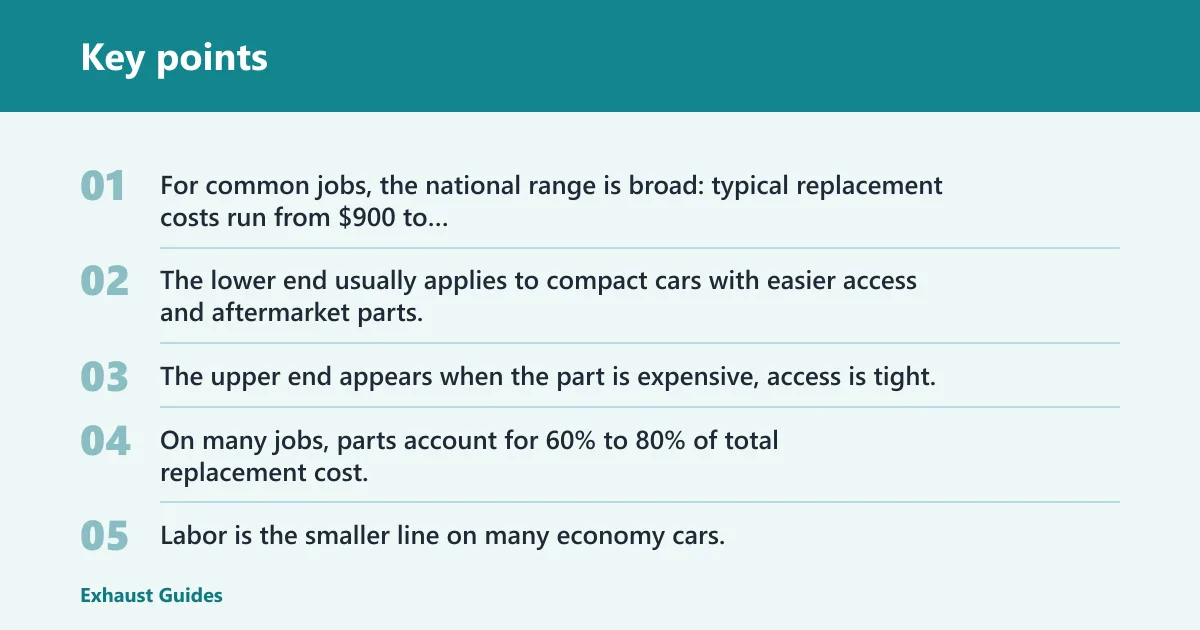


For common jobs, the national range is broad: typical replacement costs run from $900 to $2,500, with RepairPal estimating a full replacement at $2,123 to $2,459 and ConsumerAffairs reporting replacements from $933 to $4,414. The lower end usually applies to compact cars with easier access and aftermarket parts. The upper end appears when the part is expensive, access is tight, or the vehicle needs emissions-compliant hardware.
Parts usually make up most of the invoice. On many jobs, parts account for 60% to 80% of total replacement cost, so a quote can move a lot before labor changes much. Labor is the smaller line on many economy cars, but it can grow quickly when the converter is welded in, rusted hardware has to be cut off, or the exhaust layout leaves little room to work.
Say your compact sedan needs a direct-fit aftermarket converter, one upstream oxygen sensor, and basic gaskets. That can land much closer to the lower end than a luxury SUV with a manifold-mounted converter, shield damage, and CARB compliance requirements.
Why is the bill so different from one car to another?
Vehicle make and model matter because they change the part price, labor time, and legal replacement options. For a certified fit on a common car, an economy or compact model often totals about $700 to $1,600. Mid-range sedans or crossovers often total about $950 to $1,800. Luxury, OEM, or high-performance models can reach $1,800 to $4,000+.
Older cars can cost less if the exhaust is simple and parts are widely available. Newer cars can cost more because the converter may be integrated with the manifold, surrounded by heat shielding, or paired with multiple sensors that must be checked during diagnosis. Imported and performance vehicles often carry a premium because of part pricing and tighter packaging.
Some converters are part of the manifold assembly. That design can turn a part swap into a more time-consuming exhaust job, especially if the fasteners are corroded or the unit has to be removed in a cramped bay. A simple bolt-in replacement and a manifold-integrated unit do not price out the same way.
Catalytic converter quote checklist
| Quote item | Common cost bucket | Often on theft jobs? | Often on failure jobs? |
|---|---|---|---|
| Part | $200 to $2,500+ depending on type | Yes | Yes |
| Labor hours | 1 to 4+ hours, depending on access | Yes | Yes |
| O2 sensors | $75 to $250 each, plus labor | Often | Sometimes |
| Gaskets, hardware | $20 to $150 | Often | Often |
| Heat shields | $50 to $300 | Often | Sometimes |
| Diagnostics | $100 to $200+ | Sometimes | Yes |
| Tax | Varies by location | Yes | Yes |
| Emissions-compliance surcharge | Varies when CARB or other compliance rules apply | Sometimes | Sometimes |
Use the table as a line-item check, not a shopping list. A theft quote often includes missing pipe sections, damaged shields, and cut wiring. A failure quote is more likely to include diagnostics and a deeper check of sensors, leaks, and fueling faults before the part is replaced.
OEM, aftermarket, or universal?
OEM converters are usually the highest-priced option, but they are built to match the vehicle’s original emissions system and fitment. OEM converters are listed at $800 to $2,500, and OEM converters on mainstream vehicles are listed at $1,200 to $2,500 installed. They are often the safer fit when the vehicle is under emissions scrutiny or has a tighter packaging layout.
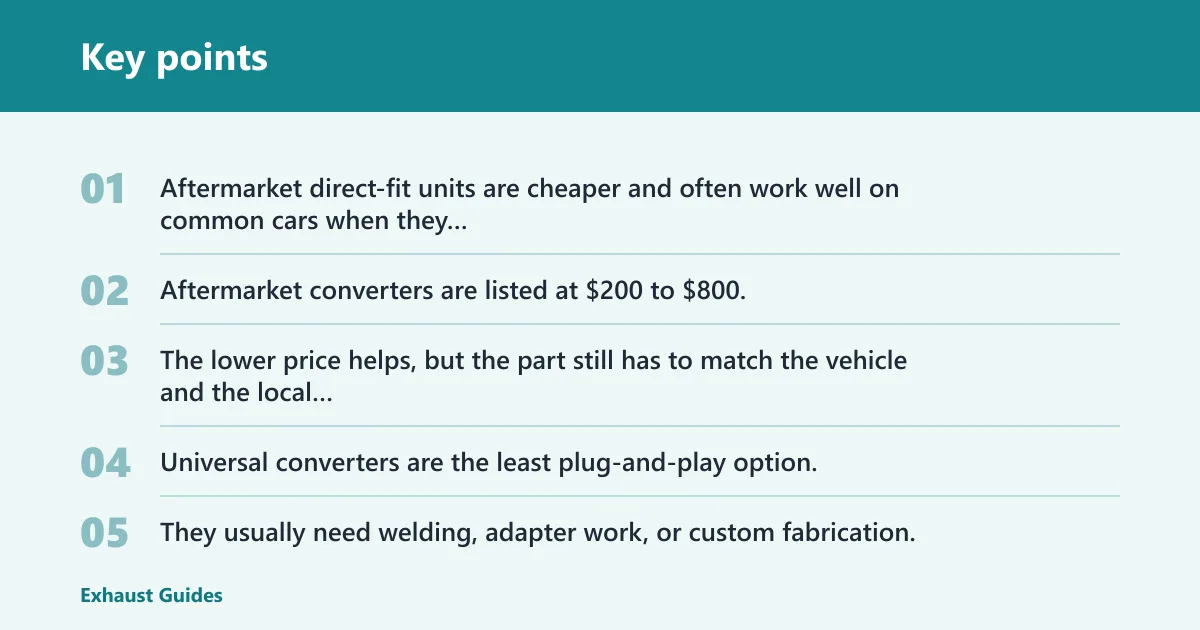
Aftermarket direct-fit units are cheaper and often work well on common cars when they are properly certified for the application. Aftermarket converters are listed at $200 to $800, and quality aftermarket direct-fit converters on common cars can be $500 to $1,200 installed. The lower price helps, but the part still has to match the vehicle and the local emissions rules.
Universal converters are the least plug-and-play option. They usually need welding, adapter work, or custom fabrication, which shifts cost from the part to labor. That can fit some older vehicles, but it adds risk if the shop has to adapt the exhaust to make the converter work correctly.
Do not assume any aftermarket part is legal everywhere. EPA rules allow replacement parts only when they meet applicable federal requirements, and CARB states require CARB-compliant converters for covered vehicles. The cheapest part can become the wrong part if it does not meet the local rule set.
How do labor and access change the total?
Labor commonly adds $100 to $300 on economy cars, and it can rise to $200 to $500+ on luxury or performance vehicles. Shop hourly rates and install time both matter, but access is often the hidden variable. A bolt-in converter on a clean, accessible exhaust is very different from a rusted, heat-shielded assembly tucked above a subframe.
Rusty fasteners, broken studs, and seized flange bolts can add time quickly. If the converter is welded in, the shop may have to cut the old section out and weld in the new one. That is not fraud; it is the cost of making the exhaust fit and seal correctly.
Picture a crossover with an oxygen sensor directly before the converter and a second sensor after it. If the rear sensor threads are corroded, the quote can rise even if the converter part itself is ordinary. The labor is carrying the bill, not just the part price.
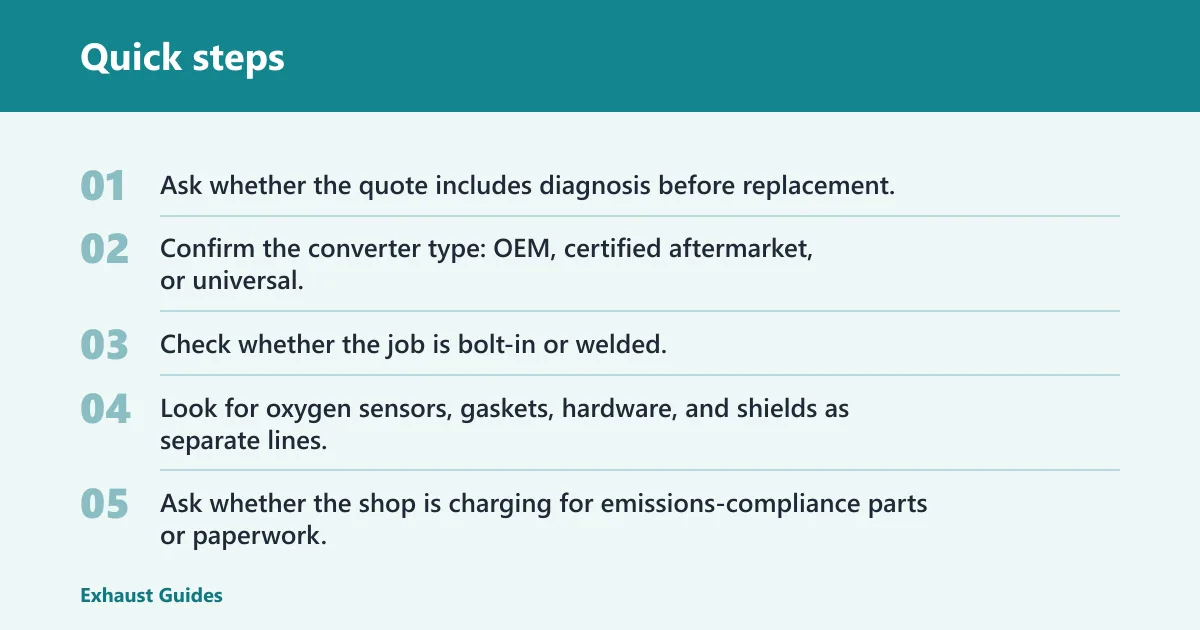
- Ask whether the quote includes diagnosis before replacement.
- Confirm the converter type: OEM, certified aftermarket, or universal.
- Check whether the job is bolt-in or welded.
- Look for oxygen sensors, gaskets, hardware, and shields as separate lines.
- Ask whether the shop is charging for emissions-compliance parts or paperwork.
Does theft change the replacement cost?
Yes. Theft jobs often cost more because the damage is different. A stolen converter may leave cut pipe sections, missing heat shields, damaged oxygen sensors, or exposed wiring. That is why theft replacement jobs can reach $1,500 to $3,500+, even when the underlying vehicle would have been cheaper to repair after a normal failure.
A common first-timer mistake is comparing a theft quote to a failure quote as if they were the same job. They are not. If the pipe was cut, the shop may need extra tubing, clamps, shields, or welding time just to restore the exhaust path before the new converter can be installed.
Theft also changes the inspection of the rest of the system. If the sensors were ripped out or the wire wiring damaged, the bill can include parts that would never appear on a routine converter failure. That is one reason theft estimates deserve a close line-by-line review.
Will insurance or warranty pay?
Comprehensive insurance may cover a stolen catalytic converter, but the deductible usually applies, and claim approval depends on the policy. For some owners, the payout is still useful; for others, the deductible is close enough to the repair cost that filing a claim may not help much. The claim details matter.
Federal emissions warranty coverage can also matter, but it is not automatic for every failure. Warranty eligibility depends on the vehicle’s age, mileage, and the specific emissions component involved. A shop can document the failure, but it cannot promise coverage. If the vehicle is still within the manufacturer’s emissions warranty window, that may reduce or eliminate the out-of-pocket bill.
Shops often note whether the converter failure may involve a covered emissions item, but they still need diagnosis first. Exhaust leaks, misfires, coolant burning, or fueling faults can damage a new converter if they are not fixed first. Replacing the part without correcting the cause can create a repeat failure.
Frequently asked questions
How much does a catalytic converter replacement cost?
Most owners should budget about $1,000 to $3,500, with lower-cost compact-car jobs below that and high-end, OEM, or theft-related repairs above it. Typical replacement costs range from $900 to $2,500. The final bill depends on part type, labor access, emissions rules, and whether the converter was stolen or simply failed.
Why is catalytic converter replacement so expensive?
The expense comes from the part and the labor around it. Parts usually account for 60% to 80% of total replacement cost, and the converter itself contains precious metals that affect pricing. Add diagnosis, sensors, gaskets, rusted hardware, and emissions-compliance rules, and the invoice can climb fast.
Does labor or parts cost more for a catalytic converter?
Parts usually cost more than labor on many jobs. That is especially true for OEM or CARB-compliant units. Labor becomes the bigger variable when access is poor, fasteners are rusted, or the converter is welded into the exhaust. In those cases, the labor line can move the estimate more than the shop rate alone suggests.
How much does an OEM catalytic converter cost vs aftermarket?
Will insurance cover a stolen catalytic converter?
Comprehensive coverage may cover theft, but the deductible reduces the payout. The claim can also include related damage such as cut pipe sections, missing shields, or sensor damage. If the deductible is high, the insurer may pay less than the full repair cost, so the claim is worth checking before filing.
Do CARB-compliant catalytic converters cost more?
Yes. CARB-compliant converters can cost $1,000 to $3,000+ because they must meet stricter state rules and often carry more limited fitment options. They are required in California and adopting states for covered vehicles. A lower-cost federal part may not pass inspection or may not be legal for that application.
Can I drive with a bad catalytic converter?
Short trips may be possible, but it is not a good long-term plan. A bad converter can trigger warning lights, reduced performance, and emissions-test failure. If the cause is an exhaust leak or engine fault, driving without repair can make the converter fail again after replacement.
Is it worth replacing a catalytic converter on an older car?
Sometimes, but not always. If the car is otherwise sound and the repair cost is still below the vehicle’s value, replacement can make sense. If the bill is near $1,800 to $4,000+ on an older car, a careful comparison against the car’s market value and the condition of the rest of the exhaust system is the smarter move.