Exhaust Back Box Replacement Cost
A common UK exhaust back box replacement price is about £120 to £350 fitted for a standard car, with dealer quotes often higher because of OEM parts and higher labour rates. Custom or stainless parts can push the bill beyond £500. Repairing a rotten back box can also fail to solve louder exhaust noise, an MOT issue if the exhaust leaks or is insecure, and extra labour if clamps, hangers, or the rear section need work. This guide breaks down the price, the parts that change it, and when repair still makes sense.
What is an exhaust back box?
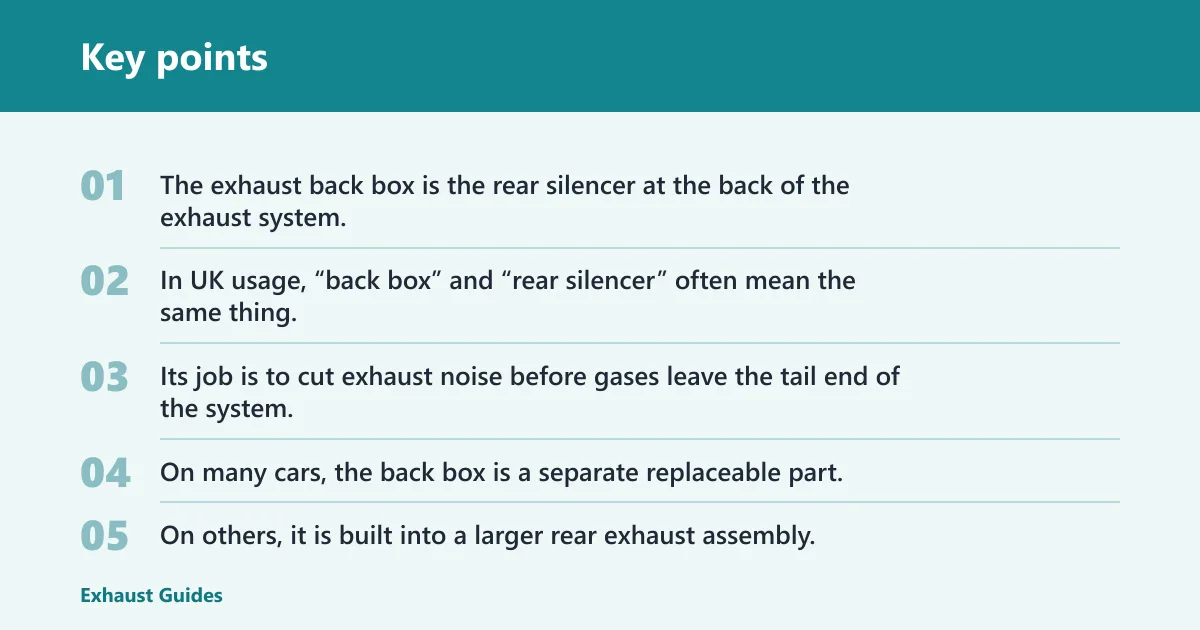


The exhaust back box is the rear silencer at the back of the exhaust system. In UK usage, “back box” and “rear silencer” often mean the same thing, while “muffler” is the common overseas term. Its job is to cut exhaust noise before gases leave the tail end of the system.
On many cars, the back box is a separate replaceable part. On others, it is built into a larger rear exhaust assembly, so you may be quoted for more than one section even if the fault is only at the rear.
Where it sits in the exhaust
The back box is typically the rearmost silencer, located near the tailpipe at the back of the car. The exact layout varies by vehicle, but this section is usually low down and exposed to road spray, salt, and debris, which is why corrosion is so common on older cars.
Why some cars do not have a separate back box
Some exhaust layouts use a combined rear section instead of a standalone silencer. In that case, a garage may need to replace the rear pipe and rear box together, which pushes the quote up even if only one part looks corroded.
How much does back box replacement cost?
For a plain fitted replacement, a practical UK budget is often £120 to £350, but the final bill depends on the part, the labour time, and whether fasteners fight back. Real-world quote data from major UK garage marketplaces shows a wide spread: FixMyCar lists an average exhaust back box repair quote of £148.08, while Bumper says back box repair prices can range from £150 to £1,500 depending on vehicle type and parts choice.
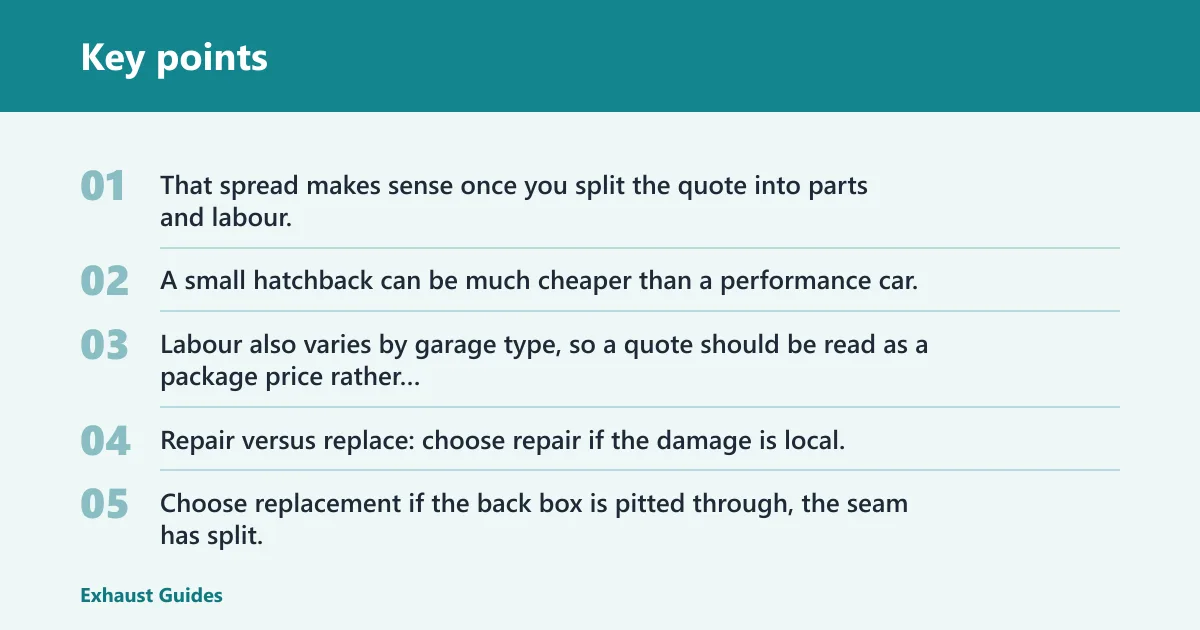
That spread makes sense once you split the quote into parts and labour. A small hatchback can be much cheaper than a performance car, and a dealer quote for an OEM part usually lands above a specialist’s pattern-part repair. Labour also varies by garage type, so a quote should be read as a package price rather than a single number.
Back box cost table
| Vehicle type | Parts only | Fitted at an independent garage | Fitted at a specialist | Fitted at a dealer | Seized-fastener surcharge | Example fitted total |
|---|---|---|---|---|---|---|
| Small hatchback / city car | £90 to £170 | £160 to £250 | £180 to £290 | £230 to £360 | £0 to £60 for cut-offs, drilled fixings, or replacement clamps/hardware when bolts are rusted solid | £160 to £360 |
| Family hatchback | £140 to £260 | £220 to £360 | £250 to £420 | £320 to £520 | £0 to £80 for extra labour to remove seized clamps, brackets, or hangers | £220 to £550 |
| Large car / SUV | £180 to £340 | £280 to £460 | £320 to £560 | £400 to £660 | £20 to £100 where corroded rear fixings slow removal or require additional hardware | £330 to £660 |
| Performance car | £380 to £1,500 | £520 to £1,900 | £600 to £2,050 | £700 to £2,150 | £30 to £150 for seized studs, special-order fittings, or extended removal time | £650 to £2,150 |
Repair versus replace: choose repair if the damage is local, the surrounding metal is still sound, and the quote is mainly for labour and a small fix. Choose replacement if the back box is pitted through, the seam has split, the shell is soft, or the rear section is insecure. A good quote should make that distinction clear before work starts.
The table above is a quote-builder, not a fixed price list. It reflects the way UK marketplace pricing typically separates common cars from larger or performance models, and it allows for labour variation consistent with typical exhaust fitting cost ranges. The seized-fastener surcharge covers the extra time and parts needed when rusted bolts, clamps, or hangers have to be cut off, heated, or replaced rather than simply undone.
Dealer quotes are often higher because they may use OEM parts, charge a higher hourly rate, or insist on replacing more of the rear section. A specialist may fit a pattern part, free up a seized clamp, and return the car for less. A local garage can sit between the two, especially if the job is simple and the rear pipe comes off cleanly.
For example, a small hatchback that starts sounding noticeably louder after a wet winter may only need a rear silencer section, a clamp, and labour if the corrosion is local. If the flange is welded solid with rust, the same job can turn into a longer fitting session with a higher bill.
What affects the final quote?
The biggest quote drivers are part type, garage type, and how much corrosion is under the car. OEM parts from a dealer usually cost more than pattern parts from a specialist. If the car needs extra fittings, the quote rises again. That is why back box pricing is best compared as a total repair, not just a part price.
OEM versus aftermarket parts
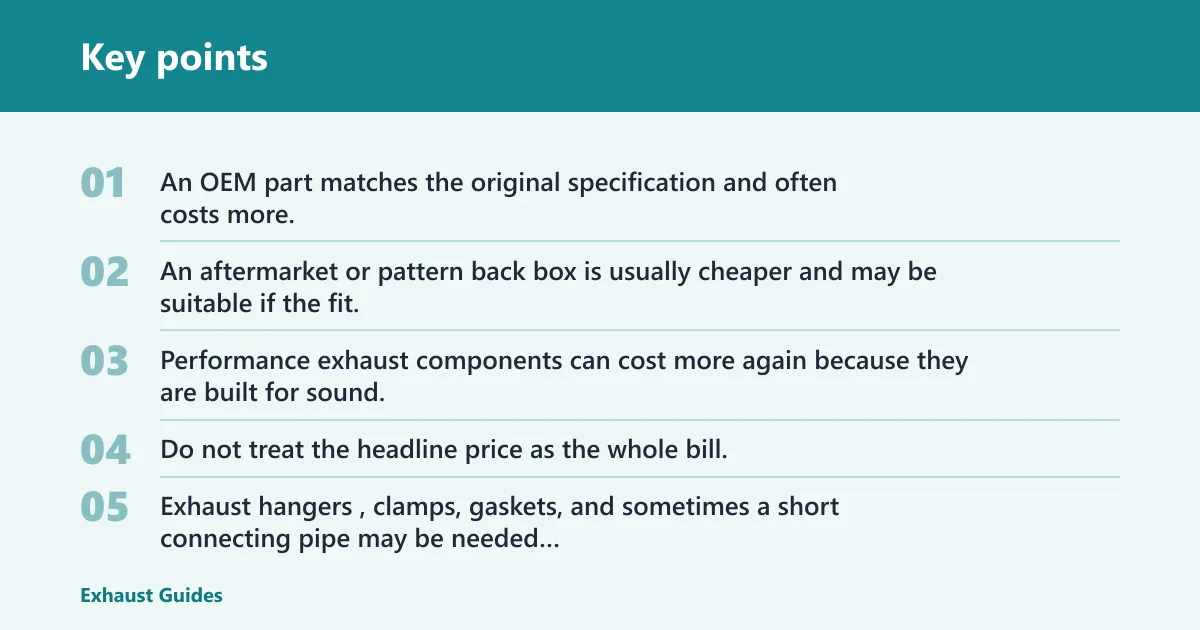
An OEM part matches the original specification and often costs more. An aftermarket or pattern back box is usually cheaper and may be suitable if the fit, hanger positions, and pipe diameter match the car. Performance exhaust components can cost more again because they are built for sound, flow, or stainless durability rather than simple replacement.
Clamp, hanger, and gasket extras
Do not treat the headline price as the whole bill. Exhaust hangers, clamps, gaskets, and sometimes a short connecting pipe may be needed if the old fixings are bent, split, or too corroded to reuse. These extras can turn a fair quote into an expensive one, or a high-looking quote into a sensible one if several parts are due anyway.
Corrosion, rust, and seized fixings
Back boxes often rust from road salt, moisture, and debris. Short trips make it worse because condensation sits inside the exhaust and does not get hot enough to dry out fully. Surface rust can stay cosmetic for a while, but pitting and rot are a sign the metal is thinning and may soon split.
Suppose a family hatchback has a rusty rear silencer and a clamp that will not undo. The first quote may look modest, but once the garage has to cut the fixings and replace the clamp and gasket, the labour line moves up. That is normal, and it is why a clean inspection matters before you agree to the work.
Parts sourcing and workshop type
Parts availability changes the price as much as labour does. A common small car may have many pattern options, while a less common SUV or performance model may need an OEM rear section, a special order, or a whole assembly from the dealer. That is why two quotes for the same symptom can differ by a wide margin.
Repair or replace the back box?
Repair can be cheaper when the damage is local and the metal around it is still sound. Welding, patching, or sealing may work on some cars, but once the shell is pitted through or the seam has opened up, replacement is usually the better call. A full rear section is often the safer choice when the rot has spread to the hangers or joints.
When welding or patching can work
A small hole, a split seam, or a leaking joint can sometimes be repaired if the surrounding metal is still solid. This is more likely on cars where the back box is separate and the damage is limited to one part of the shell. A simple exhaust leak weld or gasket replacement can be far cheaper than a full rear box swap, especially when the vehicle’s structure and fittings are otherwise sound.
When replacement is the safer call
If the box is rotted, loud, or insecure, replacement is usually the better use of money. Once corrosion reaches a point where the shell is soft or the seam has gone, a patch may buy little time. In that case, the quote should cover the correct rear silencer, the fittings, and any corroded hardware that must be removed.
A common mistake is asking for “just a weld” when the back box has visible separation around the seam and flakes of rust falling off. That can lead to a short-lived repair and a second bill soon after. A proper inspection should tell you whether the pipe, box, or rear section needs attention.
How to judge a rear section quote
Ask whether the quote is for the back box only or for the rear exhaust section as a whole. If the price includes hangers, clamps, and gaskets, it may be better value than a cheaper quote that leaves those parts out. If the garage says the repair is possible but not durable, replacement is usually the more honest spend.
Can you drive with a damaged back box?
You may be able to move the car short distances, but a damaged back box should not be treated as harmless. A leak can make the car louder, can fail an MOT if the exhaust leaks or is insecure, and can let fumes enter the cabin in some cases. The DVSA MOT inspection manual requires an exhaust to be secure and free from excessive leakage, so a damaged rear silencer can become a roadworthiness problem quickly.
Noise and road-legal concerns
A broken rear silencer often makes the car much louder than normal. If the exhaust is blowing or hanging loose, the car may also attract attention from noise enforcement and inspection checks. Loud exhaust noise is one of the clearest signs the back box has failed, and reducing exhaust noise usually means fixing the leak rather than hoping it settles down.
Carbon monoxide and cabin fume risk
Exhaust gas should stay outside the car. If a leak sits near the rear floor or the system has separated, fumes can enter the cabin, especially with windows shut and the ventilation set to recirculation. GOV.UK and major motoring organisations consistently warn that exhaust leaks are a safety issue, not only a noise issue.
Possible warning lights and sensor faults
On some cars, exhaust leaks can alter sensor readings enough to trigger warning messages. That does not always mean the sensor is broken. It can mean the leak is disturbing exhaust flow or the readings used by the engine management system.
Quote checklist
Before you book, make sure the quote tells you exactly what you are paying for. The same car can produce very different prices depending on the part number, the labour time, and whether the garage has allowed for rusted fixings. A clear quote is the easiest way to compare like for like.
- Ask whether the quoted part is OEM or aftermarket.
- Check the exact back box or rear silencer part number.
- Confirm whether labour includes seized bolts or cut-off fixings.
- Check if clamps, gaskets, and hangers are included.
- Ask whether the quote covers disposal of the old exhaust section.
- Compare at least two garages using the same part type.
Frequently asked questions
How much to replace exhaust back box uk
For many UK cars, a back box replacement sits around £120 to £350 fitted, but the exact figure depends on the car and the part used. Small hatchbacks tend to be cheaper, while SUVs, dealer quotes, and performance parts can push the price well above that range.
How much is a new exhaust back box?
A new exhaust back box can be inexpensive on a common small car or much pricier on a performance model. Marketplace data shows small hatchback and city car back box costs around £150 to £200, family hatchbacks around £220 to £350, large cars and SUVs around £230 to £420, and performance cars around £520 to £1,800.
Is it cheaper to repair or replace a back box?
Repair is cheaper when the rust is local and the shell is still strong enough to weld or patch. Replacement makes more sense when the metal is pitted through, the seam has opened up, or the rear silencer is insecure. If the leak is minor, a simple weld or gasket job may save money.
Can I drive with a broken exhaust back box?
Short trips may be possible, but it is not a good idea to keep driving it. A broken back box can be noisy, can fail inspection if the exhaust leaks or hangs loose, and can let fumes into the cabin. If the car sounds suddenly much louder, book a repair promptly.
What affects exhaust back box replacement cost
Vehicle type, part brand, garage type, and corrosion all change the bill. Dealer OEM parts usually cost more than pattern parts, and seized bolts or corroded hangers can add labour time. If the rear section needs clamps, gaskets, or extra pipework, the quote rises again.
Does car model change the back box replacement price?
Yes. A small hatchback usually costs less than a family car, SUV, or performance model because the part is smaller, easier to source, and quicker to fit. Some cars also do not have a separate back box, so the quote may cover a larger rear exhaust assembly instead of one silencer.