How Much an Exhaust System Replacement Should Cost?
A fair exhaust system replacement usually costs about $300 to $1,500, though it can sometimes run about $2,000 or more on newer cars or complete systems; if a quote is far outside that, ask what parts and labor it includes. Bad estimates often push you into paying for sections you do not need. This guide shows how to judge full-system and section-by-section quotes, spot missing line items, and decide when repair beats replacement.
Quick answer on exhaust replacement cost
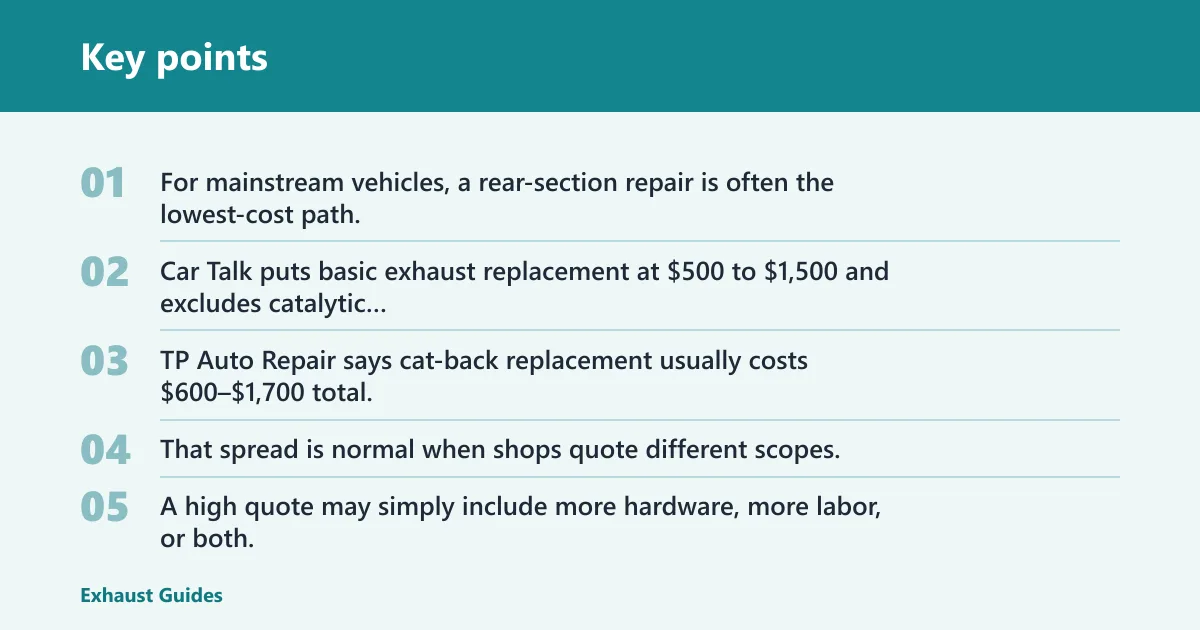


For mainstream vehicles, a rear-section repair is often the lowest-cost path, while a cat-back or full-system quote climbs quickly once a catalytic converter, manifold, or rust work is included. Car Talk puts basic exhaust replacement at $500 to $1,500 and excludes catalytic converters and manifolds from that range.
TP Auto Repair says cat-back replacement usually costs $600–$1,700 total, full systems with catalytic converters can cost $1,200–$3,500+, and diesel systems can reach $2,500–$5,500+. That spread is normal when shops quote different scopes. A high quote may simply include more hardware, more labor, or both.
Why a quote can jump fast on rusted vehicles or converter jobs
Rust changes the job. A clean bolt-on rear section can be a quick swap, but seized clamps, broken studs, welded joints, and damaged hangers add labor and parts. Catalytic converter work also adds cost because the part itself is expensive and emissions rules can limit which replacement is legal.
Suppose a 10-year-old sedan needs only a muffler and rear pipe. That should not be priced like an integrated manifold-converter assembly on a newer crossover. If the estimate jumps several hundred dollars, ask which section is being replaced and whether the converter, O2 sensor, and gaskets are actually included.
What a fair estimate should state up front
A fair estimate should name the exact scope, list parts separately, and show labor hours or a labor total. It should also say whether the job includes clamps, gaskets, hangers, shop supplies, disposal fees, and any sensors or hardware that must come off to finish the repair.
If the shop only writes “full exhaust” or “replace exhaust system,” that is too vague. A clear quote should tell you whether it means axle-back, cat-back, manifold-back, or the entire system from the manifold/downpipe to the tailpipe.
What counts as an exhaust system replacement
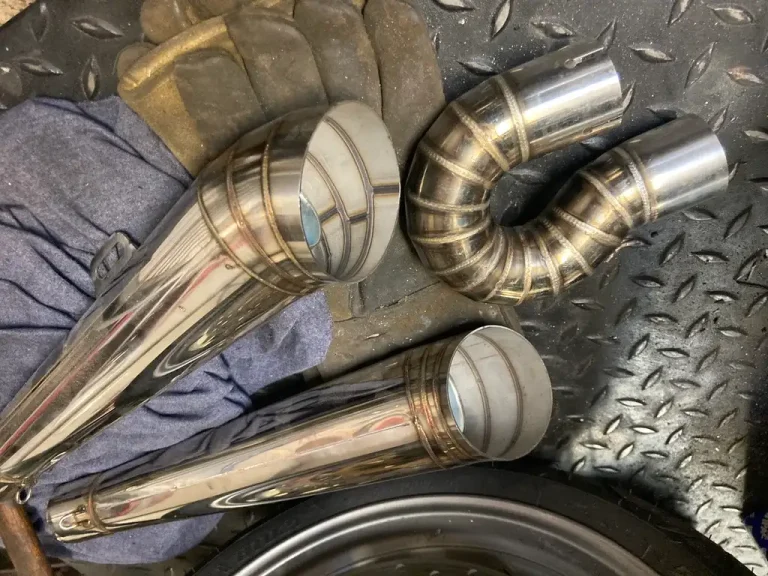
The exhaust system carries spent gases away from the engine, reduces noise, and helps control emissions. It can include the exhaust manifold, downpipe, catalytic converter, resonator, muffler, mid-pipe, tailpipe, clamps, gaskets, and hangers. Not every replacement covers all of those parts.
Common replacement scopes
- Axle-back: usually the rear piping, muffler, and tailpipe after the axle area.
- Cat-back: from the catalytic converter back to the tailpipe, often including the resonator and muffler.
- Manifold-back: from the exhaust manifold or header back, which can include the converter and mid-pipe sections.
- Full system: the complete run from the manifold/downpipe through the tailpipe, sometimes with one or more converters.
Why section-by-section pricing matters
Section pricing keeps one bad part from pulling the whole system into the estimate. A muffler failure does not automatically mean the manifold needs replacement. A tailpipe rust hole does not always justify a complete exhaust job.
That distinction matters most on older cars and rust-belt vehicles. Shops can often replace a single pipe, muffler, or hanger instead of charging for every section downstream.
How much each exhaust section usually costs
For most mainstream vehicles, rear exhaust work is the cheapest, and converter or manifold work is the most expensive. The part itself, the labor to reach it, and the amount of rust all affect the final price. OEM parts usually cost more than aftermarket parts, and that gap grows on emissions-related components.
Muffler and axle-back pricing
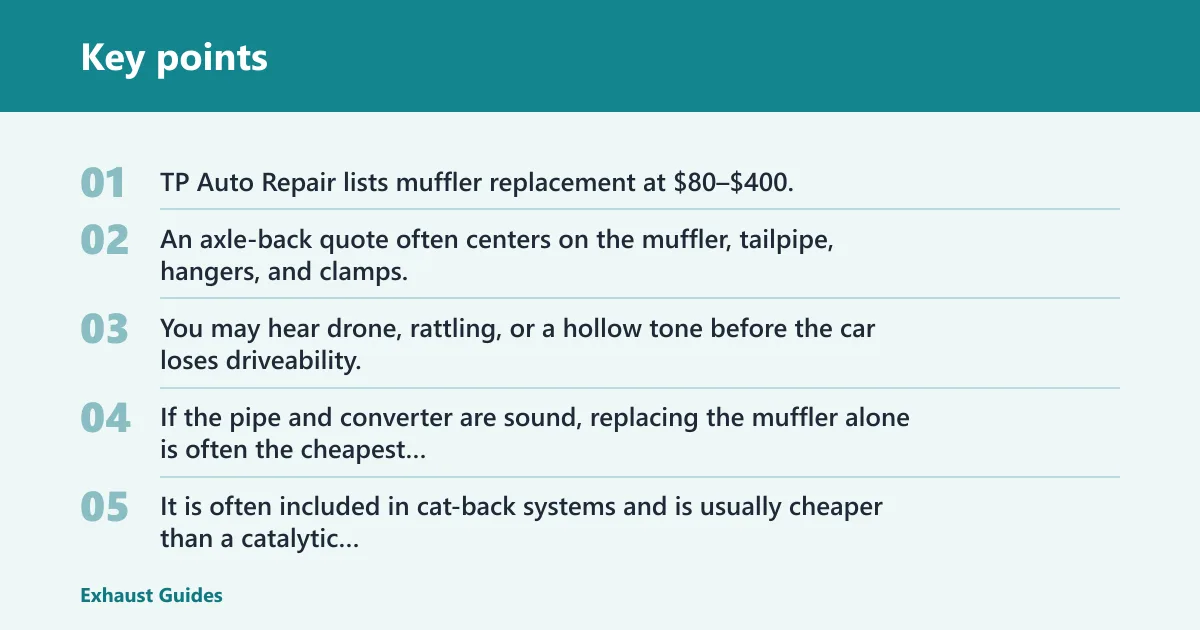
The same source lists muffler replacement at $80–$400, while MechanicBase estimates $100 to $300. An axle-back quote often centers on the muffler, tailpipe, hangers, and clamps, so the total can stay moderate if the rest of the system is solid.
A bad muffler usually changes noise first. You may hear drone, rattling, or a hollow tone before the car loses driveability. If the pipe and converter are sound, replacing the muffler alone is often the cheapest safe fix.
Resonator and cat-back pricing
A resonator is usually a sound-tuning part. It is often included in cat-back systems and is usually cheaper than a catalytic converter. The same source says cat-back replacement usually costs $600–$1,700 total.
That range can cover a bolt-on aftermarket system on one car and a rusted, welded setup on another. If the quote says “cat-back” but the parts list also includes a converter, the estimate is no longer a simple rear-exhaust job.
Exhaust pipe, mid-pipe, and tailpipe pricing
Pipe pricing depends on the section, bend shape, rust, and whether the shop can install a direct-fit part or must fabricate a section. A mid-pipe or tailpipe may be repaired as a single section instead of replacing the whole system. Clamps, gaskets, and hangers commonly show up here.
A common first-timer mistake is assuming all pipe work is the same. A straight tailpipe with a clamp is not the same as a bent mid-pipe that has to be cut, aligned, and welded to existing metal.
Exhaust manifold and converter pricing
The exhaust manifold is the first major component off the engine. It is expensive and labor-intensive, and on some vehicles the catalytic converter is built into the manifold assembly. That can turn a simple leak into a much larger repair.
The same source lists catalytic converter replacement at $200–$700 for basic federal aftermarket units and $800–$2,500 each for CARB-compliant converters. MechanicBase places catalytic converter replacement at $300 to $2,000 or more. The spread reflects part type, vehicle fitment, and emissions requirements.
What drives the quote up
Three things move the number fastest: converter type, rust, and labor. After that come brand choice, hardware, and whether the shop needs to fabricate a section. Labor rate matters too. TP Auto Repair estimates independent-shop labor at $100–$150 per hour and dealership labor at $150–$250 per hour.
Catalytic converter type and emissions compliance
Catalytic converters often drive the biggest cost jump because they use precious metals and can be integrated with the manifold. Federal aftermarket parts are usually cheaper than CARB-compliant parts, but state rules can make the cheaper part illegal for your car and location.
If the estimate involves a converter, ask whether it is federal aftermarket, CARB-compliant, or OEM. That answer changes both legality and price. Multiple converters on one vehicle can multiply the bill quickly.
Rust, broken studs, and seized hardware
Rusty bolts can turn a one-hour job into a half-day job. Broken studs at the manifold, fused clamps, and rusted hangers often force extra cutting or drilling. Those hours should appear somewhere in the estimate if the shop has inspected the vehicle closely.
Disposal fees can also appear, especially when the old converter or pipe has to be removed and scrapped. If the quote omits hardware and disposal entirely, ask whether they are included or billed later.
Labor rate, welding, and fabrication
Welding adds time, and custom fabrication adds more. A direct-fit axle-back may be a clean bolt-on job, while a corroded pipe may need cutting, shaping, and weld work to fit correctly. That is why two quotes for the same car can differ by hundreds of dollars.
Shop type matters too. A dealership often charges more per hour than an independent shop, and that gap is visible even before parts are added.
Extra parts shops should list on the estimate
- Gaskets
- Clamps
- Hangers
- O2 sensors
- Broken studs or fasteners
- Shop supplies
- Disposal fees
Exhaust quote sanity check table
| Replacement scope | Expected parts included | Normal labor hours | Common add-ons | Red-flag omissions |
|---|---|---|---|---|
| Axle-back | Muffler, rear pipe, tailpipe, hangers | 1–2 | Clamps, gaskets, rusted hardware, disposal | No mention of hangers or clamps |
| Cat-back | Piping from converter back, resonator, muffler, tailpipe | 2–4 | Welding, alignment, O2 sensor removal if needed | Converter listed when the scope is only rear of converter |
| Manifold-back | Manifold outlet/downpipe through rear sections, possibly converter | 3–6 | Broken studs, manifold gasket, heat shields | No allowance for seized manifold hardware |
| Full system | Manifold/downpipe, converter(s), mid-pipe, muffler, tailpipe | 4–8+ | Multiple gaskets, sensors, fabrication, disposal | Quote too vague to tell what is actually included |
When repair beats full replacement
Repair is usually the better buy when the damage is local and the rest of the system is solid. A single rust hole, a bad muffler, one cracked hanger, or a short tailpipe section can often be fixed without replacing the entire exhaust.
The cheapest safe fix by symptom or failure case
| Symptom or failure case | Likely cheapest safe repair path | When to avoid full replacement |
|---|---|---|
| Loud rear exhaust rumble | Replace muffler or axle-back section | When the converter and manifold are intact |
| Small pipe rust hole | Repair or replace only the damaged pipe section | When rust is limited to one segment |
| Broken hanger or loose pipe | Replace hanger, clamp, or section support | When the pipe metal itself is still sound |
| Theft-damaged converter | Replace converter with legal federal or CARB part as required | When the rest of the exhaust is undamaged |
| Exhaust leak at manifold | Replace gasket, studs, or manifold if cracked | When the rear system is still healthy |
When one section can be replaced without touching the rest
Picture a sedan with a rust hole in the tailpipe but a clean converter and manifold. A tailpipe-only repair is usually smarter than paying for a full system. The same logic applies to a muffler failure that has not spread into the upstream piping.
If a shop recommends a complete exhaust on a car with one damaged rear section, ask them to show the failed part. A good estimate should explain why the rest of the system cannot be left alone.
When a full system quote is probably too broad
A full-system quote is probably too broad when the symptom points to one section, the car is otherwise quiet, and the estimate does not note rust damage through the rest of the system. It is also too broad when the quote includes converters or manifolds without evidence those parts are failed.
How to compare shops and avoid surprise charges
Compare estimates by scope first, not by total price. A lower number can hide missing hardware, fewer parts, or a narrower repair. A fair out-the-door quote should state the parts, labor, and any added fees before you approve the work.
Questions to ask before approving work
- What exact section is being replaced?
- Does the price include clamps, gaskets, hangers, and shop supplies?
- Are O2 sensors, studs, or heat shields included if they have to come off?
- Is the converter federal aftermarket, CARB-compliant, or OEM?
- Does the quote include labor, welding, and disposal?
How to compare OEM, aftermarket, federal, and CARB parts
OEM usually costs more than aftermarket, but the cheapest part is not always legal for the job. Federal aftermarket converters may fit the car but fail emissions rules in some states. CARB-compliant parts cost more, yet they may be the only legal choice where stricter rules apply.
If two quotes differ sharply, ask whether one uses a direct-fit aftermarket pipe while the other includes an OEM converter or manifold assembly. That one detail can explain a large share of the price gap.
What should be included in out-the-door pricing?
Out-the-door pricing should include the part, labor, required hardware, and ordinary shop charges tied to the repair. If a quote leaves out disposal or fasteners, ask for a written revision before work starts. That is the clearest way to compare quotes from different shops.
Frequently asked questions
How much does an exhaust system replacement cost?
For a mainstream vehicle, basic exhaust replacement often falls between $500 and $1,500, with wider totals when converters or manifolds are included. If you are seeing a quote above that range, check whether the shop priced a cat-back, manifold-back, or full system with emissions hardware.
How much does an exhaust pipe replacement cost?
Exhaust pipe replacement depends on which section is damaged, how rusty the car is, and whether the shop can use a direct-fit part. A simple rear pipe can stay relatively modest, while a bent mid-pipe or welded section can cost more because of labor and fabrication.
How much does an exhaust system repair cost?
Small exhaust repairs are often cheaper than full replacement, especially when the issue is limited to a hanger, clamp, muffler, or one section of pipe. Once the repair involves a converter, manifold, or multiple rusted joints, the total can move toward replacement pricing fast.
How much does it cost to have exhaust replaced?
That depends on scope and parts. A rear section can be one price, a cat-back another, and a manifold or converter job far higher. Ask the shop to separate the parts from labor so you can see whether the quote covers only the damaged section or the whole system.
What parts are included in a full exhaust replacement
A full exhaust replacement can include the manifold or downpipe, catalytic converter, resonator, mid-pipe, muffler, tailpipe, clamps, gaskets, and hangers. It does not always include every one of those parts, so you need the estimate to spell out the exact scope before approving the work.
Why does one exhaust quote cost much more than another?
The biggest reasons are scope, labor, rust, and emissions parts. One quote may cover only a rear section, while another includes a converter, manifold, sensors, broken studs, or welding. A dealership quote can also run higher because of its labor rate.