OEM vs Aftermarket Exhaust Components
Choose aftermarket for hangers, clamps, resonators, mufflers, and many cat-back parts; keep OEM or direct-equivalent for oxygen sensors, catalytic converters, flex pipes, and anything tied to fitment or emissions. Bad choices can trigger check-engine lights, drone, leaks, failed inspections, and paying twice for labor. This guide shows where aftermarket saves money, where OEM avoids repeat work, and which exhaust parts deserve extra caution.
This guide is part of our Exhaust system components guide series.
| Factor | OEM | aftermarket exhaust components | Winner |
|---|---|---|---|
| Up-front price | Usually higher, with factory-spec sourcing and packaging | Wide spread, from budget universal parts to premium direct-fit parts | aftermarket exhaust components |
| Fit and warranty support | Strong fit confidence and consistent warranty backing | Varies by brand; premium lines can match OEM tolerances, budget parts may need adjustment | OEM |
| Emissions and inspection risk | Lower risk when you buy the correct direct replacement | Higher risk if the part changes catalyst spec, sensor placement, or pipe geometry | OEM |
| Sound and performance options | Usually stock sound and stock power intent | More choices for tone, flow, and weight reduction | aftermarket exhaust components |
Why the table splits that way
OEM parts are made by the vehicle maker itself. They usually arrive in branded packaging and match the original part exactly, which is why they win when the job is hard to repeat or tied to emissions. That matters most on parts buried near heat, rust, or sensors.

Aftermarket parts come from third-party companies, and the market is huge, around a $380 billion global market. That scale creates real savings on common wear parts, but it also creates the fitment spread that makes universal pieces risky on exhaust work.
OEM is the factory source. Aftermarket exhaust components are made by other companies, and they range from direct-fit replacements to cheap universal pieces that need trimming or rework. For exhaust work, the label matters less than the part’s job: noise control parts can flex toward aftermarket; emissions parts usually should not.
What OEM means in exhaust parts
OEM parts are built to the vehicle maker’s original specification. In exhaust work, that usually means factory flange shape, hanger position, sensor bung location, and pipe routing line up with the car or truck as delivered. That lowers the odds of a leak, rattle, or repeat labor.
What aftermarket means in exhaust parts
Aftermarket exhaust components are made by other companies. Some are bargain replacements; some are premium direct-fit parts that can match or exceed OEM tolerances. The problem is consistency: budget options might need fitment adjustments, especially on older vehicles with rust or bent hangers.
OE vs OEM vs aftermarket listings
OE, OEM, and aftermarket are not the same label in a listing. OE usually points to original-equipment spec or an original-style replacement; OEM means made by the original manufacturer; aftermarket means third-party made parts. If a listing says “OE-style” or “direct-fit,” check whether it still uses the original sensor count, flange pattern, and pipe diameter.
When is aftermarket the smart buy?
Aftermarket is the smart buy when the part is low-risk, easy to swap, and not tied to emissions approval or exact sensor placement. Hangers, clamps, mufflers, resonators, tailpipe sections, and many cat-back systems are common places to save money without inviting repeat labor. Premium brands are the safer version of that choice.
Budget savings on low-risk parts
Hangers and isolators are good aftermarket candidates because they mainly manage support and vibration isolation. A rubber hanger with the right durometer can stop sag and rattle without needing a factory logo. Clamps, simple tailpipe sections, and many muffler bodies also fit this category if the dimensions match.
A common first-timer mistake is buying the cheapest universal muffler because the inlet looks close. If the inlet angle is wrong by a small amount, the pipe can fight the chassis, the hanger load shifts, and the repair turns into a cut-and-weld job instead of a bolt-on swap.
Premium aftermarket versus bargain parts
Premium aftermarket manufacturers can match or exceed OEM tolerances, which makes them the safer value choice when OEM pricing is hard to justify. Cheap universal exhaust parts are different. They can fit, but they often trade away time, alignment, and long-term corrosion resistance.
For rust-prone regions, premium material choice matters as much as shape. A direct-fit stainless muffler can be a better buy than a cheaper coated mild-steel version that looks fine at install and flakes out early in winter use.
When performance parts make sense
Performance aftermarket parts make sense when your goal is sound, weight, or flow changes, not fuel-economy magic. A cat-back system can alter tone and reduce backpressure in some setups, but fuel economy gains are not the default result. More flow can also mean more cabin noise.
Which exhaust parts should stay OEM?
Keep OEM or a true direct-equivalent on catalytic converters, many oxygen-sensor-adjacent sections, flex pipes, exhaust manifolds with heat stress, and any part where a bad fit creates extra labor. These pieces are expensive to reach. If one misfit causes a leak or check-engine light, the “cheaper” part can cost more overall.
Catalytic converter fit and legality
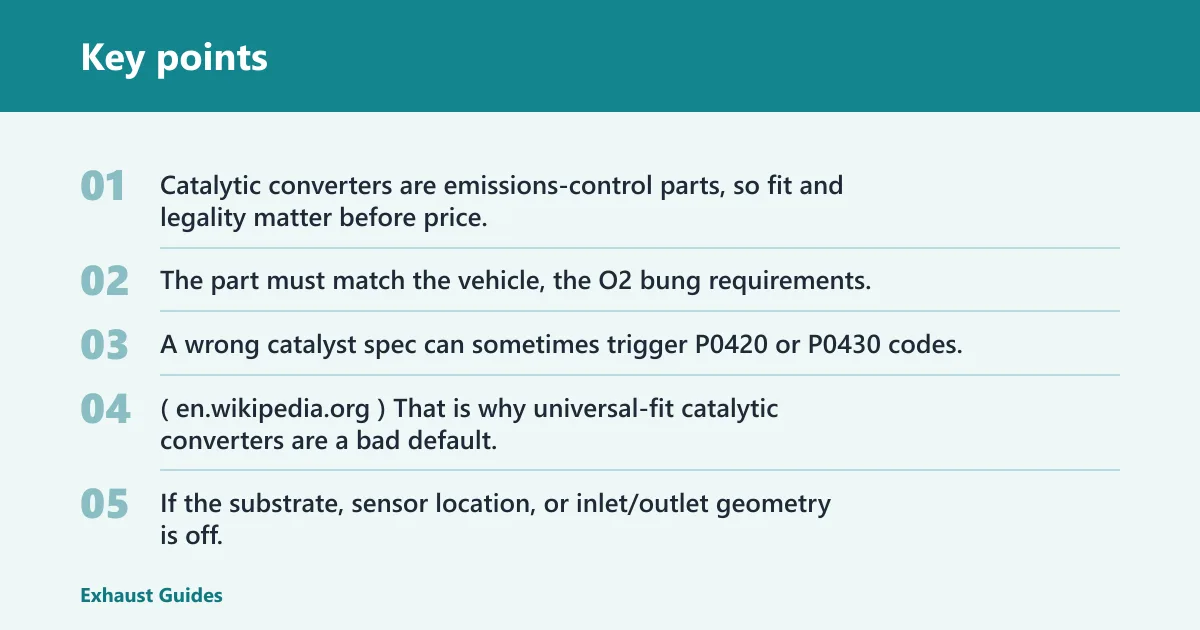
Catalytic converters are emissions-control parts, so fit and legality matter before price. The part must match the vehicle, the O2 bung requirements, and the emissions rules that apply to the car and your state. A wrong catalyst spec can sometimes trigger P0420 or P0430 codes, even if the pipe bolts up. (Wikipedia)
That is why universal-fit catalytic converters are a bad default. If the substrate, sensor location, or inlet/outlet geometry is off, you can get an inspection failure or a repeat teardown. EPA/CARB legality is not a side note here; it is the job.
Exhaust manifold and gasket risk
The exhaust manifold is the engine-side collector, and it sees the most heat. Cast iron and stainless variants both exist, but crack risk and stud fatigue make fit and durability matter more than sticker price. When replacing a manifold, gasket and stud replacement is often smart because old hardware can snap during removal or leak after reassembly.
On manifold jobs, OEM avoids a lot of false economy. A warped flange or misaligned port can produce a tick at startup, then a leak under load. That is a hard repair to ignore and an annoying one to redo.
Parts where repeat labor is expensive
Flex pipes, manifolds, and converters often live in cramped spaces with rusted fasteners above them. If a part is buried behind heat shields, subframe pieces, or sensor wiring, choose the option with the best fit certainty. Saving $40 on the part does not matter if the labor repeats.
Exhaust component decision table
Use this table to separate low-risk savings from parts that deserve OEM-level caution. Daily drivers, rust-belt repairs, towing setups, and performance builds do not need the same default.
| Part name | Best default choice | Risk of fitment issue | Emissions/legal sensitivity | Rust-belt durability | Repeat-labor risk |
|---|---|---|---|---|---|
| Exhaust manifold | OEM | Medium to high | Medium | High concern for heat cracking and flange corrosion | High |
| Flex pipe | OEM or premium aftermarket | High if length or angle is wrong | Low to medium | High concern in salted roads | High |
| Catalytic converter | OEM | High | High | Medium | High |
| Resonator | Either | Medium | Low | Medium to high, depending on material | Medium |
| Muffler | Either, with premium aftermarket preferred for value | Medium | Low | Medium to high | Medium |
| Hangers and isolators | Aftermarket exhaust components | Low if shape and durometer match | Low | Medium | Low |
| Tailpipe and tips | Either | Medium | Low | High if 304 stainless, lower with 409 or aluminized steel | Low to medium |
How to read the table
“Best default choice” does not mean every version of that part. A premium aftermarket flex pipe can be a good buy if it is direct-fit and the inlet angle matches. A low-cost universal converter is a bad buy even if the price looks attractive.
Risk goes up when the part controls emissions, sits in a tight package, or must line up with a sensor. It also goes up when rust makes a simple swap into a seized-fastener problem.
Daily driver, rust-belt, towing, and performance use cases
For a daily driver, choose OEM for converter and manifold jobs, then use aftermarket for hangers, mufflers, and resonators if the fit is direct. For rust-belt repair, prioritize stainless where possible because corrosion is the failure mode you are trying to slow down. For towing, quiet cabin behavior matters, so delete-style changes are usually the wrong move. For a performance build, premium aftermarket cat-back pieces can make sense if you accept more sound and check legality first.
Picture a 2012 sedan with a rusted rear muffler in a salt state. A direct-fit stainless aftermarket muffler can be a smart buy because the part is not emissions-critical, and the cost savings can be real without risking an inspection issue. The same car with a cracked manifold near the head is a different job; OEM is the safer call.
Component-by-component default choices
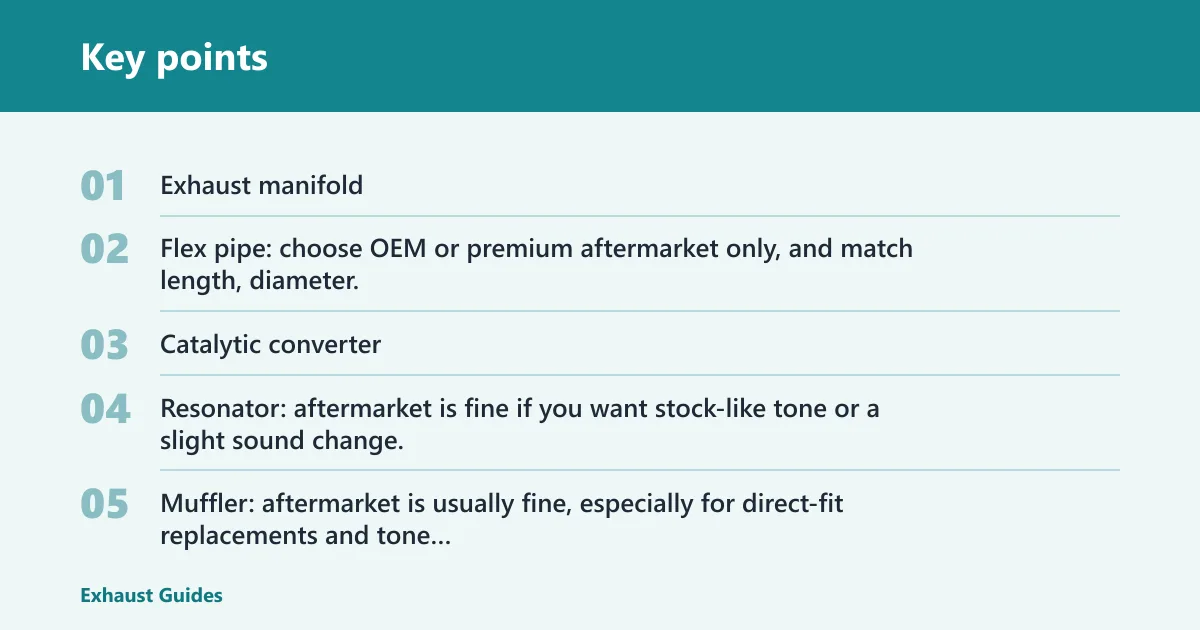
- Exhaust manifold: buy OEM unless a premium aftermarket unit is a verified direct-equivalent with the correct flange and port shape.
- Flex pipe: choose OEM or premium aftermarket only, and match length, diameter, and angular deflection closely.
- Catalytic converter: choose OEM unless local law and vehicle-specific fit are clearly satisfied by a certified direct-fit replacement.
- Resonator: aftermarket is fine if you want stock-like tone or a slight sound change.
- Muffler: aftermarket is usually fine, especially for direct-fit replacements and tone changes.
- Hangers and isolators: aftermarket is usually the practical choice.
- Tailpipe and tips: either option works if the mounting points and finish match your rust and appearance goals.
Start with the part number, then check the packaging and fit notes. OEM parts usually come in branded packaging and match the original part exactly. Aftermarket parts may list cross-references, fitment ranges, or universal dimensions that require you to verify more before buying.
Part numbers and packaging clues
If the seller gives a vehicle maker part number and the part arrives in the brand’s box, that is a strong OEM clue. Aftermarket listings often use their own part numbers, then map them to multiple vehicles. That can be fine, but only if the flange, hanger, sensor bung, and tube diameter match your application.
Direct-fit versus universal-fit labels
Direct-fit parts are cut to match a specific vehicle. Universal-fit parts are not. On exhaust work, that difference is more than marketing language. Universal pieces are where you see extra bends, welding, and hanger relocation, and that is where a cheap part eats up labor time.
Fitment checks before you buy
Check inlet and outlet diameter, hanger locations, O2 bung count, sensor spacing, flange style, and overall length. If you are replacing a converter or manifold, confirm legal status and engine code before the order. A part that looks close can still be wrong enough to create a leak or code.
Material choices that change lifespan
Material choice decides whether the part survives a few winters or keeps going. Aluminized steel is coated mild steel with a lower cost, but it has a shorter corrosion life in salt regions. Stainless steel costs more up front, and the right grade can buy longer service life.
Aluminized steel versus stainless steel
Aluminized steel is the budget material. It is common in exhaust systems because it lowers price without going fully bare mild steel. In dry climates it can be a fair trade, but in the rust belt it can lose value fast once the coating is damaged by road salt or impact.
Stainless steel is the better long-life option. It resists corrosion better than aluminized steel, but not all stainless is the same. The grade matters, especially when the pipe sits under winter spray and heat cycling.
409 versus 304 stainless
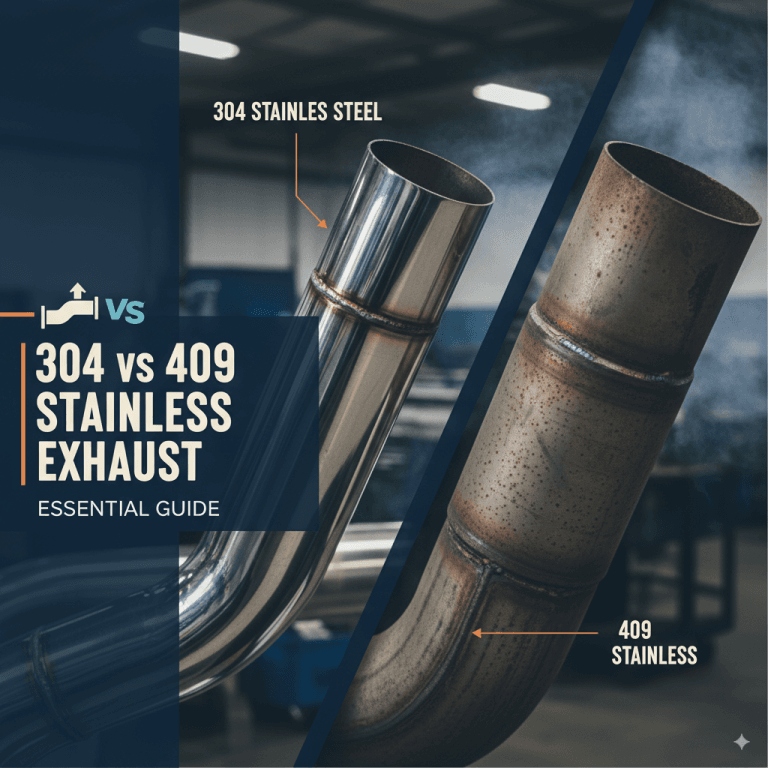
409 stainless is commonly used in OEM exhaust systems because it is often seen as a cost-effective option with reasonable corrosion resistance. 304 stainless is usually better against corrosion and often costs more. If you want the longest lifespan for tailpipes and cat-back sections, 304 is the stronger pick; if you want a middle ground, 409 is often the practical one.
For rust-belt durability, the order is usually 304 stainless, then 409 stainless, then aluminized steel. That is not a universal ranking for every part shape, but it is a useful buying rule when the route sees winter salt.
Noise, emissions, and drivability effects
Exhaust parts do more than move gas. Resonators tune frequency, mufflers cut sound, flex pipes isolate motion, and hangers keep the system from banging the body. When one part is wrong, the symptom may be drone, a leak, or a rattle rather than a dramatic failure.
Resonator and muffler differences
A resonator targets specific frequencies and helps reduce cabin drone. Some use a Helmholtz-style chamber to cancel a narrow band of sound. If you delete the resonator, the system usually gets louder and the cabin can pick up an irritating boom at cruise.
Mufflers handle overall sound attenuation. Packed designs use absorption material that can degrade over time; chambered designs use internal routing to change the note. Either style can be aftermarket or OEM, but a direct-fit unit lowers the odds of hanger and pipe mismatch.
Flex pipe and hanger function
The flex pipe is there to isolate engine movement and road shake. Corrugated stainless construction lets the exhaust move without cracking the rest of the system, but only within a limited angular deflection. If the pipe is forced too far off-axis, it can fail early or transfer stress to the manifold.
Hangers and isolators are small parts with a big job. The rubber durometer affects how much vibration gets absorbed, how much sag develops, and how much rattle reaches the cabin. Cheap rubber that hardens or tears can ruin an otherwise good exhaust repair.
Tailpipe and tip fitment
Tailpipes mostly affect fit and corrosion resistance. Tips mainly affect appearance, though they can slightly influence outlet tone and flow at the margin. Material matters here too: 304 stainless is the better corrosion choice, while 409 stainless and aluminized steel can be enough if the vehicle is not fighting winter salt every day.
Verdict: OEM or aftermarket exhaust components?
Choose OEM if you are replacing a catalytic converter, exhaust manifold, or flex pipe on a daily driver where a bad fit can trigger a check-engine light, fail inspection, or force you to pay twice for labor.
Choose aftermarket exhaust components if you are buying hangers, clamps, mufflers, resonators, tailpipe sections, or a cat-back system for a rust-belt repair or performance build where direct-fit savings, tone changes, or stainless durability matter more than factory branding.

- Genuine factory part in original retail packaging
- OEM quality with direct fitment
- Exact same part sold at dealerships
Frequently asked questions
What is an oem vs aftermarket?
OEM is the original manufacturer source; aftermarket means a third-party company made the part. For exhaust work, OEM usually gives you factory-spec fit and consistent warranty support, while aftermarket can save money and offer more sound or performance options. The right pick depends on fitment and legal risk.
What are oem parts vs aftermarket parts?
OEM parts are built by the vehicle maker’s supply chain and are usually sold as direct replacements. Aftermarket parts come from other manufacturers and can range from cheap universal pieces to premium direct-fit parts. In exhaust systems, that quality spread is wide enough to change the repair outcome.
Oem vs oe vs aftermarket parts
OE and OEM both point toward original-equipment sourcing or spec, while aftermarket points to third-party production. Those labels are not interchangeable in listings, especially for exhaust components. A converter or manifold that is only “OE-style” still needs fitment and emissions checks before you buy.
How do I tell oem from aftermarket exhaust parts?
Check the part number, packaging, and fit notes. OEM parts usually arrive in branded packaging and match the original part exactly. Aftermarket parts often list multiple vehicle applications, and universal-fit wording should trigger extra checks on pipe diameter, bung count, hanger placement, and flange shape.
Is aftermarket exhaust better than oem?
Not overall. Aftermarket exhaust components are better for cost savings on low-risk parts and for sound or performance changes, while OEM is better when the part affects emissions, fit, or repeat labor. For a muffler or hanger, aftermarket can be the better value. For a converter or manifold, OEM is usually safer.
Does aftermarket exhaust improve fuel economy?
Not by default. Some performance exhaust setups can change flow and reduce restriction, but fuel economy gains are not a reliable expectation. On a street vehicle, sound, fitment, legality, and drivability matter more than chasing a mpg promise that may not appear at all.