Catalytic Converter vs Muffler: Key Differences Explained
Catalytic converter problems usually trigger emissions faults, rotten-egg smell, power loss, or a failed smog test. Muffler failures usually cause loud exhaust, rattles, or leaks without changing emissions much. Misdiagnosis wastes money and can leave an inspection failure unresolved. This guide shows the symptom patterns, quick checks, and when the problem is actually another exhaust part.
| Decision factor | Catalytic converter | Muffler: key differences | Winner |
|---|---|---|---|
| Main job | Converts carbon monoxide, hydrocarbons, and nitrogen oxides into less harmful compounds. | Reduces exhaust noise with chambers, baffles, or absorption material. | Depends on the problem |
| Failure symptoms | Check-engine light, power loss, sulfur smell, failed emissions test, overheating. | Loud exhaust, hollow or tinny noise, rattles, visible rust holes, leak noise. | Depends on the symptom |
| Legal risk if removed | High. Driving without a catalytic converter is illegal on road cars. | Usually an inspection and noise issue, not an emissions device issue. | Catalytic converter |
| Typical replacement cost | Usually higher because of precious metals and compliance requirements. | Usually lower and simpler to replace. | Muffler |
| Diagnosis clarity for DIY checks | Needs smell, driveability, and scan-code clues. | Often obvious from sound and visible damage. | Muffler |
Catalytic converter vs muffler: what each part does


Catalytic converter: emissions control and exhaust chemistry
A catalytic converter is an emissions-control device. It changes carbon monoxide, hydrocarbons, and nitrogen oxides into less harmful gases by using a catalyst surface, often platinum, palladium, and rhodium, on a ceramic honeycomb substrate.
Most gasoline-powered vehicles starting with the 1975 model year are equipped with catalytic converters, and catalytic converters are usually used with gasoline or diesel internal combustion engines. Three-way converters also reduce oxides of nitrogen, so the part handles chemical cleanup, not noise control. (en.wikipedia.org)
Muffler: noise reduction and exhaust pulse control
A muffler is a noise-control device. It uses chambers, baffles, or absorption design to reduce exhaust pulse noise, and it does not chemically treat exhaust gases.
Because the muffler sits in the exhaust path after upstream components, it mainly changes the sound the vehicle makes. A hole, rusted seam, or broken internal baffle can make the exhaust loud fast, but that does not mean emissions chemistry has failed.
Why the two parts are often confused
Both parts live under the car and both can fail with heat, rust, or impact damage. A clogged converter can also create a restricted, droning, or strangled exhaust note that sounds like a muffler issue, while a rusted muffler can add odor and noise that some drivers mistake for converter trouble.
That overlap is why diagnosis should start with the symptom type. Noise points first to the muffler and related exhaust piping. Smell, power loss, and inspection failure point first to the converter.
📊 Most gasoline-powered vehicles starting with the 1975 model year are equipped with catalytic converters. Source: Catalytic converter.
Is the catalytic converter before or after the muffler?
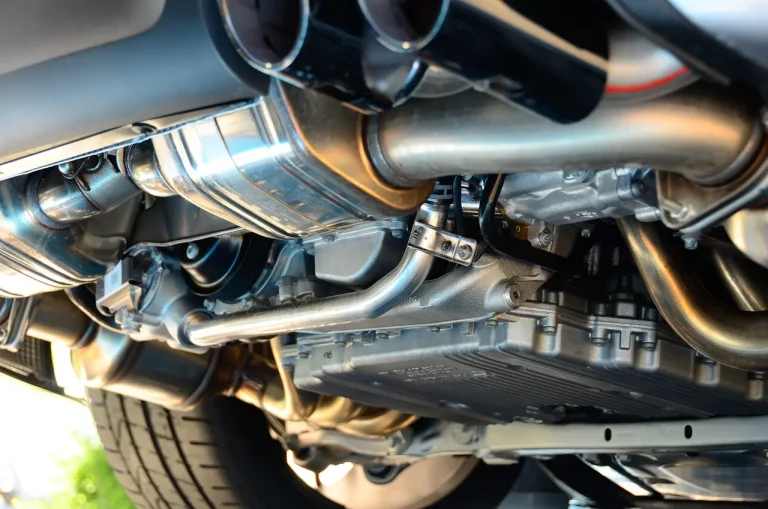
The catalytic converter is usually before the muffler. In a typical exhaust flow, gases leave the engine or manifold, pass through the catalytic converter, then a resonator if equipped, then the muffler, and finally the tailpipe. FIXD places the converter between the engine and the muffler, usually near the front.
Where resonators and exhaust pipes fit in
A resonator is another exhaust-system part that tunes sound. It sits in the flow path with the pipes, converter, and muffler, and it can change frequency and drone without chemically treating exhaust. Exhaust pipes connect all of these parts and can leak or rust anywhere along the route.
If you are tracing a problem, think upstream versus downstream. A leak before the converter can change sensor readings and emissions behavior; a leak after the converter usually changes sound more than emissions chemistry.
Upstream vs downstream damage clues
Upstream damage near the engine, manifold, or front pipe more often affects driveability and emissions. Downstream damage near the muffler or tailpipe more often creates noise, soot stains, and exhaust odor near the rear of the car. That location clue helps separate a failed converter from a failed muffler before you buy parts.
How to tell which part is failing

Start with the symptom category. Noise points to the muffler and related piping. Smell and power loss point to the converter.
Sound patterns that point to a muffler
A damaged muffler usually makes the exhaust louder, deeper, raspier, or tinny. You may also hear a metallic rattle if an internal baffle or chamber has broken loose, or a puffing sound if the case has rusted through.
Suppose a sedan gets suddenly louder after scraping a speed bump, and the noise is strongest at the rear bumper. That points strongly to the muffler, tailpipe, or rear pipe section, not the catalytic converter.
Smell, driveability, and power-loss clues that point to a converter
A bad catalytic converter often shows up as poor acceleration, reduced top-end power, hesitation under load, or a check-engine light tied to catalyst efficiency or mixture problems. A sulfur or rotten-egg smell can also point toward converter trouble, especially if the exhaust is running abnormally hot.
If the vehicle feels choked at highway speed, the converter may be restricted. If the issue is only sound, the muffler is the more likely culprit.
Visual signs under the car: rust, holes, heat damage, and loose hangers
Look for rusted seams, pinholes, soot marks, broken hangers, and crushed pipes. A muffler with holes often leaves visible black soot around the leak and may hang low or move too freely. A converter problem may show heat discoloration, cracked shell welds, or a melted nearby heat shield.
The converter also has more theft risk because of the precious-metal content in the catalyst coating. That risk is another reason replacement costs run higher than a typical muffler swap.
Stop-driving red flags
Stop driving if there is severe power loss, overheating, a strong exhaust smell inside the cabin, or a confirmed exhaust leak near the cabin floor. These signs can mean exhaust gas is entering the passenger area or that the converter is so restricted it is creating heat and backpressure problems.
- Check where the noise is loudest: front, middle, or rear.
- Note whether the problem is noise, smell, power loss, or all three.
- Look for soot, rust holes, hanging pipes, or heat damage.
- Watch for a check-engine light and scan for catalyst-related codes if available.
- If exhaust odor is present inside the cabin, do not keep driving.
Use this under-car diagnosis table
| Clue | Catalytic converter | Muffler | What it means |
|---|---|---|---|
| Sound | May sound normal, or may cause a restricted, hollow, or strained exhaust note. | Usually loud, raspy, droning, rattling, or puffy at the rear. | Loud exhaust without power loss usually favors the muffler. |
| Smell | Rotten-egg or hot-sulfur odor can point to catalyst trouble or overload. | Usually exhaust smell from a leak, but not a chemical-conversion fault. | Strong emissions odor points first to the converter. |
| Driveability | Hesitation, reduced power, poor throttle response, overheating. | Usually little change in engine output unless a leak is large. | Power loss is a converter clue. |
| Under-car inspection | Front or mid-exhaust can show heat damage, cracked shell welds, theft damage, or missing unit. | Rear can show rust holes, separated seams, or broken hangers. | Front damage points to the converter; rear damage points to the muffler. |
| Stop-driving risk | Severe restriction, overheating, or cabin exhaust smell. | Cabin leak or parts dragging on the road. | Both can be serious, but the warning signs differ. |
For non-mechanics, the table is most useful if you match one clue at a time. A noise-only problem at the rear is usually exhaust hardware after the converter. A smell-plus-power problem is much more likely to be the converter or another upstream emissions issue.
Can a car run without a catalytic converter but with a muffler?
Yes, an engine can often run mechanically without a catalytic converter if a muffler is still present, but road legality and inspection readiness are different from basic drivability. FIXD states that driving without a catalytic converter is illegal, and removed converters can fail emissions inspection even if the car still moves.
What the engine can do mechanically
The engine can still push exhaust through the system, and the muffler will still reduce some of the noise. That does not mean the vehicle is road-legal, clean-running, or likely to pass a smog check. The converter’s job is chemical cleanup, not making the vehicle merely move.
Why road legality and inspection readiness are different from drivability
Emissions standards can vary by state, and California Air Resources Board rules may be stricter than federal EPA requirements. A road car with a missing converter can become a legal problem even before it becomes a drivability problem, especially if an inspection station checks for converter presence or CARB-compliant parts.
Gasoline vehicles commonly use converters, hybrids may also use them, and diesel vehicles use diesel-specific aftertreatment. Electric vehicles do not have catalytic converters because they do not have exhaust systems.
When a missing converter becomes a legal problem
If the converter was removed, replaced with a straight pipe, or substituted with a noncompliant part, the vehicle can fail inspection and may be illegal to operate on public roads. That matters even if the exhaust sounds normal, because legality follows emissions equipment, not just noise level.
Which repair usually costs more?
The catalytic converter usually costs more to replace. FIXD estimates catalytic converter prices between $400 and $2400, and CARB-compliant converters can be more expensive than EPA-compliant ones. Mufflers are usually cheaper because they do not use precious metals or emissions-certified substrate material.
Why catalytic converters cost more
The price comes from the ceramic honeycomb core, the platinum, palladium, and rhodium coating, and the need to match the vehicle’s emissions standard. Theft risk also pushes prices up because converters contain material that has resale value outside normal scrap use.
Direct-fit and universal replacement choices matter here. FIXD notes that universal-fit converters usually require cutting and welding into the exhaust, so fitment and labor can add cost and complexity. That is a bigger decision on converters than on many muffler replacements.
Why mufflers are usually cheaper
A muffler is a mechanical sound-control box, so the part itself is usually less expensive and less regulated. If the problem is only a rusted shell or a broken hanger, replacement can be straightforward. The main cost driver is often labor and pipe condition rather than special materials.
Choose catalytic converter if…
Choose the catalytic converter path if the problem is a failed smog test, check-engine light tied to catalyst efficiency, rotten-egg odor, strong heat from the front or middle exhaust, or clear power loss under load. Those signs point to emissions treatment or exhaust restriction, not simple noise control.
Choose a direct-fit unit first when the vehicle uses a CARB-compliant part or when you want the least fitment trouble. Choose universal-fit only if you are prepared for cutting and welding and the exhaust layout makes that practical.
Choose muffler if…
Choose the muffler path if the car is simply louder, rattles at idle, leaks from the rear section, or shows rust holes and broken hangers near the back of the exhaust path. If emissions behavior is normal and the smell is not unusual, the muffler is usually the more likely failure.
A muffler can be a problem if it is too loud or leaks exhaust into the cabin, and it does not chemically clean exhaust. That is the clean dividing line.
Frequently asked questions
What is the difference between a catalytic converter and a muffler?
A catalytic converter cleans exhaust chemically by turning carbon monoxide, hydrocarbons, and nitrogen oxides into less harmful pollutants. A muffler does not clean exhaust; it reduces sound with chambers, baffles, or absorption material. If the symptom is emissions-related, think converter first. If the symptom is mainly noise, think muffler first.
Is the catalytic converter before or after the muffler?
The catalytic converter is usually before the muffler in the exhaust path. Exhaust flows from the engine or manifold to the converter, then through any resonator, then the muffler, and finally the tailpipe. Damage closer to the front usually affects emissions and power more than a rear muffler fault.
Can a car run without a catalytic converter but with a muffler?
Yes, a car can often run, and the muffler can still reduce noise, but that does not make the car legal for road use. Driving without a catalytic converter is illegal, according to FIXD, and the vehicle can fail inspection even if it still moves and sounds fairly normal.
Does a muffler reduce emissions or just noise?
A muffler reduces noise. It does not chemically treat exhaust or convert pollutants into less harmful compounds. If an exhaust part is solving emissions faults, that part is the catalytic converter or another emissions-control device, not the muffler.
How do I tell if my catalytic converter or muffler is bad?
Use the symptom type first. Noise, rattling, or rust holes near the rear point to the muffler. Power loss, sulfur smell, overheating, or a failed emissions test point to the catalytic converter. Then inspect the location under the car and look for soot, holes, heat damage, or loose hangers.
Which part is more expensive to replace, the catalytic converter or muffler?
The catalytic converter is usually more expensive. Precious metals, emissions compliance, and theft risk drive the price higher, and FIXD estimates converter prices between $400 and $2400. Mufflers are usually cheaper because they are simpler parts and do not contain a catalyst coating.
Will a clogged catalytic converter sound like a bad muffler?
Yes, sometimes. A clogged converter can create a restricted, strained, or droning exhaust note that sounds like a muffler problem, especially if the vehicle also loses power. The difference is that a clogged converter usually brings driveability symptoms and sometimes heat or smell problems with it.
Can you drive with a damaged catalytic converter or muffler?
A damaged muffler may still let the car move, but you should not keep driving if exhaust is leaking into the cabin or parts are dragging. A damaged catalytic converter is riskier because it can cause overheating, severe power loss, and emissions illegality. Stop driving if exhaust odor enters the cabin or the engine feels badly restricted.