Long vs Short Tube Headers
Long tube headers are often reported to make more peak horsepower than short tube headers, while short tube headers usually fit more easily and may keep torque flatter below about 3,000 rpm. Pick the wrong length, and you can lose low-speed driveability, fight clearance problems, or spend extra on tuning and exhaust parts. This guide compares powerband, fitment, sound, tuning, towing, street, and track use so you can pick the right length.
How tube length changes power delivery
Long tube headers push scavenging and higher-rpm power. Short tube headers make fitment easier and keep the install path milder. The right choice depends on where you want the engine to make power, how much clearance you have, and how much supporting work you want to take on.
What changes when the tube gets longer
Header primary tube length is generally measured from the exhaust port to the collector. Longer tubes change exhaust pulse timing, which tends to shift gains higher in the rev range. Long tube headers are often most useful when the engine spends time above the midrange. SAE technical literature on exhaust pulse tuning and scavenging consistently describes the same basic effect: tube length and collector design alter pulse timing, which changes where the engine makes its best cylinder evacuation and volumetric efficiency.
Where each design fits in a build
Long tubes suit performance builds that can use more scavenging, a freer-flowing exhaust, and sometimes a calibration change. Short tube headers suit street-driven vehicles that need better flow than stock manifolds without the fitment friction that often comes with long tubes. Manufacturer dyno data from header brands and exhaust-system test reports often show the same pattern: longer primaries tend to bias gains upward, while shorter designs keep the install simpler and the drivability change smaller.
How do long tube and short tube headers work?
Long tube headers use longer primary tubes to time exhaust pulses so the outgoing pulse helps pull the next one out of the cylinder. Short tube headers do the same basic job, but with less tube length and usually less shift in the powerband. The collector also matters, because collector size and merge quality affect how well pulses combine.
Primary tube length and pulse timing
Longer primary tubes generally move the strongest effect higher in the rev range. Shorter primaries usually keep the change smaller and can preserve a more familiar low-speed feel. That is why tube length is a powerband choice, not only a fitment choice.
Collector design and merge quality
A well-sized collector can help balance torque and top-end power. A poor collector can blunt the benefit of either header length. If the collector is mismatched, the engine may sound louder without making the kind of power change you expected.
How scavenging changes the powerband
Scavenging matters most when cylinder filling and exhaust evacuation are in sync. Long tubes tend to help that sync at higher rpm. Short tubes still improve flow over stock manifolds, but the gain is usually smaller and less biased toward top-end horsepower.
Which makes more power?
Long tube headers usually make more peak horsepower than short tube headers, but the useful answer is where that power shows up. Long tubes tend to move the gain upward, while short tubes often keep the low-end feel closer to stock. If the vehicle rarely sees high rpm, peak numbers alone can mislead you.
Peak horsepower versus usable powerband
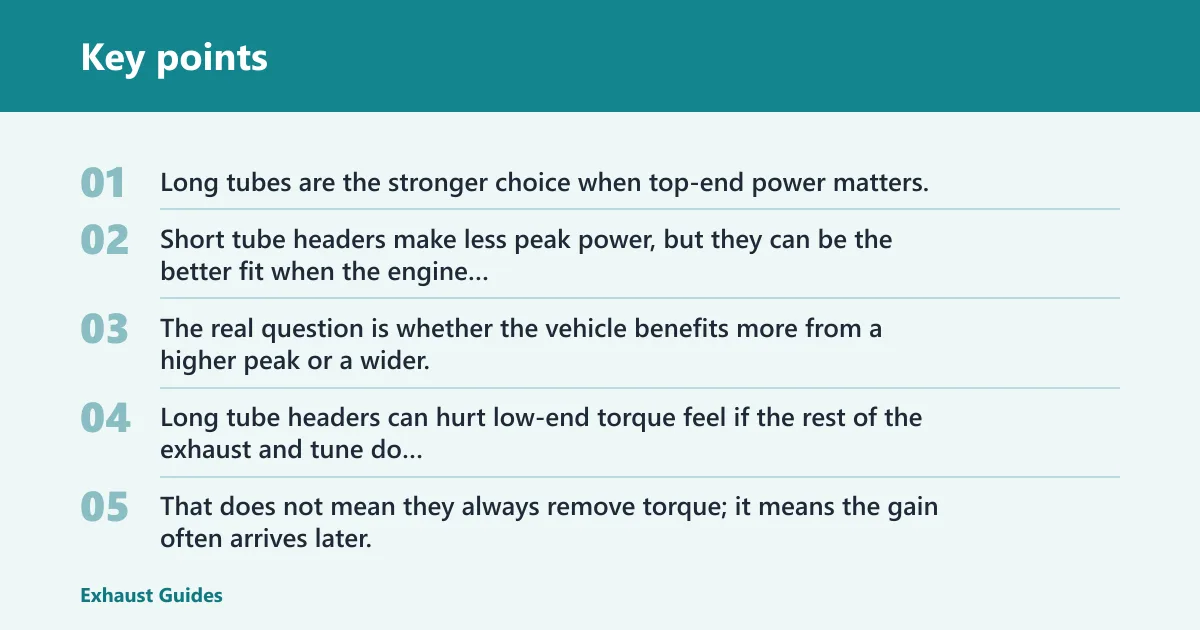
Long tubes are the stronger choice when top-end power matters. Short tube headers make less peak power, but they can be the better fit when the engine needs to stay smooth and responsive at lower speeds. The real question is whether the vehicle benefits more from a higher peak or a wider, calmer powerband.
Low-end torque tradeoffs
Long tube headers can hurt low-end torque feel if the rest of the exhaust and tune do not match the changed pulse timing. That does not mean they always remove torque; it means the gain often arrives later. Short tube headers usually keep the bottom end flatter, which is useful for stop-and-go driving and towing.
What changes on a 5.3 LS, 5.7 Hemi, and Foxbody
On a 5.3 LS, long tubes are a common choice when the goal is stronger midrange and top-end pull, especially with cam and intake changes. On a 5.7 Hemi, long tubes can help a larger street or strip build, but fitment and catalyst choices matter. On a Foxbody, long tubes can add real power, yet steering shaft and ground-clearance issues often make short tubes the easier route for a street car.
Which fits better on your vehicle?
Short tube headers usually fit better because they keep the tube path compact. Long tube headers create more friction around steering shafts, starters, crossmembers, and O2 sensor routing. That extra packaging demand is a real part of the decision, especially on trucks and older chassis.

Ground clearance and speed bumps
Long tubes sit lower more often, which raises the risk of scraping on driveways, speed bumps, and uneven roads. Trucks can have enough ride height to help, but lowered cars and some muscle cars can run into contact fast. Short tubes usually avoid that problem more easily.
Steering shaft, starter, and crossmember clearance
Fitment friction is not random. It often shows up at the steering shaft on small engine bays, the starter on certain V8 layouts, and the crossmember where the pipes sweep down. Long tubes are the more common source of those conflicts, and that can mean extra time with hardware, gaskets, and alignment.
O2 sensors, catalysts, and wiring length
Sensor placement can change with header style, so O2 bungs may move and wiring extensions may be needed. Catalytic converter choice also changes the job: catted versions can be quieter and more street-friendly, while off-road pipes can smell stronger and may not pass inspection. If the sensors end up farther downstream, the tune may need to account for it.
Say your truck tows on weekdays and sees mountain grades on weekends. Short tube headers may be the better call if you want fewer clearance issues, less exhaust work, and a powerband that stays calmer below midrange.
Suppose a Foxbody gets driven to work, parked in a steep driveway, and only sees the drag strip a few times a year. Long tubes can still make sense, but the fitment and scrape risk become part of the cost stack, not an afterthought.
Header comparison matrix

| Field | long | short tube headers | Stock manifolds | Winner |
|---|---|---|---|---|
| Peak horsepower bias | Highest | Moderate | Lowest | long |
| Low-end torque bias | Can move power higher | Flatter and friendlier | Most conservative | short tube headers |
| Sound change | Largest change in tone and volume | Smaller change | Quietest | long |
| Ground clearance | Worst of the three | Better | Usually best | Stock manifolds |
| Install complexity | Highest | Middle | Lowest | Stock manifolds |
| Tune likelihood | Often needed | Sometimes needed | Least likely | Stock manifolds |
| Emissions risk | Highest when off-road or mispaired with cats | Moderate | Lowest | Stock manifolds |
| Best use case | Track and high-rpm builds | Street-driven mild builds | Budget, clearance, and strict emissions use | Depends on use case |
| Platform notes | C10 truck steering box clearance can be a real issue, and lowered chassis often need extra attention at the collectors and midpipe routing; classic cars may also need starter and spark plug access checks. | SN95 Mustang K-member interference is less common than with long tubes, but the tighter engine bay still rewards careful O2 routing and collector angle checks. | Best for tight bays, strict inspection areas, and owners who want the fewest parts changed; factory-style packaging usually preserves steering, starter, and exhaust routing on a wider range of chassis. | Depends on platform |
Why the table resolves this way
Long tubes win the power rows because longer primaries are built to help scavenging at higher rpm. Stock manifolds win the clearance, install, and emissions rows because they keep the factory packaging and catalyst layout. Short tubes sit in the middle and often make sense when the goal is a cleaner install without giving up all the flow gain.
Choose long if… / Choose short tube headers if…
Choose long if your build spends time above 3,000 rpm, if you want the stronger midrange-to-top-end shift, or if the vehicle is aimed at track use, drag racing, or a cammed street setup that can use a tune. Choose short tube headers if you want easier fitment, fewer clearance headaches, and a setup that stays friendlier for daily driving, towing, or mixed-use street duty.
- Choose long if peak horsepower and higher-rpm pull matter more than low-speed smoothness.
- Choose long if you can accept possible O2 extension work, midpipe changes, and a tune.
- Choose short tube headers if ground clearance, starter access, or steering clearance is tight.
- Choose short tube headers if the vehicle tows, idles in traffic, or needs to stay close to stock manners.
- Choose stock manifolds if emissions compliance, cost control, or simplest installation matters most.

- LS-swap long tube routing
- Includes MLS gaskets and bolt kit
- Polished 304 stainless finish
Frequently asked questions
Long tube vs short tube headers: which is better?
Neither is always better. Long tubes are better for higher-rpm power, stronger scavenging, and track-style use. Short tube headers are better when you want easier fitment, fewer clearance problems, and a powerband that stays friendlier in normal driving.
Do long tube headers make a difference?
Yes, especially when the engine can rev and the rest of the exhaust can keep up. The difference is usually bigger in the midrange and top end than at idle, and it often shows up more clearly on tuned or modified engines than on stock ones.
Are long tube headers better than short tube headers?
They are better only when the goal is more high-rpm power and the vehicle can tolerate the fitment tradeoffs. If you need easy installation, better clearance, or a calmer street setup, short tube headers can be the smarter choice.
Are short tube headers worth it?
Yes, when you want more flow than stock without taking on the full cost and fitment friction of long tubes. They are especially sensible for daily drivers, trucks with packaging limits, and mild builds where the owner values smooth drivability over the last bit of peak power.
Long tube vs short tube headers for towing?
Short tube headers are usually the safer pick for towing because they tend to keep low-speed torque feel flatter and avoid the ground-clearance and tune issues that can follow long tubes. Long tubes can work on a tow vehicle, but they are harder to justify unless the rest of the setup is built around them.
Long tube vs short tube headers on a 5.3?
On a 5.3 LS, long tubes make sense when the engine has other airflow upgrades and the goal is stronger midrange and top-end pull. Short tube headers are the better match for a mostly stock 5.3, especially if the truck or car needs easy fitment and simple exhaust routing.
Long tube vs short tube headers on a 5.7 Hemi?
On a 5.7 Hemi, long tubes suit performance builds that can use extra scavenging and do not mind the extra work at the collector, cats, and O2 sensors. Short tube headers fit better for street use, easier installs, and setups that need to avoid major exhaust changes.
Long tube vs short tube headers sound different?
Yes. Long tubes usually deepen the tone and make the exhaust more noticeable, especially with an off-road midpipe or freer-flowing cats. Short tube headers can change the tone too, but the shift is usually smaller and less dramatic.
What changes with short vs mid vs long tube headers?
Short tubes usually keep the factory-like feel with some flow gain. Mid-length headers split the difference by adding more scavenging than short tubes without the same clearance penalty as long tubes. Long tubes push the gain farther up the rev range and usually create the most fitment and tuning friction.
Do long tube headers hurt low-end torque?
They can, especially if the collector, cats, and tune are not matched to the new pipe length. The effect is often less about losing torque everywhere and more about moving the strongest gain higher in the rpm range, which can make the bottom end feel softer.
Long tube vs short tube headers sound
Long tubes usually sound deeper and louder, while short tube headers tend to keep a more restrained tone. The final result depends on collector design, catalytic converter choice, and the rest of the exhaust, so two setups with the same header length can still sound quite different.
Long tube vs short tube headers 5.3
On a 5.3, long tubes are the stronger pick for midrange and top-end power if you can support the install and tune. Short tube headers are often the better daily-driver choice because they fit more easily and keep the truck or car closer to stock behavior at low rpm.