Exhaust Flange Gasket vs Donut Gasket: Which Fits?
Use a flat flange gasket when the flange faces are flat, parallel, and well supported; a donut gasket is often used when the joint needs some angular movement or the pipe seats in a cone-like seat. A bad match leaks, rattles, and can burn out the seal or warp the joint. This guide explains flange-face geometry, alignment, and movement so you can choose the right exhaust seal.
Exhaust flange gasket vs donut gasket: the core difference
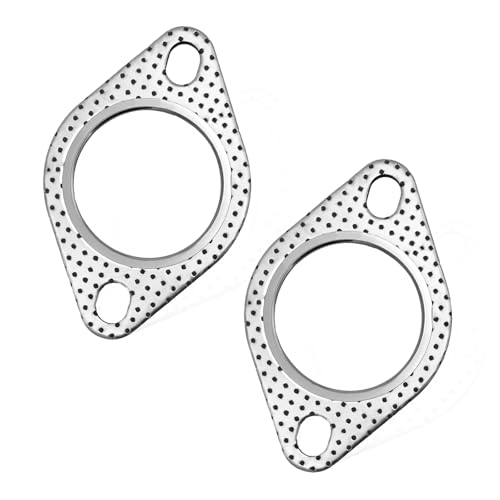


The difference is not the label on the box. It is the joint design. An exhaust flange gasket is a flat, static seal between two bolted flange faces. A donut gasket is a ring seal that compresses into a seat when the connection needs some angular tolerance or movement.
| Decision factor | Exhaust flange gasket | Donut gasket explained | Winner |
|---|---|---|---|
| Best joint geometry | Flat, parallel flange faces pulled together by bolts | Conical or rounded seat with some alignment slack | Depends on the joint |
| Tolerance for movement | Low; wants stable alignment and even compression | Higher; can accept small angular changes and pipe movement | Donut gasket |
| Reaction to damaged faces | Needs flat, clean mating surfaces to seal well | Can forgive minor motion, not severe warp or heavy pitting | Donut gasket for slight misalignment |
| Hardware sensitivity | Depends on correct bolt torque and surface flatness | Depends on correct seating, springs or clamps, and preload | Tie |
| Common real-world use | Manifold-to-pipe and pipe-to-pipe flange connections | Ball/socket, slip-style, and some header-to-midpipe joints | Depends on application |
Why the gasket type follows the geometry
A gasket is a seal that sits between two matching surfaces. In an exhaust flange, the seal depends on compression from bolts or fasteners, so the faces must line up and stay flat enough to load the gasket evenly. That is why a flat flange gasket fits a different joint than a donut gasket.
Gaskets can be made from metal, paper, rubber, or composites, but the material does not override the joint design. The seat shape decides whether the seal comes from flat-face compression or from a ring squeezing into a cone-like pocket.
What kind of exhaust joint do you have?
Start with the joint, not the symptom. Flat flange faces with bolt holes call for a flat exhaust flange gasket; a conical seat, ball/socket, or slip-style connection points toward a donut gasket. The sealing surface and the amount of movement available matter more than the pipe brand.
Flat flange faces and bolted connections
Two metal flanges pulled together by bolts make a static sealing joint. These joints show up often at manifold-to-pipe and pipe-to-pipe connections. If the faces are flat and supported, a flat flange gasket is the normal choice.
Conical seats, slip joints, and movement tolerance
Where the exhaust pipe needs a little angle change or axial movement, a donut gasket can compress into the seat and still seal. O-rings are also circular and donut-like, but in exhaust work the common idea is the ring seal that fits a groove or seat, not a flat sandwich joint. If the connection depends on springs or a clamp, do not assume a flat gasket belongs there.
Say your 2.5-inch pipe meets a converter outlet with a rounded seat and spring hardware. A flat gasket may crush unevenly and leak. The ring seal is the better match because the joint was built to move a little while still sealing.

Side-by-side decision table: which gasket fits which repair
This table is the fastest way to sort real repairs. If the flange is flat and the bolts clamp evenly, use the flat gasket. If the joint needs movement and the seat is shaped for a ring, use the donut.
| Joint type | Flange condition | Movement tolerance | Symptoms | Likely replacement hardware |
|---|---|---|---|---|
| Manifold-to-pipe, flat two-bolt flange | Flat, light rust only | Low | Cold-start ticking, soot at the edge | Flat flange gasket, new bolts and washers |
| Pipe-to-pipe flange, aligned exhaust section | Flat and parallel | Low | Noise that changes with heat, faint smell | Flat flange gasket, nuts, lock washers if used |
| Ball/socket or conical outlet | Seat intact, not deeply pitted | Moderate | Leak under vibration, hiss or tick on acceleration | Donut gasket, springs or clamp as designed |
| Slip-style joint with clamp | Round tube, usable overlap | Moderate to high | Black soot, smell near the joint | Donut gasket or clamp seal parts, plus new clamp hardware |
| Warped flange with rust pitting | Uneven or burned face | Low | Persistent tick, visible soot, repeat leak | Repair or replace flange, then fit the correct gasket |
What the symptoms usually mean
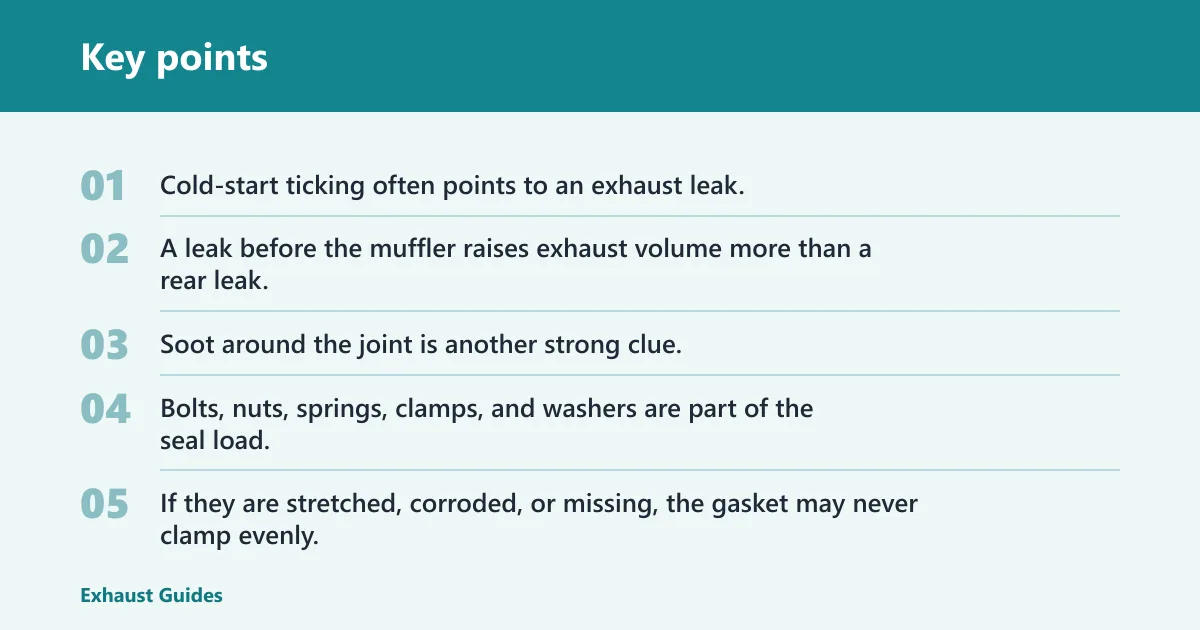
Cold-start ticking often points to an exhaust leak, and it can sound like a lifter tick or a cracked manifold. A leak before the muffler raises exhaust volume more than a rear leak, and a flange leak may quiet down as the pipe heats and expands. Soot around the joint is another strong clue.
Why hardware belongs in the decision
Bolts, nuts, springs, clamps, and washers are part of the seal load. If they are stretched, corroded, or missing, the gasket may never clamp evenly. That matters with both styles because the right torque and compression matter if you want to limit blowout or seepage.
Can a donut gasket seal a warped flange?
Not well, and often not for long. A donut gasket can tolerate small movement and some angular mismatch, but it is not a cure for a flange that is bent, heavily pitted, or rust-thinned. Severe surface damage usually needs flange repair or replacement instead of a different gasket shape.
What flatness, pitting, and rust do to a flange
Exhaust flange flatness controls how evenly the gasket loads. Rust can hold the faces apart in one spot, while pitting creates leak paths that burn the gasket edge. If the flange is warped, the gasket may be compressed hard on one side and loose on the other, which leads to seepage or blowout.
A common first-timer mistake is installing a donut gasket on a flange that has a visible banana shape. The ring may seal for a short time, then leak again because the seat itself is wrong. The better fix is to correct the flange, then install the gasket that matches the joint.
When repair beats another gasket swap
If a straightedge shows daylight across the flange, or the bolt holes no longer pull the faces parallel, the hardware is the problem as much as the seal is. In that case, a new gasket alone is usually wasted effort. Replace the damaged flange or mating pipe before sealing it again.
How torque, compression, and hardware affect the seal
Torque turns bolts into clamping force. Too little torque can leave the gasket under-compressed and more likely to seep. Too much torque can distort the flange, crush some composite gaskets, or split a sealing bead. Correct torque and compression matter.
Why under-tightening leaks and over-tightening distorts the joint
An exhaust flange gasket needs even load across both faces. If the bolts stop short, hot gas finds the low-pressure path and starts the leak cycle. If the bolts are overtightened, the flange can dish or the gasket can be crushed past its sealing range.
Why bolts, nuts, springs, and washers matter
Hardware is part of the seal system, not an afterthought. Corroded bolts can seize before reaching the right load, and worn washers can let clamping force drift as the joint heat cycles. On spring-loaded or clamp-style joints, the wrong hardware can prevent the donut from seating fully.
Do exhaust flange gaskets need sealant?
Usually no, and sealant can create its own problems. Most exhaust flange gaskets are designed to seal by compression between clean mating surfaces, not by a smear of paste. Use sealant only if the gasket maker and the joint design call for it.
When sealant is unnecessary or risky
Sealant can interfere with the gasket’s crush pattern and may hide a surface problem that should be repaired. It is especially risky on metal and multi-layer steel styles that depend on precise contact. If the flange faces are flat and the torque is correct, the gasket should do the sealing work.
Material differences matter
Metal, composite, graphite, and multi-layer steel gaskets do not behave the same under heat and clamp load. Some take temperature and corrosion better, while others follow small imperfections more easily. The material choice should follow the joint design and the exhaust temperature, not just the brand label.
How do I know which exhaust gasket fits my car or motorcycle?
Match the gasket to the joint shape, bolt pattern, pipe size, and hardware style. Fitment lists help, but they are not enough if the flange face is flat on one model and conical on another. Compare the old gasket, the flange seat, and the mounting hardware before you buy.
- Identify whether the joint is flat flange, conical seat, or slip-style.
- Check the flange for rust, pitting, and warp.
- Count bolt holes and measure the pipe or seat diameter.
- Match the hardware style: bolts, nuts, springs, clamps, or washers.
- Replace damaged hardware at the same time as the gasket.
Choose Exhaust flange gasket if… / choose donut gasket if…
Choose an exhaust flange gasket if both mating faces are flat, parallel, and supported by bolts, and if the flange is not badly warped or pitted. Choose a donut gasket if the connection uses a conical or rounded seat, or if the joint needs some movement to line up and seal without forcing the pipe.
Pick the flat gasket for manifold-to-pipe and pipe-to-pipe flange joints with good surface finish. Pick the donut gasket for ball/socket, slip-style, or spring-loaded exhaust connections where angular tolerance matters. If the flange is damaged, repair the metal first.
Suppose a 4-cylinder car has a two-bolt flange near the downpipe and the old gasket burned out on one side. If the flange is still flat, a new flat gasket and fresh hardware make sense. If the faces are visibly bent, no gasket style will fully fix that joint until the metal is corrected.
How do I tell if the leak is at the gasket, flange, or pipe?
Look at the pattern, not just the noise. Soot around the joint points to the seal area, while a crack in the pipe or flange often shows a clearer line of damage. If the noise changes with heat and rpm, the leak may be opening and closing as the metal moves.
Gasket leak clues
A burned-through gasket can leak before soot appears, especially early in failure. Cold-start ticking, exhaust smell near the joint, and visible discoloration at the seam are common signs. If the hardware is loose or uneven, the gasket may be the first part to fail.
Flange or pipe leak clues
If the gasket looks intact but soot traces start from a bent edge, rust hole, or crack, the metal may be the real leak path. A warped flange can mimic a bad gasket because it prevents even compression. A cracked pipe can also hiss or tick under load, then quiet as the metal expands.
What causes an exhaust flange gasket to blow out?
Blowout usually comes from poor compression, bad alignment, damaged sealing faces, or hardware that cannot hold load. Heat cycling, vibration, and corrosion make the problem worse. If the gasket was the wrong style for the joint, failure often comes back quickly.
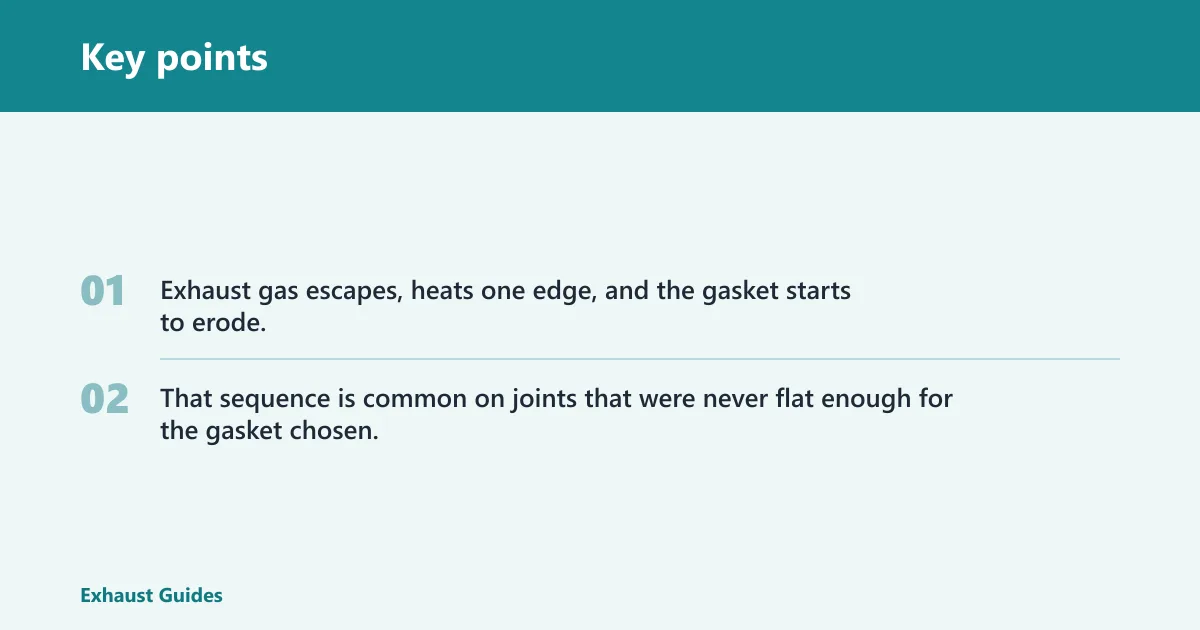
Common failure chain
A rusted flange leaves a gap. The bolts clamp unevenly. Exhaust gas escapes, heats one edge, and the gasket starts to erode. That sequence is common on joints that were never flat enough for the gasket chosen.
Can I reuse an exhaust flange gasket or donut gasket?
Reuse is risky on both styles unless the part was removed intact and the maker allows it. A gasket that has already been compressed may not return to the same sealing shape. Donut gaskets are especially sensitive to crush set and seat wear.
When reuse is a bad bet
If the gasket has burn marks, flattening, tearing, or crushed edges, replace it. If the flange hardware had to be pried apart, the seal has likely lost its original load pattern. Reusing a marginal gasket often means reopening the job later.
Frequently asked questions
What is the difference between an exhaust flange gasket and a donut gasket?
An exhaust flange gasket seals two flat, bolted flange faces. A donut gasket is a ring-style seal that compresses into a conical or rounded seat when the joint needs movement or alignment tolerance. The joint geometry decides which one fits.
When should I use a flat flange gasket instead of a donut gasket?
Use a flat flange gasket when the faces are flat, parallel, and fully supported by bolts. It is the right choice for static flange joints such as many manifold-to-pipe and pipe-to-pipe connections. If the joint needs angular movement, choose the donut style instead.
Can a donut gasket seal a warped exhaust flange?
Only minor mismatch, and often not reliably. A donut gasket can tolerate some movement, but it is not a fix for heavy pitting, bent faces, or a flange that no longer clamps evenly. Bad metal usually needs repair or replacement first.
Do exhaust flange gaskets need sealant?
Usually no. Most exhaust gaskets are meant to seal by compression between clean mating surfaces, and sealant can interfere with that load pattern. Use sealant only if the gasket maker and the joint design specifically call for it.
How do I know which exhaust gasket fits my car or motorcycle?
Match the gasket to the flange shape, bolt pattern, pipe size, and hardware style. Check whether the joint is flat flange, conical seat, or slip-style. Then replace any damaged bolts, nuts, springs, clamps, or washers at the same time.
Why does my exhaust leak tick only when the engine is cold?
Cold starts make exhaust leak ticking easier to hear. As the pipe heats and expands, the leak may quiet down for a while. That pattern often points to a marginal gasket, a warped flange, or hardware that is not clamping evenly.