Graphite Exhaust Gasket vs MLS: Which Is Better for You?
Graphite exhaust gasket is better for old, uneven, pitted, or slightly warped flanges that see lower clamp load and need help sealing small gaps. Multilayer steel is better when the flange is flatter, clamp load is higher, and thermal cycling is harsher. Pick the wrong one and you get leaks, noise, soot, warped parts, and repeated teardown. This guide compares how each seals, how much clamp load it wants, how it holds heat, and how it fits real exhaust joints so you can choose the right gasket material.
| Decision factor | Graphite exhaust gasket | Multilayer steel | Winner |
|---|---|---|---|
| Surface finish and flatness | Conforms better to small imperfections and minor flange warp | Prefers flatter, more uniform mating faces | Graphite exhaust gasket |
| Clamp load tolerance | Works with lower clamp load, but can crush under higher load | Handles higher clamp load and recovers better after cycling | Multilayer steel |
| Thermal cycling and recovery | Handles exhaust heat well, but is less resistant to compression set | Built for spring-back and repeated heat cycles | Multilayer steel |
| Reuse potential | Usually less reliable after removal because it can deform | Often better if the layers and coatings stay intact | Multilayer steel |
| Best fit use case | Older or imperfect exhaust flanges, lower-load static joints | Modern engines, flatter joints, higher-stress exhaust locations | Tie, by application |
Graphite exhaust gasket vs multilayer steel: the core trade-off


The trade-off is plain. Graphite forgives surface flaws, while multilayer steel keeps its shape better under load and repeated heat cycles. Graphite is a compressible sealing material made from compressed graphite material, and graphite itself is a crystalline allotrope of carbon with hardness 1–2 on the Mohs scale, density about 2.09–2.23 g/cm³, and a flexible, non-elastic, sectile structure. MLS gaskets are often made from several steel layers, sometimes with outer coatings, and that stack is meant to help with spring-back and compression recovery. (en.wikipedia.org)
Why exhaust flange flatness changes the answer
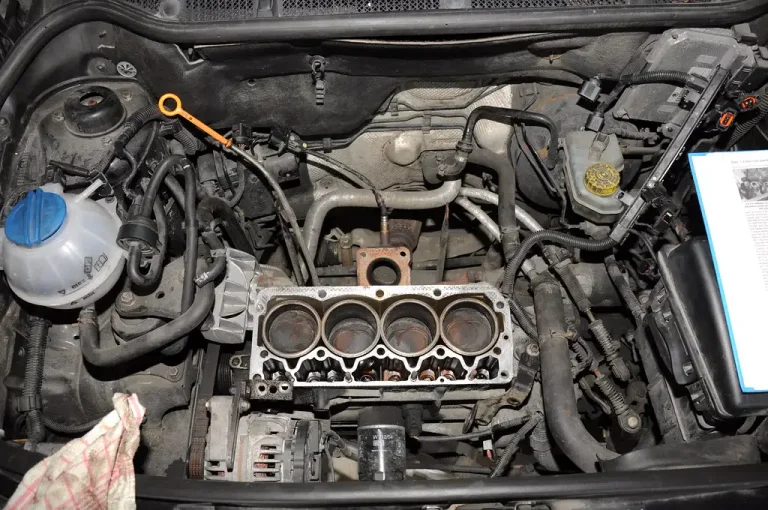
An exhaust manifold or exhaust flange joint is generally a static sealing application, but it can still see vibration, thermal cycling, and bolt load loss over time. If the flange is pitted, slightly warped, or stamped unevenly, graphite’s ability to fill small imperfections usually matters more than MLS stiffness. If the faces are flatter and the joint is loaded harder, MLS usually keeps sealing longer.
Say your 2-bolt header flange has a faint witness line and a slight bow near one bolt hole. A graphite gasket is often the safer fit because it can conform without demanding perfect machining. Put an MLS gasket there, and the harder stack may bridge the low spot instead of filling it.
📊 Graphite density is about 2.09–2.23 g/cm³. Source: Graphite.
What is a graphite exhaust gasket?
A graphite exhaust gasket is a compressed graphite material gasket used to seal hot exhaust joints. Graphite can handle very high temperatures in some sealing uses, and flexible graphite sheet material is made from natural graphite flakes; in some cases it withstands temperatures up to 1500°F (815°C). In exhaust service, its main advantage is conformity to small surface imperfections.
How compressed graphite seals minor surface imperfections
Graphite’s flexibility helps it flow into scratches, casting texture, and light flange distortion. That makes it useful on older manifolds, small-bolt exhaust flanges, and joints where the mating faces are not perfectly uniform. It is usually the more forgiving material when clamp load is modest and the joint is static.
Where graphite tends to fail: crush, compression set, and leak risk under high load
Graphite gaskets are more prone to crushing under high clamping loads. Once they take a compression set, the material does not rebound well, so the seal can loosen after heat cycles and bolt relaxation. That is why a graphite gasket can seal well on day one and still become a leak path later if the joint is highly loaded or repeatedly disturbed.
What is an MLS exhaust gasket?
An MLS gasket is a multilayer steel gasket built from three to five steel layers, often with outer elastomer coatings. MLS gaskets are standard in modern engines and high-performance uses, and they handle much higher cylinder pressures than traditional materials. In exhaust service, the value is the same: better recovery, better retention, and better resistance to repeated heat cycling.
What the outer elastomer coating does, and where it can break down
The outer elastomer coating helps the outer layers seal against flange micro-imperfections and improve initial contact. But that coating is still a formulation-dependent material, and extreme heat can deteriorate it if the joint lives near turbine outlets, very hot manifolds, or repeated over-temp events. That is why MLS is strong in the right joint, not a fit for every exhaust location.
Which seals better on uneven exhaust flanges?
Graphite usually seals better on uneven exhaust flanges because it is better at filling small imperfections in mating surfaces. MLS wins when the flange faces are flatter and the joint can be loaded evenly, because its layers depend more on contact quality and spring-back than on material softness. Surface finish is usually the first decision point, rather than brand or price.
How clamp load and bolt relaxation change the seal over time
Higher clamp load helps both materials at first, but too much load can deform softer gasket materials and drive graphite into compression set. MLS resists that better because the steel layers maintain recovery after heating and cooling. If bolts relax after a few heat cycles, MLS tends to keep more of its sealing force.
Suppose a cast-iron manifold has a slightly eroded flange and a pair of 8 mm fasteners. A graphite gasket is often the better gamble because it can fill the roughness with less clamping drama. On a milled stainless header flange with sturdy hardware, MLS has the better odds of staying tight.
Can graphite exhaust gaskets handle header temperatures?
Yes, graphite exhaust gaskets can handle header temperatures in many exhaust applications, but temperature alone is not the whole test. Peak heat matters, yet thermal cycling often matters more because repeated heat-up and cool-down can drive compression set and bolt load loss. Graphite is a good heat material for exhaust use, but it is not the best answer for every header flange.
Why thermal cycling matters as much as peak temperature
A header can see repeated expansion and contraction that works the joint loose even if the material survives the heat itself. Graphite can remain heat-tolerant and still lose seal integrity if the flange moves, bolts relax, or the gasket is crushed unevenly. MLS is usually better at recovering from that cycle.
When metal gasket construction is the better pick
If the header flange is flat, the bolt pattern is stable, and the joint sees frequent heat swings, metal gasket construction is usually the better pick. That includes many modern aftermarket headers, turbo-adjacent exhaust joints, and high-output street engines where reuse and recovery matter more. Graphite still has a place when the flange is less perfect or the load is lower.
Graphite vs MLS decision matrix
| Use case | Surface finish | Clamp load | Heat | Vibration | Reuse likelihood | Better pick |
|---|---|---|---|---|---|---|
| Stock manifold | Often imperfect | Moderate | High | Moderate | Low to moderate | Graphite exhaust gasket |
| Header flange | Usually flatter | Moderate to high | High | Moderate to high | Moderate | Multilayer steel |
| Turbo outlet | Often flat, but highly stressed | High | Very high | High | Low | Multilayer steel |
| Downpipe | Variable | Moderate | High | High | Moderate | Tie, based on flange quality |
How to read the matrix for street cars, turbo builds, and older vehicles
For a stock street car with an older manifold, graphite usually wins because fit matters more than recovery. For a turbo build, MLS is the safer default because the joint sees higher load, hotter cycling, and a stronger penalty for blowout. For a motorcycle exhaust or other light, flat joint, either can work, but the flange condition still decides the final answer.
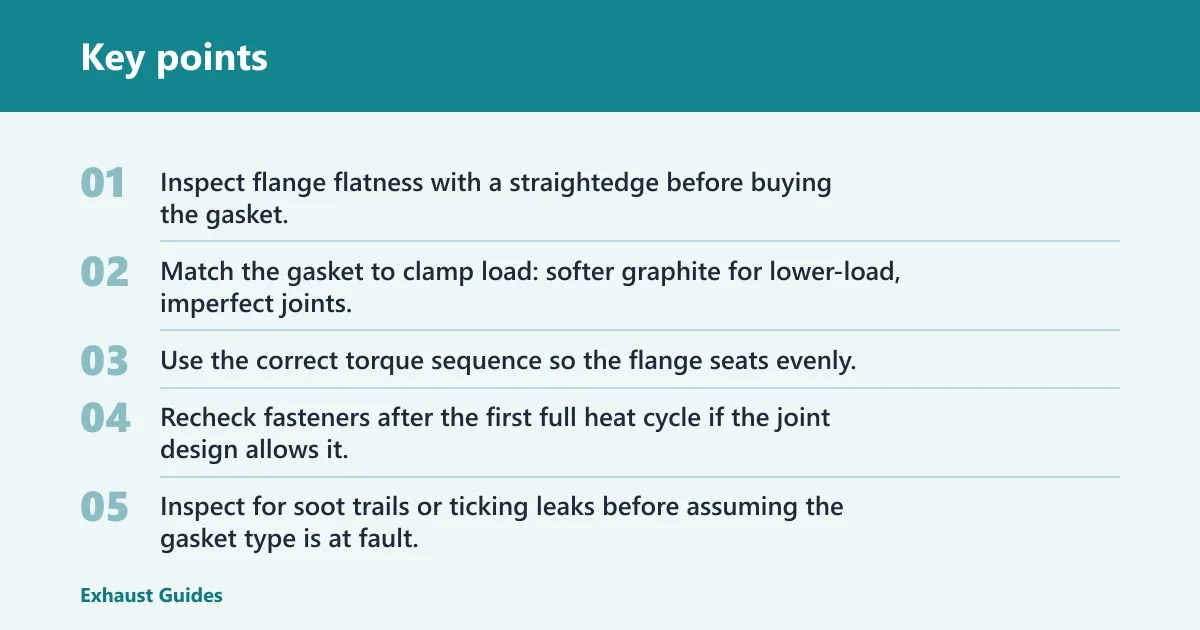
- Inspect flange flatness with a straightedge before buying the gasket.
- Match the gasket to clamp load: softer graphite for lower-load, imperfect joints; MLS for flatter, tighter joints.
- Use the correct torque sequence so the flange seats evenly.
- Recheck fasteners after the first full heat cycle if the joint design allows it.
- Inspect for soot trails or ticking leaks before assuming the gasket type is at fault.
Choose graphite exhaust gasket if… / Choose multilayer steel if…
Choose graphite exhaust gasket if the flange is old, uneven, pitted, or slightly warped; the joint is static and lower-clamp; and the main goal is sealing small imperfections without demanding perfect machining. Choose multilayer steel if the flange is flatter, the joint is tighter and hotter, thermal cycling is harsher, or reuse and long-term recovery matter more.
Choose graphite exhaust gasket if…
Use graphite when you are sealing an exhaust manifold on an older engine, a lower-load header flange with light distortion, or a joint where bolt force is limited. It is also the better bet when removal needs to be easier, because graphite generally does not stick to metal the way some harder sealing stacks can.
Choose multilayer steel if…
Use MLS when the joint is flat, the clamping load is strong, and the assembly sees repeated heat swings, such as many turbo outlet and modern header applications. MLS is also the better choice when the engine already uses it as standard practice, because the flange, fastener, and gasket design are usually matched for that construction.
Frequently asked questions
Is graphite or multilayer steel better for an exhaust gasket?
Graphite is better for imperfect, lower-clamp exhaust flanges that need help sealing small gaps. MLS is better for flatter joints with stronger clamp load and harsher thermal cycling. The right answer depends on flange condition, bolt force, and how often the joint heats and cools.
Are MLS gaskets better than graphite for sealing uneven flanges?
No. Graphite usually seals uneven flanges better because it conforms to surface imperfections more readily. MLS can work if the unevenness is minor, but it depends more on flat contact and steady clamp load. For obvious warp or rough casting marks, graphite is usually the safer choice.
Which gasket material lasts longer on exhaust manifolds?
MLS usually lasts longer on exhaust manifolds when the flange is flat and the joint is loaded correctly. Graphite can last well on forgiving joints, but it is more vulnerable to crushing and compression set under high clamp load. In the wrong setup, life drops quickly.
Do graphite gaskets crush or blow out more easily than MLS?
Graphite gaskets are more prone to crushing under high clamping loads, which can lead to leak risk after the joint relaxes. MLS is generally better at maintaining shape and seal integrity under cycling. Blowout usually points to poor fit, uneven load, or the wrong gasket for the joint design.
Should I use a metal gasket instead of graphite on a turbo or header?
Often yes, if the turbo or header flange is flat and the joint sees high load, high heat, and repeated cycling. Metal gasket construction, especially MLS, is usually the stronger long-term choice in those conditions. If the flange is imperfect or the load is modest, graphite can still be the better fit.
What type of exhaust gasket is best for older or imperfect mating surfaces?
Graphite is usually the best match for older or imperfect mating surfaces because it fills small irregularities better than a rigid stack. That matters on cast manifolds, worn flanges, and stamped parts with light distortion. Flatness still matters, but graphite gives you more tolerance.
How much heat can a graphite gasket take?
Graphite can handle very high temperatures in some sealing uses, and flexible graphite sheet can withstand temperatures up to 1500°F (815°C) in some cases. Exhaust fit still matters more than a single peak number, because heat cycling and clamp loss can end a seal even when the material survives the temperature.
Are MLS gaskets the standard choice for modern engines?
Yes. MLS gaskets are commonly used in modern engines and higher-performance applications, and they are often chosen because they handle higher pressures and thermal cycling well. That does not make them fit every exhaust flange, but it does explain why they are common in newer designs.