Are Exhaust Manifolds Cast Iron or Cast Steel: Essential Guide
Most exhaust manifolds are made from cast iron due to its excellent heat resistance and cost-effectiveness. While cast steel is also used, it’s less common for standard passenger vehicles. Understanding the material helps in maintenance and repair.
Is Your Exhaust Manifold Cast Iron or Cast Steel? The Beginner’s Guide
Ever wondered what your car’s exhaust manifold is made of? It’s a common question for many car owners, especially when something goes wrong, like a strange noise or an exhaust leak. You might hear terms like “cast iron” or “cast steel” thrown around, and it can be confusing. Don’t worry! I’m here to break it down in a way that’s easy to understand, so you can feel confident about your car’s exhaust system.
This guide will help you figure out if your exhaust manifold is made of cast iron or cast steel, why it matters, and what to look out for. We’ll cover everything you need to know without any confusing technical jargon. Let’s get started and make your car’s exhaust system less mysterious!
What is an Exhaust Manifold and Why Does Its Material Matter?
Think of the exhaust manifold as the very first part of your car’s exhaust system. It’s connected directly to your engine’s cylinders. Its main job is to collect the hot exhaust gases from each cylinder and combine them into a single pipe that leads to the rest of your exhaust system (like the catalytic converter and muffler).
The material of the exhaust manifold is super important because it has to handle extremely high temperatures and a lot of pressure from these hot gases. It also needs to be durable enough to last a long time. The choice of material affects its performance, how long it lasts, and also how much it costs to make and replace.
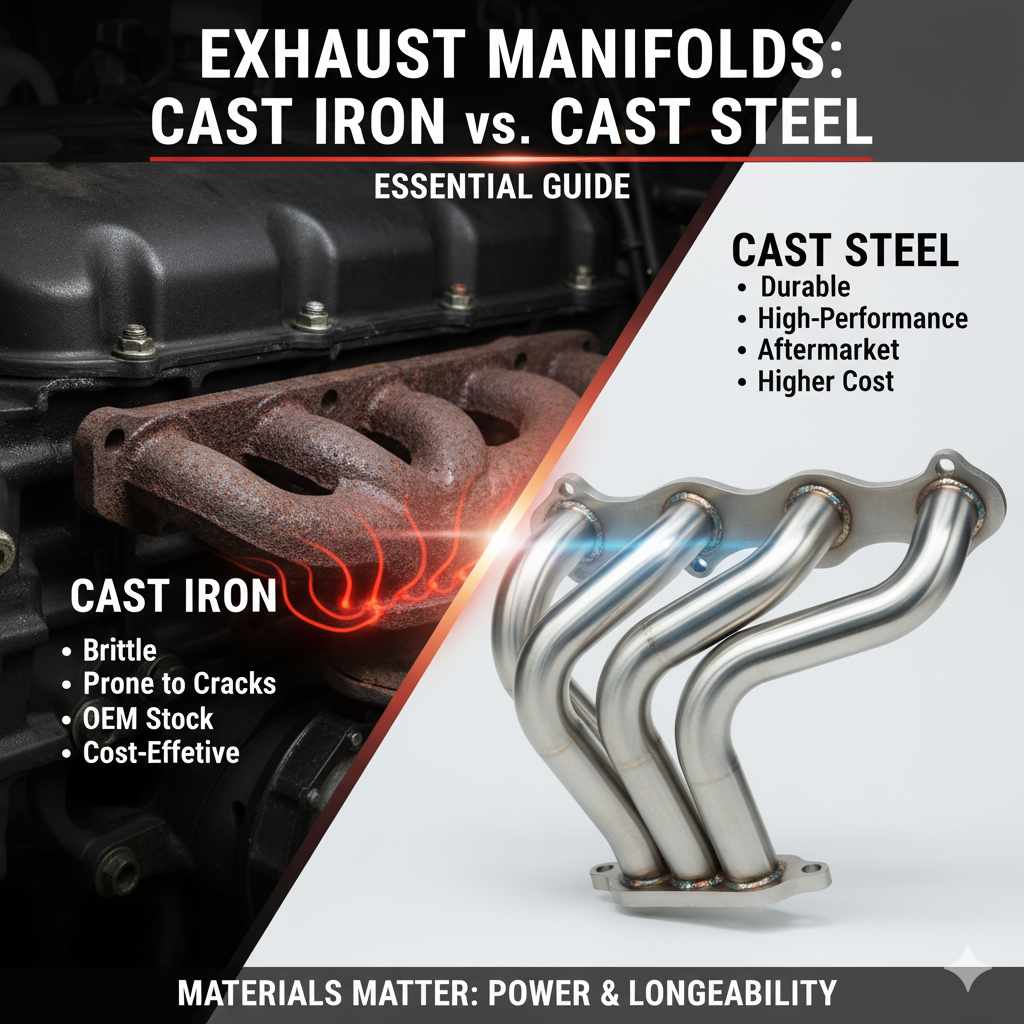
Cast Iron vs. Cast Steel: The Main Differences
When we talk about exhaust manifolds, the two main materials you’ll hear about are cast iron and cast steel. They might sound similar, but they have important differences that make one better suited for certain applications than the other.
Cast Iron: The Workhorse Material
Cast iron is by far the most common material used for exhaust manifolds on most cars and trucks. It’s been a go-to for decades.
- What it is: Cast iron is an iron alloy with a significant amount of carbon (more than 2%). This carbon content gives it some unique properties.
- Why it’s used:
- Heat Resistance: Cast iron can handle very high temperatures without warping or cracking, which is essential for exhaust gases.
- Cost-Effective: It’s relatively inexpensive to produce, making it a budget-friendly choice for manufacturers.
- Good Durability: It’s strong and can withstand the vibrations and stresses of daily driving.
- Easy to Cast: It flows well when molten, allowing manufacturers to create complex shapes like the intricate runners of an exhaust manifold.
- Types of Cast Iron: There are different types, like gray cast iron and ductile iron. For exhaust manifolds, engineers often choose specific blends to get the best balance of strength and heat tolerance. Grey cast iron is common for its vibration damping and heat-handling properties, while ductile iron offers better strength and impact resistance.
Cast Steel: The Stronger, More Expensive Option
Cast steel is also an iron alloy, but it has less carbon (typically under 2%) and often contains other elements like chromium and molybdenum, especially when used in high-heat applications.
- What it is: Cast steel is essentially iron that has been cast into a shape, with a lower carbon content than cast iron.
- Why it’s used (less commonly for standard manifolds):
- Higher Strength: Steel alloys are generally stronger and more resistant to fracture under stress than cast iron.
- Better Toughness: They can absorb more energy before breaking, making them less prone to impact damage.
- Higher Temperature Limits (with alloys): When specific alloys are added (like stainless steel or high-chrome steels), they can often handle even higher temperatures than standard cast iron, maintaining their strength at extreme heat.
- Where you might see it: You’re more likely to find cast steel, often in the form of stainless steel or specialized alloys, in high-performance vehicles, racing applications, or heavy-duty industrial equipment where extreme heat and stress are constant. These materials can offer superior longevity in punishing conditions.
How to Tell if Your Exhaust Manifold is Cast Iron or Cast Steel (Even as a Beginner!)
As a beginner, you don’t need to become a metallurgist! There are a few practical ways to get a good idea of what your exhaust manifold is made of.
1. Check Your Vehicle’s Documentation
This is the easiest and most reliable method. Your vehicle’s owner’s manual or a service manual (sometimes called a repair manual) often contains detailed specifications about its components.
- Owner’s Manual: Look in the sections about the engine or exhaust system. Sometimes, specific materials are mentioned.
- Service Manual: If you have access to a more in-depth service manual (you can often buy them online or find them at local libraries), it will have detailed information on all parts, including the manifold material specification.
2. Visual Inspection: What to Look For
While not foolproof, some visual clues can help.
- Color and Texture: Cast iron often has a slightly rougher, duller gray finish compared to some cast steels, which might appear smoother or have a different sheen. However, this can change significantly with age, rust, and coatings.
- Surface Condition: Cast iron can sometimes show small pores or pits if you look very closely, especially on older, worn parts. Cast steel might appear more uniform.
- Rust Patterns: Both can rust, but the type of rust and how it forms can sometimes offer subtle clues. Cast iron rust tends to be more flaky.
- Repair Marks: If the manifold has been repaired (welded), the type of material might be indicated by the welding rod used or the color of the weld. Welds on cast iron often look different from welds on steel.
3. Listen to the Engine (Subtle Clues)
This is less about the material itself and more about what happens when the material fails.
- Cracked Manifold Sound: A common problem with cast iron manifolds is cracking due to repeated heating and cooling cycles. This often results in a ticking or puffing sound, especially when the engine is cold, that might quiet down as the metal expands. While steel can also crack, cast iron is more prone to this specific type of failure.
4. Consult an Expert or Online Forums
If you’re still unsure after checking your manuals and doing a visual inspection, don’t hesitate to:
- Ask your mechanic: They work on cars all day and can usually tell by sight or experience.
- Check online car forums: Search for your specific car model and year, along with terms like “exhaust manifold material.” You’ll often find other owners who have asked the same question.
Common Problems with Exhaust Manifolds and What Material They Indicate
Exhaust manifold issues are quite common, and they often point towards the material they’re made from.
Cracking
This is probably the most frequent problem. The constant cycle of extreme heat and rapid cooling causes the metal to expand and contract. Over time, this stress can lead to cracks, especially in areas with thin sections or sharp turns.
- Material Indication: Cast iron is more susceptible to cracking from thermal stress than high-grade cast steel alloys. This is because its microstructure is more brittle.
- Symptoms: A loud ticking or puffing sound when the engine is cold that may disappear as the engine warms up, exhaust fumes smelling stronger than usual, reduced engine performance, or a check engine light.
Warping
Extreme and uneven heating can cause the manifold to warp, meaning it no longer sits perfectly flat against the engine head. This leads to exhaust leaks at the gasket.
- Material Indication: While both can warp, cheaper or lower-grade cast iron might be more prone to it than higher-quality cast iron or steel alloys designed for higher thermal stability.
- Symptoms: Exhaust leaks, hissing sounds, burnt gasket smell, and potential power loss.
Corrosion and Rust
Given their exposure to moisture, exhaust gases, and road salt, exhaust manifolds can rust over time. This can weaken the metal and eventually lead to leaks or complete failure.
- Material Indication: Standard cast iron will rust. While stainless steel (a type of cast steel alloy) is highly corrosion-resistant, standard cast steel will also rust, though perhaps at a different rate or with a different appearance than cast iron.
- Symptoms: Visible rust areas, holes appearing in the manifold, exhaust leaks, and a rough engine sound.
Why Using the Right Material is Crucial for Performance and Longevity
Choosing the right material for an exhaust manifold isn’t just about saving money; it’s about ensuring your engine runs safely and efficiently for years to come.
Heat Management
The exhaust manifold has to cope with temperatures that can range from a few hundred degrees to over 1,000 degrees Fahrenheit (537 to 537+ degrees Celsius) depending on engine load. The material needs to withstand this without degrading or losing its structural integrity. A material that can’t handle the heat will quickly fail, leading to leaks and reduced engine performance.
For example, materials with higher chromium content, often found in specialized cast steel alloys or stainless steel, are designed to resist oxidation and maintain strength at very high temperatures. You can learn more about material science for high-temperature applications from resources like MatWeb’s material properties database, which offers insights into how different metals behave under stress and heat.
Durability and Ticking
Your car’s engine vibrates constantly. The exhaust manifold is bolted directly to it, so it experiences these vibrations along with the thermal stresses. A material that is too brittle could easily fracture, while one that is too soft might deform. Cast iron provides a good balance for most everyday vehicles, offering enough strength and resilience.
For high-performance or extreme-duty applications, cast steel alloys or even fabricated stainless steel tubing (not cast, but relevant for performance exhausts) offer superior toughness and resistance to fatigue, ensuring they hold up under much harsher conditions.
Impact on Engine Tuning and Efficiency
The shape and material of the exhaust manifold can even influence how your engine performs. The way exhaust gases flow through the manifold affects the engine’s “breathing.” Any leaks caused by material failure can disrupt this flow, leading to:
- Reduced horsepower and torque
- Decreased fuel efficiency
- Increased emissions
- Potential damage to catalytic converters or oxygen sensors
A healthy, leak-free exhaust manifold made of a suitable material is essential for optimal engine performance and environmental compliance.
Comparing Materials: A Quick Table
To make it easy to see the differences, here’s a comparison of cast iron and cast steel for exhaust manifolds:
| Feature | Cast Iron | Cast Steel |
|---|---|---|
| Primary Use for Manifolds | Most standard passenger vehicles | High-performance, heavy-duty, or specialized applications |
| Cost | Lower, more economical | Higher, especially with specialized alloys |
| Heat Resistance | Good to very good | Very good to excellent (especially with alloys) |
| Strength | Good | Higher than standard cast iron |
| Brittleness / Fracture Risk | More prone to cracking from thermal stress | Less prone to fracture than cast iron |
| Corrosion Resistance | Moderate; prone to rust without protection | Varies greatly with alloy; stainless steel is excellent |
| Ease of Manufacturing Complex Shapes | Excellent flow properties when molten | Good, but can be more challenging for very intricate designs |
Choosing the Right Replacement Part
If you ever need to replace your exhaust manifold, it’s crucial to choose a part made from the correct material for your vehicle. Using a less durable or lower-quality material can lead to premature failure.
For most daily drivers: Stick with a high-quality cast iron replacement. It’s what the manufacturer originally designed for your car and offers the best balance of performance, durability, and cost.
For performance vehicles or heavy-duty use: You might consider a manifold made from a higher-grade alloy or even a fabricated stainless steel unit if available and suitable for your application. Consult with a performance parts specialist or a trusted mechanic.
When buying a replacement, always ensure it’s designed specifically for your vehicle’s make, model, and year. Reputable auto parts stores and online retailers will have databases to help you find the correct part.
Maintenance Tips for Your Exhaust Manifold
While you can’t prevent all issues, some basic maintenance can help extend the life of your exhaust manifold, regardless of whether it’s cast iron or steel.
- Regular Inspections: When you get your oil changed or have other service done, ask your mechanic to visually inspect the exhaust manifold. Look for any signs of cracking, rust, or soot (which can indicate a leak).
- Listen for Unusual Noises: Pay attention to any new ticking, hissing, or puffing sounds coming from the engine bay, especially when the engine is cold. These could be early signs of a manifold issue.
- Avoid Harsh Impacts: Be mindful when driving over rough terrain or large speed bumps. While most manifolds are robust, extreme impacts can exacerbate existing weaknesses or cause damage.
- Keep it Clean (Where Possible): While you can’t easily clean the inside, keeping the exterior relatively free of excessive dirt and debris can help prevent moisture from lingering and accelerating rust. However, avoid using harsh chemicals.
- Address Leaks Promptly: If you suspect a leak, get it checked out immediately. Small leaks can worsen over time and potentially cause damage to other exhaust components like the catalytic converter.
Frequently Asked Questions (FAQ)
Q1: Can a cracked exhaust manifold be repaired?
A1: Sometimes, small cracks in cast iron exhaust manifolds can be repaired by welding. However, it’s often a temporary fix because the extreme heat and stress can cause the weld to fail or new cracks to form nearby. For significant cracks or warped manifolds, replacement is usually the best and most reliable solution.
Q2: How soon should I fix an exhaust manifold leak?
A2: You should address an exhaust manifold leak as soon as possible. Leaks can lead to reduced engine performance, decreased fuel economy, increased emissions, and can even damage more expensive exhaust components like your catalytic converter due to improper exhaust flow and oxygen sensor readings. It also poses a health risk, as exhaust fumes could potentially enter the cabin.
Q3: Will a faulty exhaust manifold affect my car’s fuel economy?
A3: Yes, absolutely. An exhaust leak before the oxygen sensor can disrupt the sensor’s ability to accurately measure the exhaust gases. This can trick the car’s computer into thinking there’s too much or too little fuel being injected, leading to the engine running inefficiently and consuming more combustível than necessary.
Q4: Are stainless steel exhaust manifolds better than cast iron?
A4: For high-performance and durability in extreme conditions, stainless steel (a type of alloy) manifolds often offer superior heat resistance and corrosion resistance compared to standard cast iron. However, they are usually much more expensive. For most everyday vehicles, a well-made cast iron manifold is perfectly adequate and more cost-effective.
Q5: What is the black soot around my exhaust manifold?
A5: Black soot around your exhaust manifold is a clear sign of an exhaust leak. The soot is essentially burnt carbon particles from the exhaust gases escaping the manifold before they’re supposed to.
Q6: Can I drive my car with a cracked exhaust manifold?
A6: While your car may still run, it’s not recommended to drive for extended periods with a cracked exhaust manifold. You’ll likely experience reduced performance, poor fuel economy, and potentially unpleasant smells. More importantly, the escaping hot gases can pose a fire risk and could damage other parts of your engine or exhaust system.